
 Request A Quote


What is the difference between all-in-one and split solar street lights
 FACEBOOK
 TWITTER
 LINKEDIN
What is the difference between all-in-one and split solar street lights is a key question for your project planning. You should start by looking at solar street lighting systems as a whole category. The main thing you need to understand is how system design affects your results.
There are two main design philosophies that you must choose between for your site. One focuses on being compact and easy, while the other focuses on being powerful and flexible. You will see where they differ most when you look at real-world needs like road width and sun levels. Knowing these differences helps you set the right expectations for your budget and timeline.
This guide walks you through the decision logic you need to pick the best model. You will learn about parts placement, sunlight needs, and how much area you can cover. Making the right choice ensures your streets stay bright every night. You can avoid wasting money by picking the style that fits your exact site conditions.
What problem do all-in-one and split designs solve differently
You will see that solar street lights use different designs for a reason. Some projects have limited space and need a quick setup. Other jobs need a lot of power for wide roads or tall poles. You must look at the design trade-offs for each model to see which fits. One style puts everything in one case to save on your labor costs. The other style lets you move parts around to catch more sun. The system architecture you pick changes how you plan your whole project. You should think about your goals for light levels and run time. This choice helps you fix problems that are unique to your specific site. You get to decide if speed or raw power is the main goal for your project.
How component placement differs between all-in-one and split systems
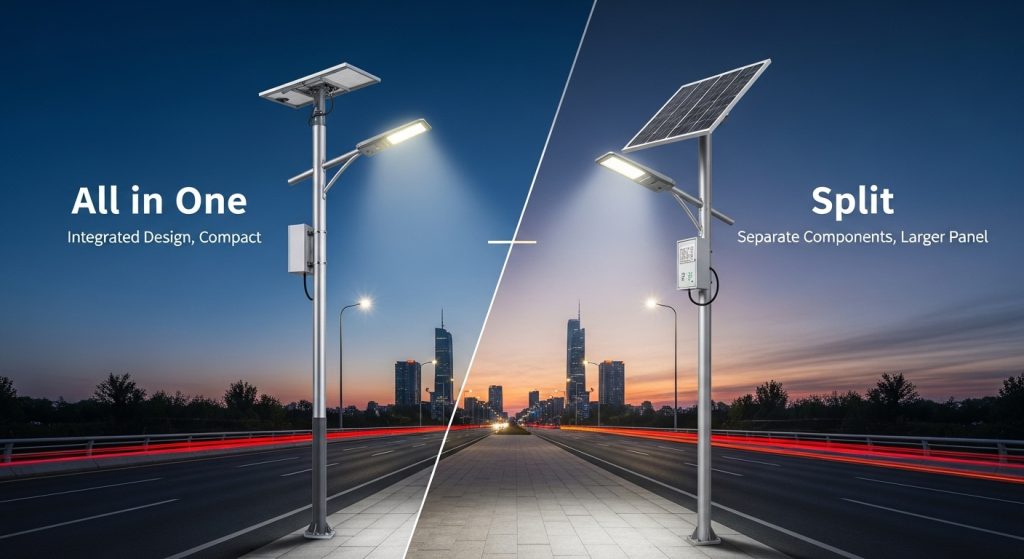
Component placement is the main physical change you will notice between these two units. In an all-in-one light, the panel, battery, and lamp stay inside one single shell. You mount the whole box on the pole in one step. A split system has a panel at the top of the pole and the light lower down. The battery sits in its own box, either on the pole or in the ground. This layout changes how you handle panel orientation to catch the sun. You can turn the panel in a split system to face south perfectly. An all-in-one panel is fixed to the light body and faces where the light points.
| Feature | All-in-One Solar Light | Split Type Solar Light |
| Solar Panel | Built into the light top | Separate and adjustable |
| Battery Location | Inside the light head | Separate box or underground |
| Wiring | No external wires | Wires connect parts on pole |
| Panel Angle | Fixed with the lamp | Fully adjustable for sun |
| Poles | Light-duty poles okay | Needs strong, heavy poles |
How sunlight conditions affect each system type
The amount of sun on your site changes how your lights work every night. An all-in-one system has a fixed panel that cannot be tilted alone. If trees or buildings block the sun, the light might stay dark. This can lead to poor performance consistency during the winter months. A split system gives you more solar exposure because you can move the panel freely. You can tilt it to catch the best rays throughout the day regardless of road direction. This helps your battery stay full even on shorter, cloudy days. You should check your site for shadows before you choose a model. Planning for your specific weather keeps your project running smoothly.
Which system handles higher power and larger areas better
You must look at your wattage requirements for big roads or parking lots. All-in-one lights are great for small paths or garden trails. They have lower power because all parts must fit in one small box. A split system can handle much larger area coverage with ease. You can use a very large panel and a high-capacity battery. These systems are better for wide highways and busy city streets. They give you the high brightness that big projects need to stay safe. You should pick the split style if your pole is very tall. It provides the heavy-duty power that critical infrastructure often needs for total safety.
How installation, maintenance, and upgrades compare
Your maintenance planning is a big part of your long-term project cost. All-in-one lights are the fastest to put up on your site. You can finish a whole street in just a few hours with a small crew. If a part breaks inside, you often have to replace the whole unit. A split system takes more time to build because of the extra wires. But you can fix individual parts much easier later. This can help your system lifespan reach many years without full replacement. You should decide if speed now is worth more than easy repairs later. Think about who will be fixing your lights five years from today.
Which type is more suitable for different project scenarios
Choosing the right light depends on your project scale and your site conditions. You should look at the area you need to light before you make a buy. Small jobs and paths work well with the compact all-in-one style. Big roads and dark spots need the strength of a split system.
You can follow these tips to pick the right one for your site:
- Use all-in-one units for garden paths and small park trails.
- Pick integrated designs for private driveways and narrow roads.
- Choose split type lights for main highways and tall poles.
- Use split systems for areas with a lot of shade from trees.
- Select split models if you need the light to stay bright for 12 hours.
Is there a middle ground between all-in-one and split systems
You might find a partial integration design that fits your needs best. These are often called semi-integrated solar lights. They keep the battery with the light but use a separate solar panel. This gives you better charging without the complex wiring of a full split system. You could also look at a hybrid configuration for extra safety. These systems use the sun but have a backup wire to the grid. These choices help you find the perfect balance for your specific project. They offer more ways to keep your road bright and safe for everyone. Looking at these alternatives helps you stay within your budget.
How to decide between all-in-one and split solar street lights
Your final choice should be based on clear decision criteria for your site. You must look at your total budget and the sun levels at your location. Pick an all-in-one light if you want a clean look and very fast setup. Choose a split system if you need the most power for a big road. Your project suitability depends on the safety rules for your specific area. Think about how long you want the lights to last without needing a major fix. By checking these points, you can pick the model that works best. You will have a safe and bright site for years to come.
What are solar street lighting systems
A solar street lighting systems setup is a group of lights that run on sun power. These solar lighting networks are a smart way to light up a city or a park. Each unit captures sunlight and saves it in a battery for the night. This provides outdoor illumination without using any city power or wires. You can save a lot of money on your monthly bills with these units. They are very easy to place in remote spots where power lines do not reach.
What is an all-in-one solar street light
Using an all-in-one solar street light guide helps you see how these units work. Everything is kept in one simple case for your road. This makes them very easy to mount on any pole you have. They are perfect for small jobs where you want to finish the work quickly. You get a clean design that looks great in modern parks or residential areas. You do not have to worry about complex wiring with this style of light.
What is a split type solar street light
A split type solar street light keeps its parts in separate spots on the pole. You put the panel at the top and the light lower down. This lets you use a much bigger battery for your project. You can point the panel at the sun to get the best charge possible. These are the best choice for big highways and very dark roads. While they take more work to install, they provide the best lighting performance for large areas.
What is a semi-integrated solar street light
A semi integrated solar street light is a mix of both designs for your site. It keeps the battery and light together but has a separate panel. This gives you more power than an all-in-one unit. It is still easier to put up than a full split system. You should pick this if you need a middle ground for your site. It works well for city streets that need good light and a simple setup.
When grid-connected solar hybrid lighting is used
You should use grid connected solar hybrid lighting for total safety. These lights use the sun but have a wire to the city power grid. If it stays cloudy for too long, the grid power turns on automatically. This ensures your lights never go dark on a busy road or highway. It is a very safe way to run your lighting project when failure is not an option. You get the benefits of green energy with a reliable backup.


- 10 Meters Lamp Post
- 10 Meters Pole
- 1000w Led Projector
- 100W LED Tunnel Light
- 12 Meters Lamp Post
- 12 Meters Pole
- 1200w Led Projector
- 15 Light Pole
- 1500w Led Projector
- 150W LED Tunnel Light
- 1800w Led Projector
- 2 In 1 Solar Flood Light
- 200w Led Tunnel Light
- 50w Led Tunnel Light
- 6 Meters Lamp Post
- 6 Meters Pole
- 8 Meters Lamp Post
- 8 Meters Pole
- 800w Led Projector
- 80w Led Tunnel Light
- Colourful Decorative Light
- Conical post
- Courtyard Lamp
- courtyard light
- courtyard lighting fixture
- Decorative Landscape Light
- Decorative road Light
- Flood Light For Courtyard
- Flood Light for Garden
- Flood Light For Outdoor
- Foot Led High Bay Lights
- high bay led lights 100w
- industrial lampshade
- industrial LED shed lights
- industrial magnifying glass with light
- Integrated Solar Flood Light
- led courtyard lamp
- led courtyard light
- led high bay light 100w
- LED Projector For Stadium
- Led UFO High Bay 150W 5000k
- Lighting Plants Mining Price
- Maintenance Free LED Street Light
- Pic Controlling Tunnel Light
- PLC controlling tunnel light
- Post Top Garden Light
- RGB Landscape Light
- Rgbw Decorative Light
- Smart Tunnel Light
- solar courtyard lamp
- solar courtyard light
- Solar LED Road Light
- Solar Street Light For 10 Meter Pole
- Solar Street Light For 12 Meter Pole
- Solar Street Light For 6 Meter Pole
- Solar Street Light For 8 Meter Pole
- Split Type Solar Flood Light
- Sporting Projector
- Stadium Led Projector
- Street Lighting Post
