
 Request A Quote


Aluminum vs Steel Light Poles Which Is Better for Outdoor Use
 FACEBOOK
 TWITTER
 LINKEDIN
When you are planning an outdoor lighting project, the debate between aluminum and steel is one of the most significant decisions you will face. Both materials serve as the primary structural options for street, parking lot, and area lighting, yet they offer vastly different profiles in terms of material performance. Steel is often prized for its immense strength and lower initial price point, making it a staple for heavy-duty infrastructure. Aluminum, on the other hand, is a lighter alternative known for its natural ability to withstand harsh weather without the constant need for protective maintenance.
Your choice should ultimately depend on the specific environmental conditions and the required service life of the installation. Factors such as proximity to the ocean, local wind speeds, and your long-term maintenance budget will dictate which material provides the best value. Steel offers high load capacity but requires rigorous corrosion resistance strategies to prevent rust from compromising the structure. Aluminum provides a “set it and forget it” solution for many climates but may face limitations in extremely high-load scenarios. By understanding the physical properties and lifecycle implications of each metal, you can select the pole material that ensures safety and reliability for your specific outdoor application.
What are aluminum and steel light poles and how do they differ structurally
Aluminum light poles are crafted from high-strength alloys that are valued for being lightweight yet remarkably durable. In a structural application, aluminum is often used in residential areas, parks, and coastal regions where ease of handling and a clean aesthetic are priorities. While it possesses good material strength, it is naturally more flexible than steel. This flexibility means that for very tall or high-mast installations, aluminum poles often require thicker walls to maintain the same rigidity as their steel counterparts.
Steel light poles represent the powerhouse of the lighting industry, utilized wherever maximum material strength is a non-negotiable requirement. Because of the favorable weight comparison regarding its stiffness-to-cost ratio, steel is the go-to choice for high-speed highways and stadium lighting. Structurally, steel is much stiffer than aluminum, allowing it to carry heavier luminaires and longer outreach arms with less visible swaying. However, this strength comes with significantly more mass, making the poles more difficult to move and install without heavy machinery.
How do outdoor environmental conditions affect aluminum and steel light poles
The primary challenge of weather exposure is how each metal reacts to oxygen and moisture. Aluminum is naturally gifted in this area; when exposed to air, it forms a thin, invisible layer of aluminum oxide that protects the underlying metal from further corrosion behavior. This makes it incredibly resilient in salt-air environments and high-humidity zones where other metals would fail quickly. Furthermore, aluminum remains stable under UV exposure and does not become brittle in extreme cold, maintaining its environmental durability across diverse climates.
Steel, conversely, has a much more aggressive relationship with the elements. Without a barrier, steel will oxidize rapidly, leading to rust that can eventually eat through the pole’s wall. To combat this, steel poles must be hot-dip galvanized or painted with high-performance coatings. While these finishes are effective, they can be compromised by scratches during installation or by the constant expansion and contraction caused by temperature swings. In coastal regions, the salt can bypass even minor chips in the finish, making steel a higher-risk choice for long-term outdoor use unless it is meticulously maintained.
Why corrosion resistance matters for outdoor light pole performance
In the world of outdoor infrastructure, corrosion protection is the single most important factor in preventing structural failure. When a pole begins to rust, its wall thickness decreases, which directly lowers its ability to withstand wind and the weight of the fixture. For steel, this means the maintenance frequency is much higher; you must regularly inspect the base and the mounting points for signs of orange oxidation. If rust is caught early, it can be treated, but if left alone, it can turn a sturdy pole into a public safety hazard.
Aluminum’s inherent resistance to rust changes the entire maintenance landscape. Because it does not require protective finishes to stay structurally sound, it is often the more cost-effective choice for municipalities with limited service budgets. While you might choose to powder-coat an aluminum pole for color, the coating is purely aesthetic—if the paint chips, the pole won’t fail. Understanding these corrosion mechanisms allows you to choose a material that matches your community’s ability to provide long-term care and inspection.
How weight and handling influence installation and logistics
From a logistics planning perspective, the weight difference between the two materials is massive. Aluminum is roughly one-third the weight of steel, which translates into significant installation ease. You can often move aluminum poles with smaller crews and lighter lifting equipment, which can lower your labor costs on the job site. Furthermore, because they are lighter, you can fit more units on a single delivery truck, reducing the total number of trips and the overall carbon footprint of your project’s transport phase.
Steel poles require more intensive handling considerations. Their weight means that every stage of the process—from unloading at the port to the final erection on the roadside—requires heavy-duty cranes or specialized bucket trucks. This added weight can increase the cost of transport logistics and necessitates a larger, more skilled installation crew. However, for large-scale projects where the poles are extremely tall, the specialized equipment would be required anyway, which can sometimes diminish the weight advantage of aluminum in those specific high-mast scenarios.
How load capacity and structural strength compare between aluminum and steel poles
When it comes to structural strength, steel is the undisputed leader. It has a higher modulus of elasticity, meaning it can handle much higher wind load capacity without excessive bending. If your project involves mounting multiple heavy LED fixtures or using long, decorative arms that create significant leverage, steel provides a much larger safety margin. This rigidity is why steel is almost always specified for bridges, highways, and sports complexes where the “EPA” (Effective Projected Area) of the fixtures is high.
Aluminum poles are perfectly capable of handling standard load factors, but they must be engineered more carefully as they get taller. Because aluminum is more prone to vibration and “pole sway,” manufacturers often use internal dampeners or thicker extrusions to meet safety standards. While an aluminum pole can be built to match a steel pole’s strength, it often becomes more expensive to do so at extreme heights. For standard street lighting, both materials are safe, but for the most demanding structural tasks, steel’s raw power remains the industry standard.
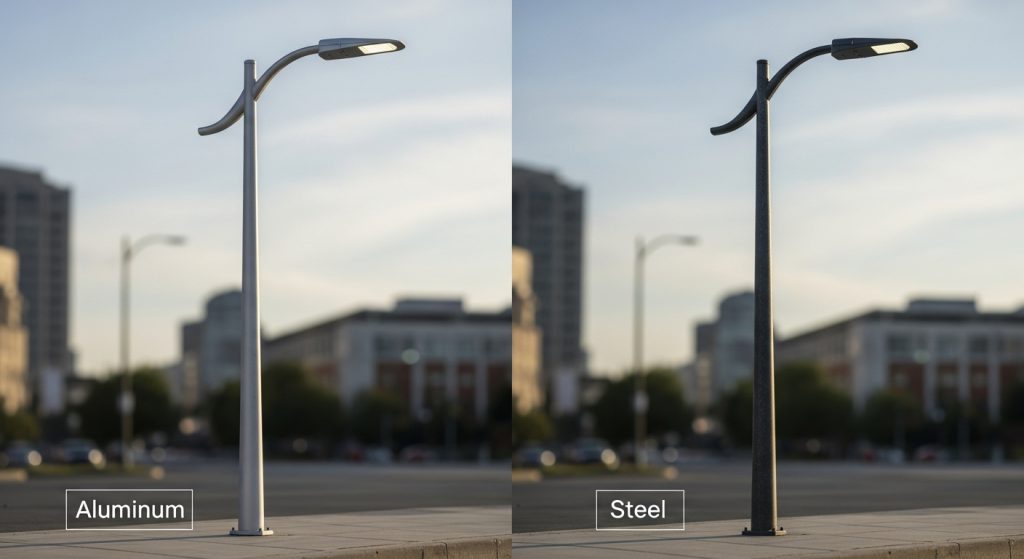
Material Selection Comparison Table
| Feature | Aluminum Light Poles | Steel Light Poles |
| Weight | Lightweight (1/3 the weight of steel) | Heavy (High density) |
| Corrosion Resistance | Naturally High (Rust-proof) | Low (Requires galvanization/paint) |
| Initial Cost | Higher upfront | Lower upfront |
| Maintenance | Low/Zero | High (Regular inspections for rust) |
| Structural Rigidity | Moderate (More flexible/sway) | High (Very stiff) |
| Best Environment | Coastal, Humid, Parks | Highways, Stadiums, High Wind |
| Service Life | 30 – 50+ Years | 20 – 30 Years (Maintenance dependent) |
How cost and lifecycle value differ between aluminum and steel light poles
Choosing based on budget planning requires looking at both the sticker price and the total cost of ownership. Steel poles usually have a lower initial purchase price, which can be tempting for projects with tight upfront capital. However, if you are building in a corrosive environment, the money you save today may be spent many times over on repainting and rust remediation. Over a 30-year span, the lifecycle cost of a steel pole can actually exceed that of an aluminum one due to these ongoing maintenance requirements.
Aluminum poles typically carry a higher upfront cost because the raw material and the extrusion process are more expensive. However, they offer a very low total cost of ownership because they essentially require zero maintenance for the life of the pole. For many developers and cities, paying a premium now to avoid the labor and equipment costs of future rust repairs is a wise investment. When you evaluate cost, you must weigh the short-term savings of steel against the long-term, “worry-free” performance of aluminum.
What common mistakes lead to poor material selection for outdoor poles
One of the most frequent selection errors is choosing steel for a coastal project simply because it was the cheapest option on the bid. Salt air is incredibly unforgiving, and a steel pole that looks great on day one can show signs of structural rust within five years. Another design oversight is underestimating the weight of modern LED fixtures on aluminum poles. If you don’t account for the added mass and wind resistance of the lamp, an aluminum pole may vibrate excessively, leading to early failure of the sensitive electronic drivers inside the light.
Planners also sometimes ignore the “scrap value” or recyclability of the material. Aluminum is highly recyclable and maintains a high market value even after its service life ends, whereas old, rusted steel has very little recovery value. A major performance risk is also created when the foundation is not matched to the material’s weight; installing a heavy steel pole on a foundation designed for aluminum can lead to soil settling and a leaning pole. Avoiding these blunders requires a holistic view of the environment, the equipment, and the long-term goals of the community.
What should be reviewed before finalizing aluminum vs steel poles for your project
Before you finalize your material choice, you must conduct a thorough design validation to ensure your selection aligns with the site’s reality. This final review ensures that your operational planning is sound and that the project is truly ready for long-term success.
Use this selection checklist to guide your final decision:
- Environmental Check: Are you within 5 miles of salt water? (If yes, prioritize aluminum).
- Load Requirement: Are you mounting multiple high-wattage fixtures? (If yes, verify steel’s load capacity).
- Maintenance Budget: Do you have a dedicated team for rust inspection and repainting? (If no, choose aluminum).
- Aesthetic Goals: Does the project require a specific color or a high-end architectural finish?
- Foundation Compatibility: Does your foundation design account for the specific weight of the chosen metal?
- Wind Zone: Does the pole meet the local wind speed requirements for its height and material?
- Logistics: Do you have the heavy equipment needed to install steel, or do you need the installation ease of aluminum?
What specifications should street light poles and brackets meet when choosing materials
When selecting your system, you must ensure that material standards are met for both the pole and the attachments. A critical factor is bracket compatibility; for example, using a steel bracket on an aluminum pole can lead to galvanic corrosion if they aren’t properly insulated from each other. You should always verify that the mounting hardware is compatible with the base metal to ensure a secure, long-lasting connection. For more on these standards, see Street light poles brackets.
How do straight light pole specifications differ with aluminum vs steel construction
In design standards, the wall thickness for a straight aluminum pole is typically greater than that of a steel pole to compensate for lower material limits in stiffness. While both can follow a Straight light pole specs framework, the steel version will be much thinner and heavier. Planners must choose the construction that fits the visual scale of the project while meeting the structural demands of the site.
Why polygon light poles use specific materials for highway conditions
For highway lighting, the faceted geometry of polygon poles is almost always executed in steel. This is because these heavy-duty poles must resist massive wind gusts and the constant vibrations from speeding traffic. Steel’s superior stiffness makes it the ideal material for the polygon shape, providing the rigidity needed for heights of 40 feet or more. You can find more on these structural powerhouses in Polygon light pole highways.
How do foldable light pole benefits interact with material choice for maintenance
A foldable design can be made from either material, but the material strength of the hinge is usually steel to handle the stress of the pivoting action. Using an aluminum body with a steel hinge provides the benefit of a lightweight pole that is easy to lower, combined with a strong pivot point. This hybrid approach maximizes maintenance access while keeping the overall unit easy to ship. Explore these benefits in Foldable light pole benefits.
How do lighting pole arm brackets differ in sizing for aluminum vs steel poles
The Lighting pole arm bracket must be sized specifically to account for the material impact of the pole. Aluminum poles require brackets with a larger surface area to distribute the load and prevent the pole wall from “dimpling.” Arm bracket sizing for steel is often more compact because the metal can handle higher localized pressure without deforming.
Why foundation design is essential when selecting aluminum or steel poles
Your foundation design must be calibrated to the material load of the pole. A steel pole requires a significantly deeper and wider concrete base to anchor its massive weight and resist overturning forces. Conversely, an aluminum pole may allow for a smaller foundation, which can save on construction costs. However, both must provide a rock-solid anchor for structural stability, as explained in our guide on Street light pole foundation.
Final Thought
Both aluminum and steel light poles have a clear place in modern outdoor lighting. Steel remains the champion of raw strength and initial affordability for large-scale infrastructure, while aluminum offers an unmatched lifecycle value through its natural corrosion resistance and ease of handling. By matching the material to your environment and maintenance capacity, you ensure a lighting system that is as durable as it is effective.


- 10 Meters Lamp Post
- 10 Meters Pole
- 1000w Led Projector
- 100W LED Tunnel Light
- 12 Meters Lamp Post
- 12 Meters Pole
- 1200w Led Projector
- 15 Light Pole
- 1500w Led Projector
- 150W LED Tunnel Light
- 1800w Led Projector
- 2 In 1 Solar Flood Light
- 200w Led Tunnel Light
- 50w Led Tunnel Light
- 6 Meters Lamp Post
- 6 Meters Pole
- 8 Meters Lamp Post
- 8 Meters Pole
- 800w Led Projector
- 80w Led Tunnel Light
- Colourful Decorative Light
- Conical post
- Courtyard Lamp
- courtyard light
- courtyard lighting fixture
- Decorative Landscape Light
- Decorative road Light
- Flood Light For Courtyard
- Flood Light for Garden
- Flood Light For Outdoor
- Foot Led High Bay Lights
- high bay led lights 100w
- industrial lampshade
- industrial LED shed lights
- industrial magnifying glass with light
- Integrated Solar Flood Light
- led courtyard lamp
- led courtyard light
- led high bay light 100w
- LED Projector For Stadium
- Led UFO High Bay 150W 5000k
- Lighting Plants Mining Price
- Maintenance Free LED Street Light
- Pic Controlling Tunnel Light
- PLC controlling tunnel light
- Post Top Garden Light
- RGB Landscape Light
- Rgbw Decorative Light
- Smart Tunnel Light
- solar courtyard lamp
- solar courtyard light
- Solar LED Road Light
- Solar Street Light For 10 Meter Pole
- Solar Street Light For 12 Meter Pole
- Solar Street Light For 6 Meter Pole
- Solar Street Light For 8 Meter Pole
- Split Type Solar Flood Light
- Sporting Projector
- Stadium Led Projector
- Street Lighting Post
