
 Request A Quote


Bollard Lights vs Post Lights What Is the Difference
 FACEBOOK
 TWITTER
 LINKEDIN
Selecting the right outdoor fixture requires you to understand the balance between lighting purpose and the specific usage scenario of your space. Bollard lights and post lights are both essential pillars of landscape design, yet they serve very different masters. A bollard is a short, sturdy vertical post—typically reaching waist-height or lower—designed to ground the light and focus it on the immediate walking surface. In contrast, a post light is an elevated lighting solution mounted on a much taller pole, often used to mimic the broad, overhead reach of a street lamp.
The core of the decision rests on the fixture height and the resulting design style. While bollards excel at providing intimate guidance along a garden path, post lights are the preferred choice when you need to illuminate a large driveway or a public plaza. Choosing between them is not just a matter of aesthetics; it affects how safe your guests feel and how effectively you manage light pollution.
By matching the hardware to the scale of your environment, you ensure a harmonious look that provides security without overwhelming the senses. Whether you prioritize subtle wayfinding or high-intensity visibility, understanding these functional boundaries allows you to plan an outdoor space that is both safe and visually stunning.
What bollard lights are and where they are typically used
A bollard fixture is a specialized source of low-level lighting designed to sit close to the earth. Most bollards range in height from 0.5 to 1.2 meters, keeping the light source well below eye level. This positioning is strategic; it ensures that the glow is directed precisely where your feet land, making them the gold standard for pathway guidance. You will find them lining garden edges, marking the transitions between different lawn zones, or bordering the steps of a patio to prevent trips and falls.
Because they focus on the ground, bollards are excellent for maintaining the nighttime feel of a garden. They provide enough light for safety without washing out the delicate textures of your plants or the stars above. They are frequently used in residential yards where a soft, guiding light is more important than raw power. By using a series of bollards, you create a rhythmic trail of light that leads the eye naturally through the landscape, defining the rooms of your outdoor space with subtle elegance.
What post lights are and why they are chosen for other outdoor spaces
A post fixture is a taller, more dominant element of elevated lighting that aims for wide coverage. Reaching heights of 2 to 4 meters or more, these units are designed to clear obstacles and push light across a vast footprint. They are the primary choice for gateway areas such as the start of a long driveway, the center of a large courtyard, or the perimeter of a community plaza. Their height allows them to act as a central beacon, providing the general illumination needed for high-traffic public zones.
The taller profile of a post light makes it a significant part of the daytime architecture as well. While a bollard might disappear into the shrubs, a post light stands tall, often reflecting a specific design style like classic Victorian or sleek modernism. They are chosen when the primary goal is total visibility across a distance. By lifting the light source high above the ground, these fixtures ensure that large open spaces remain secure and accessible for groups of people, making them indispensable for urban parks and spacious residential estates alike.
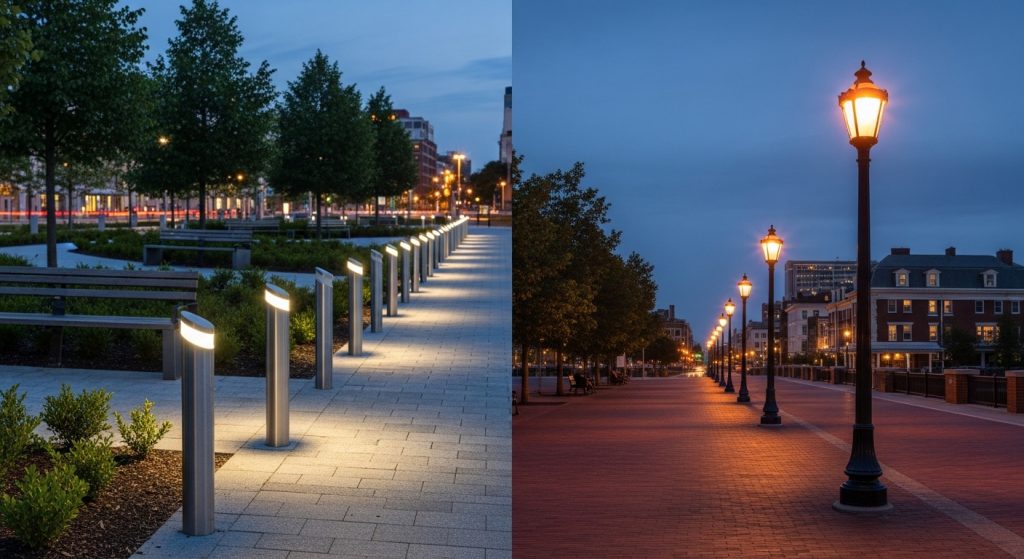
Comparison table: bollard lights vs post lights
Choosing the right fixture depends on the specific scale of your project and the level of safety required for the area. Use this comparison to see how each type performs in the field:
| Feature | Bollard Lights | Post Lights |
| Typical Height | Low (0.5–1.2m) | Taller (1.5–4m+) |
| Primary Use | Pathways, garden borders | Driveways, plazas, entrances |
| Coverage Area | Localized, near-floor | Elevated, broad footprint |
| Fixture Functionality | Pathway guidance and wayfinding | High visibility and area security |
| Glare Risk | Lower (directed downward) | Higher (requires careful shielding) |
| Installation Ease | Often simpler (lower reach) | May require high-access setup |
| Lighting Purpose | Subtle, intimate ambiance | Functional, wide-scale lighting |
How brightness and spacing differ between bollard and post lights
The brightness planning for these fixtures follows the logic that the further light travels, the more it spreads and dims. Because bollards are close to the ground, they can achieve excellent results with a lower lumens focus. You only need enough light to see the texture of the path. Consequently, the spacing logic for bollards is tighter; you typically place them every 2 to 3 meters to ensure there are no dark holes along the walking route.
Post lights, however, require a much higher light output to maintain effectiveness from their elevated position. A single post light might produce three times the lumens of a bollard to ensure the ground remains bright enough for safety. Because of this high power and height, you can space them much further apart—often 10 meters or more—while still maintaining uniform coverage. Balancing these factors is essential; putting post lights too close together can lead to over-lighting a space, while placing bollards too far apart creates dangerous shadows between poles.
How design and aesthetics vary between the two types
In terms of visual integration, bollards are the masters of subtlety. Modern fixture styles often utilize hidden light sources that reflect off internal baffles, casting intricate patterns of shadow and light on the pavement. They are designed to complement the natural lines of your landscape, often blending into the flora during the day. This makes them ideal for contemporary garden designs where the light should feel like an organic part of the environment.
Post lights offer a more traditional sense of design harmony. They act as anchors for the property’s architectural theme. A classic wrought-iron post light can tie together the look of a traditional brick home, while a minimalist aluminum pole fits a high-tech corporate plaza. Because they are visible from a distance, the visual style of the post itself is just as important as the light it produces. Selecting a style that matches your home’s hardware ensures the fixtures look like a permanent, well-thought-out investment rather than a random addition.
When to prefer bollard lights over post lights
You should prioritize bollard fixtures when your primary goal is wayfinding lighting for pedestrians. If you have a winding stone path, a set of stairs, or a narrow side garden, bollards provide the necessary safety without being aggressive. They are the best low-height solutions for residential areas where you want to protect your night vision and enjoy the natural ambiance of the yard.
Bollards are also preferred in Dark Sky compliant areas. Because they are designed to push light strictly downward, they minimize light spill into the atmosphere and your neighbor’s windows. If you want a garden that feels private, intimate, and secure, bollards provide the perfect amount of light exactly where you need it most—at your feet.
When post lights are a better choice
Post lights are the superior choice for functional lighting in expansive areas. If you are lighting a driveway where vehicles need to navigate safely or a large open lawn where children play, the wide coverage of an elevated post is essential. They provide the big picture visibility that allows you to monitor the entire property from a distance, making them a core part of any home security strategy.
They are also better for gateway moments. A pair of matching post lights at the entrance of a housing society or the start of a driveway provides a grand, welcoming feel that bollards cannot match. When the usage scenario involves moving at higher speeds or managing large groups of people, the high-mounted visibility of a post light is the only way to ensure total safety and clarity.
What checklist should be reviewed before choosing between bollard and post lights
Before you finalize your design criteria, a thorough site assessment is necessary to avoid common planning errors. Use this selection checklist to ensure your hardware choice matches the reality of your land.
- Space Size: Is the area a narrow path (Bollard) or a wide open space (Post)?
- Safety Need: Are you preventing trips on steps (Bollard) or lighting a vehicle route (Post)?
- Height Constraints: Are there low-hanging tree branches that would block a post light?
- Aesthetic Goal: Do you want the lighting to be hidden (Bollard) or an architectural feature (Post)?
- Installation: Do you have the depth for a post foundation or the proximity for a bollard run?
- Light Spill: Are there nearby bedroom windows that need protection from high-mounted glare?
- Maintenance: Can you easily reach a 3-meter post to change a bulb or clean the lens?
Is lawn bollard pathway lighting included in outdoor settings?
Lawn bollard pathway lighting refers to the specific use of bollard fixtures to provide pathway lighting. These are the primary tools for guiding movement across a yard. They ensure that the transitions between different landscape zones are clear, safe, and visually appealing, serving as the functional anchor for any residential lighting plan.
How solar spiral bollard lights combine design and function
Choosing a Solar spiral bollard light adds a unique spiral design to your path. These solar lighting units are self-contained power plants that require no wiring. They provide a decorative, 360-degree light pattern that is perfect for adding modern flair to your garden while maintaining a high level of wayfinding safety.
Why spacing is important when using bollard lights for safety
Following a Bollard light spacing guide is the best way to achieve uniform coverage. A solid spacing strategy prevents dark gaps that can hide obstacles. By ensuring that the light pools overlap slightly, you create a continuous, safe ribbon of light that makes your walkways feel secure and predictable for every user.
How bollard brightness considerations differ from post lights
The Solar bollard lights brightness guide explains that brightness planning for bollards focuses on the ground. Because they sit lower, the lumens focus can be more modest. This differs from post lights, which must be much brighter to compensate for their height. Matching the brightness to the fixture height is the key to achieving efficient and comfortable outdoor illumination.
What installers should know about setting up solar bollard lights
To Install solar bollard lights effectively, you must focus on site preparation. Proper installation tips involve identifying the sunniest spots to ensure the internal batteries reach a full charge. Because there are no wires, the process is much faster than setting up a traditional post light, allowing you to secure your property in a single afternoon.



- 10 Meters Lamp Post
- 10 Meters Pole
- 1000w Led Projector
- 100W LED Tunnel Light
- 12 Meters Lamp Post
- 12 Meters Pole
- 1200w Led Projector
- 15 Light Pole
- 1500w Led Projector
- 150W LED Tunnel Light
- 1800w Led Projector
- 2 In 1 Solar Flood Light
- 200w Led Tunnel Light
- 50w Led Tunnel Light
- 6 Meters Lamp Post
- 6 Meters Pole
- 8 Meters Lamp Post
- 8 Meters Pole
- 800w Led Projector
- 80w Led Tunnel Light
- Colourful Decorative Light
- Conical post
- Courtyard Lamp
- courtyard light
- courtyard lighting fixture
- Decorative Landscape Light
- Decorative road Light
- Flood Light For Courtyard
- Flood Light for Garden
- Flood Light For Outdoor
- Foot Led High Bay Lights
- high bay led lights 100w
- industrial lampshade
- industrial LED shed lights
- industrial magnifying glass with light
- Integrated Solar Flood Light
- led courtyard lamp
- led courtyard light
- led high bay light 100w
- LED Projector For Stadium
- Led UFO High Bay 150W 5000k
- Lighting Plants Mining Price
- Maintenance Free LED Street Light
- Pic Controlling Tunnel Light
- PLC controlling tunnel light
- Post Top Garden Light
- RGB Landscape Light
- Rgbw Decorative Light
- Smart Tunnel Light
- solar courtyard lamp
- solar courtyard light
- Solar LED Road Light
- Solar Street Light For 10 Meter Pole
- Solar Street Light For 12 Meter Pole
- Solar Street Light For 6 Meter Pole
- Solar Street Light For 8 Meter Pole
- Split Type Solar Flood Light
- Sporting Projector
- Stadium Led Projector
- Street Lighting Post
