
 Request A Quote


What sets COB and SMD LED flood lights apart and how to choose between them
 FACEBOOK
 TWITTER
 LINKEDIN
Choosing the right LED technology for your project requires an understanding of the structural and functional differences between COB (Chip-on-Board) and SMD (Surface-Mount Device) designs. COB technology features multiple LED chips packed into a single module, creating a dense “point source” of light that delivers intense, high-lumen output. Conversely, SMD fixtures utilize multiple individual diodes spread across a circuit board, allowing for a more diffused and versatile light spread. These technical variations directly dictate flood light performance, influencing everything from the sharpness of shadows to the efficiency of the fixture’s cooling system.
In real-world applications, the choice between COB and SMD depends on your specific goals for light distribution and thermal management. COB flood lights are the gold standard for high-intensity focal lighting where a powerful “punch” is required to pierce through darkness over long distances. SMD lights excel in providing uniform, wide-area coverage, making them ideal for general perimeter security or washing large facades. By evaluating the mounting height, environmental exposure, and desired beam uniformity, you can select the architecture that provides the best balance of longevity and visual comfort. Understanding these core differences ensures that your outdoor lighting remains a reliable, high-performance asset for your property.
What COB and SMD LED flood lights are and how they differ structurally
The primary differentiator lies in the chip design. A COB (Chip-on-Board) light consists of many LED dies mounted directly onto a single substrate, covered by a uniform phosphor coating. This creates a singular, large glowing surface that functions as a powerful point source. Because the chips are so tightly packed, COB technology allows for a much higher lumen density in a smaller physical footprint than traditional arrays. This structural density is why COB is often favored for compact, high-power fixtures.
In contrast, SMD technology (Surface-Mount Device) involves individual LED packages soldered onto a printed circuit board (PCB). Each SMD diode is a self-contained unit that can be independently positioned and angled. This structural independence allows manufacturers to create fixtures with complex beam shapes and wide-area coverage. While COB provides a concentrated “beam,” SMD provides a flexible “wash,” making the structural choice fundamental to how the fixture will eventually interact with the outdoor environment.
How light output and beam patterns compare between COB and SMD
Because of its point-source nature, a COB fixture produces an intense, focused beam with high center-point brightness. This is ideal for applications where you need to throw light across a great distance, such as lighting a tall building or a deep industrial yard. The beam distribution of COB is often cleaner, producing a single, sharp shadow that mimics the look of traditional high-intensity discharge lamps. It provides a focused intensity that is hard to match with distributed diodes.
SMD flood lights prioritize output uniformity across a broader area. Since the diodes are spread out, they can use individual lenses to shape the light into wide or asymmetric patterns. This reduces “hot spots” and creates a more even ribbon of light along a fence line or pathway. While SMD might not have the same long-range “punch” as COB, its ability to provide consistent coverage patterns over a wide horizontal plane makes it a versatile tool for general residential and commercial security projects.
Why thermal performance and efficiency vary for COB and SMD
Effective thermal management is the key to LED longevity. In a COB chip, all the heat is generated in a single, highly concentrated area. This requires a robust, high-performance heat sink to pull heat away from the core. If the heat sink is undersized, the COB chip can experience rapid efficiency loss and a shortened lifespan due to heat-induced stress on the phosphor and diodes. The cooling system must be highly efficient to handle this concentrated energy.
SMD fixtures have a natural advantage in heat dissipation because the diodes are physically separated. This “distributed heat” design allows the PCB to act as a larger surface area for cooling, reducing the stress on each individual component. This often translates to higher overall efficiency and a longer, more stable operating life. For outdoor fixtures that run for long hours every night, the superior thermal profile of SMD can lead to reduced maintenance and better long-term reliability in varying seasonal conditions.
Where COB and SMD flood lights work best outdoors
COB flood lights are the premier choice for focal illumination. Their intense output makes them perfect for “grazing” architectural textures on building facades or lighting up high-traffic service areas from a distance. Because they can provide a lot of light from a small fixture, they are also favored for situations where the aesthetic of the hardware must remain subtle while the light remains powerful. They act as “spotlights” for the most critical points of a facility.
SMD technology is generally better for large area lighting projects. Its ability to create wide, uniform washes of light makes it ideal for parking lots, loading docks, and perimeter security. By using many diodes to cover the area, SMD minimizes the risk of leaving dark “coverage gaps” between fixtures. When planning your layout, use COB for the “highlights” and SMD for the “foundational” lighting to create a professional, multi-layered environment that covers every corner of your facility effectively.
How maintenance and long-term performance differ
From a maintenance perspective, COB fixtures offer a simpler structural array. Since there is usually only one primary light source, diagnosing a failure is straightforward. However, because COB is an integrated module, a failure of the chip usually requires a complete replacement of the light engine. High-quality COB units are built with extreme outdoor durability in mind, but they rely heavily on the integrity of their singular, centralized cooling path to avoid premature failure.
SMD boards are more complex multi-element systems. While the individual diodes are very reliable, the complexity of the board means there are more potential points of failure in the circuitry. However, because the load is distributed, an SMD fixture is often more resilient to partial failures; if one diode fails, the rest of the board often continues to provide light. For serviceability in remote or high-altitude locations, choosing the technology that matches your long-term maintenance access and budget is a critical part of the planning process.
When a comparison table clarifies the choice
Using a comparison table is the most effective way to validate your selection criteria. It allows you to move past the technical jargon and focus on how each attribute—such as beam shape or cost—applies to your specific site. By viewing these factors side-by-side, you can quickly identify which technology aligns with your primary goals, whether those are long-range visibility, energy efficiency, or budget management. It provides a visual roadmap for your technical decision.
Reading a visual summary in the context of your site’s geography helps prevent “over-specifying” a project. For instance, you might find that while COB offers higher intensity, the wider beam of an SMD fixture actually provides better safety for your specific walkway. This section helps you reconcile the “on-paper” specs with the real-world needs of your yard. The table acts as a final safeguard, ensuring your final hardware choice is based on objective performance data rather than marketing claims alone.
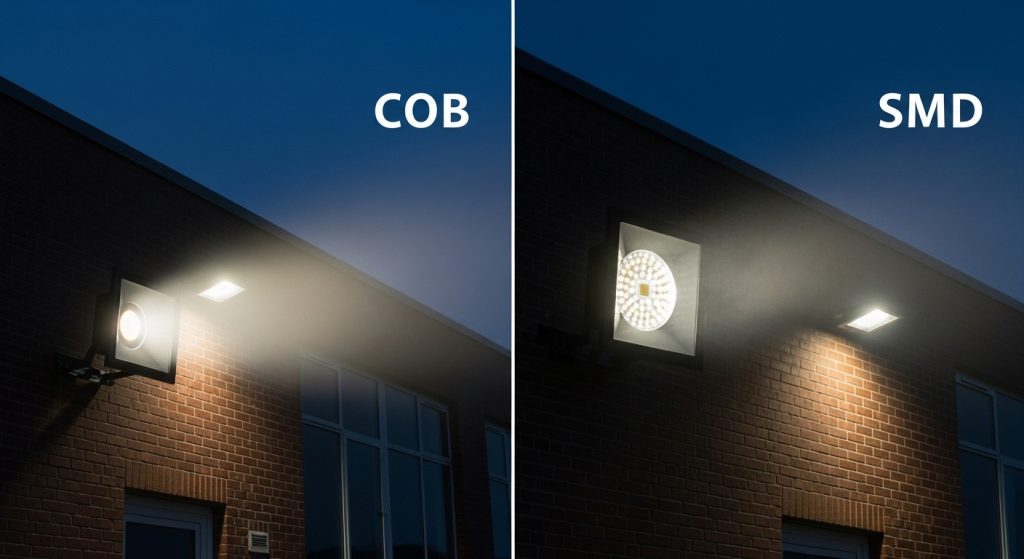
| Attribute | COB Flood Lights | SMD Flood Lights |
| Light Source | Single high-density chip | Multiple smaller diodes |
| Beam Pattern | Intense, narrow, “point source” | Flexible, wider, “wash” |
| Thermal Performance | Higher heat density | Better heat distribution |
| Efficiency | High per individual chip | Excellent across multiple diodes |
| Suitability | Focused high-brightness / Facades | Large area / General security |
| Maintenance | Simpler (fewer parts) | Slightly more complex board |
| Cost | Mid to high | Variable (scalable) |
Which mistakes occur when comparing COB vs SMD LEDs?
One of the most frequent selection errors is choosing a fixture based on price alone. While a cheap COB light might look bright in a showroom, its thermal management might be inadequate for long-term outdoor use, leading to premature dimming or failure. Another common blunder is a performance mismatch regarding beam patterns; using a narrow COB light for a wide driveway will create a blinding “hot spot” while leaving the edges of the path in total darkness.
Planning pitfalls also include ignoring the environment’s specific needs. For example, using a high-intensity COB light near a neighbor’s window will cause aggressive glare and complaints, whereas a more diffused SMD wash would have provided the same safety with significantly more visual comfort. To avoid these blunders, you should always conduct a “night walk” with a similar-powered light or refer to a professional lighting map. Visualizing exactly how the beam will behave is the only way to ensure a professional and harmonious result.
How to decide between COB and SMD for your flood lighting project
Before you commit to an environment assessment, a thorough review of your site’s geometry is essential to ensure the hardware is a perfect match. Use this selection checklist as a final guide to ensure your output planning results in a safe, efficient, and professional outdoor lighting system that stands the test of time.
- Primary Goal: Do you need high-intensity “punch” (COB) or a broad, uniform “wash” (SMD)?
- Mounting Height: Taller poles (25ft+) often benefit from the concentrated throw of COB.
- Area Size: Large, wide zones are usually better served by the uniform spread of SMD.
- Visual Comfort: If people will be moving near the light, choose the softer spread of SMD.
- IP Rating: Ensure both types carry a high rating (e.g., IP65+) for outdoor durability.
- Maintenance Access: Consider if the simplicity of a single COB chip is easier for your team.
- Budget Logic: Balance initial cost with the long-term efficiency and lifespan of the fixture.
How flood lights, high bay and sports lighting systems relate to LED flood light choice
Flood lights, high bay and sports lighting represent the three pillars of wide area illumination. Understanding the performance lighting differences between COB and SMD is the foundation for selecting the right fixtures in these categories. Whether you are lighting an industrial warehouse or a local football pitch, your choice of chip technology dictates the safety and efficiency of the entire site.
When COB flood lights deliver high-output performance
Choosing an LED COB flood light is the most direct way to achieve high intensity illumination. Because of its superior COB lighting density, it is the top choice for industrial perimeters and high-mast installations. If your project requires raw power and a sharp, focused beam to pierce the darkness over long distances, COB technology provides the necessary intensity to ensure every corner of your facility remains secure.
How modular flood lights compare to COB and SMD solutions
Reviewing the LED modular flood light provides a clear view of light scalability. Modular modular systems often use SMD technology to allow you to add or subtract light “blocks” as your project needs evolve. This provides a flexible alternative to fixed COB units, allowing you to tailor the output and beam spread of your large-area lighting with extreme precision as your facility grows.
How projector lights differ from flood lights in outdoor applications
The guide to Flood light vs projector explains the difference in projector lights versus standard washes. While an SMD flood provides a wide wash, a flood vs projector comparison highlights how COB technology is often used in projector-style fixtures to create highly targeted, narrow-angle beams. This is essential for illuminating specific architectural features or far-off targets without wasting light on the surrounding area.


- 10 Meters Lamp Post
- 10 Meters Pole
- 1000w Led Projector
- 100W LED Tunnel Light
- 12 Meters Lamp Post
- 12 Meters Pole
- 1200w Led Projector
- 15 Light Pole
- 1500w Led Projector
- 150W LED Tunnel Light
- 1800w Led Projector
- 2 In 1 Solar Flood Light
- 200w Led Tunnel Light
- 50w Led Tunnel Light
- 6 Meters Lamp Post
- 6 Meters Pole
- 8 Meters Lamp Post
- 8 Meters Pole
- 800w Led Projector
- 80w Led Tunnel Light
- Colourful Decorative Light
- Conical post
- Courtyard Lamp
- courtyard light
- courtyard lighting fixture
- Decorative Landscape Light
- Decorative road Light
- Flood Light For Courtyard
- Flood Light for Garden
- Flood Light For Outdoor
- Foot Led High Bay Lights
- high bay led lights 100w
- industrial lampshade
- industrial LED shed lights
- industrial magnifying glass with light
- Integrated Solar Flood Light
- led courtyard lamp
- led courtyard light
- led high bay light 100w
- LED Projector For Stadium
- Led UFO High Bay 150W 5000k
- Lighting Plants Mining Price
- Maintenance Free LED Street Light
- Pic Controlling Tunnel Light
- PLC controlling tunnel light
- Post Top Garden Light
- RGB Landscape Light
- Rgbw Decorative Light
- Smart Tunnel Light
- solar courtyard lamp
- solar courtyard light
- Solar LED Road Light
- Solar Street Light For 10 Meter Pole
- Solar Street Light For 12 Meter Pole
- Solar Street Light For 6 Meter Pole
- Solar Street Light For 8 Meter Pole
- Split Type Solar Flood Light
- Sporting Projector
- Stadium Led Projector
- Street Lighting Post
