
 Request A Quote


How to tell flood lights and projector lights apart for outdoor illumination
 FACEBOOK
 TWITTER
 LINKEDIN
Selecting the right fixture for outdoor illumination requires a clear understanding of the fundamental differences between flood lights and projector lights. While both are used to pierce the darkness of exterior spaces, they are engineered for entirely different lighting goals. A flood light is designed for light diffusion, emitting a wide, voluminous wash of light that can reach angles of 120 degrees or more.
In contrast, a projector light—often referred to as a spotlight—is built for beam control, utilizing precision optics to concentrate light into a narrow, intense cone. This structural difference determines whether a fixture is suited for broad safety coverage or the surgical highlighting of architectural details.
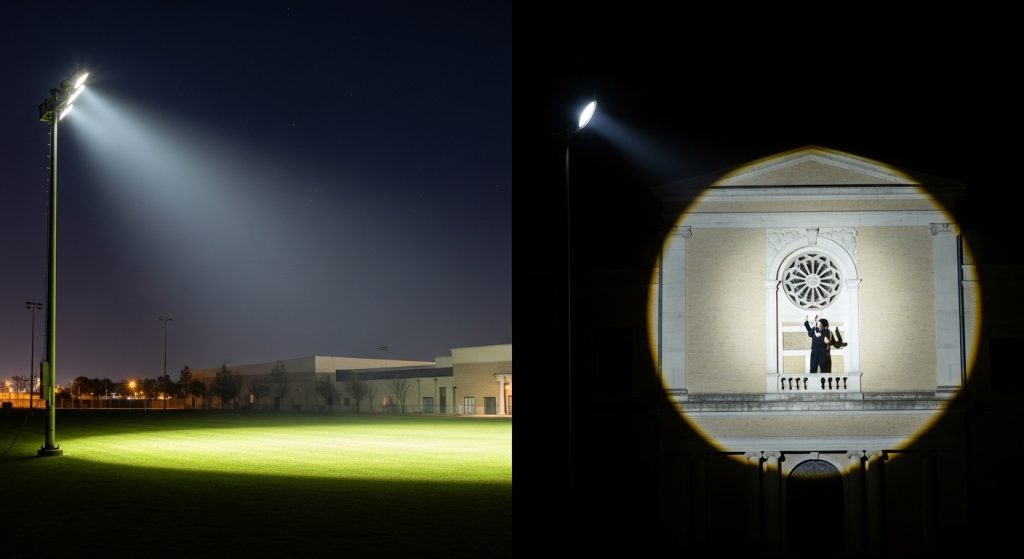
The decision-making process for coverage planning depends on the specific geometry of your site. Flood lights are the primary tool for creating a safe, high-visibility environment in open areas like yards, driveways, or industrial zones where uniform illumination is the priority.
Projector lights serve a more specialized role, providing the “punch” needed to reach distant targets or accent specific features without wasting light on the surrounding area. By matching the fixture’s output behavior to your architectural or security needs, you can achieve a professional and efficient layout. Understanding these distinctions ensures that your outdoor space is not just bright, but intentionally and effectively lit to support both functionality and visual comfort.
What defines a flood light and a projector light
The primary differentiator between these two categories lies in their fixture design and internal optics. A flood light utilizes a broad reflector or a wide-angle lens array to scatter photons across a massive arc. This results in a diffuse, high-volume output that is designed to “flood” an area with light. Because the source is spread out, the light feels less intense at any single point but covers a much larger horizontal and vertical footprint, making it the workhorse of general-purpose outdoor lighting.
A projector light, conversely, is a high-precision instrument. It uses deep reflectors or TIR (Total Internal Reflection) lenses to “columnarize” the light, preventing it from scattering. This beam control allows the light to maintain its intensity over much longer distances than a standard flood light. While a flood light might struggle to reach a target 50 feet away without excessive “spill,” a projector light can hit that same target with a sharp, clear beam. This structural focus is what allows for the dramatic “spotlighting” effects seen in professional landscape and architectural designs.
How beam distribution and coverage differ
In coverage planning, the beam spread is the most critical metric. Flood lights provide a wide “wash” that is ideal for eliminating shadows across an entire yard or parking lot. Because the light is so broad, it is easier to achieve uniform illumination with fewer fixtures, as the edges of the light pools blend together naturally. However, this wide distribution means the light loses its “punch” quickly, making it less effective for targets that are far away from the mounting point.
Projector lights prioritize distance and precision over area coverage. They are designed to create a “hot spot” on a specific zone—such as a statue, a flag, or a distant gate. This targeted approach prevents light from spilling into areas where it isn’t wanted, such as a neighbor’s window or the night sky. By concentrating all its lumens into a tight 15 to 45-degree angle, a projector light provides a high-contrast effect that draws the eye toward specific landmarks. Choosing between the two is a matter of deciding whether you need to light the “whole room” or just a “single seat.”
Why output and mounting affect performance
The relationship between mounting height and performance is where these two fixtures diverge most significantly. Flood lights are typically mounted higher up (10 to 20 feet) to take full advantage of their wide spread. At these heights, the broad beam can cover a large area of the ground effectively. If a flood light is mounted too low, it often results in intense glare for pedestrians and a very small, inefficient pool of light.
Projector lights offer more flexibility in field planning because their focused beam doesn’t dissipate as quickly. They can be mounted low to the ground for dramatic “uplighting” of trees or high on a pole to project a narrow beam onto a distant security checkpoint. Because their output spread is so controlled, you can place them further away from the target than you could with a standard flood light. Coordinating your mounting positions with the fixture’s “throw” distance is the only way to ensure that the light reaches its destination with the intended brightness and clarity.
How luminous output and control differ in practical use
In light planning, matching your lumen requirements to the fixture type is essential for efficiency. Flood lights generally require higher total lumens to cover a wide space, as the light is spread thin across the yard. This makes them ideal for supporting safety and security in high-traffic outdoor zones. Their goal is to provide enough ambient light so that motion and obstacles are clearly visible from any angle.
Projector lights excel in control precision, allowing you to use fewer lumens more effectively. Because the light isn’t being wasted on “spill,” a lower-lumen projector can often appear much brighter on its target than a high-lumen flood light. This is a critical consideration for architectural highlighting where you want to emphasize texture and form without washing out the entire building facade. By prioritizing “targeted” over “broad” lighting, you can create a more sophisticated, multi-layered environment that balances security with aesthetic drama.
When to choose flood lights or projector lights outdoors
Your lighting goals should always dictate your output strategy. Choose flood lights when your primary concern is wide-area coverage and safety. They are the definitive choice for lighting up backyards, industrial loading docks, and residential driveways. If the objective is to ensure that a large, open area is bright and navigable for both human eyes and security cameras, the broad, consistent wash of a flood light is the most reliable tool for the job.
Select projector lights when you need to highlight specific features or light up targets at a distance. Typical use cases include illuminating a specific tree in a garden, a company sign on a high wall, or a distant perimeter gate. Projectors are also the preferred choice for “grazing” walls to show off stone or brick textures. By using projector lights for these focal points, you add depth and visual interest to your property, ensuring that your most important architectural and landscape assets are the stars of the show.
Which mistakes occur when combining flood and projector lighting?
One of the most frequent lighting errors is a beam mismatch, where a flood light is used to try and light a distant target. This results in a hazy, dim environment and significant light pollution. Another common blunder is overlapping too many flood lights in a small space, which creates a “flat” look with no shadows and intense, uncomfortable glare. Projectors, if aimed poorly, can also create “blinding” spots for drivers if they aren’t positioned with sightlines in mind.
Ignoring the visual imbalance is another major pitfall. If your feature lights (projectors) are significantly brighter or dimmer than your background lights (floods), the yard will look disjointed and chaotic. To avoid these blunders, conduct a “night walk” with a high-powered flashlight to see how shadows fall. By visualizing the “footprint” of each beam before permanent installation, you can ensure that your flood and projector lights work together as a harmonious and professional system.
How to decide which type fits your outdoor project
Before finalizing your space assessment, use this selection checklist to ensure your hardware matches your lighting objectives. Choosing the right tool for the job prevents energy waste and ensures a professional result that enhances the safety and beauty of your property.
- Area Scale: Do you need to light a broad zone (Flood) or a specific point (Projector)?
- Throw Distance: How far is the target from the mounting point? (Far = Projector).
- Uniformity Goal: Is consistent brightness across the ground the priority? (Yes = Flood).
- Glare Audit: Will the beam spread disturb neighbors or oncoming drivers?
- Mounting Options: Are you limited by height or placement?
- Fixture Style: Do you need modular flexibility or a compact, single-source design?
- Maintenance: Is the light easily accessible if the lens needs cleaning to maintain precision?
| Feature | Flood Light | Projector Light |
| Beam Spread | Wide, diffuse (60°–120°+) | Narrow, focused (15°–45°) |
| Coverage | Broad, open area wash | Targeted zones / Precision |
| Best Use | Yards, fields, industrial zones | Features, accents, distance |
| Mounting Height | Usually higher for wide spread | Flexible, depends on target |
| Glare Control | Moderate (spread is broad) | High (precision optics) |
| Output Behavior | Uniform wash across space | Intense “hot spot” on target |
| Typical Fixtures | Modular or COB flood heads | Precision TIR or reflector optics |
How flood lights, high bay and sports lighting relate to outdoor coverage needs
Flood lights, high bay and sports lighting represent the three pillars of wide coverage. In professional sports lighting, flood lights handle the broad field while projector-style optics are often used to ensure that the light reaches the center of the stadium from tall masts. Understanding how these systems overlap is the key to creating a balanced, professional outdoor environment.
When to use modular flood lights for flexible outdoor coverage
Choosing an LED modular flood light provides the ultimate in output flexibility. These modular systems allow you to adjust individual LED modules to cover complex site shapes, essentially giving you the ability to combine the “wash” of a flood light with the directed “aim” of a projector in a single, scalable fixture for large areas.
How COB flood lights support high-output outdoor flooding
An LED COB flood light utilizes COB lighting to provide an intense, single-source beam. This technology is excellent for high lumen output applications where you need the power of a flood light but the concentrated “punch” typically associated with a projector, making it ideal for industrial facades and deep yards.
How lumen planning guides broad vs targeted lighting decisions
A Flood lighting lumens guide is your roadmap for output planning. This lumens guide helps you determine if you need high lumens for a broad flood wash or more targeted, efficient lumens for a projector-style accent, ensuring your energy use is optimized for the scale of your outdoor project.
How sports lighting design supports flood vs projector planning
The placement of a Sports light pole stadiums is the primary factor in pole lighting design. In field coverage, designers must choose between broad flood washes to eliminate shadows and narrow projector-style beams to reach the far side of the field. This high-level planning ensures that athletes have perfect visibility across every square foot of the athletic surface.


- 10 Meters Lamp Post
- 10 Meters Pole
- 1000w Led Projector
- 100W LED Tunnel Light
- 12 Meters Lamp Post
- 12 Meters Pole
- 1200w Led Projector
- 15 Light Pole
- 1500w Led Projector
- 150W LED Tunnel Light
- 1800w Led Projector
- 2 In 1 Solar Flood Light
- 200w Led Tunnel Light
- 50w Led Tunnel Light
- 6 Meters Lamp Post
- 6 Meters Pole
- 8 Meters Lamp Post
- 8 Meters Pole
- 800w Led Projector
- 80w Led Tunnel Light
- Colourful Decorative Light
- Conical post
- Courtyard Lamp
- courtyard light
- courtyard lighting fixture
- Decorative Landscape Light
- Decorative road Light
- Flood Light For Courtyard
- Flood Light for Garden
- Flood Light For Outdoor
- Foot Led High Bay Lights
- high bay led lights 100w
- industrial lampshade
- industrial LED shed lights
- industrial magnifying glass with light
- Integrated Solar Flood Light
- led courtyard lamp
- led courtyard light
- led high bay light 100w
- LED Projector For Stadium
- Led UFO High Bay 150W 5000k
- Lighting Plants Mining Price
- Maintenance Free LED Street Light
- Pic Controlling Tunnel Light
- PLC controlling tunnel light
- Post Top Garden Light
- RGB Landscape Light
- Rgbw Decorative Light
- Smart Tunnel Light
- solar courtyard lamp
- solar courtyard light
- Solar LED Road Light
- Solar Street Light For 10 Meter Pole
- Solar Street Light For 12 Meter Pole
- Solar Street Light For 6 Meter Pole
- Solar Street Light For 8 Meter Pole
- Split Type Solar Flood Light
- Sporting Projector
- Stadium Led Projector
- Street Lighting Post
