
 Request A Quote


How to choose and apply flood lights, high bay lights, and sports lighting for large spaces
 FACEBOOK
 TWITTER
 LINKEDIN
Selecting the right large space lighting solution requires a precise understanding of the environment’s scale and the visual tasks involved. Flood lights, high bay lights, and sports lighting are engineered for high-performance field illumination and wide-area lighting, yet they serve distinct operational roles. Flood lights are the versatile workhorses of outdoor security and facade lighting, designed to wash expansive areas in a broad, even glow. High bay lights are the standard for indoor high bay applications, specifically tailored for warehouses and factories where high ceilings demand powerful, vertical light penetration. Sports lighting represents the pinnacle of precision, requiring specific beam control to ensure athlete safety and broadcast-quality clarity.
Choosing the correct system involves balancing flood light performance with technical factors like mounting height and lumen density. A well-designed layout doesn’t just provide brightness; it manages glare control to protect the visual comfort of spectators and workers alike. Whether you are illuminating a commercial parking lot or a professional stadium, matching the fixture’s light distribution to the space’s geometry is essential. By evaluating the mounting constraints and necessary lux levels during the planning phase, you can achieve a lighting system that enhances both safety and operational efficiency, turning vast, dark areas into productive, well-defined environments.
What flood lights, high bay lights, and sports lighting are used for
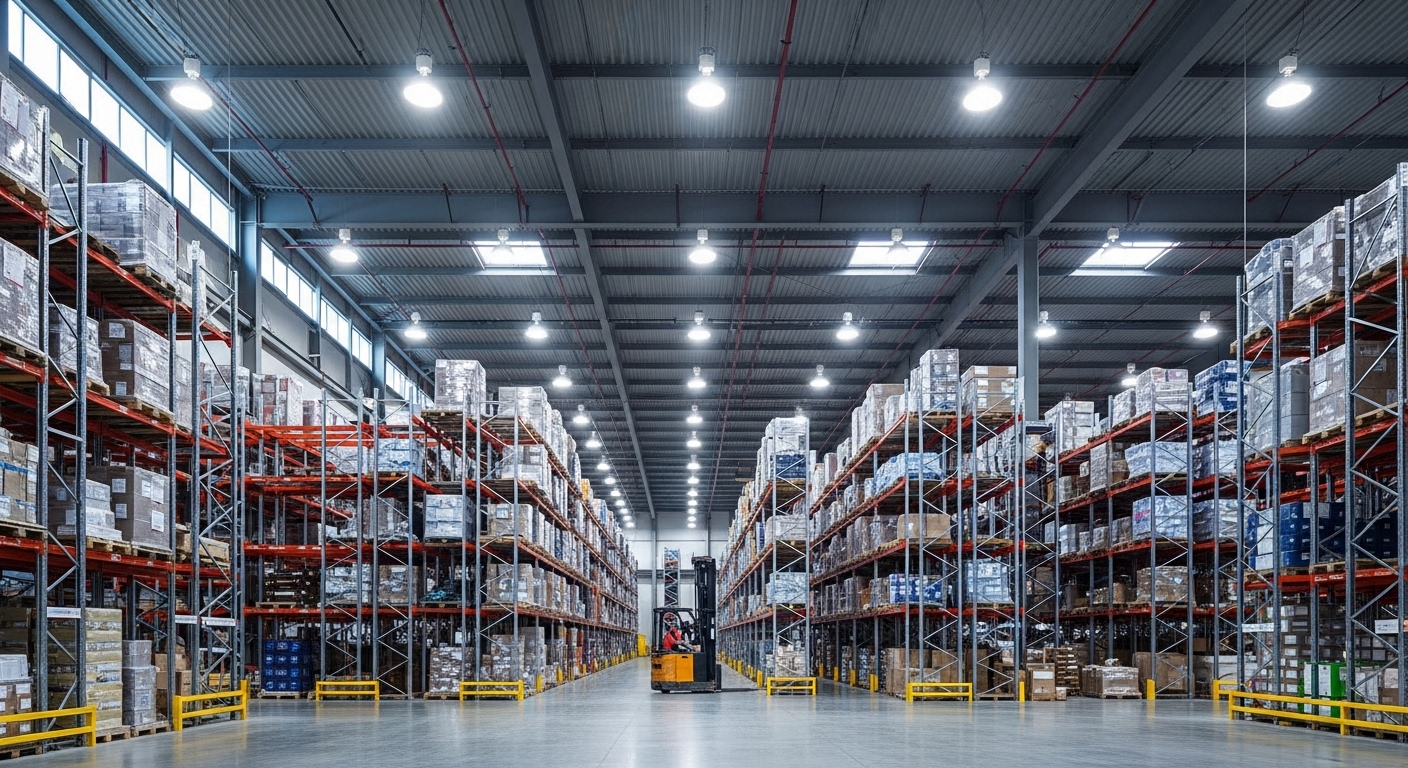
The application of high-output fixtures is defined by the direction and spread of the light they produce. Flood lights are primarily used for wide-area lighting in outdoor settings, such as building perimeters, storage yards, and billboards. Their broad beam is designed to cover as much horizontal ground as possible from a single point. Indoor high bay lights, conversely, are designed for vertical spaces with ceiling clearances usually exceeding 20 feet. They provide a concentrated downward beam that pierces through height to illuminate workstations and inventory racks in industrial settings.
Field illumination for sports requires a specialized hybrid of these technologies. Sports lighting must provide enough intensity for high-speed action while maintaining extreme uniformity across the playing surface. Unlike a standard flood light that might allow for some light “spill,” sports fixtures are often highly targeted to prevent dark zones that could lead to player injury. By selecting the fixture based on the space’s specific usage—whether for general security, vertical storage, or competitive athletics—you ensure the light serves its functional purpose with maximum efficiency.
How mounting height and ceiling clearance affect high bay and flood lighting
In any industrial or commercial layout, mounting height is the primary variable that dictates the “throw” of the light. For high bay fixtures, the ceiling clearance determines whether you need a narrow-angle reflector to drive light to the floor or a wider distribution to cover a larger footprint. Mounting a low-lumen fixture too high results in inadequate lux levels at the work surface, while mounting a high-power fixture too low can cause intense “hot spots” and uncomfortable glare for workers.
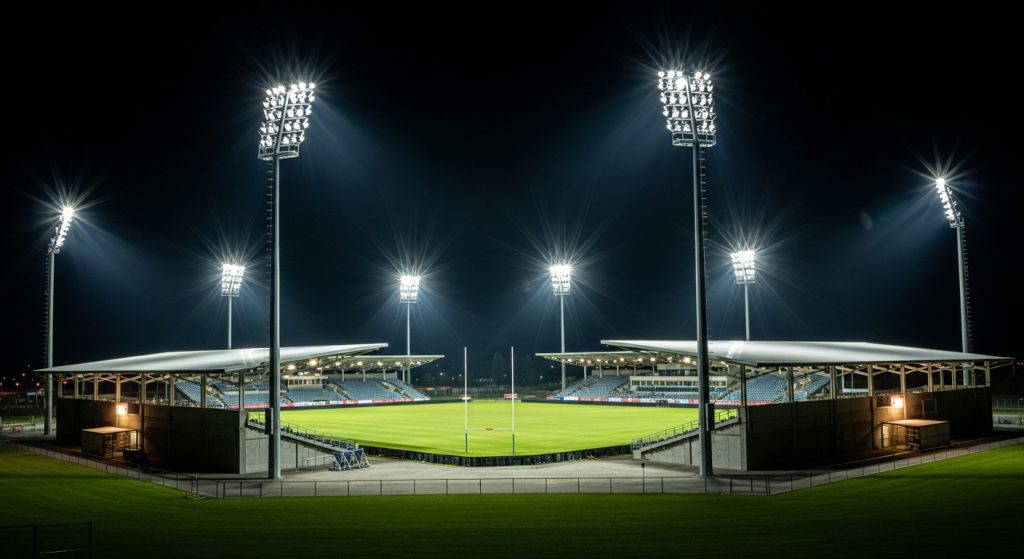
Flood lights also require careful height planning to maximize beam performance. When mounted on poles for large-area coverage, the angle of the fixture must be adjusted to reach the intended target without wasting light on the sky. A higher mounting position generally allows for a wider coverage area but requires a significant increase in lumen output to maintain the same brightness on the ground. By coordinating the height of your poles or ceiling with the fixture’s optics, you can achieve a balanced environment where light is delivered precisely where it is needed most.
How beam angle and coverage differ for sports fields vs open areas
The beam angle is the tool used to “shape” the light across the landscape. For general open areas, a wide beam angle (60° to 120°) is often preferred to achieve maximum coverage uniformity with fewer fixtures. This is ideal for parking lots or construction sites where the goal is a broad wash of light. However, sports lighting demands much more precision. To achieve high lux levels on a distant field from a tall stadium pole, narrow beam angles (15° to 30°) are often used to project the light over a long distance without it dissipating.
Uniformity is the key to safety in competitive zones. If the beam angles are poorly planned, the field will suffer from “zebra stripes”—alternating bands of bright and dark light—that make it difficult for players to track a ball or see opponents clearly. In professional sports lighting, multiple fixtures with different beam angles are often layered to create a seamless, shadow-free environment. By matching the beam’s spread to the distance and the area’s size, you can ensure the light is consistent and reliable across the entire playing surface.
When modular flood lights are preferable over COB flood lights
The choice between a modular lighting design and a COB (Chip on Board) system depends on your needs for scalability and maintenance. Modular flood lights consist of multiple independent LED engines on a single frame. This flood solution choice is often preferable for very large areas because it allows for customized beam angles within a single fixture—one module can point far while another lights the foreground. If one module fails, the rest of the fixture remains active, making them a “fail-safe” choice for critical security or sports zones.
COB flood lights utilize a single, large LED chip to produce a powerful, concentrated light source. They are often more compact and cost-effective for medium-scale wide-area lighting where a simple, high-output beam is sufficient. While they offer excellent COB vs SMD efficiency and a high-quality “point source” look, they lack the flexibility of modular systems. For industrial projects where long-term maintenance and specialized light shaping are required, modular designs provide the modularity needed to adapt to complex site geometries and performance requirements.
How projector style and traditional flood lights compare in performance
Projector lighting represents a high-precision alternative to traditional flood designs. A traditional flood light is designed for broad “spill,” throwing light in a wide arc that is excellent for general security. Projector-style lights, however, use advanced optics to create a highly targeted illumination. This allows you to “cut” the light precisely at the edge of a property or a sports field, minimizing light pollution and ensuring that no energy is wasted on areas that don’t require lighting.
This light control is especially valuable in urban environments or sports stadiums located near residential areas. Traditional flood lights often suffer from “light trespass,” which can annoy neighbors and violate local ordinances. Projector lights utilize specific reflectors and lenses to keep the light focused, offering much higher flood coverage efficiency. By choosing a projector style for applications that require “pinpoint” accuracy, you can achieve professional results that prioritize both the performance on the field and the environmental impact on the surrounding community.
Why lumen output matters and how to size lights correctly
The flood light lumens count is the raw measurement of the fixture’s power, but sizing a light correctly requires looking at the resulting “lux”—the light that actually reaches the surface. Matching the lighting power to the space requirements is vital; an underpowered high bay in a tall warehouse will leave the floor dim and dangerous, while an overpowered flood light in a small yard will cause blinding glare. Proper space brightness is achieved by calculating the required lux based on the activity type (e.g., 200 lux for a warehouse vs. 500+ lux for a tennis court).
Efficiency is the other side of the lumen equation. High-performance LEDs offer more “lumens per watt,” allowing you to achieve the necessary flood light performance with lower energy consumption. When sizing your lights, you must consider the “lumen depreciation” over time; LEDs naturally lose a small percentage of brightness as they age. By planning for slightly higher initial output, you ensure the space remains safe and productive for the entire lifespan of the system. Accurate sizing ensures you don’t overpay for hardware or utility costs while maintaining a safe, high-visibility environment.
How glare control strategies improve sports and large space lighting
In large-scale installations, glare mitigation is a critical factor for visual comfort. Glare occurs when a high-intensity light source is directly visible against a dark background, which is a constant risk with high-mounted sports and industrial fixtures. Effective strategies include using internal louvers, external shields, or “cutoff” designs that prevent light from being emitted above a certain angle. This ensures that players can look up at a ball and workers can look at high shelves without being temporarily blinded.
Angling the fixtures correctly is another key field lighting strategy. By mounting lights at a steep downward angle and using precise optics, you can keep the “hot spot” of the LED away from the direct line of sight. This is essential for spectator comfort in stadiums and for driver safety in large logistics yards. By prioritizing visual comfort during the design phase, you turn a powerful lighting system into a helpful tool that supports human performance rather than a source of distraction and discomfort.
Common mistakes that reduce lighting effectiveness in large spaces
One of the most frequent lighting errors is over-lighting an area with beams that are too narrow. This creates high-contrast “pools” of light surrounded by pitch-black coverage gaps, which is disorienting for the eye and creates security risks. Another common blunder is an output mismatch, where undersized fixtures are mounted at heights they weren’t designed for, resulting in a dim and hazy environment that fails to meet safety standards.
Ignoring uniformity is perhaps the most significant mistake in large-scale projects. If the “max-to-min” ratio of light intensity is too high, the human eye struggles to adjust, leading to fatigue and reduced reaction times. This is especially dangerous in sports and industrial environments. To avoid these blunders, you should always conduct a thorough photometric study or “light map” during the planning phase. By visualizing exactly how the light will fall on the ground, you can ensure a professional, consistent, and safe result for the entire site.
Practical steps to select the right high bay, flood, or sports light
Before finalizing your selection planning, a thorough site survey is necessary to ensure the hardware matches the performance outcomes you need. This lighting checklist acts as a final guide to ensure your large space is bright, safe, and efficient. By verifying these factors now, you can move forward with absolute confidence.
- Space Audit: Identify the primary activity (e.g., warehouse, football field, or parking lot).
- Height Measurement: Confirm the mounting height or ceiling clearance.
- Lux Requirements: Determine the necessary brightness level for the task.
- Beam Angle Mapping: Choose angles (15°, 60°, 120°) that ensure coverage uniformity.
- Technology Choice: Decide between modular lighting or COB designs for your specific needs.
- Glare Review: Ensure the fixtures include shielding or cutoff features for visual comfort.
- Environmental Check: Confirm the IP rating (e.g., IP65/IP66) for outdoor durability.
What tower and high bay lights are best for warehouses and industrial heights
Tower high bay light for warehouse fixtures are specifically engineered for high-altitude warehouse lighting. These units provide the vertical punch needed to reach the floor from a high bay height, ensuring that inventory racks and shipping lanes are clearly visible. They are the essential tool for maintaining safety and productivity in large-scale logistics centers.
When to choose a modular LED flood light for large outdoor areas
An LED modular flood light is the premier choice for large area illumination. The modular flood light design allows you to adjust individual LED modules to cover complex site geometries, making them ideal for high-mast lighting in ports, rail yards, and expansive industrial perimeters where precision and scalability are required.
How COB flood lights deliver high output for sports and large zones
An LED COB flood light utilizes COB lighting technology to provide a powerful, high-density beam from a single chip. This high output design is perfect for medium-sized sports zones and parking areas where a concentrated, reliable source of light is needed to ensure broad visibility and safety across the entire site.
How sports lighting poles and stadium lights shape field lighting projects
Sports light pole stadiums are the backbone of any sports field lighting infrastructure. The height and placement of these stadium poles significantly dictate the final light uniformity on the field. Selecting the right pole height and fixture mounting ensures the beam angles can be optimized for maximum player safety and broadcast quality.
How to think about lumens when planning flood and high bay lighting
A Flood lighting lumens guide provides the technical framework for your output planning. This lumens guide helps you calculate exactly how much raw power you need based on the size and height of your space. Matching the lumens to the application is the only way to guarantee a safe, lux-compliant environment for your workers or athletes.
Why COB vs SMD flood lights matter when designing performance systems
Reviewing COB vs SMD flood lights is a critical technology choice for performance lighting. While COB offers a powerful point source, SMD (Surface Mounted Device) modules often provide better heat dissipation and a wider spread. Choosing the right COB vs SMD architecture ensures your system meets your specific needs for brightness, longevity, and beam control.
How ceiling height impacts good high bay lighting decisions
High bay lights ceiling height guidelines are essential for installation planning. The high bay height dictates whether you need a narrow optic to drive light down or a wide lens for broader coverage. Proper height coordination ensures the light reaches the ground with the necessary intensity to support industrial tasks and worker safety.
What beam angles work best for sports fields and wide coverage areas
A Sports field lighting beam angle guide is vital for coverage planning. In a competitive environment, selecting the right sports field beam angle ensures the light is concentrated on the playing surface while minimizing spill. Correct beam angles are the key to achieving the extreme uniformity required for high-speed sports and clear viewing.
How lighting design can reduce glare in sports and large outdoor zones
Reduce glare sports lighting techniques are the foundation of visual comfort. Through advanced glare reduction, you can shield the high-intensity light source from the direct line of sight of players and fans. This sports lighting strategy ensures the focus remains on the action rather than the distracting and potentially dangerous effects of unmanaged brightness.


- 10 Meters Lamp Post
- 10 Meters Pole
- 1000w Led Projector
- 100W LED Tunnel Light
- 12 Meters Lamp Post
- 12 Meters Pole
- 1200w Led Projector
- 15 Light Pole
- 1500w Led Projector
- 150W LED Tunnel Light
- 1800w Led Projector
- 2 In 1 Solar Flood Light
- 200w Led Tunnel Light
- 50w Led Tunnel Light
- 6 Meters Lamp Post
- 6 Meters Pole
- 8 Meters Lamp Post
- 8 Meters Pole
- 800w Led Projector
- 80w Led Tunnel Light
- Colourful Decorative Light
- Conical post
- Courtyard Lamp
- courtyard light
- courtyard lighting fixture
- Decorative Landscape Light
- Decorative road Light
- Flood Light For Courtyard
- Flood Light for Garden
- Flood Light For Outdoor
- Foot Led High Bay Lights
- high bay led lights 100w
- industrial lampshade
- industrial LED shed lights
- industrial magnifying glass with light
- Integrated Solar Flood Light
- led courtyard lamp
- led courtyard light
- led high bay light 100w
- LED Projector For Stadium
- Led UFO High Bay 150W 5000k
- Lighting Plants Mining Price
- Maintenance Free LED Street Light
- Pic Controlling Tunnel Light
- PLC controlling tunnel light
- Post Top Garden Light
- RGB Landscape Light
- Rgbw Decorative Light
- Smart Tunnel Light
- solar courtyard lamp
- solar courtyard light
- Solar LED Road Light
- Solar Street Light For 10 Meter Pole
- Solar Street Light For 12 Meter Pole
- Solar Street Light For 6 Meter Pole
- Solar Street Light For 8 Meter Pole
- Split Type Solar Flood Light
- Sporting Projector
- Stadium Led Projector
- Street Lighting Post
