
 Request A Quote


Foldable Light Pole Benefits for Shipping and Maintenance
 FACEBOOK
 TWITTER
 LINKEDIN
In the world of infrastructure, the biggest costs often come after the initial purchase, particularly in transport and long-term upkeep. Foldable light poles are a design solution created specifically to tackle these hurdles by integrating a pivot point that allows the structure to collapse.
This shift away from rigid, one-piece designs transforms the logistics efficiency of a project, allowing poles that would normally require specialized, oversized trucking to be moved in standard containers. By addressing the physical footprint of the hardware, you change how these systems are managed from the factory floor to the final installation site.
Beyond the initial move, the real value of a foldable design lies in maintenance access and installation safety. Traditional poles require expensive bucket trucks and high-altitude work for even the simplest bulb change or sensor repair.
A foldable pole allows technicians to bring the light fixture down to their level, creating significant operational savings and reducing the risk of falls. Planners are increasingly turning to these designs because they offer a path to long-term reliability without the constant overhead of heavy machinery.
By choosing a system that prioritizes accessibility, you ensure that the lighting remains functional and safe for the community while keeping maintenance budgets under control.
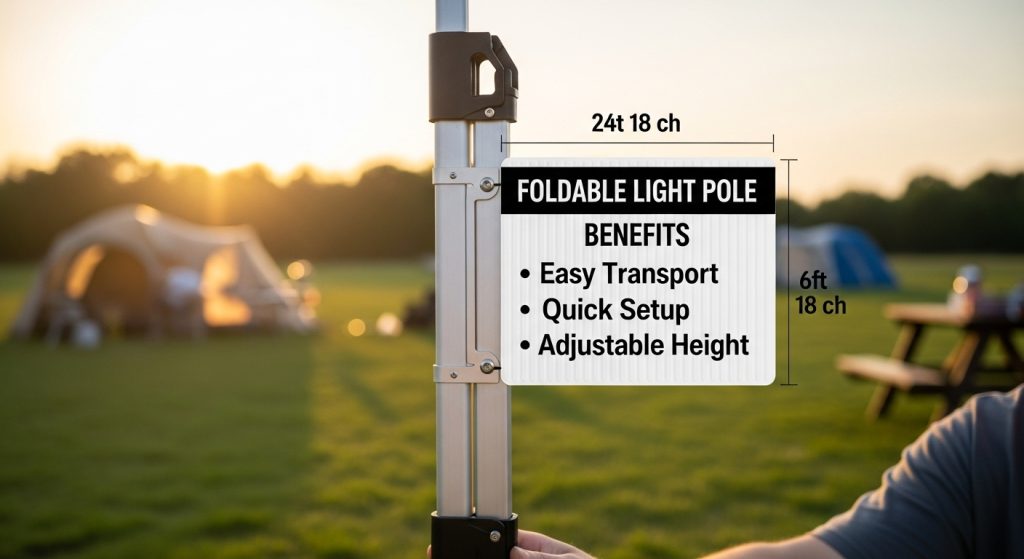
What makes a light pole foldable and how does the mechanism work
A foldable light pole is defined by a central or base-mounted folding mechanism that allows the upper section of the pole to tilt toward the ground. This system typically utilizes a heavy-duty hinge system and a secure locking pin or winch to manage the movement. When the pole is in its upright position, the locking mechanism ensures it maintains its structural integrity, behaving much like a traditional fixed pole even under environmental stress. The pivot point is engineered to handle the specific weight of the pole and the attached fixture, ensuring a smooth, controlled transition between the vertical and folded states.
The strength of these poles comes from the precision of the hinge and the quality of the locking hardware. High-tensile steel is often used at the pivot point to prevent warping over time. When you engage the mechanism, the pole safely pivots, bringing the fixture within reach of a technician standing on the ground. This eliminates the need for ladders or lifts, making the “folding” action the core functional benefit of the entire structure. A well-designed foldable pole ensures that while the structure is flexible for servicing, it remains a rigid and dependable part of the streetscape during normal operation.
How does a foldable design simplify transportation and shipping
The most immediate impact of choosing a foldable design is the dramatic increase in shipping efficiency. Standard street light poles are often 20 to 30 feet long, which makes them difficult and expensive to transport, especially for international projects. Because these poles can be folded in half, they fit into standard shipping containers or onto smaller flatbed trucks. This transport logistics advantage reduces the need for specialized “long load” permits and oversized vehicle escorts, which can significantly drive up the total cost of a project before the poles even arrive at the site.
Managing handling safety at ports and warehouses also becomes much easier with a compact footprint. Shorter, folded units are less prone to being bent or damaged during crane maneuvers and are much simpler to stack. For planners, this means you can order more units per shipment, maximizing your budget and ensuring that your timeline isn’t delayed by the complexities of moving oversized cargo. By reducing the physical length of the hardware during the journey, you simplify every step of the move, from the manufacturer’s gate to the final roadside destination.
Why foldable light poles reduce installation complexity on site
When the poles arrive at the construction site, the foldable design enables a more efficient installation workflow. Unlike traditional poles that must be lifted into a vertical position by a crane while a crew works at the base, foldable poles allow for ground-level assembly. You can attach the arms, brackets, and fixtures while the pole is still folded or lying flat. This makes the electrical wiring process much faster and safer, as technicians don’t have to balance on specialized equipment to make final connections.
The result is a significant equipment reduction on-site. In many cases, you can install the base section and then simply winch the top section into place, rather than hiring a heavy-duty crane for the entire day. This speed allows for faster installation timelines, which is particularly beneficial when working on busy roads where traffic closures must be kept to a minimum. By moving the majority of the work to the ground, you create a more controlled environment that lowers the chance of errors and speeds up the completion of the entire lighting project.
How foldable poles improve maintenance access and worker safety
The primary operational benefit of a foldable pole is the superior maintenance access it provides. When a fixture fails or a sensor needs a software update, there is no need to call for a bucket truck or block off entire lanes of traffic for a lift. A single technician can safely lower the pole to ground level, perform the necessary repairs, and raise it back up in a fraction of the time. This service efficiency means that “down-time” for your lighting system is minimized, keeping the streets well-lit and secure.
This design also represents a major leap forward in worker safety. Working at heights is one of the most dangerous aspects of street lighting maintenance. By bringing the work to the ground, you virtually eliminate the risk of falls from height. Technicians can work with both feet on the pavement, using standard tools in a stable environment. This not only protects the staff but also reduces the insurance and liability costs for the municipality or contractor. In the long run, the ability to service hardware without specialized high-access machinery translates into massive savings and a much safer workplace.
How pole height and structure influence foldable pole performance
While the benefits are clear, pole height plays a major role in the design and feasibility of foldable systems. Most foldable poles are found in the 10 to 30-foot range; as the height increases, the structural balance becomes more complex to manage. The weight of a very tall pole creates immense leverage at the hinge point during the folding process. For this reason, planners must carefully match the pole’s height to its specific design limits to ensure that it doesn’t become unwieldy or dangerous to lower.
The internal structure of the pole must also be considered. Because the wiring must pass through or around the hinge, the internal wire-way needs to be flexible enough to survive repeated folding cycles without pinching the cables. For taller applications, such as in sports fields or parking lots, the mechanism is often beefed up with hydraulic assists or manual winches to maintain control. Understanding these limits helps you choose the right foldable solution for your specific site, ensuring that the pole remains stable in the wind while remaining easy to operate when it’s time for service.
How wind load considerations affect foldable light pole design
Every foldable pole must be engineered to handle wind load with the same precision as a fixed pole. The presence of a hinge and a locking system introduces potential points of movement that must be neutralized. Engineers use load resistance calculations to ensure that the locking pin and hinge can withstand the “chatter” and vibration caused by high winds. A failure to account for these forces could lead to the pole sagging or the locking mechanism failing during a storm, which is a major structural safety risk.
The hinge area often requires reinforced plates and high-grade fasteners to distribute the wind force evenly across the pole’s body. Planners must review the wind zone ratings for their specific location and ensure the foldable pole is rated to handle those peak gusts while carrying the intended fixture and arm. By prioritizing structural safety in the design phase, you ensure that the convenience of the folding mechanism does not come at the expense of the pole’s ability to stand firm in the face of the elements.
What mistakes reduce the benefits of foldable light pole systems
One of the most common design mistakes is choosing a hinge specification that is not rated for the weight of the actual luminaires being used. This can make the pole difficult or even impossible to lower safely. Another frequent error is ignoring the long-term effects of environmental exposure on the hinge itself. If the pivot point isn’t properly galvanized or lubricated, it can rust shut, turning your “foldable” pole into a fixed one and creating a major performance risk.
Installation errors can also compromise the system. If the foundation is not perfectly level, the pole may tilt unevenly when being lowered, causing it to bind or swing dangerously to one side. Planners must also ensure that the area around the base is clear of obstacles like trees or fences that would prevent the pole from folding all the way down. Avoiding these blunders requires a combination of clear technical specifications and a thorough site survey to ensure that the folding feature can actually be used as intended for the life of the project.
What should buyers review before selecting foldable light poles
Before finalizing a purchase, a thorough design validation is necessary to ensure that foldable poles are the right fit for your operational planning. You must weigh the higher initial cost of the folding mechanism against the expected savings in shipping and maintenance over the next 20 years. This selection checklist helps you determine if the long-term reliability justifies the design:
- Confirm the shipping dimensions fit standard container sizes for logistics efficiency.
- Verify the weight of the luminaires is within the hinge’s safe operating load.
- Check the wind load rating for the upright position to ensure structural stability.
- Ensure there is a 360-degree or specific-path “clear zone” at the base for lowering the pole.
- Review the material finish to ensure the hinge and locking parts won’t seize due to rust.
- Validate that the winch or lowering tool is easy for a single technician to operate.
- Confirm the internal wiring plan includes “slack” or protection at the pivot point.
What specifications should street light poles and brackets meet when using foldable design
When implementing foldable systems, adhering to pole standards is vital for bracket compatibility. The hardware that holds your light must be securely fastened so that it doesn’t shift during the tilting process. You should ensure that the arm and bracket can handle the temporary change in orientation without putting undue stress on the fixture’s housing. For more on general hardware requirements, see our guide on Street light poles brackets.
How do lighting pole arms and brackets interact with foldable poles
The Lighting pole arm bracket serves as the heavy end of the lever when a pole is folded. Proper load distribution is essential to prevent the pole from “dropping” too quickly as it reaches the ground. You must choose arms that are structurally compatible with the pivot mechanism, ensuring that the entire assembly stays balanced during maintenance. High-quality brackets help maintain the light’s aiming angle even after the pole has been lowered and raised multiple times.
How should pole height be planned when choosing foldable light poles
Effective Street light pole height guide strategies for foldable poles involve matching the pivot height to the available workspace. During pole height planning, you must ensure that when the pole is folded, the fixture reaches a comfortable height for a technician. If the pole is too tall or the pivot is too high, you might still need a ladder, which defeats the purpose of the coverage design. A well-planned height ensures that “ground-level” really means ground-level.
How does tapered pole design compare with foldable pole structures
A structural comparison between a Tapered light pole explained and a foldable one reveals that tapered poles are often more aerodynamic. However, foldable poles offer a unique operational advantage that fixed tapered poles cannot match. While a tapered design is excellent for reducing wind load on high-speed roads, a foldable pole is often the better choice for remote areas or locations where maintenance vehicles cannot easily travel, such as narrow park paths or steep hillsides.
Why is wind load calculation critical for foldable light pole safety
A detailed wind load analysis is the only way to ensure structural stability at the hinge point. Because the hinge is a break in the continuous metal of the pole, it must be the strongest part of the assembly. The Light pole wind load calculation must prove that the locking mechanism can survive the torque and shear forces of a major storm. Without this verification, the convenience of the folding feature could become a liability during extreme weather events.
Final Thought
Foldable light poles represent a smart evolution in street lighting, turning a static piece of infrastructure into a dynamic tool that is easier to ship, install, and maintain. By moving the most dangerous and expensive parts of the job to the ground, these poles provide a safer environment for workers and significant cost savings for municipalities. When you prioritize high-quality mechanisms and correct site planning, you create a lighting system that is as practical as it is effective.


- 10 Meters Lamp Post
- 10 Meters Pole
- 1000w Led Projector
- 100W LED Tunnel Light
- 12 Meters Lamp Post
- 12 Meters Pole
- 1200w Led Projector
- 15 Light Pole
- 1500w Led Projector
- 150W LED Tunnel Light
- 1800w Led Projector
- 2 In 1 Solar Flood Light
- 200w Led Tunnel Light
- 50w Led Tunnel Light
- 6 Meters Lamp Post
- 6 Meters Pole
- 8 Meters Lamp Post
- 8 Meters Pole
- 800w Led Projector
- 80w Led Tunnel Light
- Colourful Decorative Light
- Conical post
- Courtyard Lamp
- courtyard light
- courtyard lighting fixture
- Decorative Landscape Light
- Decorative road Light
- Flood Light For Courtyard
- Flood Light for Garden
- Flood Light For Outdoor
- Foot Led High Bay Lights
- high bay led lights 100w
- industrial lampshade
- industrial LED shed lights
- industrial magnifying glass with light
- Integrated Solar Flood Light
- led courtyard lamp
- led courtyard light
- led high bay light 100w
- LED Projector For Stadium
- Led UFO High Bay 150W 5000k
- Lighting Plants Mining Price
- Maintenance Free LED Street Light
- Pic Controlling Tunnel Light
- PLC controlling tunnel light
- Post Top Garden Light
- RGB Landscape Light
- Rgbw Decorative Light
- Smart Tunnel Light
- solar courtyard lamp
- solar courtyard light
- Solar LED Road Light
- Solar Street Light For 10 Meter Pole
- Solar Street Light For 12 Meter Pole
- Solar Street Light For 6 Meter Pole
- Solar Street Light For 8 Meter Pole
- Split Type Solar Flood Light
- Sporting Projector
- Stadium Led Projector
- Street Lighting Post
