
 Request A Quote


What Height Should Garden Lamp Posts Be 3M vs 4M vs 5M
 FACEBOOK
 TWITTER
 LINKEDIN
Selecting the correct mounting height for your garden lamp posts is one of the most significant factors in determining the effectiveness of your outdoor lighting. It is not just about aesthetics; the height of the pole dictates the total light coverage on the ground and the mood of the environment. If you choose a pole that is too tall for a small area, you risk creating an industrial feel that ruins the spatial scale of your garden. Conversely, a pole that is too short for a large lawn will leave dangerous dark gaps and fail to provide the security you need.
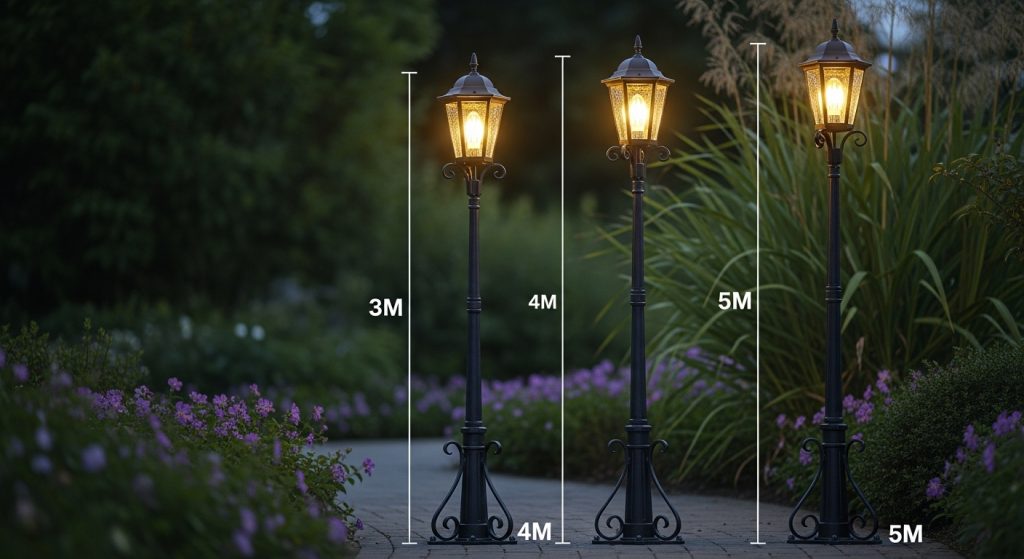
Planners must approach height selection by matching the pole to the specific usage of the area. Whether you are lighting a narrow woodland path, a medium-sized residential lawn, or a large public plaza, the height determines the balance between intensity and reach. Proper selection ensures high visual comfort, preventing harsh glare while maintaining enough brightness for safe navigation. By understanding how 3m, 4m, and 5m heights change the physics of light distribution, you can move away from generic guesses and toward a tailored plan that enhances both the beauty and the safety of your landscape.
What effect does lamp post height have on light spread and comfort
The height of a lamp post acts as a lever for light spread; as the lamp moves further from the ground, the cone of light expands to cover a wider area. While this is great for visibility, it also changes the intensity of the light hitting the surface. Taller posts generally provide more uniform illumination, which reduces the “zebra stripe” effect of alternating bright and dark spots. However, this wider spread often requires more powerful bulbs to ensure the light doesn’t feel too dim by the time it reaches your feet.
Glare control is another critical aspect of height. When a light source is positioned at a lower level, it is more likely to be in a person’s direct line of sight, which can be blinding and uncomfortable. Raising the fixture moves the “hot spot” of the bulb above the natural eye level, significantly improving comfort for pedestrians. Finding the right height allows you to maximize the glow across the garden while keeping the source of the light subtle and non-intrusive.
When is a 3M lamp post height most suitable
A 3-meter (roughly 10-foot) lamp post is the gold standard for human-scale lighting. This height is specifically designed for areas where people are moving at a walking pace, such as residential garden paths, side walkways, or intimate courtyard settings. At 3 meters, the light feels personal and cozy, providing excellent pathway visibility without overpowering the surrounding landscape or spilling light into nearby windows. It is the perfect choice for homes where the goal is to create a welcoming, secure atmosphere that respects the privacy of the neighbors.
Because of the lower mounting, 3M posts are very effective at highlighting the textures of nearby plants and stonework. They work best in environments where you want the lighting to feel like an extension of the home’s interior. These poles are also easier to maintain and install, as they don’t require specialized high-access equipment. If your project involves a typical backyard or a winding neighborhood trail, the 3M option provides the right balance of safety and charm without the “industrial” look of taller commercial poles.
Why 4M lamp posts are often chosen for standard garden and landscape lighting
The 4-meter height is perhaps the most versatile option in the industry, offering a perfect coverage balance for medium-to-large residential gardens and shared community spaces. At roughly 13 feet, these poles provide a significantly wider medium reach than the 3M version, allowing you to light a broad lawn or a standard driveway with fewer fixtures. It is the go-to choice for housing societies and public parks where the need for safety is high, but the environment still needs to feel accessible and “human” in scale.
Choosing 4M posts often improves visual comfort because the light source is high enough to be completely out of the direct line of sight, even for taller individuals. This height allows the light to dissipate slightly before it hits the ground, creating a soft, professional wash of light that looks intentional and well-planned. For planners, the 4M pole is the “safe bet” that works in almost any standard landscape setting, providing enough lift for great visibility while maintaining a profile that doesn’t dominate the skyline.
In what scenarios 5M lamp posts make sense
When you are dealing with wide area lighting—such as in large public plazas, open play spaces, or expansive parking lots—the 5-meter (16-foot) pole becomes the most efficient tool. The higher reach of a 5M post allows the light to travel a vast distance, covering a much larger footprint than shorter alternatives. This is an essential part of open space design, where the goal is to provide maximum security and visibility across a broad, unobstructed surface.
Using 5M poles can significantly reduce the total number of fixtures needed for a project, which lowers the overall energy consumption and installation cost. However, because the light source is so high, you must use high-lumen LED heads to ensure the ground remains bright enough for safety. These taller poles are most effective when placed in the center of large open areas where they can cast a 360-degree glow. If your project involves a commercial courtyard or a major park entrance, the 5M option provides the structural power and reach required to keep the space feeling open and secure.
How spacing interacts with post height when planning layout
Your spacing strategy is entirely dependent on the height of your chosen poles. Taller posts have a larger “footprint” of light, meaning you can space them further apart without creating dark gaps. For example, you might place 3M poles every 15 feet to maintain a continuous path, but 5M poles could be spaced 30 feet apart while providing the same level of safety. This interaction is the foundation of layout planning, as it directly dictates your budget for hardware and cabling.
During the coverage mapping phase, you must ensure that the edges of the light pools overlap slightly. If you use tall poles but space them too far apart, you end up with “islands” of light surrounded by pitch-black zones, which is disorienting and dangerous. Conversely, putting tall poles too close together creates over-illumination and wastes energy. By coordinating the height with the distance between poles, you create a seamless, professional lighting environment that guides the eye naturally through the space.
How light intensity (lumens) affects height choices
Height and light output must be balanced to ensure the project meets its goals. In lumen planning, you have to account for the fact that light loses intensity as it travels through the air. A 5M pole requires a much higher lumen count than a 3M pole to achieve the same brightness on the pavement. If you put a low-lumen “decorative” bulb at 5 meters, the ground will remain dark; if you put a high-power industrial LED at 3 meters, the glare will be unbearable for pedestrians.
Maintaining a height-intensity balance is the key to high-quality results. For shorter 3M posts, lower lumen levels are preferred to keep the light soft and intimate. As you move to 4M and 5M, you must increase the power of the lamp head to compensate for the distance. This ensures that while the light spreads further, it still provides the necessary foot-candles on the ground for safety. Always verify that your chosen fixture’s optics are designed for the specific height you plan to use to ensure the light is pushed downward and outward effectively.
What common mistakes happen when choosing lamp post height
One of the most frequent planning mistakes is the “copy-paste” error, where a designer chooses a 5M pole for a small, enclosed garden simply because it worked for a large park. This leads to a massive design mismatch where the garden feels like a high-security prison rather than a private retreat. Another common blunder is choosing an unsuitable choice in height without considering nearby obstacles; a 3M pole might be perfect for a path, but if it is placed under a low-hanging tree branch, the light will be blocked entirely.
Ignoring the “glare zone” is also a common issue. If you use a very bright lamp on a short 3M pole without a diffused lens, you will blind everyone who walks by. Finally, planners often forget to check the maintenance requirements; a 5M pole requires a much taller ladder or a lift to change a bulb than a 3M pole. Avoiding these blunders requires a walk-through of the site at night to visualize where the light needs to go and a commitment to matching the hardware to the actual dimensions of the environment.
What practical checks should be done before finalizing post height
Before you finalize your order, a thorough planning review is necessary to ensure the heights are correct for your specific site. This height validation ensures that you don’t run into expensive problems during the installation phase. By checking the physical constraints of the garden, you can select your poles with confidence.
Use this design checklist to guide your final decision:
- Scale Check: Does the pole height feel in proportion with the surrounding buildings and trees?
- Coverage Goal: Does the height provide the required spread for the width of the path or lawn?
- Glare Audit: Is the light source high enough to stay out of the direct line of sight for users?
- Obstacle Review: Are there any tree canopies or roof overhangs that will block the light?
- Maintenance Access: Do you have the equipment needed to reach the fixture for future repairs?
- Spacing Match: Have you calculated the distance between poles to ensure there are no dark gaps?
- Lumens Check: Is the light intensity strong enough to reach the ground from that height?
What landscape lighting roles do garden post top lighting systems fill
Garden post top landscape lighting fixtures are designed to provide the primary area-wide illumination for a yard. These post top fixtures are the most versatile part of landscape lighting, as they can be used for both functional safety along paths and decorative highlighting of large garden features. They serve as the anchor for the entire outdoor lighting plan, providing a steady, reliable glow from an elevated position.
What advantages do solar landscape lamp posts offer for flexible placement
Choosing a Solar landscape lamp post provides incredible installation flexibility. Because these units don’t require underground wiring, you have much more freedom in your solar placement. You can place a 3M or 4M post in a remote corner of the garden or a new park trail without the cost and mess of digging trenches. This makes it easy to adjust your lighting heights and positions even after the garden is finished.
How should the 3m and 4m height options fit into garden light post planning
Incorporating Aluminum 3m 4m garden light poles into your height planning ensures a durable and attractive result. These heights are the most popular for garden lighting because they fit the scale of most residential and community spaces. Aluminum construction provides the necessary weather resistance to ensure that the poles remain upright and beautiful for decades, regardless of the climate.
Why a lighting layout plan matters when choosing post height
A rigorous Landscape lighting layout plan is essential for visualizing the height interaction between your poles. By mapping out the space before you buy, you can see if you need the broad reach of a 5M pole or the intimate spread of a 3M version. Good layout planning ensures that your garden is lit efficiently, with no wasted energy and no dangerous dark spots.
How many lumens are suitable for different garden post heights
The Garden pathway lighting lumens guide helps you achieve the perfect height balance. For a 3M pole, you might only need 1,000 lumens, but a 5M pole might require 3,000 or more to maintain the same visibility. Proper lumen planning ensures that your garden is bright enough for safety while remaining comfortable and inviting for evening relaxation.



- 10 Meters Lamp Post
- 10 Meters Pole
- 1000w Led Projector
- 100W LED Tunnel Light
- 12 Meters Lamp Post
- 12 Meters Pole
- 1200w Led Projector
- 15 Light Pole
- 1500w Led Projector
- 150W LED Tunnel Light
- 1800w Led Projector
- 2 In 1 Solar Flood Light
- 200w Led Tunnel Light
- 50w Led Tunnel Light
- 6 Meters Lamp Post
- 6 Meters Pole
- 8 Meters Lamp Post
- 8 Meters Pole
- 800w Led Projector
- 80w Led Tunnel Light
- Colourful Decorative Light
- Conical post
- Courtyard Lamp
- courtyard light
- courtyard lighting fixture
- Decorative Landscape Light
- Decorative road Light
- Flood Light For Courtyard
- Flood Light for Garden
- Flood Light For Outdoor
- Foot Led High Bay Lights
- high bay led lights 100w
- industrial lampshade
- industrial LED shed lights
- industrial magnifying glass with light
- Integrated Solar Flood Light
- led courtyard lamp
- led courtyard light
- led high bay light 100w
- LED Projector For Stadium
- Led UFO High Bay 150W 5000k
- Lighting Plants Mining Price
- Maintenance Free LED Street Light
- Pic Controlling Tunnel Light
- PLC controlling tunnel light
- Post Top Garden Light
- RGB Landscape Light
- Rgbw Decorative Light
- Smart Tunnel Light
- solar courtyard lamp
- solar courtyard light
- Solar LED Road Light
- Solar Street Light For 10 Meter Pole
- Solar Street Light For 12 Meter Pole
- Solar Street Light For 6 Meter Pole
- Solar Street Light For 8 Meter Pole
- Split Type Solar Flood Light
- Sporting Projector
- Stadium Led Projector
- Street Lighting Post
