
 Request A Quote


Grid connected solar hybrid street lighting system
 FACEBOOK
 TWITTER
 LINKEDIN
A grid connected solar hybrid street lighting system offers the most reliable way to light your large projects. This system uses solar power during the day and switches to grid power if the battery runs low. Buyers choose this setup to ensure lights stay on during long periods of rain or heavy clouds. You will find that these hybrid systems provide better energy reliability than standard solar lights.
They use high-power LED street lights that can handle heavy traffic areas with ease. Key features include custom energy storage and smart controllers that manage both power sources. When sizing these units, you must look at panel wattage and local sun hours.
While the capital investment per pole is higher, the lifecycle value is excellent for critical infrastructure. You can match the lamp wattage to your specific road width for better safety. Use a detailed checklist to verify your site before you start the buying process. This guide helps you decide if a hybrid setup fits your project suitability. Photovoltaic lighting with a grid backup is the best choice for total operational continuity.
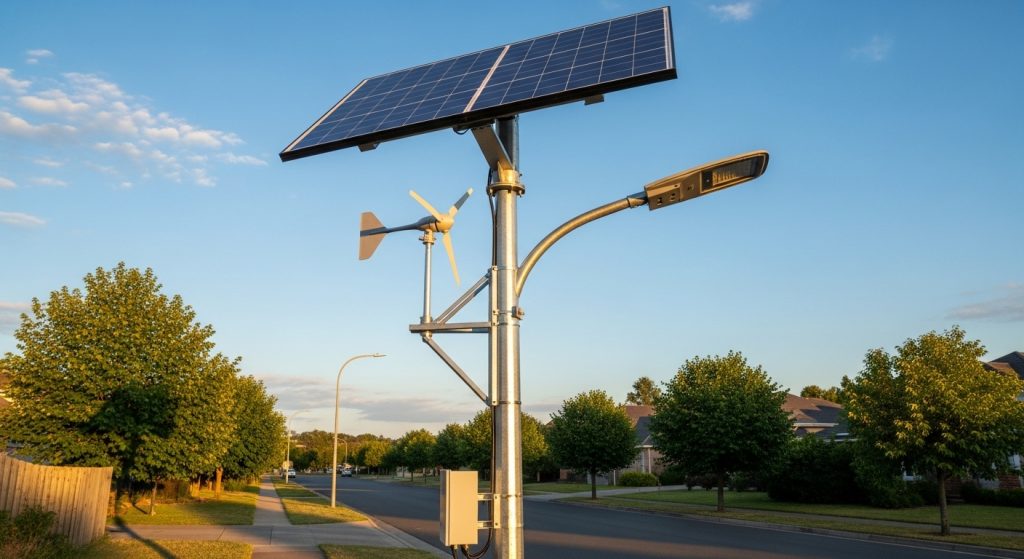
What is a grid connected solar hybrid street lighting system
A grid connected solar hybrid street lighting system is a dual-power solution for outdoor areas. It uses solar panels to catch sun energy and stores it in a battery. Unlike a standard solar light, it also has a wire that connects to the local power grid. If the battery runs out of energy, the grid backup turns on to keep the light shining. This hybrid system ensures that the light never fails, even during a week of storms. You get the best of both worlds: free solar power and steady grid power. This setup provides high energy reliability for places that must stay bright for safety. The system moves between sun and grid power without you needing to do anything. It is a smart way to use clean energy while having a safe backup plan.
Why buyers choose hybrid solar grid connected street lighting
You should consider this hybrid configuration if your project is in a place with many cloudy days. Buyers pick these systems because they offer a guarantee that the lights will work every single night. Solar plus grid setups are perfect for main highways or busy city intersections. In these spots, a dark lamp could cause a serious accident. This system also helps you save on power bills most of the year. You only pay for electricity when the sun has not been out for a long time. It provides operational continuity that a battery-only system might struggle to give in winter. If you are building large infrastructure, these lights grow with your needs. They are a solid choice for any site where failing to light the road is not an option.
How hybrid systems compare to other solar street light types
When you look at system architecture, the hybrid model is more complex than other types. All-in-one lights are simpler but depend entirely on the sun. Split type systems have larger batteries but can still run out of power during a long storm. Hybrid systems offer the highest flexibility because they have two ways to get power. This performance comparison shows that hybrids win when you need 100% uptime.
- All-in-one units are cheaper but might go dark in bad weather.
- Split systems offer more power than all-in-one but still have limits.
- Hybrid systems use the grid to fill the gaps that solar power leaves.
- Grid backup makes hybrids the most dependable choice for public roads.
Key features and specifications that matter
You must check the power rating of the LED lamp to ensure it meets your brightness needs. Most hybrid systems use high-wattage lamps between 100W and 200W for big projects. The system configuration includes a solar panel, a battery, and a hybrid controller. This controller is the brain that decides when to use the grid. Energy storage is still important, but you might use a smaller battery than a full split system. This is because the grid is always there if the battery gets low. You should look for smart sensors that dim the light when the street is empty. These sensors help you use less power from both the sun and the grid. High-quality wires and weather-proof boxes are also vital for a long life.
How hybrid systems are sized for performance
Sizing a hybrid system starts with your energy demand for the night. You calculate how many watts your light uses and multiply it by the hours it stays on. You then look at the sun exposure at your site to pick the right panel wattage. In a hybrid setup, you can be more flexible with your sizing. You do not need a massive battery to cover ten days of rain because you have the grid. However, you still want a panel that can charge the battery on a normal day. This helps you use as much free solar power as possible. Finding the right balance between the panel, battery, and grid usage saves you money. You should work with a specialist to map out the power flow for your specific city.
Cost per pole considerations for hybrid systems
The capital investment for a hybrid pole is usually the highest among solar options. You have to pay for the solar parts plus the cost of digging trenches for wires. This connection complexity adds to the upfront price of each pole. However, the lifecycle cost is often lower than a pure grid light. You save a lot of money on your monthly energy bill over many years. Maintenance planning is similar to other solar lights, though you have to check the grid connection too. For a large deployment, you should budget for the extra work of wiring the poles together. The value comes from having a system that is both green and completely reliable. High-quality parts will reduce your repair costs over the next ten to fifteen years.
How to match wattage to road width and usage
Matching your lamp wattage to the road width ensures you meet illumination levels for safety. A road that is too dark is a risk, but a light that is too bright wastes power. You should follow road safety rules to pick the right light distribution for your project.
- Narrow local roads (6–8 meters) usually need a 50W to 80W lamp.
- Standard city streets (10–12 meters) work well with 100W to 120W lamps.
- Wide highways (15+ meters) often require 150W to 200W for full coverage.
- Higher poles help spread the light further across multiple lanes of traffic.
Buyer checklist before specifying hybrid street lights
Before you buy, you must do a site survey to see where the grid wires are. You also need to check the site conditions to ensure panels will get enough sun. Project feasibility depends on the cost of running wires versus the savings from solar power. Your operational planning should include a plan for long-term grid costs.
- Confirm that the local power grid is stable and close to your light poles.
- Check that trees or buildings will not block the sun from the panels.
- Ensure the controller can switch between power sources without flickering.
- Look for a warranty that covers both the solar parts and the hybrid components.
- Verify that the light levels meet the specific code for your road type.
Is a grid connected solar hybrid system right for your project
A hybrid system is the right fit if your project suitability requires zero downtime. If you are lighting a major highway or a city center, the operational needs demand a backup. This system is perfect for areas with unpredictable weather or very long winters. However, if your site is very remote, the cost of running grid wires might be too high. In that case, a full split solar system with a larger battery might be better. For most modern cities, the hybrid model is the top choice for critical lighting. It gives you the green benefits of solar with the peace of mind that comes from the grid. You should weigh the cost of wiring against the need for total reliability before making your final choice.
What are solar street lighting systems
A solar street lighting systems setup uses the sun to provide outdoor illumination. These solar lighting networks are popular because they reduce carbon footprints and save on energy costs. Each unit typically consists of a solar panel, a battery, and an LED light. They can work as stand-alone units or as part of a larger managed grid. These systems are an excellent way to bring light to areas where power is expensive or hard to reach.
All-in-one versus split solar lights
The all-in-one vs split solar lights choice is a major part of project planning. An all-in-one light is a single piece that is very easy to install. A split light has separate parts, which allows for a much larger panel and battery. The architectural difference means you can get more power from a split system. However, the installation tradeoffs for split lights include more labor and complex mounting. Hybrid systems often use a split design to handle the extra grid components.
What is the cost per pole for solar street lighting
The solar street light cost per pole depends on several cost drivers. These include the wattage of the LED, the battery type, and the pole material. Installation variables like soil conditions and local labor rates also play a role. While the price per pole is higher than a standard light, you save money over time. There are no monthly power bills for the solar part of the system. Hybrid systems will have a slightly higher cost due to the grid connection work.
How to choose solar street light wattage for road width
Knowing the right solar street light wattage road width is vital for roadway coverage. You must meet specific illumination standards to keep drivers and pedestrians safe. A narrow path might only need 30W, while a four-lane highway could need 150W or more. Choosing the right wattage prevents dark spots on the road. It also ensures you are not overspending on power and equipment that you do not really need.


- 10 Meters Lamp Post
- 10 Meters Pole
- 1000w Led Projector
- 100W LED Tunnel Light
- 12 Meters Lamp Post
- 12 Meters Pole
- 1200w Led Projector
- 15 Light Pole
- 1500w Led Projector
- 150W LED Tunnel Light
- 1800w Led Projector
- 2 In 1 Solar Flood Light
- 200w Led Tunnel Light
- 50w Led Tunnel Light
- 6 Meters Lamp Post
- 6 Meters Pole
- 8 Meters Lamp Post
- 8 Meters Pole
- 800w Led Projector
- 80w Led Tunnel Light
- Colourful Decorative Light
- Conical post
- Courtyard Lamp
- courtyard light
- courtyard lighting fixture
- Decorative Landscape Light
- Decorative road Light
- Flood Light For Courtyard
- Flood Light for Garden
- Flood Light For Outdoor
- Foot Led High Bay Lights
- high bay led lights 100w
- industrial lampshade
- industrial LED shed lights
- industrial magnifying glass with light
- Integrated Solar Flood Light
- led courtyard lamp
- led courtyard light
- led high bay light 100w
- LED Projector For Stadium
- Led UFO High Bay 150W 5000k
- Lighting Plants Mining Price
- Maintenance Free LED Street Light
- Pic Controlling Tunnel Light
- PLC controlling tunnel light
- Post Top Garden Light
- RGB Landscape Light
- Rgbw Decorative Light
- Smart Tunnel Light
- solar courtyard lamp
- solar courtyard light
- Solar LED Road Light
- Solar Street Light For 10 Meter Pole
- Solar Street Light For 12 Meter Pole
- Solar Street Light For 6 Meter Pole
- Solar Street Light For 8 Meter Pole
- Split Type Solar Flood Light
- Sporting Projector
- Stadium Led Projector
- Street Lighting Post
