
 Request A Quote


How warehouse ceiling height determines the best high bay lighting solutions
 FACEBOOK
 TWITTER
 LINKEDIN
Ceiling height is the most influential variable in warehouse lighting design, acting as the primary regulator of high bay illumination performance. In industrial environments, the distance between the fixture and the floor dictates how light behaves as it travels through space. Due to the inverse square law, light intensity decreases rapidly as the distance increases, meaning a fixture that works perfectly at 15 feet will be woefully inadequate at 35 feet. Choosing the right solution requires a strategic approach to ceiling height planning, where you must balance raw lumen output with precise beam control to ensure that light reaches the ground with the necessary intensity for safe and productive work.
A successful height-based strategy also addresses light distribution and uniformity. In a tall facility, the goal is to drive light vertically through the “air gap” without excessive spill onto the upper walls or racking tops. This requires matching the fixture’s optics to the physical dimensions of the space. Taller ceilings generally demand narrower beam angles and higher lumen counts to maintain a consistent “lux” level on the floor. By aligning your lighting specifications with the vertical reality of your warehouse, you can optimize energy use, reduce maintenance cycles, and create a high-visibility environment that supports complex logistics and manufacturing operations.
Why ceiling height changes how high bay lighting performs
In large industrial volumes, ceiling height fundamentally changes the “footprint” of each light source. As you mount a fixture higher, the light spread naturally expands, covering more area but at a significantly lower intensity. This relationship is critical because a facility with high ceilings risks becoming a dim, shadowy environment if the fixtures aren’t powerful enough to compensate for the distance. Conversely, if a high-output light is mounted too low, it creates an intense “hot spot” that causes glare and visual discomfort for workers.
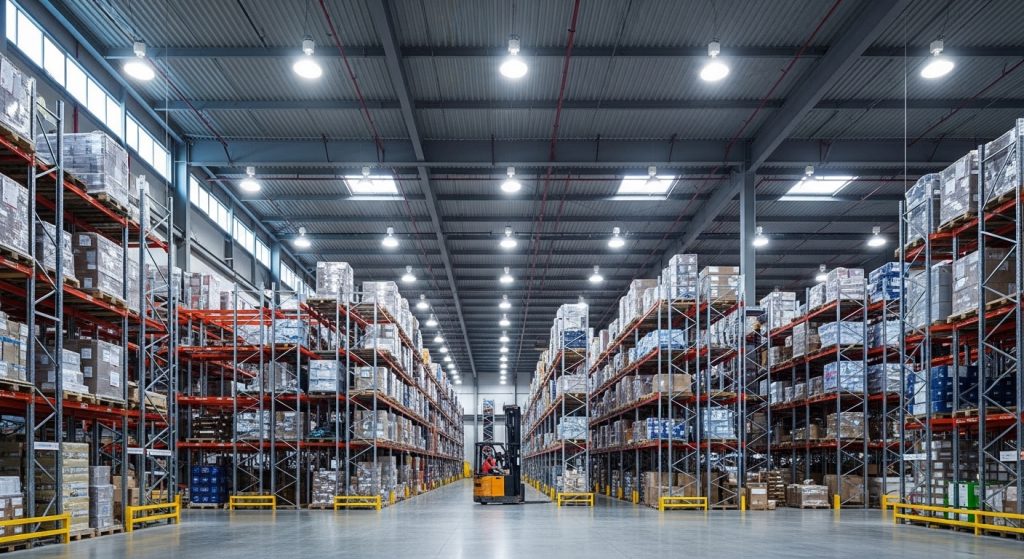
Achieving uniformity also becomes a greater challenge as height increases. In taller spaces, the overlapping beams from adjacent fixtures must be carefully calculated to avoid “valleys” of darkness between light poles or ceiling mounts. Proper height management ensures that the floor remains a stable, high-contrast surface, which is essential for forklift safety and inventory picking. By understanding that height is a dynamic factor in your layout, you can choose hardware that maintains its performance from the rafters to the loading dock.
What are typical warehouse height categories and lighting strategies?
Industrial facilities are generally categorized into three vertical zones that dictate your beam planning. Low-ceiling zones (10–15 ft) are often best served by “low bay” or wide-angle high bay fixtures that provide a broad wash of light to maximize coverage with fewer units. In these spaces, high lumen density is less important than a wide, comfortable spread. Mid-height ceilings (20–35 ft) are the standard for most modern logistics centers, requiring a balance of output scaling and medium-width beams (around 90°) to pierce through the distance while maintaining overlap.
Very high spaces, exceeding 35 feet, represent the most demanding warehouse lighting category. These environments require narrow beam angles (60° or less) to “columnarize” the light, driving it straight down to the working plane. Without this focused approach, much of the light is lost to the atmosphere or absorbed by the tops of inventory racks. By categorizing your facility into these specific height brackets, you can apply a logic-based lighting strategy that ensures maximum visibility regardless of how far the rafters are from the floor.
How lumen output must scale with mounting height
The relationship between light output and height is non-linear; as the ceiling gets taller, the required lumens guide targets must jump significantly to maintain the same brightness on the ground. For a 20-foot ceiling, a 15,000-lumen fixture might be sufficient, but at 40 feet, you may need 30,000 lumens or more per fixture. This scaling is necessary to overcome atmospheric scattering and the sheer distance the photons must travel to provide a safe, workable environment.
Failing to scale correctly leads to “shadow zones” and a significant drop in uniform illumination. In warehouses where high-speed machinery or vertical racking is present, these dark spots are major safety hazards. A professional layout uses photometric data to ensure that the lux levels at the floor remain consistent across the entire footprint. By matching your lumen “punch” to the vertical scale of your building, you ensure that every aisle and packing station is lit to a professional standard that supports 24/7 industrial operations.
How beam angle affects performance at different ceilings
Selecting the correct beam angle is the primary way to manage your coverage balance. In a low-ceiling warehouse, a wide 120-degree beam ensures that the light spreads quickly to cover a large horizontal area. This is ideal for open-floor assembly or low-stack storage. However, as the mounting height increases, these wide beams become inefficient, spreading the light so thin that the floor looks hazy and dim.
For tall facilities, a narrow 60-degree beam acts like a spotlight, concentrating the energy into a powerful downward column. This is the secret to field planning in high-cube warehouses, as it allows the light to penetrate deep into narrow aisles without being wasted on the sides of the racks. Choosing between concentrated and broad lighting is not a matter of preference but of geometry. By coordinating your beam angle with your mounting height, you ensure every watt of energy is converted into functional, floor-level visibility.
Where tower high bay solutions fit into height-based lighting
For the most extreme tall lighting challenges, standard UFO-style high bays may not provide enough structural or optical stability. This is where tower high bay solutions become essential. These fixtures are engineered with vertical heat sinks and specialized optics to manage the high-wattage heat and long-distance throw required for massive facilities. Their structural integration is designed to resist the vibrations and air currents common at the top of large industrial buildings, ensuring the light remains perfectly aimed.
Tower high bays are often the preferred choice when ceiling heights exceed 40 feet. They offer a more robust mounting strategy that keeps the fixture level and secure, which is critical for maintaining long-term uniformity. By utilizing a tower-style design, manufacturers can pack more LED power into a single unit while maintaining the thermal efficiency needed for 24/7 use. When standard approaches fall short, tower high bays provide the specialized performance needed to light the largest and tallest warehouses in the industry.
How sports lighting principles inform high bay height decisions
Industrial planners can learn a lot from sports lighting when it comes to managing high-altitude illumination. In stadium design, achieving uniform coverage from tall poles is the primary goal, and the same beam planning logic applies to warehouses. Both environments rely on layering different beam angles—using narrow beams to reach the center of the “field” (or floor) and wider beams to fill in the areas directly beneath the fixture.
Translating this sports logic to a warehouse means thinking about the floor as an athletic surface where shadows must be eliminated for safety. By viewing your high bay layout through the lens of a “lighting pole” strategy, you can better visualize how height and angle interact. This cross-disciplinary approach helps in creating a more immersive, high-contrast environment that improves worker reaction times and reduces the fatigue associated with poor-quality, flickering industrial light.
Common mistakes when matching high bay lights to warehouse height
One of the most frequent lighting errors is a coverage mismatch caused by using oversized output in low-ceiling areas. This leads to intense glare and “blinding” reflections off concrete floors, which can be just as dangerous as darkness. Another common blunder is using too narrow a beam for mid-height ceilings; this creates a “checkerboard” effect of bright spots and deep shadows, making it difficult for workers to navigate the space safely.
Planning pitfalls also include ignoring the specific workflow patterns. A light that looks perfect for an open floor may be completely blocked if it is mounted directly over the top of a newly installed racking system. To avoid these blunders, always conduct a thorough site survey that includes the final heights of all inventory and equipment. By visualizing the “light path” from the ceiling to the floor, you can identify and correct potential obstructions and beam errors before the first fixture is ever installed.
How do you choose high bay lights based on ceiling height?
Before you finalize your installation criteria, a thorough height planning review is necessary to ensure your project is a success. Use this selection checklist as a final safeguard to ensure your warehouse is bright, efficient, and safe. By verifying these factors now, you can avoid the high cost of field corrections later.
- Measure Zone Heights: Are there different ceiling levels (e.g., office vs. shipping)?
- Lumen Mapping: Match the output (15k to 30k+ lumens) to the mounting elevation.
- Optic Selection: Use wide beams (120°) for <20ft and narrow beams (60°) for >35ft.
- Uniformity Check: Will the light beams overlap enough to eliminate shadows?
- Glare Audit: Is the output comfortable for workers looking up at high-racking labels?
- Aisle Coordination: Are the lights centered over the aisles rather than over the racks?
- Maintenance Access: Consider how you will reach the fixtures for future repairs.
How flood lights, high bay and sports lighting systems connect to warehouse lighting
Flood lights, high bay and sports lighting represent the three pillars of wide area illumination. In a professional warehouse project, these systems must be coordinated to ensure a balanced lighting performance. While high bays manage the interior rafters, flood lighting handles the loading docks and perimeter, and sports-grade optics are often used for extreme-height industrial training zones.
How tower high bay lights help with very tall warehouse heights
For facilities with extreme vertical clearance, choosing a Tower high bay light warehouse provides the necessary structural support. These tall lighting solutions are specifically designed to drive light through massive distances, ensuring even the tallest warehouses maintain high visibility at the floor level. They are the essential choice for high-cube storage and large-scale manufacturing plants.
When to use COB flood light output for supplemental warehouse coverage
In some layouts, an LED COB flood light provides excellent supplemental illumination. COB lighting is often used at the ends of high-racking aisles or in loading bays where a high-density “punch” is needed to fill in shadow zones. This technology helps balance the light levels in complex, high-traffic industrial zones where top-down high bays might be obstructed.
How lumen targets guide planning for warehouse and high bay lighting
A Flood lighting lumens guide is your technical roadmap for output planning. Understanding how many lumens are needed for specific mounting heights is the only way to guarantee a safe and compliant warehouse lighting installation. Accurate lumen targets ensure you don’t over-invest in energy while still providing the necessary brightness for industrial productivity.
What beam angles work best for large indoor spaces by height
Reviewing Sports field lighting beam angle data is essential for achieving coverage planning in large buildings. The correct beam angle depends entirely on the distance between the fixture and the target. By mastering beam geometry, you can ensure your high bay lighting is efficient, localized, and capable of eliminating dark spots across the entire industrial floor.


- 10 Meters Lamp Post
- 10 Meters Pole
- 1000w Led Projector
- 100W LED Tunnel Light
- 12 Meters Lamp Post
- 12 Meters Pole
- 1200w Led Projector
- 15 Light Pole
- 1500w Led Projector
- 150W LED Tunnel Light
- 1800w Led Projector
- 2 In 1 Solar Flood Light
- 200w Led Tunnel Light
- 50w Led Tunnel Light
- 6 Meters Lamp Post
- 6 Meters Pole
- 8 Meters Lamp Post
- 8 Meters Pole
- 800w Led Projector
- 80w Led Tunnel Light
- Colourful Decorative Light
- Conical post
- Courtyard Lamp
- courtyard light
- courtyard lighting fixture
- Decorative Landscape Light
- Decorative road Light
- Flood Light For Courtyard
- Flood Light for Garden
- Flood Light For Outdoor
- Foot Led High Bay Lights
- high bay led lights 100w
- industrial lampshade
- industrial LED shed lights
- industrial magnifying glass with light
- Integrated Solar Flood Light
- led courtyard lamp
- led courtyard light
- led high bay light 100w
- LED Projector For Stadium
- Led UFO High Bay 150W 5000k
- Lighting Plants Mining Price
- Maintenance Free LED Street Light
- Pic Controlling Tunnel Light
- PLC controlling tunnel light
- Post Top Garden Light
- RGB Landscape Light
- Rgbw Decorative Light
- Smart Tunnel Light
- solar courtyard lamp
- solar courtyard light
- Solar LED Road Light
- Solar Street Light For 10 Meter Pole
- Solar Street Light For 12 Meter Pole
- Solar Street Light For 6 Meter Pole
- Solar Street Light For 8 Meter Pole
- Split Type Solar Flood Light
- Sporting Projector
- Stadium Led Projector
- Street Lighting Post
