
 Request A Quote


High Bay Sport Lights: Direct vs. Indirect LED Lighting to Reduce Glare
 FACEBOOK
 TWITTER
 LINKEDIN
Walk into a well-lit Sport and you feel it right away: crisp visibility without the sting, quick recognition of motion, and colors that look true instead of washed out. That level of clarity is intentional. It comes from pairing High Bay Sport Lights with optics, mounting heights, and surface reflectances that work together rather than against each other. When lighting is shaped to the geometry of the room and the sports being played, athletes react faster, coaches notice small technical cues, and spectators follow the game with less effort.
What Glare Really Is in High Bay Sports
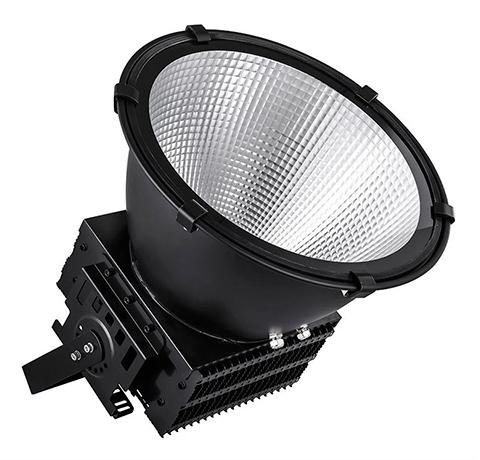
Glare isn’t just “too much light.” It’s light headed in the wrong direction or bouncing off the wrong surfaces, forcing your eyes to work harder to separate signal from noise. In tall Sports with light-colored walls, glossy courts, and metal hardware, it’s surprisingly easy to create uncomfortable brightness – even when the measured average illuminance looks acceptable.
•Common Causes: Narrow beams ricocheting off polished hardwood at steep angles, bright fixtures pointing toward reflective banners, and uncontrolled spill that lights the rafters instead of the play.
•Symptoms You’ll Notice: Squinting, more blinking, trouble tracking high balls, and uneven brightness within the same court or training zone.
•Performance Impact: Slower reaction times, visual fatigue over long sessions, and a “sparkle” off shiny finishes that distracts players and cameras.
•The Real Goal: A uniform, legible, and comfortable visual field. You want enough punch to read lines and flight paths, without the harsh angles that drive light back into eyes.
Controlling glare is a design exercise. Beam angles, optics, mounting height, and color temperature all shape how light leaves a fixture and lands on surfaces. The best High Bay Sport Lights put directional energy on task while avoiding the specular reflections that make people squint.
Direct LED Lighting: Precision Where It Matters
Direct lighting sends most of its output straight to the floor and court markings. For high-intensity sports in defined zones.
•Beams: 25°/45°/60° for punch; reduced spill to ceiling/seating.
•Uniformity: Fewer hotspots, cleaner edges; lines stay readable, exposure stays stable.
•Cameras: Controlled direct light supports consistent capture with low flicker risk.
•Efficacy: More useful lux on the action; less waste above the truss.
In tall truss environments, narrow beams are essential for glare control. They keep light off glossy finishes at problematic angles, limit secondary reflections, and reduce perceived harshness during long tournaments.
Indirect LED Lighting: Comfort, Coverage, and Vertical Clarity
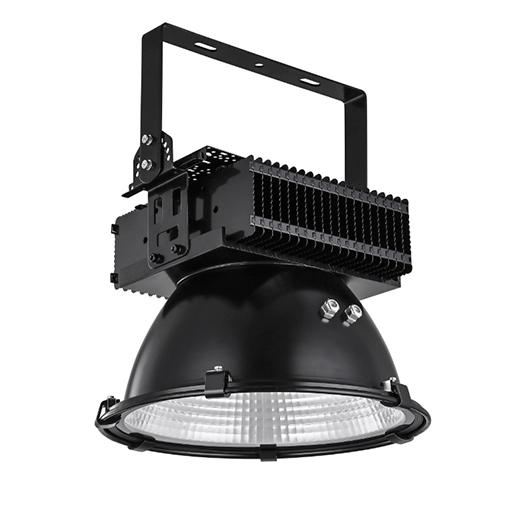
Indirect lighting intentionally pushes part of the output to the ceiling and upper walls, then brings it back down as diffuse illumination. The result is softer contrast and lower visual effort.
•Visual Ease: Diffusion lowers brightness ratios, softens shadow edges, and calms the overall scene.
•Strong Verticals: Faces, jerseys, and ball trajectories read more clearly thanks to smoother vertical illumination – critical for coaching cues and tracking play above the net.
•Whole-Room Reach: Wider beams – often 90° and above – make corners, banners, wall targets, and scoreboards more legible.
•Balanced Atmosphere: A direct – indirect blend gives the court the crispness it needs while keeping spectators and multi-use activities comfortable.
For multi-purpose venues, mixing direct and indirect light often hits the sweet spot: sharp detail where the sport happens, and welcoming ambient light everywhere else.
Finding the Right Direct – Indirect Mix for Your Facility
There’s no universal ratio. The correct balance depends on mounting height, ceiling reflectance, floor gloss, wall color, and the sports calendar.
•High, Light Ceilings: Favor a meaningful indirect component. Reflective ceilings can return a smooth base layer that reduces contrast and glare.
•Dark or Complex Ceilings: Lean more on direct lighting with controlled spill, since you’ll gain less from uplight.
•Glossy Courts: Prefer tighter direct optics to prevent steep-angle reflections. Indirect: supplement lightly only where ceiling reflectance is predictable.
•Modes: Training/weight zones → broader distributions; competition courts → tight optics + selective fill.
How Dawn Lighting Controls Glare Without Dimming the Action
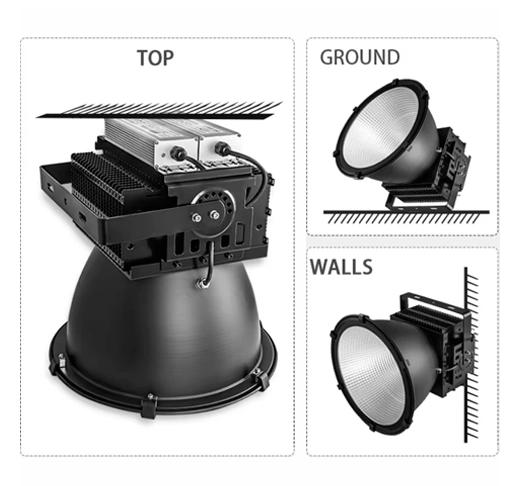
Dawn Lighting engineers High Bay Sport Lights that combine output, optical control, and durability, so the look on day one holds up across seasons.
•High-Output LED Engines: Up to 75,000 lumens around 500W helps cover full-size courts and fast-moving play without oversaturating the room.
•Tuned Color Options: A standard 5000K offers crisp contrast; 3000 – 6000K ranges allow you to match venue aesthetics or broadcast needs. A typical CRI near 85 keeps jerseys, lines, and skin tones honest.
•Thermal Stability: Copper heat pipes manage junction temperature, maintaining lumen output and color consistency across extended events.
•Built For Tough Environments: Corrosion-resistant housings, an 8-hour aging cycle, and a 500-hour salt-spray qualification provide reliable operation in humid venues and coastal climates.
•Environmental Protection: IP65 sealing keeps out dust and water – well suited for Sports with routine washdowns, ball strikes, and chalk particulates around lifting areas.
A thoughtful balance of optics and durable construction minimizes glare while sustaining brightness athletes and broadcast cameras rely on.
Practical Design Guidance for Low-Glare Sports
Modeling is step one. Use these field-proven practices to turn renderings into repeatable outcomes.
•Simulate first (DIALux): check beams, heights, and up/down ratios; review E_avg, E_min, uniformity.
•Match optics to surfaces: glossy/light → tight + precise; dark/matte → wider OK.
•Layered beams: 25° – 60° for courts/platforms; 60° – 90° for seating, circulation, perimeters to raise verticals and soften contrast.
•CCT: 5000K for speed and clarity; 3000 – 4000K for comfort and lower perceived glare.
•Prioritize Reliability: IP65 protection, robust thermal management, and stable drivers prevent outages and light-level drift, keeping quality steady year-round.
•Verify On Site: After installation, aim and dim to the space. A two-degree tilt or a modest output trim can eliminate a stubborn reflection on a glossy floor.
Where Direct and Indirect Shine in Real Sports
Different zones benefit from different balances of High Bay Sport Lights. Tailor distribution to the activity.
•Basketball: Narrow, direct beams; limit spill to upper seating; add soft indirect only with predictable ceiling reflectance to reduce fatigue in long tournaments.
•Volleyball/indoor soccer: Precision direct lighting to preserve uniformity during fast transitions. A measured indirect fill helps with ball tracking at height.
•Weight/functional: Broad distributions to minimize rack/platform shadows; improve safety and spotting.
•Multi-purpose: Direct over activity; indirect ambient for assemblies/classes/events.
•Spectators: Wider optics to lift vertical illuminance for faces/wayfinding; do not overpower court.
•Mounting height + optics: High mount → narrow beams to keep aim and avoid steep reflections. Low ceiling → wide distributions to control veiling reflections and improve verticals. As a starting point, many Sports use tighter beams above 35 – 40 feet and progressively wider beams at 20 – 30 feet, adjusting based on ceiling reflectance and surface gloss.
Choose Dawn Lighting for Reliable Performance and Support
High Bay Sport Lights should make every game easier to see – and keep doing so year after year. Dawn Lighting pairs engineering with planning support to help you reach that outcome.
•Proven Durability: Thermal design, oxidation-resistant housings, and IP65 ratings support operation from roughly -25 to 65°C without noticeable drift.
•Reliable uptime: Stabilized drivers and robust housings cut maintenance events and keep practice blocks intact.
•On-floor clarity: Comfortable, even light reduces eye strain, supports ball tracking, and improves visibility of subtle coaching cues for players and staff.
•Plan-ready support: Replacing HID or specifying from scratch, Dawn Lighting can produce DIALux simulations, advise on beam optics, and propose 100 – 500 W configurations that hit your budget and performance marks.
If your aim is to cut glare, tighten uniformity, and elevate the look and feel of your facility, start with optics, mounting, and materials – and choose hardware designed to hold its performance. With well-planned High Bay Sport Lights, you’ll deliver bright, reliable illumination that supports safer play, sharper coaching, and a better spectator experience.


- 10 Meters Lamp Post
- 10 Meters Pole
- 1000w Led Projector
- 100W LED Tunnel Light
- 12 Meters Lamp Post
- 12 Meters Pole
- 1200w Led Projector
- 15 Light Pole
- 1500w Led Projector
- 150W LED Tunnel Light
- 1800w Led Projector
- 2 In 1 Solar Flood Light
- 200w Led Tunnel Light
- 50w Led Tunnel Light
- 6 Meters Lamp Post
- 6 Meters Pole
- 8 Meters Lamp Post
- 8 Meters Pole
- 800w Led Projector
- 80w Led Tunnel Light
- Colourful Decorative Light
- Conical post
- Courtyard Lamp
- courtyard light
- courtyard lighting fixture
- Decorative Landscape Light
- Decorative road Light
- Flood Light For Courtyard
- Flood Light for Garden
- Flood Light For Outdoor
- Foot Led High Bay Lights
- high bay led lights 100w
- industrial lampshade
- industrial LED shed lights
- industrial magnifying glass with light
- Integrated Solar Flood Light
- led courtyard lamp
- led courtyard light
- led high bay light 100w
- LED Projector For Stadium
- Led UFO High Bay 150W 5000k
- Lighting Plants Mining Price
- Maintenance Free LED Street Light
- Pic Controlling Tunnel Light
- PLC controlling tunnel light
- Post Top Garden Light
- RGB Landscape Light
- Rgbw Decorative Light
- Smart Tunnel Light
- solar courtyard lamp
- solar courtyard light
- Solar LED Road Light
- Solar Street Light For 10 Meter Pole
- Solar Street Light For 12 Meter Pole
- Solar Street Light For 6 Meter Pole
- Solar Street Light For 8 Meter Pole
- Split Type Solar Flood Light
- Sporting Projector
- Stadium Led Projector
- Street Lighting Post
