
 Request A Quote


High Efficiency LED Road Lights for Highways
 FACEBOOK
 TWITTER
 LINKEDIN
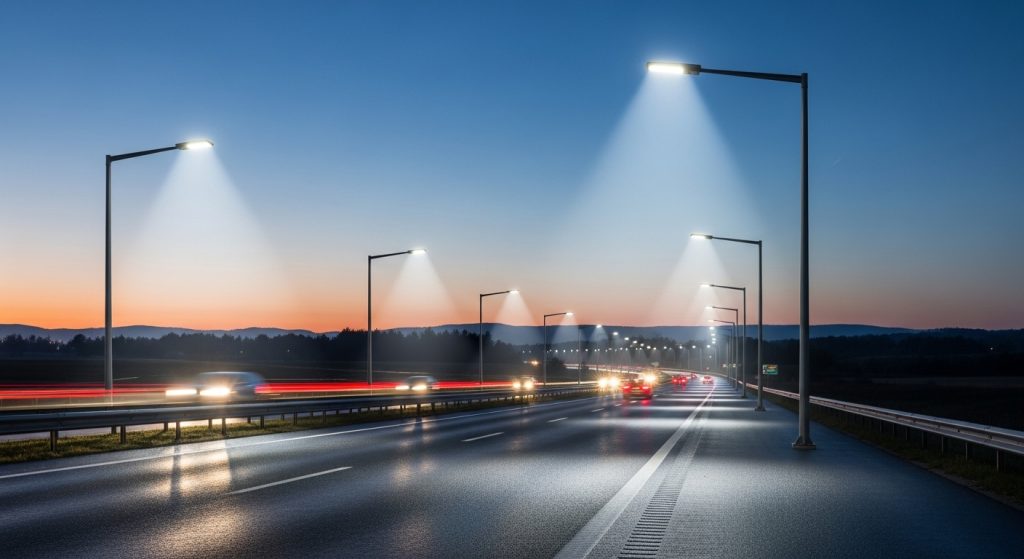
High efficiency LED road lights for highways represent the gold standard for large-scale transportation infrastructure. Unlike standard street lamps, highway systems must manage extreme speeds and vast road widths with unwavering reliability. You need a solution that prioritizes energy efficiency to handle the massive power demands of long-distance roads. These fixtures are designed to operate for extended hours every night, making every watt saved a significant financial win for your budget.
Superior highway visibility is the primary driver behind this transition. High-efficiency LEDs provide uniform light that helps drivers identify hazards from a distance. This clarity is vital for maintaining lighting performance during inclement weather or deep night.
Planners evaluate these systems at scale to ensure that light reaches the pavement without wasting energy on the surrounding landscape. By focusing on efficiency, you reduce the heat load on the fixtures, which extends the life of the internal components.
This reliability ensures that your highway network remains bright and safe without frequent, dangerous lane closures for repairs. Ultimately, high-efficiency systems deliver the best long-term value by balancing peak safety with minimal operating costs. They are no longer just an option; they are the standard for modern, resilient highway networks.
How do highway lighting requirements differ from urban street lighting
Your approach to highway lighting must account for the high speed of travel and the physical scale of the environment. Unlike urban streets, where pedestrians and low speeds are common, highways focus almost entirely on the needs of the driver. A proper road classification for a highway demands a much higher level of driver visibility to ensure safety at high speeds. You need a system that offers continuous illumination over miles of asphalt to prevent dangerous dark patches.
These roads are often much wider than city streets, requiring more powerful fixtures mounted on taller poles. The reliability demands are also much stricter because a failed light on a remote highway is much harder and more expensive to fix. You must plan for consistent light levels that cover multiple lanes and emergency shoulders. This ensures that every vehicle has a clear view of the road geometry and any potential obstacles. Highway lighting is an essential safety tool that must perform perfectly under constant use.
What defines high efficiency in LED road lights used on highways
On a highway, high efficiency is measured by how much usable light you get for every unit of electricity consumed. This is often referred to as luminous efficiency, and it is the key to managing large-scale utility costs. You should look for fixtures that use advanced optics to direct every lumen onto the road surface. High-quality lenses prevent light from spilling into the sky or nearby fields, ensuring power optimization.
The physical build of the light also plays a major role in its efficiency. Effective thermal management keeps the LED chips cool, which allows them to produce more light with less stress. If a light runs too hot, its output drops, and its lifespan is cut short. You need a system where the driver and the LED modules work in perfect harmony to deliver maximum brightness. This technical precision is what allows a high-efficiency light to outperform a standard model while using far less energy.
Why does efficiency directly impact highway safety and operating costs
Efficiency is not just about saving money; it is a critical component of road safety. High-efficiency lights provide performance stability, meaning the brightness stays consistent over many years. When lights dim or fail, it creates “zebra stripes” of light and dark on the highway, which can disorient drivers. By using efficient systems, you ensure a steady and reliable glow that protects everyone on the road.
From a financial perspective, the operational cost of a highway lighting network is immense. Even a small improvement in efficiency can lead to thousands of dollars in annual savings across a long network. You also save on labor because efficient fixtures generally have longer service intervals. This means your maintenance crews spend less time in high-risk zones on the side of the highway. A high-efficiency system pays for itself by reducing both your electric bills and your long-term repair needs. It is a smart way to manage public funds while improving infrastructure quality.
How should wattage and output be planned for highway LED road lights
Planning for highway lighting requires a shift in how you think about wattage. In the past, high wattage was the only way to get high brightness. With modern LEDs, you should focus on actual output levels on the ground rather than just power consumption. High-efficiency chips can produce the same light as an old lamp using only a fraction of the power.
To meet your coverage requirements, follow these steps for wattage planning:
- Determine the required lux level based on the road’s speed limit and traffic volume.
- Choose the appropriate mounting height for your poles to ensure even distribution.
- Select a fixture with a beam angle that covers all lanes without excessive glare.
- Factor in a maintenance margin to account for slight output drops over time.
- Verify that the selected wattage provides enough light for interchanges and merge lanes.
How does color temperature affect visibility on highways
Choosing the right color tone is essential for safe night driving. On highways, the goal is to maximize visual clarity so that drivers can react quickly to hazards. Most highway authorities prefer cooler color temperatures, typically between 4000K and 5000K. This range provides a crisp, white light that helps drivers stay alert and improves the contrast of road markings.
Choosing the right color temperature also affects how the eye perceives distance and depth at high speeds. While warmer tones might be more comfortable in a park, they can make a highway feel dim or hazy. You want a light that mimics natural daylight as closely as possible without causing eye strain. This balance ensures that drivers can see clearly for hundreds of feet ahead. Proper color selection is a simple but effective way to boost the overall safety of your long-distance road network.
What role does power reliability play in high-efficiency highway lighting
Maintaining power stability is a major challenge for lighting networks that stretch over many miles. You must ensure that the voltage remains consistent from the first pole to the last. Any dip in power can cause flickering or premature failure of the LED drivers. This makes system reliability the foundation of your entire highway lighting project.
Your network planning should include robust surge protection to guard against lightning and grid spikes. Highway lights are often exposed in open areas, making them prime targets for electrical surges. A reliable power supply ensures that your high-efficiency lights can perform at their peak without interruption. If the power is unstable, even the best LED technology will underperform. You need a resilient electrical infrastructure to back up your investment in high-end lighting fixtures.
What mistakes reduce the effectiveness of high-efficiency LED road lights on highways
One of the biggest planning mistakes is choosing a fixture based solely on the lowest price. Cheap LEDs often have poor thermal management, leading to performance gaps within just a few years. You might also encounter a design mismatch if you use the same optics for a narrow urban street and a wide highway. This leads to wasted light and dark spots on the shoulder.
Ignoring the road geometry is another common error. If you don’t account for curves or hills, your lighting pattern will be uneven. Some buyers also overlook the need for a long-term maintenance plan, assuming LEDs are “set and forget.” While they last a long time, they still need occasional cleaning and inspections. Taking the time to avoid these errors ensures that your highway stays bright and safe for its entire service life.
What should highway authorities verify before final approval
Before you finalize a large highway project, you must perform a strict performance validation. Your operational planning should cover everything from energy use to future repairs. Use this checklist as a guide for your final approval checklist:
- Confirm that the fixtures meet all national highway lighting standards.
- Verify the luminous efficacy (lm/W) meets your energy saving targets.
- Check that the surge protection is rated for outdoor, high-exposure use.
- Review the light distribution maps to ensure even coverage across all lanes.
- Ensure the manufacturer provides a comprehensive warranty for both parts and labor.
- Test the fixtures’ compatibility with your existing central monitoring system.
- Assess the ease of maintenance for crews working in high-traffic environments.
What are LED road and street lights and how are they applied to highways
LED road and street lights provide the versatile LED technology needed for modern transportation. For highways, these fixtures are scaled up to handle larger areas and higher speeds. They offer a more durable and efficient alternative to old HID lamps. Applying this road illumination to your highway network ensures a safer journey for every driver.
How do on-grid LED road lamps support high-efficiency highway lighting
On-grid LED road lamps are the backbone of highway infrastructure. These on-grid systems draw steady power from the local grid to provide power reliability. They are designed to stay on for twelve hours or more every day without failing. This makes them a dependable choice for the most demanding long-distance road projects.
What do outdoor LED road lighting projects reveal about highway performance
Reviewing outdoor LED road lighting projects gives you a clear view of real-world field performance. You can see the project outcomes from other highway authorities who have made the switch. These examples show how much energy you can save and how safety improves at high speeds. It is a practical way to see the technology’s value before you start your own project.
How should highway planners choose road lighting color temperature
The road lighting color temperature you pick changes how drivers feel at night. For highways, you should prioritize visual clarity over soft aesthetics. A cooler color temperature helps drivers stay focused and see objects more clearly. This choice is vital for preventing accidents on high-speed roads where reaction time is everything.
How can a LED road light wattage guide help highway lighting planning
A LED road light wattage guide is a helpful wattage reference for your engineering team. It helps you translate old power levels into the correct LED output planning. This ensures you buy enough light for your highway without overspending on electricity. Using a guide prevents you from installing lights that are too dim for safe high-speed travel.


- 10 Meters Lamp Post
- 10 Meters Pole
- 1000w Led Projector
- 100W LED Tunnel Light
- 12 Meters Lamp Post
- 12 Meters Pole
- 1200w Led Projector
- 15 Light Pole
- 1500w Led Projector
- 150W LED Tunnel Light
- 1800w Led Projector
- 2 In 1 Solar Flood Light
- 200w Led Tunnel Light
- 50w Led Tunnel Light
- 6 Meters Lamp Post
- 6 Meters Pole
- 8 Meters Lamp Post
- 8 Meters Pole
- 800w Led Projector
- 80w Led Tunnel Light
- Colourful Decorative Light
- Conical post
- Courtyard Lamp
- courtyard light
- courtyard lighting fixture
- Decorative Landscape Light
- Decorative road Light
- Flood Light For Courtyard
- Flood Light for Garden
- Flood Light For Outdoor
- Foot Led High Bay Lights
- high bay led lights 100w
- industrial lampshade
- industrial LED shed lights
- industrial magnifying glass with light
- Integrated Solar Flood Light
- led courtyard lamp
- led courtyard light
- led high bay light 100w
- LED Projector For Stadium
- Led UFO High Bay 150W 5000k
- Lighting Plants Mining Price
- Maintenance Free LED Street Light
- Pic Controlling Tunnel Light
- PLC controlling tunnel light
- Post Top Garden Light
- RGB Landscape Light
- Rgbw Decorative Light
- Smart Tunnel Light
- solar courtyard lamp
- solar courtyard light
- Solar LED Road Light
- Solar Street Light For 10 Meter Pole
- Solar Street Light For 12 Meter Pole
- Solar Street Light For 6 Meter Pole
- Solar Street Light For 8 Meter Pole
- Split Type Solar Flood Light
- Sporting Projector
- Stadium Led Projector
- Street Lighting Post
