
 Request A Quote


IP65 vs IP66 vs IP67 Outdoor Lights Which Rating Do You Need
 FACEBOOK
 TWITTER
 LINKEDIN
Selecting the correct IP rating is a technical decision that directly determines the lighting durability of your outdoor project. An IP (Ingress Protection) rating is a two-digit code that quantifies a fixture’s resistance to solid particles and liquids. In the context of outdoor exposure, choosing between IP65, IP66, and IP67 is not about finding the “highest” number, but about matching the fixture’s internal seals to the specific environmental stressors of your site. Whether your lights face gentle garden rain, high-pressure cleaning, or temporary puddling at ground level, the right rating ensures that moisture never breaches the housing to cause a short circuit.
For most residential applications, IP65 provides the standard level of water protection needed for rain and dust. However, as the intensity of the environment increases—such as on a wind-swept cliffside or a low-lying patio—moving to IP66 or IP67 becomes a non-negotiable safety requirement. A systematic evaluation of your yard’s geography allows you to invest with confidence, preventing the common cycle of replacing fogged lenses and corroded LEDs. By focusing on decision-oriented criteria rather than technical jargon, you can ensure your home remains bright and secure through every storm, year after year.
Why outdoor lights require different IP protection levels
Outdoor fixtures face a relentless cycle of environmental exposure that would destroy an indoor lamp within weeks. Beyond simple rainfall, lights must contend with high-velocity winds that drive dust into small crevices, as well as the intense heat and humidity that can cause seals to expand and contract. Fixture protection is essential because any breach in the housing leads to internal condensation, which is the “silent killer” of modern LED electronics.
The level of protection required also depends on the light’s function. A decorative wall light tucked under a porch eaves has lower outdoor reliability risks than a functional security light mounted on an unshielded garage facade. By identifying these varying risk levels across your property, you can allocate your budget effectively—choosing high-durability seals for exposed zones and standard protection for sheltered ones. This tailored approach ensures a safe, high-performing system that stands up to the specific demands of your local climate.
What the two digits in an IP rating actually represent
The ingress protection code is a standardized shorthand for safety. The first digit (0–6) represents dust resistance, or protection against solid particles. For outdoor lighting, you should almost always look for a “6,” which signifies that the fixture is completely dust-tight. This prevents garden debris, sand, and fine pollutants from entering the light engine, ensuring that the internal components stay factory-clean and operate at peak efficiency.
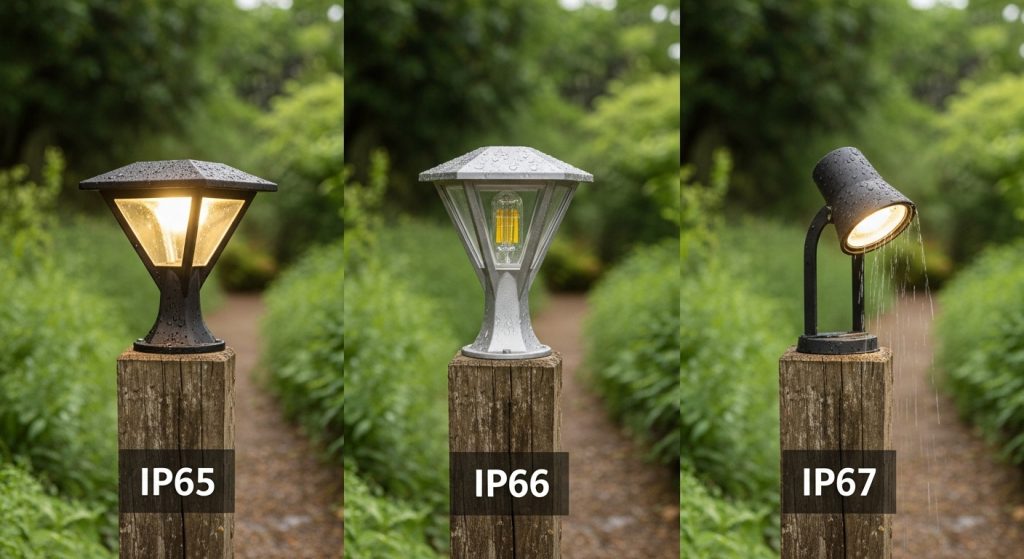
The second digit (0–8) measures water resistance. This is where the primary differences between IP65, IP66, and IP67 occur. Each step up the scale represents a significant increase in the fixture’s ability to handle water volume and pressure. Understanding that these digits work as a pair is critical; a fixture must be both solid-tight and water-tight to be truly considered an outdoor-grade product. By decoding these numbers, you move past vague “waterproof” claims and into a verified world of technical performance.
How IP65 outdoor lights perform in everyday exterior use
An IP65 rating is the “all-rounder” for residential lighting. It is designed to provide complete weather protection against dust and low-pressure water jets from any direction. In practical terms, this means an IP65 light is perfectly capable of handling a typical rainstorm or the gentle spray from a garden hose. It is the most common rating for garden bollards, path lights, and wall fixtures that are located in relatively stable general outdoor use areas.
However, IP65 has its limits. It is not designed to withstand high-pressure water or immersion. If your fixture is located where it will be hit by a powerful power-washer or sit in a zone where water pools after a heavy downpour, you may need a more robust rating. For the majority of suburban yards and sheltered entrances, IP65 offers an ideal balance of performance and value, keeping your property bright and secure without over-engineering.
When IP66 is the safer choice for outdoor wall and surface lights
Moving to an IP66 rating is a strategic decision for exposed installations where water is driven by force. This rating is tested against “powerful water jets,” meaning it can handle significantly more water pressure than an IP65 unit. This is the safer choice for lights mounted on high, unshielded walls or on coastal properties where stormy winds drive rain horizontally against the building’s facade with intense pressure.
IP66 fixtures often feature thicker gaskets and more rigid housing designs to ensure the seals remain intact under mechanical stress. They are also ideal for commercial settings or residential areas where surfaces are frequently hosed down with high-pressure equipment. If your lighting layout includes fixtures on North-facing walls or corners that take the brunt of the weather, upgrading to IP66 ensures that your home’s security remains uncompromised even during the most severe weather events.
Why IP67 is reserved for high-exposure or ground-level lighting
An IP67 rating is a specialized level of protection designed for temporary immersion. This means the fixture can be submerged in up to one meter of water for 30 minutes without leaking. In a landscape context, this is rarely needed for wall lights, but it is essential for ground-level “well lights” or fixtures located in drainage zones where water might sit temporarily after a storm. It offers the highest level of high exposure security for units in the line of fire.
However, for most wall or pillar lights, IP67 is often unnecessary. Unless your property is prone to extreme flooding or you are installing lights inside a water feature, the added cost of an IP67 unit may not provide a functional benefit over an IP66 model. The key is to identify the “flood risk” of your installation site. If there is a chance the light will be underwater—even for a short time—IP67 is your only guarantee against a catastrophic electrical failure.
How fixture design affects the IP rating you actually need
A fixture’s perforated design or open-air housing can complicate the way IP ratings are achieved. In many modern decorative lights, the outer shell is intentionally “open” to create shadow patterns, meaning the water sealing must happen at an internal level. This requires an encapsulated LED module that holds its own IP rating independent of the outer fixture housing. When buying decorative pieces, you must verify that the internal protection matches the exposure of the site.
Design complexity also affects airflow. A high IP rating requires a very tight seal, which can trap heat inside the unit. Manufacturers of high-quality outdoor lights balance this by using the metal housing as a heat sink. When selecting a light with an intricate design, look for a product that successfully integrates a high IP rating with structural durability. This synergy ensures that the decorative patterns you love are supported by a professional-grade core that survives the outdoors.
How mounting height changes water exposure on outdoor lights
The mounting height of a fixture significantly alters its risk profile. Lights placed in the “splash zone”—within 1 meter of the ground—face a constant barrage of mud, garden debris, and rebounding water. These units benefit from a high dust and water rating to prevent the lens from being obscured. In contrast, lights mounted high on a facade face more water exposure from wind-blown rain, requiring a seal that can handle pressure from multiple angles.
Effective installation planning coordinates the height with the IP code. A tall mount on a multi-story building may face higher wind speeds, putting more stress on the housing seals than a light at head-height. Conversely, if you are mounting lights near the base of a wall where splash exposure is high, you need a fixture that is easy to clean and holds a tight “6” rating for solids. By thinking about how water and wind behave at different heights, you can select the most resilient hardware for every level of your home.
What problems occur when the IP rating is over- or under-specified
A rating mismatch is one of the most common causes of performance issues in outdoor lighting. If you under-specify a light—using IP44 in an IP66 zone—the fixture will inevitably fail due to moisture damage and corrosion. The cost of replacing the unit and the labor of troubleshooting usually far exceeds the initial savings of a cheaper light. Water ingress is a progressive problem; it often starts as a small lens fog and ends with a tripped circuit breaker.
On the other hand, over-specifying (using IP67 for a sheltered porch) is a lapse in cost efficiency. You are paying for submersible technology that will never be utilized. High-rated fixtures are often heavier and more complex to mount, which can add unnecessary difficulty to your IP planning. The goal is precision: choosing the right tool for the job. By matching the technical rating to the site reality, you achieve a system that is both reliable and sustainable without wasting your project budget.
How to choose the right IP rating for your outdoor lighting project
Before you commit to an outdoor installation, it is vital to have a clear understanding of your site’s environmental stressors. This selection checklist acts as a final guide to ensure your IP planning is accurate and effective. By verifying these factors now, you can create a lighting layout that is as durable as it is beautiful.
- Sheltered Areas (Porches): IP44 or IP54 is usually sufficient for ambient moisture.
- Open Walls (Standard Rain): Look for a minimum of IP65 for reliable rain protection.
- High Exposure (Stormy Zones): Choose IP66 to handle powerful, wind-driven water.
- Ground Level (Pool/Drainage): Select IP67 to protect against temporary submersion.
- Fixture Design: Does the perforated design have an internally sealed LED?
- Material Check: Is the housing made of durable metal like aluminum to keep seals tight?
- Maintenance Goal: Will a higher rating reduce your need for cleaning and troubleshooting?
What types of outdoor wall and pillar lights commonly use IP-rated designs
Outdoor wall pillar residential lights refer to the primary fixtures used on facades and boundaries. Because these wall lighting and pillar fixtures are the most exposed parts of a home’s exterior, a verified IP rating is the only way to ensure they remain functional and safe throughout the year.
How metal outdoor LED wall lights handle higher water exposure
Choosing an Outdoor metal LED wall light provides a superior metal housing that supports high-level waterproofing. Metal is much better at maintaining outdoor durability through temperature changes than plastic, ensuring that the gaskets stay compressed and the internal seals never fail during a storm.
How perforated outdoor wall lamps affect IP rating requirements
Perforated wall lamp outdoor units require careful IP planning because of their housing openings. Since the outer shell is “open,” the internal LED engine must meet its own perforated fixtures protection standards. This ensures that the decorative patterns do not compromise the safety or longevity of your lighting system.
How mounting height decisions influence IP rating selection
Following an Outdoor wall light mounting height guide is critical for water exposure planning. The mounting height significantly dictates whether a light will face splashes from the ground or pressure from wind-blown rain. Matching the IP rating to the height is the key to achieving a professional and lasting outdoor lighting layout.


- 10 Meters Lamp Post
- 10 Meters Pole
- 1000w Led Projector
- 100W LED Tunnel Light
- 12 Meters Lamp Post
- 12 Meters Pole
- 1200w Led Projector
- 15 Light Pole
- 1500w Led Projector
- 150W LED Tunnel Light
- 1800w Led Projector
- 2 In 1 Solar Flood Light
- 200w Led Tunnel Light
- 50w Led Tunnel Light
- 6 Meters Lamp Post
- 6 Meters Pole
- 8 Meters Lamp Post
- 8 Meters Pole
- 800w Led Projector
- 80w Led Tunnel Light
- Colourful Decorative Light
- Conical post
- Courtyard Lamp
- courtyard light
- courtyard lighting fixture
- Decorative Landscape Light
- Decorative road Light
- Flood Light For Courtyard
- Flood Light for Garden
- Flood Light For Outdoor
- Foot Led High Bay Lights
- high bay led lights 100w
- industrial lampshade
- industrial LED shed lights
- industrial magnifying glass with light
- Integrated Solar Flood Light
- led courtyard lamp
- led courtyard light
- led high bay light 100w
- LED Projector For Stadium
- Led UFO High Bay 150W 5000k
- Lighting Plants Mining Price
- Maintenance Free LED Street Light
- Pic Controlling Tunnel Light
- PLC controlling tunnel light
- Post Top Garden Light
- RGB Landscape Light
- Rgbw Decorative Light
- Smart Tunnel Light
- solar courtyard lamp
- solar courtyard light
- Solar LED Road Light
- Solar Street Light For 10 Meter Pole
- Solar Street Light For 12 Meter Pole
- Solar Street Light For 6 Meter Pole
- Solar Street Light For 8 Meter Pole
- Split Type Solar Flood Light
- Sporting Projector
- Stadium Led Projector
- Street Lighting Post
