
 Request A Quote


How to Choose the Right Wattage for LED Road Lights
 FACEBOOK
 TWITTER
 LINKEDIN
Choosing the correct power level is a foundational step in your wattage planning process. You should view wattage as a specific tool for managing lighting performance rather than a simple guess. In modern systems, wattage represents the amount of electricity a fixture consumes to produce its light. You must align this consumption with your specific road conditions to ensure the environment is safe for everyone. Modern energy efficiency has completely changed traditional thinking about power.
You no longer need high power to achieve high road visibility. A well-planned system uses the lowest possible energy to meet safety standards. Planners like you must balance the need for clear sightlines with the desire to lower city utility costs. Higher wattage is not always the better choice. It can lead to blinding glare and wasted funds.
Getting the wattage right improves the long-term health of your electrical grid. It ensures that every pole provides the exact amount of light needed for its specific location. By following a structured approach, you can avoid the common traps of over-lighting. Your final selection should support a sustainable and safe nighttime environment for your community. You gain confidence in your infrastructure by basing decisions on data. Every watt should serve a clear purpose in your final design.
What does wattage really mean in LED road lighting systems
You should look at wattage as a measure of the power consumption of your light fixture. It tells you how much your city will pay in electricity costs for every hour the light is on. However, it is a mistake to think that more watts always mean more light output. LEDs have a much higher efficiency ratio than the old-style bulbs you might be replacing.
This change means you can get the same brightness from a 100-watt LED that you used to get from a 250-watt lamp. You need to focus on the lumens-per-watt rating to understand the true value of the fixture. High wattage in a low-quality light just creates heat, not better sightlines. Understanding this difference helps you pick the most effective tool for your infrastructure. It allows you to design a system that is both powerful and fiscally responsible. You reduce waste by looking at the actual light delivered to the road. This technical shift requires you to rethink how you evaluate every new project.
Why road type plays a key role in wattage selection
Your road classification is the primary guide for how much power you actually need. You must evaluate the traffic conditions and the speed of the vehicles in your project zone. A major highway with fast cars creates a much higher visual demand than a local park path. Consequently, highways often require fixtures with higher wattage to cover the broad, fast-moving lanes. Drivers need more time to react, so the light must reach further.
On the other hand, residential streets benefit from lower wattage to keep the area comfortable for homeowners. You do not want a 300-watt light shining into someone’s bedroom window at midnight. Matching the power to the street’s use prevents you from wasting energy in quiet areas. It also ensures that busy intersections have enough light to keep drivers and pedestrians safe. Your plan must reflect the unique safety needs of every specific road type in your network. You create a balanced urban environment by respecting the function of each street.
How mounting height and spacing influence required wattage
The physical layout of your poles has a massive impact on your coverage planning. You will find that pole height determines how wide the light spreads across the pavement. If your poles are very tall, you need a higher wattage to ensure the light is still bright enough when it hits the ground. A light that works at fifteen feet will be much too dim if you move it to thirty feet. The distance weakens the beam intensity significantly.
Your spacing layout also dictates your power needs. If your poles are far apart, you need more wattage per fixture to fill the gaps between them. Using a low-wattage light on widely spaced poles creates dangerous dark zones. This design mismatch can lead to more accidents because drivers cannot see clearly. You should always calculate the distance between poles before you decide on the final wattage. Proper spacing helps you achieve a smooth and even ribbon of light. You want to avoid “zebra stripes” of light and dark on the asphalt.
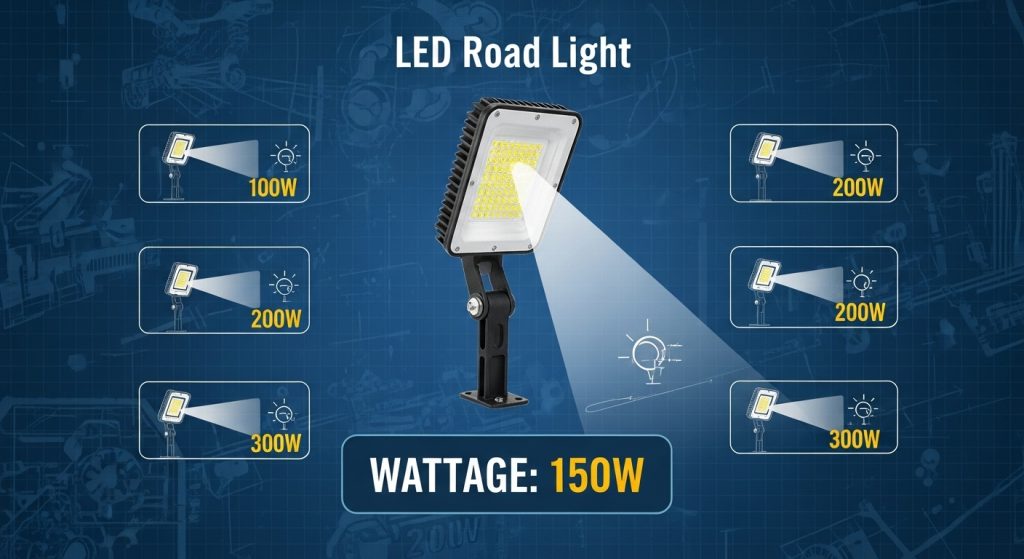
How efficiency and optics reduce wattage needs in modern LED road lights
You can achieve better usable illumination by focusing on the optical efficiency of your fixtures. Modern LEDs use specialized lenses to direct light exactly where it is needed on the road. This directional lighting is a massive advantage over older bulbs that scattered light in all directions. Because you are not wasting light on the sky or trees, you can use a lower wattage. You are essentially doing more with less.
Precise beam control allows you to light up the whole road with much less total power. This means you can meet safety standards while keeping your energy bills very low. You should look for fixtures that use high-quality materials to maximize their light throw. This focus on quality helps you reach your targets without relying on high-power consumption. It is a smarter way to provide safety for your local street networks. You reduce light pollution by keeping the beam focused on the driving surface. This technical precision is what makes modern LED systems so cost-effective.
How smart controls and dimming affect wattage decisions
Using an adaptive lighting strategy allows you to think beyond fixed wattage levels. You can plan for a dimming strategy where the lights run at lower power when the streets are empty. This approach significantly reduces your total energy use over the course of a year. You might choose a higher-wattage fixture for peak safety but only run it at 100% during rush hour. You gain flexibility that old systems never offered.
A central energy management system gives you the power to adjust every light in your city. This flexibility means you do not have to settle for one brightness level all night long. You can save money while still having the power ready if conditions become hazardous. Planning your wattage with these controls in mind helps you build a future-proof system. It turns your street lights into a responsive city asset. You can lower the power draw when the moon is bright or traffic is low. This control keeps your budget under your direct command.
What common mistakes lead to incorrect wattage selection
A frequent source of planning mistakes is choosing wattage based on old habits from the era of gas lamps. You might end up with over-lighting if you try to match the old wattage numbers with new LEDs. This mistake wastes money and creates harsh glare that can blind drivers. Another issue is a design mismatch where you ignore the actual layout of your poles. You cannot fix a bad pole layout by simply buying a bigger light.
You must avoid the temptation to “over-size” your lights to make up for a poor layout. This just creates hot spots of light and deep shadows that are dangerous for everyone. Some planners also forget to check the efficiency of the fixture before they buy. A cheap, low-efficiency LED might need twice the wattage to do the same job as a high-quality one. Taking the time to avoid these errors keeps your project safe and on budget. You save time by doing the calculations correctly the first time.
What should be completed before finalizing LED road light wattage
You should perform a full planning review before you sign the final purchase order. Your performance criteria must be based on the actual physical conditions of your site. Use this validation checklist to ensure your selection is correct:
- Confirm the road width and the speed limit for the area.
- Verify the exact mounting height of your existing or new poles.
- Check the current spacing between poles to ensure even overlap.
- Review the photometrical data to see how the light falls on the ground.
- Confirm that the chosen wattage meets local safety and visibility laws.
- Assess the potential for smart controls to lower future power use.
- Check with residents to ensure the light levels are comfortable for the neighborhood.
What are LED road and street lights and how do they affect wattage planning
LED road and street lights are the modern tools for your city’s infrastructure. This LED technology allows you to get more brightness for less power than ever before. You use these road lighting systems to keep every path and highway safe for the public. They are designed to last for many years with very little help from your crews. These fixtures are the best way to modernize your city while saving on electricity costs. You get a reliable light source that works in all weather conditions.
How do smart LED road lights with sensors influence wattage requirements
Smart LED road lights with sensors use smart sensors to help you manage your power. You can use adaptive dimming to lower the wattage when no cars are on the road. This technology allows you to buy a fixture with more power and only use it when it is truly needed. It is a powerful way to keep your streets safe while reaching your green energy goals. You get a system that is both responsive and very cheap to run. This smart approach protects your city budget from waste.
Why are high-efficiency LED road lights important when selecting wattage
High-efficiency LED road lights help you achieve better energy optimization for your whole network. You can pick a lower wattage when you use high efficiency chips that produce more light per watt. This reduces your initial project costs and your monthly utility bills at the same time. These fixtures are the best choice for any project that needs to be both bright and sustainable. You get a reliable system that pays for itself through lower energy use. You see the benefits in your lower maintenance and power bills.
How do on-grid LED road lamps affect wattage planning for road networks
On-grid LED road lamp units provide the power stability you need for your main roads. These on-grid systems draw steady power from your city’s main grid for a consistent light level. You can plan your wattage with confidence because you do not have to worry about battery life or weather. These lamps are easy to set up on your existing poles and work perfectly with your current grid. They are the most dependable choice for any urban or industrial lighting project. You ensure your streets stay lit regardless of the time of year.
What can outdoor LED road lighting projects teach about real wattage use
Reviewing outdoor LED road lighting projects gives you actual field performance data. You can see the project outcomes from other cities that have already made the switch to LEDs. This helps you understand which wattage levels work best for different road widths and types. You can use these real-world examples to avoid mistakes in your own project planning. It is a practical way to learn how to balance brightness with budget before you buy. You gain insights into how these lights look and perform over several years.


- 10 Meters Lamp Post
- 10 Meters Pole
- 1000w Led Projector
- 100W LED Tunnel Light
- 12 Meters Lamp Post
- 12 Meters Pole
- 1200w Led Projector
- 15 Light Pole
- 1500w Led Projector
- 150W LED Tunnel Light
- 1800w Led Projector
- 2 In 1 Solar Flood Light
- 200w Led Tunnel Light
- 50w Led Tunnel Light
- 6 Meters Lamp Post
- 6 Meters Pole
- 8 Meters Lamp Post
- 8 Meters Pole
- 800w Led Projector
- 80w Led Tunnel Light
- Colourful Decorative Light
- Conical post
- Courtyard Lamp
- courtyard light
- courtyard lighting fixture
- Decorative Landscape Light
- Decorative road Light
- Flood Light For Courtyard
- Flood Light for Garden
- Flood Light For Outdoor
- Foot Led High Bay Lights
- high bay led lights 100w
- industrial lampshade
- industrial LED shed lights
- industrial magnifying glass with light
- Integrated Solar Flood Light
- led courtyard lamp
- led courtyard light
- led high bay light 100w
- LED Projector For Stadium
- Led UFO High Bay 150W 5000k
- Lighting Plants Mining Price
- Maintenance Free LED Street Light
- Pic Controlling Tunnel Light
- PLC controlling tunnel light
- Post Top Garden Light
- RGB Landscape Light
- Rgbw Decorative Light
- Smart Tunnel Light
- solar courtyard lamp
- solar courtyard light
- Solar LED Road Light
- Solar Street Light For 10 Meter Pole
- Solar Street Light For 12 Meter Pole
- Solar Street Light For 6 Meter Pole
- Solar Street Light For 8 Meter Pole
- Split Type Solar Flood Light
- Sporting Projector
- Stadium Led Projector
- Street Lighting Post
