
 Request A Quote


What Beam Angle Is Best for LED Street Lights 60 vs 120 Degrees
 FACEBOOK
 TWITTER
 LINKEDIN
Deciding between a 60° and 120° beam angle for LED street lights is a fundamental step in your lighting design process. The beam angle determines the beam distribution and how the light spreads from the fixture to the pavement. You must select an angle that matches your specific street geometry to ensure safe and efficient travel. A 60° angle provides a more concentrated and directional flow of light. In contrast, a 120° angle offers a broader wash that covers more area but with less intensity at the center.
Your choice directly affects the light coverage and the number of poles you need for your project. Planners like you must balance the distance between poles with the need for visibility control. If you choose an angle that is too narrow for your spacing, you will end up with dangerous dark spots. If the angle is too wide, you may waste light on areas that do not need it, such as building facades or the night sky.
By understanding how these geometries behave, you can create a uniform lighting environment that protects both drivers and pedestrians. Your goal is to maximize the useful light on the road while minimizing glare and energy waste. The right beam angle ensures that every watt contributes to a safer city.
What does beam angle mean in LED street lighting
You should view the beam angle as the measurement of the light spread from your fixture. It defines the area where the illumination coverage is at least half of its maximum intensity. This distribution geometry is what allows you to target the light exactly where you want it. In street lighting, the angle is shaped by the internal optics and lenses of the LED unit.
Choosing the right angle is vital because it determines how much of the road you actually light up. A light with high lumens but the wrong beam angle will still result in poor visibility. You use these angles to ensure the light reaches the curb and the center of the lane without spilling over. Understanding this measurement helps you translate raw light power into usable road safety. It is the key to creating a system that meets your technical and budget targets.
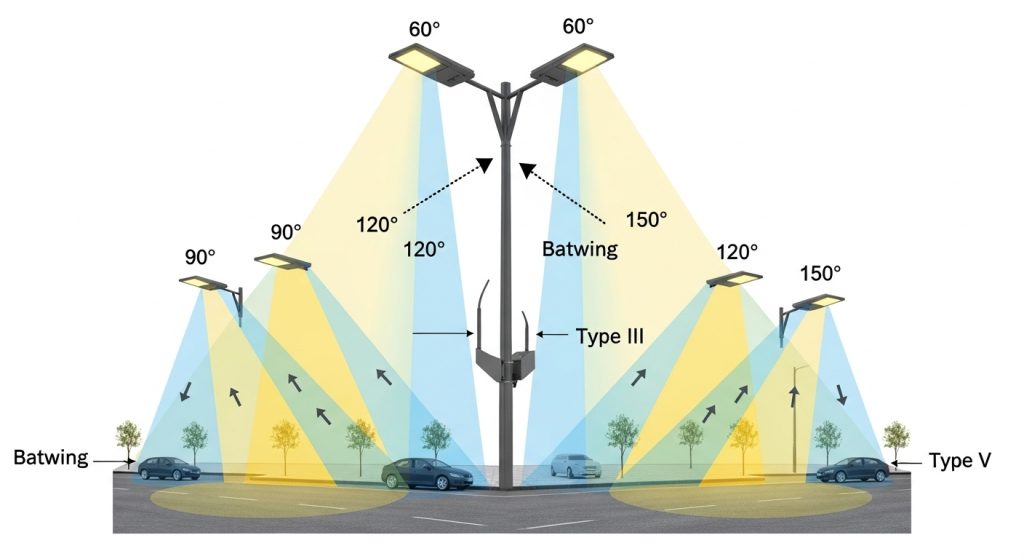
How does a 60° beam angle behave on streets and roads
A 60° angle creates a narrow beam that delivers highly focused coverage on the ground. You will find that this setup is excellent for taller poles or very narrow streets. Because the light is concentrated, it can reach the pavement from a greater height with high intensity. This helps you achieve better penetration in areas with thick trees or overhead obstacles.
One of the main benefits is the reduced spill of light into nearby residential windows. You have more control over the edges of the light pool, which helps prevent light pollution. However, the drawback is that you need closer pole spacing to avoid dark gaps. If your poles are too far apart, the narrow cones of light will not overlap enough to keep the road safe. You should use this angle when you need precise placement and high brightness in a specific, confined zone.
How does a 120° beam angle behave on streets and roads
Choosing a 120° angle provides a wide beam that is perfect for broad uniform lighting across multiple lanes. This pattern offers extensive overlap coverage, which allows for much greater distances between your light poles. You will find that this is the standard choice for wide urban boulevards and large parking areas. It creates a smooth wash of light that makes the entire environment feel bright and open.
The broad spread helps you cover sidewalks and bike lanes at the same time as the main road. This improves safety for pedestrians who need to be seen by turning vehicles. The potential drawback is that the light intensity is lower at any single point compared to a narrow beam. You also face a higher risk of light “trespass” into areas where it is not wanted. You must use high-quality optics to ensure that the wide spread remains efficient and does not cause excessive glare for residents.
Why street geometry and spacing influence beam angle choice
Your coverage planning must start with an analysis of your street width and the height of your poles. The relationship between pole spacing and the beam spread determines if your road will be safe or patchy. If you have a very wide road, a 60° beam might only light up the center, leaving the edges in the dark. In this case, a 120° beam is almost always the better choice to ensure the light reaches the curbs.
If your poles are already installed far apart, you are often forced to use a wider beam angle to fill the space. Using a narrow beam on widely spaced poles creates a “zebra stripe” effect that is very dangerous for drivers. You want the light from one pole to meet the light from the next one smoothly. Matching the angle to your physical layout is the only way to reach your safety goals without adding extra poles. Your design should always prioritize a continuous ribbon of light for the driver’s path.
How does beam angle affect perceived brightness and comfort
The angle you choose changes the perceived brightness of the road for every user. A narrow 60° beam can feel much brighter because the light is packed into a smaller area. This can improve your glare control if the light is aimed correctly away from the driver’s eyes. However, the high contrast between the bright pool and the surrounding darkness can tire the eyes over long periods.
A wider 120° beam often provides better visual comfort by reducing sharp shadows and high-contrast zones. It creates an environment where the human eye does not have to constantly adjust to different light levels. This uniformity is a major factor in how safe and welcoming a street feels at night. You must balance the need for intense light with the need for a comfortable, even glow. Choosing the right angle helps you support the natural visual response of drivers and pedestrians alike.
What mistakes to avoid when choosing a beam angle for street lighting
A common planning mistakes is an angle mismatch where you pick a light based only on its price or wattage. You might buy a 120° light for a very narrow alley, which wastes half the light on the walls of buildings. Another of the frequent coverage errors is assuming that a wider beam is always better. If your poles are very high, a wide beam might be too weak by the time it reaches the ground.
You should also avoid ignoring the mounting angle of the fixture itself. If the light is tilted, the beam pattern on the road will change completely. Some planners forget to check if the beam angle will cause glare for people living in nearby second-story apartments. You must look at the 3D space of the street, not just the flat map. Taking the time to simulate the light spread prevents costly replacements after the project is finished.
How should planners confirm the right beam angle before implementation
You should perform a full design criteria check to ensure your choice meets all field requirements. Your validation checklist should be based on the actual physical conditions of your site. Consider these points before you finalize your order:
- Measure the exact width of the road and the height of your poles.
- Check the current distance between poles to see how much overlap you need.
- Verify the required lux levels for your specific road classification.
- Review the photometrical files from the manufacturer for both 60° and 120° options.
- Conduct a small test on one block to see the real-world effect at night.
- Confirm that the light does not spill into windows or the sky.
- Ensure the chosen angle supports the driver’s ability to see road markings clearly.
What are LED road and street lights and how do they relate to beam angle choices
LED road and street lights are the modern foundation for your city’s street lighting needs. This LED technology allows for much more precise beam control than old-fashioned bulbs. You can select the exact optics needed to push light into a 60° or 120° pattern. This flexibility helps you save energy by only lighting the areas that truly need it. Choosing high-quality fixtures ensures your beam remains consistent for the life of the lamp.
How do smart LED road lights with sensors influence beam angle performance
Smart LED road lights with sensors add smart control to your chosen beam pattern. You can use these systems to manage adaptive lighting where the output changes based on traffic. While the beam angle stays the same, the sensors help you use that light more effectively. For example, the lights can brighten when they detect a car and dim when the street is empty. This is a powerful way to enhance the safety provided by your chosen beam geometry.
Why do high-efficiency LED road lights matter when comparing beam angles
High-efficiency LED road lights ensure that you get the most light output for every watt you use. The efficiency impact is even greater when you pick the correct beam angle for your street. An efficient light with a 60° beam can reach deep into dark areas with very little power. This allows you to reach your safety targets while keeping your city’s energy bills as low as possible. You get a better result and a faster return on your investment.
How do on-grid LED road lamps support beam angle choices in street systems
On-grid LED road lamp units provide the power stability needed for a steady light beam. In your network lighting, having a consistent power supply means the beam shape and brightness never flicker. This reliability is vital for maintaining the overlap needed for safety. You can count on your grid-connected lights to perform exactly as they were designed every single night. They are the most dependable choice for your main urban street projects.
How should planners use a street lighting lumens guide with beam angle decisions
A Street lighting lumens guide helps you manage your lumen planning alongside your beam choice. You need to ensure coverage consistency across the whole road surface. The guide tells you how many lumens you need, while the beam angle tells you where they go. Using these two tools together helps you avoid both dark spots and over-lighting. It is the best way to design a professional and safe lighting environment for your community.
How does street light spacing influence the effectiveness of different beam angles
The Street light spacing guide is essential for your spacing strategy. It helps you see how your coverage planning changes when you move the poles further apart. If you have wide spacing, you almost always need a 120° beam to fill the gap. If your poles are close, a 60° beam might provide more intense and useful light. Following these rules ensures that your street looks bright and safe from end to end.
How do LED and sodium street lights compare in beam distribution and performance
Comparing LED vs sodium street lights shows a massive technology comparison in light control. Old sodium lights have a messy distribution pattern that wastes light in every direction. LEDs allow for the precise 60° or 120° angles that you need for modern roads. This precision helps you improve safety and reduce light pollution at the same time. Switching to LEDs is the best way to gain total control over your city’s nighttime environment.


- 10 Meters Lamp Post
- 10 Meters Pole
- 1000w Led Projector
- 100W LED Tunnel Light
- 12 Meters Lamp Post
- 12 Meters Pole
- 1200w Led Projector
- 15 Light Pole
- 1500w Led Projector
- 150W LED Tunnel Light
- 1800w Led Projector
- 2 In 1 Solar Flood Light
- 200w Led Tunnel Light
- 50w Led Tunnel Light
- 6 Meters Lamp Post
- 6 Meters Pole
- 8 Meters Lamp Post
- 8 Meters Pole
- 800w Led Projector
- 80w Led Tunnel Light
- Colourful Decorative Light
- Conical post
- Courtyard Lamp
- courtyard light
- courtyard lighting fixture
- Decorative Landscape Light
- Decorative road Light
- Flood Light For Courtyard
- Flood Light for Garden
- Flood Light For Outdoor
- Foot Led High Bay Lights
- high bay led lights 100w
- industrial lampshade
- industrial LED shed lights
- industrial magnifying glass with light
- Integrated Solar Flood Light
- led courtyard lamp
- led courtyard light
- led high bay light 100w
- LED Projector For Stadium
- Led UFO High Bay 150W 5000k
- Lighting Plants Mining Price
- Maintenance Free LED Street Light
- Pic Controlling Tunnel Light
- PLC controlling tunnel light
- Post Top Garden Light
- RGB Landscape Light
- Rgbw Decorative Light
- Smart Tunnel Light
- solar courtyard lamp
- solar courtyard light
- Solar LED Road Light
- Solar Street Light For 10 Meter Pole
- Solar Street Light For 12 Meter Pole
- Solar Street Light For 6 Meter Pole
- Solar Street Light For 8 Meter Pole
- Split Type Solar Flood Light
- Sporting Projector
- Stadium Led Projector
- Street Lighting Post
