
 Request A Quote


LED Tree Light for Landscape and Garden Decoration
 FACEBOOK
 TWITTER
 LINKEDIN
Integrating LED tree lights into your landscape design is a transformative step that shifts your yard from a flat, dark void into a multi-dimensional nighttime retreat. These fixtures are specifically engineered for tree illumination, typically utilizing upward-facing beams to highlight the majestic height of trunks and the intricate textures of branches. By strategically placing these lights at the base of your most prominent trees, you create a powerful visual focus that defines the boundaries of your garden and adds a layer of sophistication to the entire property. The goal is to build a sense of depth, where the illuminated trees act as pillars of light that separate the foreground from the distant background.
Beyond simple garden decoration, tree lighting supports a balanced outdoor ambiance that prioritizes both beauty and usability. The soft, reflected light from the canopy provides a gentle glow that helps with nighttime navigation without the harshness of direct overhead lamps. Because these units are designed for long-term outdoor performance, they allow you to enjoy your garden through every season, showcasing the skeletal beauty of winter branches just as effectively as the lush greenery of summer. By focusing on the unique structure of each tree, you can “sculpt” your nighttime environment, creating a secure and stunning landscape that serves as a high-end extension of your home’s living space.
What role tree lighting plays in landscape and garden design
In a professional garden layout, tree lighting serves as the foundational “anchor” for your nighttime design. By selecting a few key trees to illuminate, you establish clear visual focal points that guide the eye through the space. This technique is essential for breaking up large, dark lawns and creating a sense of order. Without these anchors, a yard can feel uninviting and small after dark; with them, the property line expands, making the landscape feel much larger and more immersive.
These lights also play a critical role in separating the layers of your garden. By lighting trees in the mid-ground and background, you create a “stage” effect that adds immense depth. This layered approach ensures that your landscape has a professional, three-dimensional look rather than a flat, “one-note” appearance. Furthermore, the indirect light provided by tree canopies adds to the safety of the garden, revealing paths and garden structures in a subtle, non-aggressive way that enhances the overall property value.
How LED tree lights interact with branches, trunks, and foliage
The effectiveness of tree illumination depends on the relationship between the light direction and the natural texture of the bark. When you place a fixture at a sharp upward angle near the trunk, the light “grazes” the surface, emphasizing every ridge and knot in the wood. This creates a dramatic, high-contrast look that celebrates the unique tree structure. As the light moves higher, it filters through the branches, creating a dappled effect that adds movement and life to the garden as the wind blows.
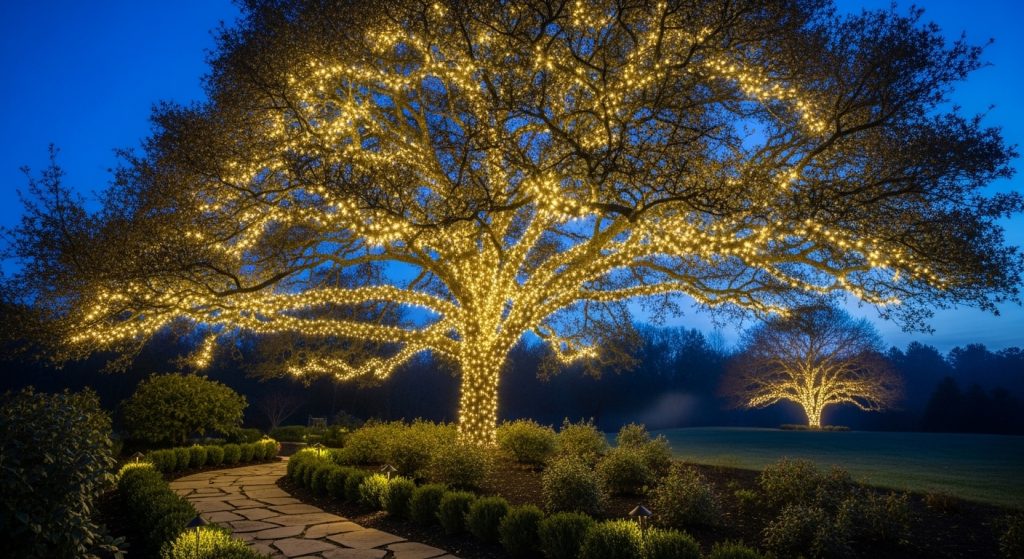
Foliage also dictates how the light is perceived. Broad, dense leaves will catch more light and create a solid “umbrella” of brightness, while fine, needle-like leaves allow more light to pass through, creating a soft, ethereal glow. You must also consider seasonal changes; a light that looks perfect on a leaf-filled summer maple will create a much more stark, architectural silhouette once the leaves have fallen in winter. By understanding these interactions, you can adjust your beam angles to ensure your trees look stunning throughout the entire year.
Why LED technology is preferred for decorative tree lighting
Modern LED efficiency has revolutionized the way we decorate landscapes. Because LEDs use a fraction of the power of traditional halogen bulbs, you can light multiple large trees without worrying about a massive increase in your utility bill. This low power draw also allows for thinner wiring and more flexible outdoor operation, making it easier to install lights in remote parts of the garden. LEDs provide a stable, consistent brightness that stays true for thousands of hours, ensuring your garden stays beautiful with minimal bulb changes.
Plant safety is another major advantage. Older high-intensity bulbs produced significant heat, which could actually scorch the bark or delicate leaves of a tree if placed too close. LEDs run remarkably cool, meaning they won’t stress the biological health of your plants even after a full night of use. This lack of heat also protects the fixture’s seals from expanding and contracting too aggressively, which is a major factor in maintaining the long-term waterproof integrity of the housing.
How tree lights contribute to garden atmosphere at night
The ultimate goal of tree lighting is to set a specific nighttime ambiance. Unlike a security floodlight that washes out the environment, tree lights provide soft illumination that creates a relaxing and intimate mood. By focusing on the trees, you create “pockets” of light that act as natural lampshades for your garden. This layered lighting approach is much easier on the eyes, providing enough visibility for social gatherings while protecting your visual comfort.
When you light trees at the perimeter of your yard, you create a “perimeter glow” that makes the space feel private and enclosed, like an outdoor room. This sense of enclosure is highly effective at reducing stress and making the garden feel like a safe sanctuary. By balancing the intensity of the light—using brighter beams for tall oaks and softer glows for delicate flowering trees—you can create a professional-level atmosphere that invites you to linger outdoors long after the sun has set.
How placement distance affects tree lighting results
The placement distance between your fixture and the tree trunk is what determines the “mood” of the illumination. If the light is placed right against the bark, the effect is narrow and intense, highlighting the verticality of the tree. This is known as “grazing.” If you move the fixture back a few feet, the light spread widens, allowing the beam to cover more of the canopy and providing a more “natural” wash of light.
[Image showing different uplighting results based on fixture-to-trunk distance]
Maintaining a visual balance requires you to coordinate the distance with the height of the tree. A tall, expansive tree might need two or three fixtures placed at different angles to ensure the light reaches all the way into the upper branches without leaving the other side in shadow. Conversely, placing a powerful light too far from a small tree will result in overexposed lighting, where the tree looks flat and washed out. By testing the distance at night before final installation, you can find the “sweet spot” that reveals the tree’s best features.
Why waterproofing matters for outdoor tree lights
Fixtures placed at the base of trees face the harshest outdoor protection challenges in the yard. They are in constant contact with soil moisture, mulch, and high-pressure irrigation systems. A high level of water resistance is essential to prevent internal corrosion and lens fogging. You should look for fixtures with a robust, sealed housing—often rated IP65 or higher—to ensure that even during a heavy monsoon, the sensitive electronics inside remain bone-dry.
Fixture durability also depends on how the light handles “capillary action,” where water can be pulled into the wire leads over time. Professional-grade tree lights feature “anti-wicking” cables and thick silicone gaskets to prevent this. Without these protections, the lifespan of your lighting system will be significantly shortened by the relentless moisture of the garden bed. By choosing hardware with a proven track record of waterproof performance, you protect your home’s electrical circuits and ensure a dependable glow through all weather conditions.
What common mistakes reduce the impact of garden tree lighting
One of the most frequent lighting mistakes is over-lighting, which can turn a peaceful garden into a “light-polluted” commercial lot. Putting too much power on a single tree creates a “hot spot” that is disorienting and ruins the visual comfort of the space. Another common blunder is poor alignment; if a tree light is placed where it shines directly into a window or toward a walkway, it causes aggressive glare that makes the space feel uninviting.
Design imbalance also occurs when you only light the foreground. This creates a “black wall” effect where the trees at the back of the yard disappear, making the property feel smaller and more confined. To avoid these blunders, you should always think about the “big picture” of your garden layout. By staggering your lights and choosing the right intensities, you can create a seamless, professional environment where every tree plays its part without creating visual clutter.
What should be planned before installing LED tree lights
Before you start digging or mounting fixtures, a thorough design coordination review is necessary to ensure the hardware matches your garden’s reality. This planning checklist helps you catch potential issues before the first light is turned on, guaranteeing a professional and lasting installation layout.
- Tree Assessment: What is the height and tree structure (dense vs. open canopy)?
- Brightness Planning: Does the LED efficiency and lumen count match the tree’s scale?
- Spacing Map: Are you lighting enough trees to create depth and visual focus?
- Glare Audit: Is the light direction pointed away from windows and primary paths?
- IP Verification: Does the fixture have the necessary water resistance for its location?
- Material Check: Is the housing made of a durable metal like aluminum for long-term use?
- Layering Review: How does the tree lighting integrate with your Outdoor wall pillar residential lights?
What types of outdoor wall and pillar lights support landscape layouts
Outdoor wall pillar residential lights refer to the primary fixtures used on the building itself. In a professional landscape coordination plan, these fixtures work in tandem with your tree lights. While the wall lights define the architecture, the tree lights define the environment, creating a unified and secure nighttime profile for the entire property.
How metal LED pillar lights visually complement tree lighting
A Metal LED pillar light adds a sturdy, vertical element to your garden structure. These fixtures provide pillar lighting that acts as a visual anchor at eye-level, which balances the dramatic upward beams of your tree lights. Together, they create a cohesive and professional look that ensures every part of your yard feels intentionally lit and secure.
What LED tree lights are designed for landscape decoration
Choosing an LED tree light landscape unit is the core of any landscape decoration project. These specialized fixtures are built to survive the humid, dirty environment of a garden bed while providing the specific beam angles needed for tree lighting. They are the essential tools for transforming your yard into a multi-layered, atmospheric sanctuary.
What IP ratings are suitable for garden and tree lighting
Reviewing a Waterproof wall lights IP guide is vital because tree lights face extreme outdoor exposure. A high IP rating (such as IP65 or IP67) is the only way to guarantee that your lights won’t fail during a storm or a heavy watering cycle. This technical validation ensures that your decorative investment stays bright and safe for the long haul.
How residential garden lighting layouts integrate tree lights
A professional Residential garden lighting layout focuses on how tree lights interact with the rest of the yard. In most residential landscapes, tree lights provide the “background” glow that adds depth, while path and wall lights handle the “task” lighting. Coordinating these elements into a single garden lighting layout ensures a balanced, high-end look for your home.



- 10 Meters Lamp Post
- 10 Meters Pole
- 1000w Led Projector
- 100W LED Tunnel Light
- 12 Meters Lamp Post
- 12 Meters Pole
- 1200w Led Projector
- 15 Light Pole
- 1500w Led Projector
- 150W LED Tunnel Light
- 1800w Led Projector
- 2 In 1 Solar Flood Light
- 200w Led Tunnel Light
- 50w Led Tunnel Light
- 6 Meters Lamp Post
- 6 Meters Pole
- 8 Meters Lamp Post
- 8 Meters Pole
- 800w Led Projector
- 80w Led Tunnel Light
- Colourful Decorative Light
- Conical post
- Courtyard Lamp
- courtyard light
- courtyard lighting fixture
- Decorative Landscape Light
- Decorative road Light
- Flood Light For Courtyard
- Flood Light for Garden
- Flood Light For Outdoor
- Foot Led High Bay Lights
- high bay led lights 100w
- industrial lampshade
- industrial LED shed lights
- industrial magnifying glass with light
- Integrated Solar Flood Light
- led courtyard lamp
- led courtyard light
- led high bay light 100w
- LED Projector For Stadium
- Led UFO High Bay 150W 5000k
- Lighting Plants Mining Price
- Maintenance Free LED Street Light
- Pic Controlling Tunnel Light
- PLC controlling tunnel light
- Post Top Garden Light
- RGB Landscape Light
- Rgbw Decorative Light
- Smart Tunnel Light
- solar courtyard lamp
- solar courtyard light
- Solar LED Road Light
- Solar Street Light For 10 Meter Pole
- Solar Street Light For 12 Meter Pole
- Solar Street Light For 6 Meter Pole
- Solar Street Light For 8 Meter Pole
- Split Type Solar Flood Light
- Sporting Projector
- Stadium Led Projector
- Street Lighting Post
