
 Request A Quote


LED Street Lights vs Sodium Street Lights Which Is More Efficient
 FACEBOOK
 TWITTER
 LINKEDIN
Deciding between LED and sodium street lights is a critical step for your municipal or commercial lighting project. You must evaluate lighting efficiency as a primary factor because it determines your long-term utility costs. In modern public works, “efficiency” describes more than just power use; it encompasses how much light actually reaches the pavement. You want a system that minimizes energy consumption while maximizing street illumination.
Sodium lamps have served as the industry standard for decades, but modern planners are rapidly reassessing this operational performance. LED technology offers a different approach by focusing light precisely where it is needed. Efficiency in real street applications means reducing “sky glow” and wasted side-light. You need to consider how each technology converts electricity into visible brightness.
As energy costs rise, your choice between these two will impact your budget for years. Comparing them objectively allows you to identify which system provides the best value for your specific road types. By understanding the technical differences, you can move forward with a plan that supports both safety and fiscal responsibility. Your goal is a lighting network that stays bright and reliable without draining your city’s financial resources.
What does efficiency actually mean in street lighting systems
You should look at efficiency as the relationship between the power you buy and the usable light you get on the road. High energy efficiency means your fixtures waste very little electricity as heat or invisible radiation. In a street system, this also includes how well the fixture controls the beam. If half the light shines into the trees or the sky, the system is not efficient, regardless of the bulb type.
You must also factor in the system lifespan when calculating total efficiency. A light that maintains its brightness for ten years is much more efficient than one that dims after two. Maintenance trips also consume resources, so a long-lasting light improves your overall operational efficiency. You want a system where every watt contributes to a safer and more visible environment. This holistic view helps you see the true cost of keeping your streets lit every night.
How do LED street lights convert power into usable light
LEDs use a semiconductor process to create light, which is fundamentally different from older gas-discharge lamps. This power conversion is highly direct, creating very little wasted heat during operation. You benefit from directional lighting because the LED chips naturally emit light in one direction. This allows your fixtures to skip the heavy use of internal reflectors that often trap light.
Your light utilization increases because the fixture can be designed with precise lenses. These optics push the light exactly onto the driving lanes and sidewalks. You will notice that very little light spills over into the surrounding properties or the atmosphere. This precision is why LEDs often feel brighter even at lower power levels. You get a crisp, clear view of the road using only a fraction of the electricity required by older systems.
How do sodium street lights perform in terms of energy efficiency
Sodium lamps represent a legacy technology that produces light by passing an arc through a gas. This process creates an omni-directional glow, meaning the light shines in every direction at once. You lose a significant amount of energy to light dispersion because the fixture must use reflectors to bounce the light back down. This results in an inevitable energy loss as light is absorbed by the fixture housing itself.
These systems also struggle with “light spill,” where the yellow glow reaches areas that do not need illumination. You might find that sodium lamps lose their brightness more quickly than modern alternatives over time. While they were once the most efficient option available, they cannot compete with the targeted nature of newer semiconductors. You are essentially paying for light that never reaches the ground. This makes sodium systems a more expensive choice when you look at the total power consumed versus the light delivered.
How does LED efficiency compare to sodium street lighting in real use
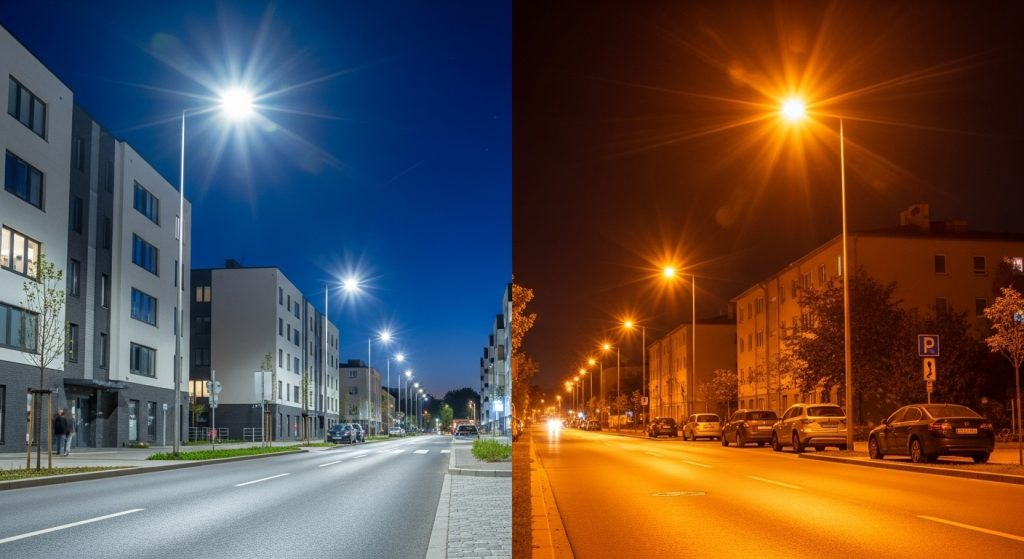
Evaluating the comparative efficiency of these systems requires looking at several real-world performance factors. You can see how usable illumination changes based on the technology you select for your poles.
- Energy consumption: LEDs offer significantly lower power use for the same level of visibility on the road.
- Light direction: LED systems provide directional, focused light, while sodium lamps are omni-directional and cause more spill.
- Usable illumination: A high percentage of LED light reaches the roadway, whereas sodium systems suffer significant loss to the surroundings.
- Warm-up time: You get instant full brightness with LEDs, but sodium lamps have a delayed warm-up period.
- Efficiency over time: LEDs maintain a stable output for years, while sodium output degrades much faster.
Mandatory Comparison Table:
| Efficiency factor | LED street lights | Sodium street lights |
|---|---|---|
| Energy consumption | Lower power use for same visibility | Higher power use |
| Light direction | Directional, focused on road | Omni-directional, more spill |
| Usable illumination | High percentage reaches roadway | Significant loss to surroundings |
| Warm-up time | Instant full brightness | Delayed warm-up |
| Efficiency over time | Stable output | Output degrades faster |
Why lumen output and beam control change efficiency outcomes
Your lumen output tells you the total amount of light leaving the fixture, but beam control determines its value. You could have a very high-lumen sodium lamp that still provides poor visibility if the light is scattered. LEDs allow you to manage light distribution with much more precision than gas lamps. By using specialized lenses, you can shape the light to fit the exact width of your street.
Sodium systems rely on large reflectors that are difficult to aim with accuracy. This often leads to “hot spots” directly under the pole and dark zones in between. You want a system that provides a smooth, even glow from end to end. Better control means you can use fewer lumens to achieve the same safety standards. This is the secret to why modern lighting feels so much clearer while using less energy.
How does wattage planning differ between LED and sodium street lights
Your wattage planning changes completely when you switch to modern semiconductor lighting. In the past, you might have used 250W or 400W sodium lamps to light a main road. You can often achieve the same or better results with a 100W or 150W LED unit. This massive power reduction is the primary reason for the lower energy demand on your city’s grid.
Planners no longer look at wattage as a measure of brightness. Instead, you should look at the lux levels on the pavement and the lumens per watt of the fixture. This allows you to pick the smallest possible power draw that still keeps the road safe. You will find that your infrastructure can support more lights with the same amount of available power. This flexibility is vital for growing cities with expanding road networks.
What operational factors make LEDs more efficient over time
The maintenance efficiency of your lighting network is just as important as the power bill. You will find that LEDs have a much longer system lifespan, often lasting five to ten times longer than sodium bulbs. This means your crews spend much less time in bucket trucks performing bulb swaps. You save a significant amount of money on labor and fuel for your repair vehicles.
Your long-term performance stays consistent because LEDs do not dim as quickly as gas-filled lamps. This reliability reduces the operational cost of your entire project over a twenty-year period. You also face fewer emergency calls for failed lights, which improves public perception of your infrastructure. An efficient system is one that works every night without needing constant attention. This stability is why modern projects almost always move away from legacy gas lamps.
What should decision makers verify before choosing LED or sodium lighting
You should conduct a thorough efficiency evaluation before you finalize your purchase. Your planning criteria must be based on the long-term goals of your community. Use this decision checklist to help guide your choice:
- Confirm the total power savings you expect over a ten-year period.
- Verify that the chosen light color supports driver visibility and community comfort.
- Check the warranty terms to ensure the drivers and modules are protected.
- Assess the ease of integrating smart controls for even more energy savings.
- Review the light distribution maps to ensure the road is lit evenly.
- Calculate the reduction in maintenance trips and labor costs.
- Ensure the fixtures meet all local environmental and dark-sky rules.
What are LED road and street lights and how do they improve efficiency
LED road and street lights are the modern standard for your street lighting systems. This LED technology allows you to get more brightness for less power than ever before. You can find these lights in every part of a city, from the smallest path to the largest highway. They are built to last for years and require very little maintenance from your crews. These fixtures are the best way to keep your community safe while lowering your energy use.
How do smart LED road lights with sensors increase lighting efficiency
Smart LED road lights with sensors help you manage your city’s power use more effectively. You use smart sensors to see exactly which streets are empty or busy at night. This allows for adaptive lighting where the lamps dim to save even more energy. You can manage your whole network from a single computer in your office. This makes your city smarter and more responsive to the needs of your people.
How do on-grid LED road lamps support efficient street lighting networks
On-grid LED road lamp units provide the power stability needed for your main roads. These on-grid systems connect directly to your city power lines for a steady stream of energy. You do not have to worry about batteries or the sun, making them very dependable. They are easy to set up on your existing poles and work with your current power grid. This is the most common way to light up a large road network safely.
How should planners use a street lighting lumens guide when comparing technologies
A Street lighting lumens guide helps you manage your lumen planning across different types of lamps. You can use it to set high brightness standards while keeping your power use low. The guide shows you how many lumens you need for a highway versus a local neighborhood. This prevents you from over-lighting areas and wasting money. It is a helpful tool that takes the guesswork out of your technical design work.
Why does LED street light beam angle matter in efficiency comparisons
The LED street light beam angle determines the light focus of your fixture. You need the right beam angle to make sure the light stays on the road and not in the sky. This allows you to use your lumens more effectively without wasting any power. A good angle helps you cover the whole street with a clean and even glow. It is a vital part of planning a professional and helpful lighting system.
How does wattage guidance help compare LED and sodium street lights
A LED road light wattage guide serves as a vital wattage reference for your energy comparison. It helps you see exactly how much power you can save by switching to LEDs. You might find that a low-wattage LED can replace a much more powerful sodium lamp. This guide ensures that you buy the right equipment for your specific road conditions. It takes the guesswork out of your design process and saves you money.


- 10 Meters Lamp Post
- 10 Meters Pole
- 1000w Led Projector
- 100W LED Tunnel Light
- 12 Meters Lamp Post
- 12 Meters Pole
- 1200w Led Projector
- 15 Light Pole
- 1500w Led Projector
- 150W LED Tunnel Light
- 1800w Led Projector
- 2 In 1 Solar Flood Light
- 200w Led Tunnel Light
- 50w Led Tunnel Light
- 6 Meters Lamp Post
- 6 Meters Pole
- 8 Meters Lamp Post
- 8 Meters Pole
- 800w Led Projector
- 80w Led Tunnel Light
- Colourful Decorative Light
- Conical post
- Courtyard Lamp
- courtyard light
- courtyard lighting fixture
- Decorative Landscape Light
- Decorative road Light
- Flood Light For Courtyard
- Flood Light for Garden
- Flood Light For Outdoor
- Foot Led High Bay Lights
- high bay led lights 100w
- industrial lampshade
- industrial LED shed lights
- industrial magnifying glass with light
- Integrated Solar Flood Light
- led courtyard lamp
- led courtyard light
- led high bay light 100w
- LED Projector For Stadium
- Led UFO High Bay 150W 5000k
- Lighting Plants Mining Price
- Maintenance Free LED Street Light
- Pic Controlling Tunnel Light
- PLC controlling tunnel light
- Post Top Garden Light
- RGB Landscape Light
- Rgbw Decorative Light
- Smart Tunnel Light
- solar courtyard lamp
- solar courtyard light
- Solar LED Road Light
- Solar Street Light For 10 Meter Pole
- Solar Street Light For 12 Meter Pole
- Solar Street Light For 6 Meter Pole
- Solar Street Light For 8 Meter Pole
- Split Type Solar Flood Light
- Sporting Projector
- Stadium Led Projector
- Street Lighting Post
