
 Request A Quote


Outdoor Wall Pillar and Residential Lighting Guide
 FACEBOOK
 TWITTER
 LINKEDIN
Planning residential exterior lighting is a multi-dimensional task that requires you to balance functional safety with a sophisticated aesthetic. Wall-mounted fixtures and pillar illumination act as the architectural anchors of your home’s night profile, providing the essential light needed for orientation and security. While wall lights typically focus on the structure itself—illuminating entrances and highlighting facade textures—pillar lights define the boundaries of your property, marking gates and garden perimeters. Together, they create a cohesive environment that makes your outdoor spaces feel as deliberate and welcoming as your interior rooms.
A successful layout relies on a clear planning logic that prioritizes visual balance. You must consider how light transitions from the bright primary entrance to the softer glow of a perimeter wall. Without a strategic approach, you risk over-lighting certain areas while leaving dangerous dark zones in others. By evaluating factors such as mounting height, light spread, and glare control before selecting your hardware, you ensure that your lighting serves its purpose without becoming an eyesore. This guide helps you navigate the complexities of residential planning, allowing you to create a secure, attractive, and high-performing lighting scheme that enhances your home’s curb appeal and functionality for years to come.
What types of outdoor wall and pillar lights are used in residential settings
In the realm of home exteriors, wall lighting typically includes fixtures mounted directly onto the structural facade. These are most commonly placed near front doors, along porch walls, or overlooking garage bays. These wall-mounted fixtures often feature “up-and-down” light paths, which emphasize the height of the building while providing a pool of light on the ground for safe passage. They act as the first line of defense in home security by ensuring that all entry points are clearly visible.
Pillar fixtures are vertical units designed to sit on top of stone, brick, or metal posts. These are traditionally found at the start of a driveway, marking a gateway, or at regular intervals along a boundary wall. Unlike wall lights, which are fixed to the main building, pillar lights push the illumination toward the edges of the property. This exterior illumination helps define the shape of your land and provides a sense of scale, making even large yards feel enclosed and secure. By using both types, you ensure the entire residential footprint is accounted for in your lighting design.
Why wall lights and pillar lights serve different lighting purposes
While both provide functional lighting, their roles in a layout are distinct. Wall lights are primarily about “task” and “ambient” illumination for the building itself. They ensure you can find your keys at the door and that the architectural details of your home are visible from the street. Because they are often at eye level, their design is highly visible, making them a key part of your home’s daytime aesthetic as well as its nighttime performance.
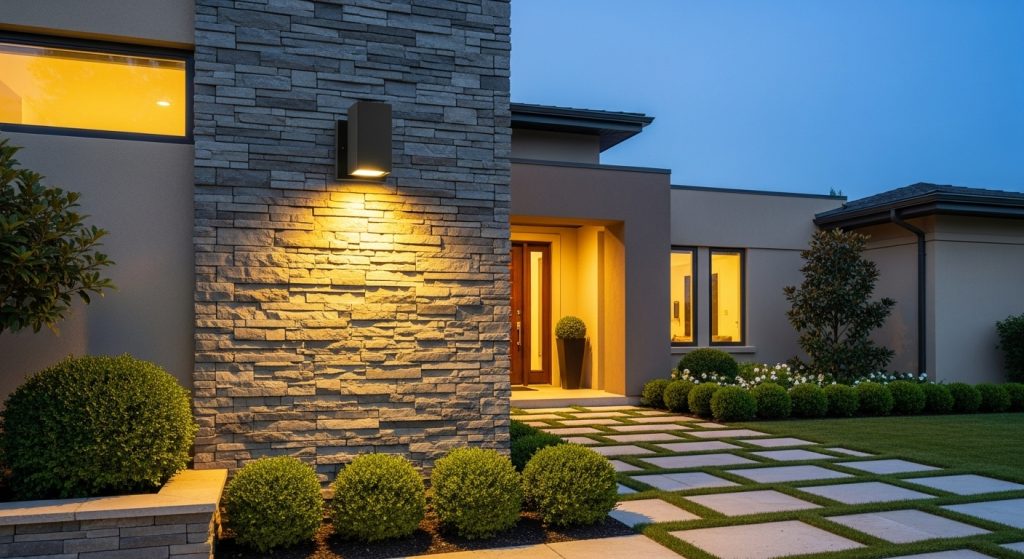
Pillar lights, conversely, are the masters of boundary definition. They provide the long-range “wayfinding” light that tells a visitor where the property begins and how the path leads toward the house. When you use them together, you achieve layered illumination—a professional technique where different light sources work at various heights and distances to eliminate flat, boring lighting. This layering adds depth to your property, making it look more luxurious and ensuring every corner of the landscape has a specific, well-lit purpose.
How fixture placement affects safety and visual clarity
Strategic light placement is the difference between a safe home and a hazardous one. You should prioritize areas with high foot traffic, such as the path from the garage to the kitchen door or the steps leading to a deck. Effective visibility planning ensures these transition zones have a consistent light flow, preventing the “black hole” effect where your eyes have to constantly adjust between extreme brightness and total darkness.
For safe navigation, you should also look for potential “hiding spots” along your home’s facade. A wall light placed in a deep alcove or a pillar light at a dark corner of the driveway removes the shadows that intruders might exploit. Consistent spacing between fixtures ensures the light pools overlap slightly, providing a continuous ribbon of brightness that makes the entire property feel open and easily monitored. By focusing on the “dark spots” during your site survey, you can place your fixtures where they will have the most impact on both safety and clarity.
How mounting height influences light spread and glare
The mounting height of your fixtures is a critical lever for light distribution. For wall-mounted lights near an entrance, the standard practice is to place the center of the light source roughly 60 to 66 inches above the floor. This keeps the light at a “human scale,” providing enough spread to light the floor and the door without shining directly into the eyes of arriving guests. If a light is mounted too high, the beam may dissipate before it reaches the ground; if it is too low, it can cause uncomfortable glare.
Glare control is equally important for pillar lights. Since these are often placed on top of structures that vary in height, you must ensure the lamp head is shielded or diffused. A pillar light on a tall 2-meter gate post will cast light further than one on a 1-meter garden wall. Planners must match the lumen output to the height; a taller mount requires more power to reach the ground, while a lower mount needs a softer touch to avoid blinding people. Finding this balance ensures your property is bright and clear without being aggressive to the senses.
How design styles shape residential wall and pillar lighting choices
Your choice of design style should be a direct reflection of your home’s architecture to maintain architectural harmony. For modern homes with clean lines and flat surfaces, minimalist metal fixtures with perforated or geometric patterns are a top choice. These designs often hide the light source, emphasizing the fixture aesthetics and the patterns they cast rather than the bulb itself. This creates a sophisticated, high-tech look that feels integrated into the building’s facade.
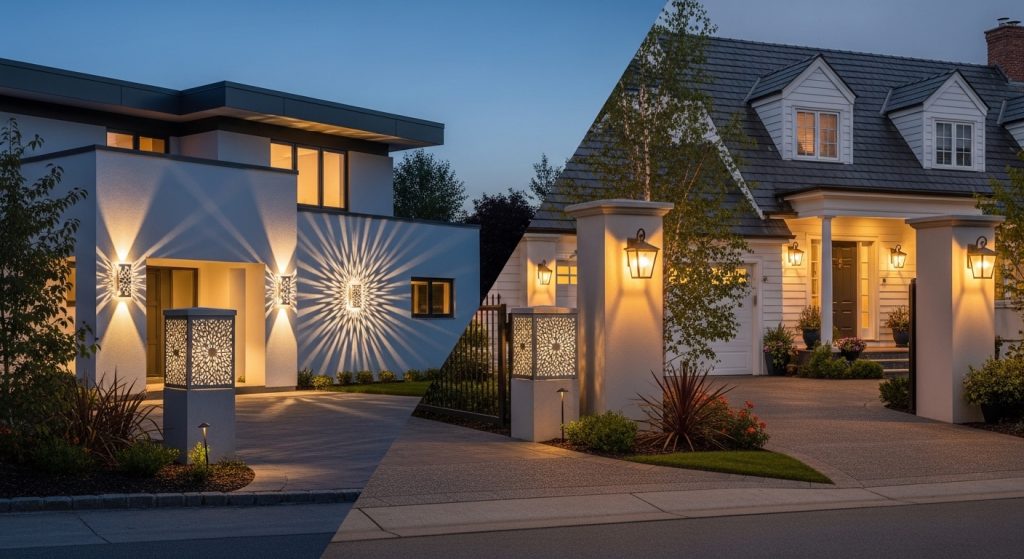
For traditional or cottage-style homes, you might prefer classic lantern shapes with frosted or seeded glass. Maintaining visual consistency across the property is the goal; your pillar lights should look like “cousins” to your wall lights, sharing the same metal finish or design motifs. This unified approach ensures the lighting doesn’t look like a collection of random parts, but rather a professional system that enhances the overall value and character of your residential project.
Why waterproofing and IP ratings matter for outdoor residential lights
Outdoor fixtures face constant weather resistance challenges, from heavy rain to wind-blown dust. An IP protection rating is a technical guarantee that a fixture’s housing is sealed against these elements. For wall and pillar lights that are fully exposed to the sky, a rating of at least IP65 is recommended. This ensures the light can handle a direct downpour and that garden debris won’t enter the casing to cause a short circuit or corrode the LED.
Prioritizing outdoor durability through high IP ratings is a long-term investment in your home. Lower-rated fixtures may work for a few months, but moisture will eventually seep in, causing the lens to fog or the electronics to fail. In a residential setting, you want “fit and forget” reliability. By choosing hardware with verified IP ratings and durable materials like aluminum or stainless steel, you ensure your investment stays bright and safe through every season, reducing the need for frustrating maintenance or early replacements.
How to integrate wall and pillar lights into a residential lighting layout
A professional lighting layout is about more than just these two fixture types; it’s about fixture coordination. You should think about how your wall and pillar lights interact with your garden spots and pathway bollards. Achieving a brightness balance is the key; your primary entrance should be the brightest point, with the light levels gently tapering off as you move toward the edges of the yard. This creates a natural hierarchy that is easy for the eyes to follow.
During the residential planning phase, you should avoid over-lighting. If every light is at maximum intensity, your property will look like a commercial parking lot rather than a home. Use wall lights to define the building’s shape and pillar lights to mark the gateways, then fill in the gaps with lower-lumen garden accents. This layered approach ensures the lighting is functional for safety but remains warm and inviting for social gatherings, making your outdoor space a true extension of your home’s living area.
What common mistakes reduce effectiveness of wall and pillar lighting
One of the most frequent design mistakes is a lighting imbalance caused by poor spacing. If wall lights are placed too far apart, you create “dark gaps” that are disorienting and unsafe. Another common blunder is choosing a mounting height based on aesthetics alone without considering where the light actually falls. A beautiful fixture is useless if it spends most of its energy lighting the roof instead of the walkway.
Performance issues also arise from ignoring the “glare zone.” If a wall light has an unshielded bulb at eye level, it will blind guests as they approach the door. Similarly, putting high-output pillar lights near a neighbor’s bedroom window is a planning error that can cause friction. To avoid these blunders, you should always conduct a “night walk” with a high-powered flashlight to visualize the light spread before you commit to a permanent installation. By anticipating how the light moves, you can create a layout that is as professional as it is practical.
What checklist should be reviewed before finalizing residential wall and pillar lighting
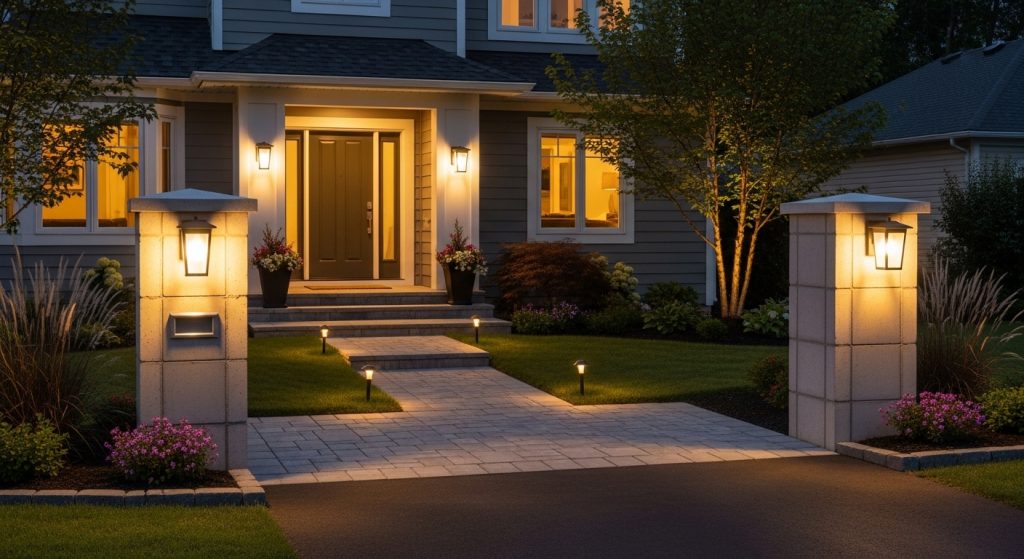
Before you finalize your order or start the installation, a thorough site review ensures that your design validation is complete. This planning checklist helps you catch minor errors before they become expensive permanent problems. By verifying your goals now, you can move forward with absolute confidence in your home’s new lighting scheme.
- Entrance Focus: Is the front door the brightest and most welcoming point in the layout?
- Safety Path: Have you provided consistent light for all stairs and major walkways?
- Mounting Height: Are the wall lights at a height that prevents glare while lighting the floor?
- IP Verification: Do all exposed fixtures have a rating of IP65 or higher for outdoor durability?
- Style Match: Do the wall and pillar lights share a consistent finish and architectural theme?
- Light Direction: Are you using “downward” lighting to prevent light pollution and glare?
- Maintenance Access: Can you easily reach the fixtures for occasional cleaning or bulb changes?
What outdoor metal LED wall lights are used for in residential exteriors
Outdoor metal LED wall light fixtures are the workhorses of facade lighting. Constructed from durable materials like aluminum, these metal wall lights provide the primary illumination for home entrances and porches. They are designed to withstand the elements while offering a sharp, modern look that complements a wide range of residential architectural styles.
How perforated outdoor wall lamps control light and glare
A Perforated wall lamp outdoor utilizes a unique perforated design to achieve superior glare reduction. By filtering the light through intricate patterns, these lamps provide a soft, decorative glow that is comfortable for the eyes. They are an ideal choice for residential areas where you want to add visual interest while maintaining a high level of lighting comfort.
Why metal LED pillar lights are used at entrances and boundaries
Metal LED pillar light units are essential for entry illumination. These pillar lighting fixtures act as beacons that define the boundaries of your property. By placing them on top of gate posts or perimeter walls, you provide the necessary orientation for arriving guests while enhancing the security and curb appeal of your residential estate.
How LED tree lights complement wall and pillar lighting layouts
Integrating an LED tree light landscape unit into your plan adds depth to your tree lighting. These landscape accents work in harmony with your wall and pillar lights to create a multi-layered effect. By lighting up the natural features of your garden, you expand the perceived size of your yard and create a more immersive and beautiful outdoor environment.
What IP ratings outdoor wall lights need for reliable weather protection
Reviewing a Waterproof wall lights IP guide is vital for long-term reliability. A high IP rating ensures your wall-mounted fixtures can handle constant weather exposure. Choosing the right level of protection prevents moisture from entering the housing, protecting your home’s electrical circuits and ensuring the LEDs remain bright through all seasons.
How pillar light usage varies across residential spaces
The Pillar light uses guide explains the various pillar applications for your home. From marking residential boundaries to providing task light for a driveway gate, these fixtures are highly versatile. Understanding how to use them effectively allows you to create a lighting plan that is both functional for security and aesthetically pleasing for your guests.
Why IP65, IP66, and IP67 ratings matter for outdoor residential lighting
An IP65 IP66 IP67 rating guide provides an IP comparison that is essential for selecting outdoor protection. Depending on how exposed your fixtures are to wind and rain, you may need a higher level of sealing. Knowing the difference between these ratings ensures you pick the most durable hardware for your specific local climate and site conditions.
How residential garden lighting layouts integrate wall and pillar lights
A Residential garden lighting layout focuses on fixture coordination. By planning your wall and pillar lights as part of a single garden lighting layout, you ensure a consistent look and feel across the entire property. This holistic approach prevents clashing styles and ensures the brightness levels are balanced for both safety and beauty.
How perforated light designs help manage glare in residential areas
The Perforated lights glare control guide explains how these fixtures provide glare management. By shielding the direct light source, visual comfort is significantly improved for pedestrians. This makes perforated designs a smart choice for high-traffic residential areas where safety and a relaxing atmosphere must go hand-in-hand.
What mounting height works best for outdoor wall lights in homes
Following an Outdoor wall light mounting height guide ensures correct light positioning. Choosing the right mounting height prevents the light from being too aggressive or too dim. By placing your wall-mounted fixtures at the optimal level, you maximize the light spread across your entrance while maintaining a professional and attractive look for your home.



- 10 Meters Lamp Post
- 10 Meters Pole
- 1000w Led Projector
- 100W LED Tunnel Light
- 12 Meters Lamp Post
- 12 Meters Pole
- 1200w Led Projector
- 15 Light Pole
- 1500w Led Projector
- 150W LED Tunnel Light
- 1800w Led Projector
- 2 In 1 Solar Flood Light
- 200w Led Tunnel Light
- 50w Led Tunnel Light
- 6 Meters Lamp Post
- 6 Meters Pole
- 8 Meters Lamp Post
- 8 Meters Pole
- 800w Led Projector
- 80w Led Tunnel Light
- Colourful Decorative Light
- Conical post
- Courtyard Lamp
- courtyard light
- courtyard lighting fixture
- Decorative Landscape Light
- Decorative road Light
- Flood Light For Courtyard
- Flood Light for Garden
- Flood Light For Outdoor
- Foot Led High Bay Lights
- high bay led lights 100w
- industrial lampshade
- industrial LED shed lights
- industrial magnifying glass with light
- Integrated Solar Flood Light
- led courtyard lamp
- led courtyard light
- led high bay light 100w
- LED Projector For Stadium
- Led UFO High Bay 150W 5000k
- Lighting Plants Mining Price
- Maintenance Free LED Street Light
- Pic Controlling Tunnel Light
- PLC controlling tunnel light
- Post Top Garden Light
- RGB Landscape Light
- Rgbw Decorative Light
- Smart Tunnel Light
- solar courtyard lamp
- solar courtyard light
- Solar LED Road Light
- Solar Street Light For 10 Meter Pole
- Solar Street Light For 12 Meter Pole
- Solar Street Light For 6 Meter Pole
- Solar Street Light For 8 Meter Pole
- Split Type Solar Flood Light
- Sporting Projector
- Stadium Led Projector
- Street Lighting Post
