
 Request A Quote


Are Perforated Outdoor Lights Good for Glare Control
 FACEBOOK
 TWITTER
 LINKEDIN
Determining whether perforated outdoor lights are effective for glare control requires looking past their decorative appeal to their functional engineering. Glare occurs when a high-intensity light source is directly visible to the eye, causing visual discomfort and temporarily reducing a person’s ability to see clearly. Perforated housings address this by acting as a structural shield, breaking up the direct path of light into smaller, manageable beams. Instead of a single, blinding “hot spot,” the light is filtered through intricate patterns, which significantly reduces the perceived brightness at typical viewing angles. This makes them an excellent choice for visual comfort in residential settings where lights are often mounted at eye level.
The effectiveness of these fixtures depends heavily on the relationship between the internal light output and the density of the perforation. When specified correctly, they provide a soft illumination that is ideal for entrances, porches, and pathways. However, perforation alone is not a universal fix; if the internal LED is excessively bright, light can still “leak” through the openings and cause irritation. Ultimately, perforated lights are a powerful tool for achieving a balanced outdoor lighting environment. They provide the necessary safety and security light while ensuring that the garden remains a relaxing and welcoming space for residents and guests alike.
What causes glare problems in outdoor lighting
Glare is essentially a conflict between different light intensity levels within the human field of vision. It occurs when a light source—often a bare LED chip or a clear-lensed bulb—is much brighter than the surrounding environment. This is a common issue in outdoor lighting where the backdrop is a dark night sky. When your eyes encounter these glare sources, they struggle to adjust, leading to squinting, eye strain, and a temporary loss of detail in the shadows.
Residential areas are particularly prone to these issues near entrances and walkways, where wall lights are frequently mounted at eye level. High-output security lights with unshielded optics are the primary culprits, creating harsh contrast that makes the yard feel industrial rather than inviting. Understanding that glare is a physical byproduct of unmanaged brightness is the first step in selecting fixtures that prioritize visual discomfort prevention and create a more professional-looking landscape.
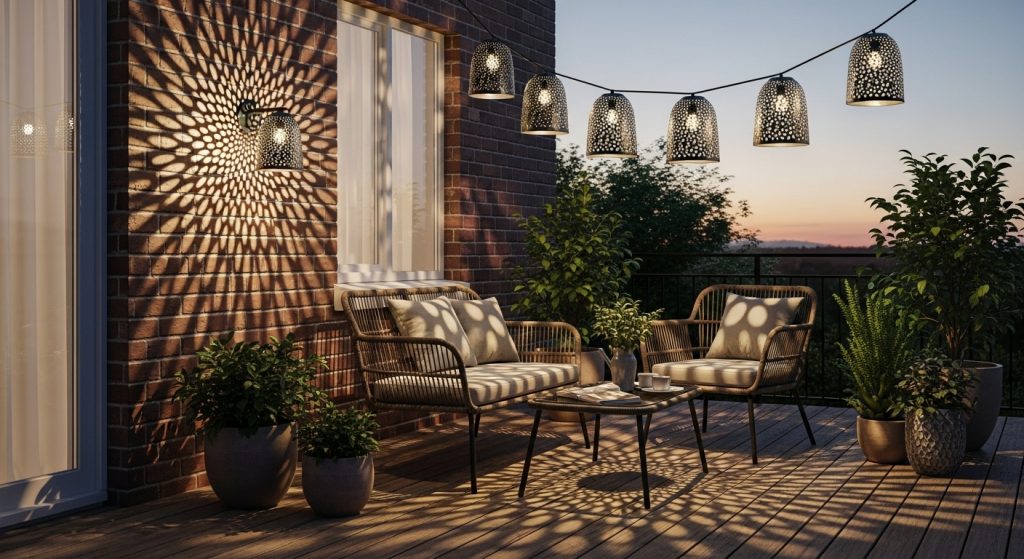
How perforated housings change the way light exits a fixture
A perforated housing functions as a complex optical filter that manages the light diffusion of the fixture. Unlike a solid metal shell that completely blocks light or a glass lens that transmits it all, the perforation creates a series of precisely engineered light openings. As the photons travel from the LED, they are forced to interact with the metal “web” of the housing. This physical barrier blocks the direct line of sight to the bulb, ensuring that most of the light you see is reflected or filtered.
This interaction breaks up the concentrated beam of a standard light source into hundreds of smaller, lower-intensity points of light. This controlled output is much gentler on the eye because it reduces the “dazzle” effect. By spreading the light across a larger surface area (the patterned housing), the fixture achieves a more uniform glow. This engineering choice turns the entire body of the lamp into a diffuser, ensuring that the illumination remains functional for safety without being aggressive to the senses.
When perforated outdoor lights improve visual comfort
The primary benefit of perforated designs is the massive improvement in visual comfort for pedestrians. These fixtures are at their most effective when used near front doors, on patio walls, or along low-lying garden pillars. Because they shield the eyes from the “piercing” quality of modern LEDs, they allow visitors to approach the home without being blinded. This creates a much more welcoming soft illumination that sets a relaxed tone for the entire property.
In controlled lighting scenarios, such as a backyard seating area or a narrow side path, perforated lights provide the necessary orientation without ruining the ambiance. They allow you to maintain “night vision”—the ability of your eyes to see into the darker corners of the yard—because they don’t flood the environment with excessive, unmanaged light. By providing a clear but gentle guide, these fixtures ensure that your outdoor spaces feel secure and high-end, proving that functionality and decorative style can work in perfect harmony.
Where perforated designs fall short in glare reduction
While effective, perforated fixtures are not immune to design limitations. The most common failure occurs when the internal light source is significantly overpowered for the housing. If you place a high-lumen, unshielded bulb inside a fixture with large, sparse perforations, you will still experience light leakage that causes glare. In these cases, the perforation serves more as an aesthetic detail than a functional shield, leading to an ineffective shielding result.
The pattern of the perforation also matters. If the cutouts are too large or aligned directly with the primary viewing angle, the “glare control” is lost. Furthermore, perforated designs are generally not suitable for “area lighting” where you need a single fixture to throw light over a vast distance, like a large driveway. In those high-output applications, the perforation would block too much of the light needed for safety. Understanding these limits helps you place perforated lights where they thrive—as intimate, comfortable guides rather than heavy-duty floodlights.
How fixture brightness and perforation must work together
Achieving a perfect fixture balance requires a delicate match between the light output and the physical design of the shell. For the best glare-control results, perforated lights should utilize lower-lumen LEDs or internal diffusers (like frosted sleeves) that pre-soften the light before it reaches the cutouts. This ensures that the light emerging from the patterns is a “glow” rather than a “beam.” This brightness control is the secret to a professional landscape.
When selecting a fixture, you should look for the ratio of “open space” to metal. A denser pattern with smaller holes provides superior glare control but lower overall light spread. A sparser pattern provides more light but carries a higher risk of irritation. By matching the fixture selection to the specific needs of the space—prioritizing comfort for social areas and output for navigation—you can ensure that the perforation is doing its job effectively.
How mounting height influences glare control in perforated lights
The mounting height of a fixture significantly dictates the viewing angle and how much glare a person will perceive. For wall-mounted perforated lights, the “glare zone” is typically at eye level (between 5 and 6 feet). If a fixture is mounted at this height, the perforation is the only thing protecting the user from the bulb. If the light is mounted much higher, the user is looking up at the fixture from underneath, which can change how the light is shielded.
[Image showing viewing angles and glare zones for wall-mounted outdoor lights]
Effective installation planning involves testing the sightlines from your primary walkways. If a light causes discomfort, moving it just six inches higher or lower can often tuck the bulb behind a solid part of the perforated pattern, resolving the issue. For pillar lights, which are often lower, the perforation is excellent at providing 360-degree light while keeping the source below the direct line of sight of arriving drivers. Coordinating height and design ensures that the light remains a helpful guide rather than a distraction.
What common mistakes reduce glare performance in perforated fixtures
One of the most frequent installation errors is a lighting misuse involving the “wrong bulb.” Homeowners often replace a factory LED with a much brighter, unshielded “corn bulb” or clear filament lamp, which “blows out” the glare-control benefits of the perforation. Another common blunder is poor placement near highly reflective surfaces like glossy white walls or large glass windows. These surfaces can catch the “leaked” light and bounce it back into the eyes, causing a visual imbalance.
Ignoring the primary user’s height is also a pitfall. A light that looks comfortable to a tall adult might be at the perfect “glare angle” for a child or someone sitting on low patio furniture. To avoid these blunders, you should always view the fixture from multiple positions—sitting, standing, and walking—during the planning phase. By anticipating how the light interacts with the surrounding environment, you can ensure that your perforated fixtures deliver on their promise of superior comfort and safety.
How to decide if perforated outdoor lights are right for your space
Before finalizing your fixture selection, a thorough glare evaluation is necessary to ensure the hardware meets your functional goals. This decision checklist helps you match the design to the reality of your site, ensuring a professional and comfortable result for your property.
- Primary Location: Is the light for a social area where visual comfort is the priority?
- Mounting Height: Will the light be at eye level for pedestrians or drivers?
- Brightness Level: Is the lumen count modest enough to be softened by the perforation?
- Internal Diffusion: Does the fixture have a frosted sleeve to prevent light leakage?
- Pattern Style: Does the density of the cutouts provide enough shielding for your needs?
- Viewing Distance: Will users be standing right next to the light or seeing it from afar?
- Layout Consistency: Does the design match your Outdoor wall pillar residential lights?
What outdoor wall and pillar lights commonly address glare issues
Outdoor wall pillar residential lights refer to the primary fixtures used on facades and boundaries. Because these wall lighting and pillar fixtures are often placed at eye level, selecting designs with built-in glare control is essential for creating a safe and welcoming residential environment.
How metal outdoor LED wall lights manage brightness and shielding
Choosing an Outdoor metal LED wall light provides a durable metal housing that acts as a natural shield. These materials allow for the light control needed to push illumination downward toward the path while protecting the eyes of anyone approaching the building.
How perforated outdoor wall lamps are designed to reduce glare
A Perforated wall lamp outdoor is specifically engineered for glare reduction. By utilizing a perforated design to filter the light, these lamps provide a soft, patterned glow that is comfortable for the eyes. They are the ideal choice for high-traffic areas where safety and ambiance must be balanced.
How mounting height decisions affect glare from outdoor wall lights
Following an Outdoor wall light mounting height guide is critical for maintaining visual comfort. The mounting height determines the angle at which people view the light source. By placing your fixtures at the optimal level, you can maximize the shielding benefits of perforated designs and ensure a professional-looking layout.



- 10 Meters Lamp Post
- 10 Meters Pole
- 1000w Led Projector
- 100W LED Tunnel Light
- 12 Meters Lamp Post
- 12 Meters Pole
- 1200w Led Projector
- 15 Light Pole
- 1500w Led Projector
- 150W LED Tunnel Light
- 1800w Led Projector
- 2 In 1 Solar Flood Light
- 200w Led Tunnel Light
- 50w Led Tunnel Light
- 6 Meters Lamp Post
- 6 Meters Pole
- 8 Meters Lamp Post
- 8 Meters Pole
- 800w Led Projector
- 80w Led Tunnel Light
- Colourful Decorative Light
- Conical post
- Courtyard Lamp
- courtyard light
- courtyard lighting fixture
- Decorative Landscape Light
- Decorative road Light
- Flood Light For Courtyard
- Flood Light for Garden
- Flood Light For Outdoor
- Foot Led High Bay Lights
- high bay led lights 100w
- industrial lampshade
- industrial LED shed lights
- industrial magnifying glass with light
- Integrated Solar Flood Light
- led courtyard lamp
- led courtyard light
- led high bay light 100w
- LED Projector For Stadium
- Led UFO High Bay 150W 5000k
- Lighting Plants Mining Price
- Maintenance Free LED Street Light
- Pic Controlling Tunnel Light
- PLC controlling tunnel light
- Post Top Garden Light
- RGB Landscape Light
- Rgbw Decorative Light
- Smart Tunnel Light
- solar courtyard lamp
- solar courtyard light
- Solar LED Road Light
- Solar Street Light For 10 Meter Pole
- Solar Street Light For 12 Meter Pole
- Solar Street Light For 6 Meter Pole
- Solar Street Light For 8 Meter Pole
- Split Type Solar Flood Light
- Sporting Projector
- Stadium Led Projector
- Street Lighting Post
