
 Request A Quote


Polygon Light Pole for Highways and Stadiums
 FACEBOOK
 TWITTER
 LINKEDIN
When you are tasked with lighting vast, high-stakes areas like multi-lane highways or professional stadiums, standard poles often fall short of the required structural strength. Polygon light poles are specifically engineered for these high-load environments, featuring a faceted, multi-sided design that offers superior resistance to bending and twisting. Unlike simple round poles, the edges of a polygon structure act as natural reinforcement ribs, providing the lighting stability necessary to keep heavy luminaires steady, even at extreme heights. This unique geometry makes them a premier choice for planners who need to balance massive equipment loads with public safety.
Choosing a polygon design is a matter of design suitability for demanding infrastructure. These poles are not just about holding a light; they are about managing the complex physics of wind, weight, and vibration over decades of service. Because highways and stadiums are often exposed to unobstructed wind, the pole must be capable of dissipating force without failing. By selecting a polygon configuration, you ensure that your lighting system remains a reliable asset that can handle the specific stresses of large-scale projects. This specialized hardware provides the backbone for consistent, high-performance illumination in the most challenging outdoor settings.
What makes polygon light poles different from straight or tapered poles
The primary distinction of a polygon light pole lies in its pole geometry, which consists of several flat longitudinal facets—typically 8, 12, or 16 sides—rather than a smooth circular surface. This multi-sided cross-section significantly enhances structural rigidity. While a straight pole maintains a uniform diameter and a standard tapered pole relies on a circular decrease in width, the corners of a polygon pole serve as integrated structural members. These “bends” in the metal increase the moment of inertia, allowing the pole to resist much higher forces before deforming.
From a functional perspective, this shape allows for more efficient load distribution. When wind hits a faceted surface, the pressure is managed differently than on a curved one, often reducing the tendency of the pole to oscillate or vibrate. This makes polygon poles particularly effective when you need to mount multiple heavy fixtures or long outreach arms. While they may appear more industrial than decorative poles, their performance-to-weight ratio is often superior, providing a high-strength solution that is easier to transport and install than solid-walled alternatives.
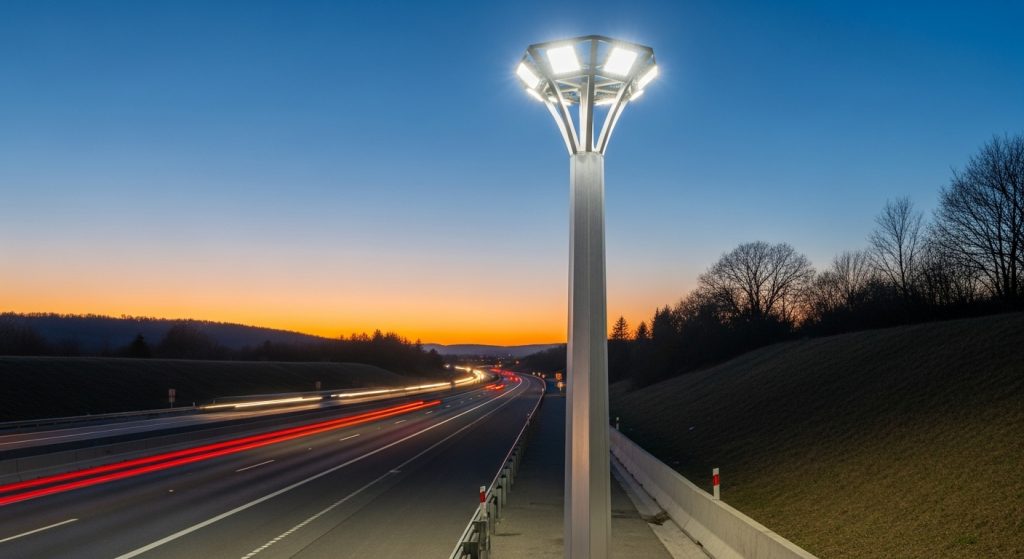
Why polygon light poles are suitable for highway lighting environments
Highway environments present a unique set of challenges, most notably a high wind load tolerance requirement. Because highways are often elevated or located in open plains, poles are subjected to constant, high-velocity wind gusts and the “truck pluck” effect—the sudden air pressure changes caused by speeding heavy vehicles. Polygon poles are built to withstand these forces without fatigue, ensuring roadside durability over long stretches of infrastructure. Their faceted design prevents the microscopic swaying that can lead to metal cracking over time.
For planners, the goal is to provide continuous coverage over several lanes of traffic. This often requires mounting lights at heights of 30 to 50 feet. A polygon pole can maintain its vertical integrity at these heights even when supporting large, high-wattage LED fixtures. The strength of the faceted design allows for longer intervals between poles, which reduces the total number of obstacles on the roadside and lowers project costs. By using polygon structures, you create a highway lighting system that is both cost-effective and resilient against the harsh reality of high-speed transit environments.
Why stadium lighting demands strong pole structures
Stadium lighting represents the extreme end of the load capacity spectrum. To illuminate a massive sports field evenly, luminaires must be placed at an immense mounting height, often exceeding 100 feet. At these heights, the weight of the fixtures is compounded by the leverage of the pole itself. Furthermore, stadium poles often carry large “banks” of lights, sometimes dozens of units on a single headframe, which creates a massive wind-sail area. Only a polygon structure provides the necessary stiffness to prevent these tall towers from leaning.
Beyond static weight, stadium poles must survive dynamic forces such as seismic activity and high-altitude turbulence. Vibrations caused by wind or nearby machinery can be magnified at the top of a tall pole, potentially damaging the sensitive electronic drivers in modern LED systems. The inherent dampening qualities of a multi-sided polygon pole help to neutralize these vibrations, protecting your investment in lighting technology. When you plan a stadium project, the pole is the anchor of your entire visibility strategy; if the structure sways, the light on the field shifts, which can compromise the safety of athletes and the experience of fans.
What design factors must be considered for polygon pole installations
Successful design planning for polygon poles begins with a precise calculation of the “Effective Projected Area” (EPA). This involves analyzing how much wind resistance the total surface area of the pole and its attachments will generate. You must ensure that the fixture integration—including the headframe, arms, and brackets—does not exceed the rated capacity of the pole’s multi-sided profile. If you overload one side of a faceted pole, you risk uneven stress that can lead to structural failure.
Planners also need to prioritize structural testing and safety margins. Because these poles are often used in crowded public spaces like stadiums or busy highway interchanges, the “factor of safety” must be rigorously applied. This includes reviewing the base plate thickness and the anchor bolt circle to ensure the foundation can handle the massive overturning moment of a tall, multi-sided tower. By verifying these design factors during the procurement phase, you prevent costly field modifications and ensure that the installation proceeds smoothly and safely.
How environmental conditions influence polygon pole performance
Polygon poles are frequently subjected to intense environmental stress, and their performance is directly tied to their material durability. In areas with high humidity or industrial pollution, the facets of the pole can trap moisture or chemicals more easily than a round surface if not properly finished. For this reason, hot-dip galvanization is a standard specification, as it ensures that the protective zinc layer reaches into every corner of the polygon shape to prevent rust and maintain wind resistance.
Temperature fluctuations also play a role in the health of the metal. In regions with extreme seasonal changes, the metal undergoes constant expansion and contraction, which can lead to metal fatigue at the welding seams of the facets. High-quality polygon poles are designed to absorb these thermal stresses without compromising their structural integrity. By choosing a pole built for your specific climate zone, you ensure that the structure remains a permanent, safe fixture that won’t require premature replacement due to weather-induced degradation.
What role do arms and brackets play with polygon poles in large spaces
In large open areas, the arm configuration is what allows you to direct light toward specific zones while the pole provides the lift. Polygon poles are particularly well-suited for complex bracket support because their flat faces provide a stable mounting surface for attachment hardware. Unlike round poles, where brackets must rely on friction and curved clamps, a bracket on a polygon pole can be bolted directly to a flat side, which significantly reduces the risk of the arm slipping or rotating during a storm.
Proper load sharing across these arms is vital for maintaining the balance of the pole. If you are lighting a stadium, you might use a circular or rectangular headframe that distributes the weight of 20 or more luminaires around the top of the polygon tower. This ensures that the vertical force is pushed straight down through the center of the structure, maximizing the efficiency of the metal. By coordinating the arms and brackets with the faceted sides of the pole, you achieve a level of precision in light placement that is difficult to replicate with simpler structural designs.
What common mistakes compromise polygon pole performance
A frequent cause of design errors is the structural mismatch created by adding additional equipment, such as security cameras or cellular antennas, to a pole without recalculating the wind load. Because polygon poles are often specified to their near-limit for highway or stadium use, even a small increase in surface area can push the structure into a danger zone. Another mistake is using generic brackets that are not designed for the specific number of facets on the pole, leading to “gaps” where water can enter and cause internal corrosion.
Performance gaps also occur when planners neglect the foundation design. A tall polygon pole exerts incredible leverage on its base. If the concrete foundation is too shallow or the soil strength was underestimated, the pole will begin to lean, even if the metal structure itself is perfect. To avoid these failures, you must treat the pole, the hardware, and the ground as a single integrated system. Neglecting any one of these elements can lead to a catastrophic failure that endangers the public and ruins the lighting layout.
What checks should planners complete before finalizing polygon pole selection
Before you finalize your order for polygon poles, you must complete a thorough design validation to ensure that the hardware is ready for the specific demands of your site. This is your final opportunity to catch errors in load calculation or compatibility before the equipment arrives for installation readiness.
Use this selection checklist to safeguard your project:
- Confirm the facet count (e.g., 12-sided) matches the required stiffness for the mounting height.
- Verify that the wind load (EPA) rating includes all planned luminaires, arms, and future attachments.
- Check that the bracket mounting system is specifically designed for the flat faces of the polygon pole.
- Ensure the material finish (galvanization or specialized paint) is rated for the local environment.
- Validate the foundation specs against a site-specific soil report.
- Review the internal wire-way space to ensure it can accommodate the power cables for large banks of lights.
- Confirm that the pole meets all regional DOT or sports association structural standards.
What specifications should street light poles and brackets meet for large-scale projects
For large-scale projects, you must ensure that structural standards are met by choosing a verified bracket selection. This means the hardware used to attach the light to the polygon pole must be rated for the same wind zone as the pole itself. You should look for specifications that detail the grade of steel and the type of fasteners used, ensuring that every bolt is high-tensile and corrosion-resistant. For more details on these requirements, see our guide on Street light poles brackets.
How do straight light poles compare with polygon poles in structural use
A design comparison shows that while straight poles are excellent for aesthetic application suitability in parks, they lack the raw power of polygon designs. Polygon poles are much more efficient at handling “top-heavy” loads because their faceted geometry naturally resists buckling. If your project involves high mounting heights or extreme wind, the polygon pole is almost always the technically superior choice. You can find more on straight pole limits in the Straight light pole specs documentation.
What benefits do foldable light poles offer for installation and maintenance
In some large projects, you might use foldable poles to complement your main polygon towers. These offer superior maintenance access because they can be lowered for servicing. This increases installation efficiency in areas where a large crane or bucket truck cannot reach. While they are usually used for smaller areas, they share the same need for high-quality materials as larger polygon structures. Learn more about these versatile options in the Foldable light pole benefits overview.
How do lighting pole arms and brackets affect polygon pole load requirements
The Lighting pole arm bracket is the primary source of eccentric loading. This means that the further an arm extends from the flat face of a polygon pole, the more torque it creates at the base. Planners must ensure that the arm brackets are positioned to optimize load distribution, preventing the pole from twisting. High-quality brackets are designed to lock onto the facets, creating a rigid connection that maintains light alignment even in heavy storms.
How does tapered pole design compare to polygon poles for load handling
A structural comparison between round tapered and polygon poles often comes down to manufacturing and local wind patterns. While a Tapered light pole explained highlights the benefits of a smooth tapered design, the polygon pole is often preferred for high-mast stadium use because the flat sides allow for easier mounting of complex, multi-light headframes. Both designs use geometry to increase strength, but the polygon’s “folded” edges provide an extra layer of stiffness for the tallest installations.
Why wind load calculation is essential for polygon poles on highways and stadiums
A rigorous wind load analysis is the only way to ensure structural safety for highway and stadium projects. Because these poles are often in open, exposed locations, you must calculate the total pressure against the facets of the pole. The Light pole wind load calculation must account for the specific wind speeds of your region, ensuring that the pole won’t snap under peak gust conditions. Without this math, you are essentially guessing with public safety.
How does foundation design support polygon light pole stability in large projects
Effective foundation design is the hidden half of pole anchoring. For a large polygon pole, the concrete base must be deep enough to resist the massive leverage created by its height. A Street light pole foundation must be engineered based on the soil’s ability to resist lateral forces. Without a correctly calculated foundation, the most advanced polygon pole in the world will still fail if the ground beneath it gives way during a storm.
Final Thought
Polygon light poles provide the essential structural foundation for the world’s most demanding lighting projects. By utilizing the physics of faceted geometry, these poles offer the raw strength needed for highways and stadiums without unnecessary bulk. When you prioritize correct load calculations, environmental resistance, and foundation design, you create a lighting system that stands firm against time and the elements.


- 10 Meters Lamp Post
- 10 Meters Pole
- 1000w Led Projector
- 100W LED Tunnel Light
- 12 Meters Lamp Post
- 12 Meters Pole
- 1200w Led Projector
- 15 Light Pole
- 1500w Led Projector
- 150W LED Tunnel Light
- 1800w Led Projector
- 2 In 1 Solar Flood Light
- 200w Led Tunnel Light
- 50w Led Tunnel Light
- 6 Meters Lamp Post
- 6 Meters Pole
- 8 Meters Lamp Post
- 8 Meters Pole
- 800w Led Projector
- 80w Led Tunnel Light
- Colourful Decorative Light
- Conical post
- Courtyard Lamp
- courtyard light
- courtyard lighting fixture
- Decorative Landscape Light
- Decorative road Light
- Flood Light For Courtyard
- Flood Light for Garden
- Flood Light For Outdoor
- Foot Led High Bay Lights
- high bay led lights 100w
- industrial lampshade
- industrial LED shed lights
- industrial magnifying glass with light
- Integrated Solar Flood Light
- led courtyard lamp
- led courtyard light
- led high bay light 100w
- LED Projector For Stadium
- Led UFO High Bay 150W 5000k
- Lighting Plants Mining Price
- Maintenance Free LED Street Light
- Pic Controlling Tunnel Light
- PLC controlling tunnel light
- Post Top Garden Light
- RGB Landscape Light
- Rgbw Decorative Light
- Smart Tunnel Light
- solar courtyard lamp
- solar courtyard light
- Solar LED Road Light
- Solar Street Light For 10 Meter Pole
- Solar Street Light For 12 Meter Pole
- Solar Street Light For 6 Meter Pole
- Solar Street Light For 8 Meter Pole
- Split Type Solar Flood Light
- Sporting Projector
- Stadium Led Projector
- Street Lighting Post
