
 Request A Quote


How to reduce glare in outdoor sports field lighting for comfort and performance
 FACEBOOK
 TWITTER
 LINKEDIN
Glare in sports field illumination is more than a mere distraction; it is a significant barrier to safety and athletic performance. It occurs when a high-intensity light source is directly visible within a person’s field of vision, causing visual discomfort and reducing the eye’s ability to perceive contrast. For players tracking a high-velocity ball, glare can create “blind spots” that lead to errors or injury.
Similarly, for spectators and officials, unmanaged light spill ruins the experience and hinders the ability to follow the action clearly. Reducing glare requires a multi-layered approach that moves beyond raw lumen output to focus on the precision of the light path, ensuring that the field remains bright while the source remains unobtrusive.
Effective glare reduction is achieved through a combination of strategic fixture selection, precise beam control, and thoughtful installation. By utilizing advanced optics that shape the light into tight, functional cones, designers can drive illumination exactly where it is needed on the grass while cutting off “stray” light that would otherwise bleed into the stands or the sky.
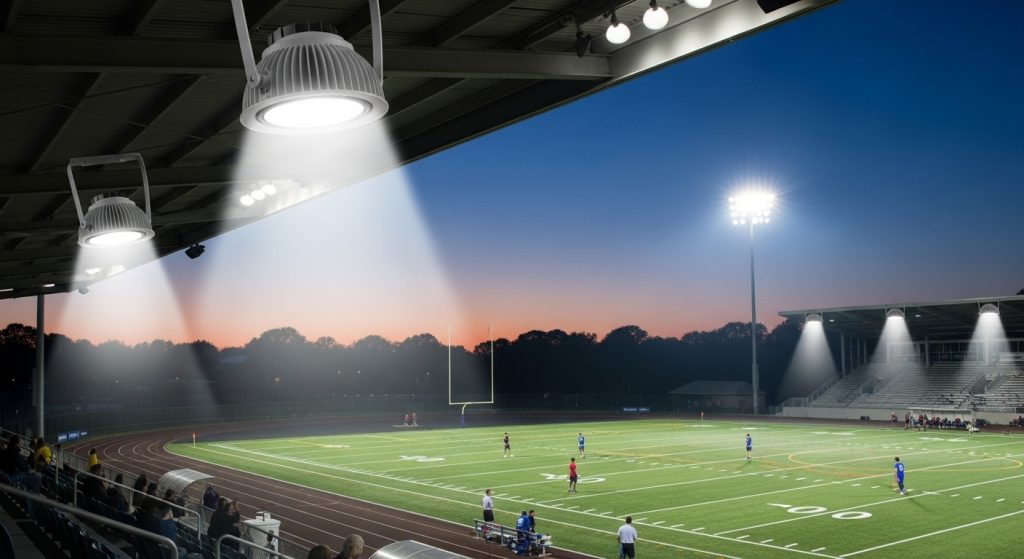
Coordinating pole height with targeted aiming angles is the final piece of the puzzle. When lights are mounted high and aimed at a steep downward angle, the intensity remains on the activity zone, shielding the eyes of athletes and fans from the direct “piercing” quality of high-output LEDs. Proper planning ensures a professional environment where performance and comfort exist in perfect harmony.
What causes glare in outdoor sports lighting and why it matters
In the context of athletic venues, direct glare is primarily caused by an unobstructed view of the LED light engine from standard playing or viewing positions. Because sports lighting requires extreme intensity to support fast-paced movement, the “hot spot” of an unshielded bulb is significantly brighter than the surrounding dark sky. This extreme lighting contrast makes it difficult for the human eye to adjust, leading to temporary “dazzle” that can obscure a player’s vision at critical moments during a game.
Beyond the athletes, glare matters for the overall safety and enjoyment of the facility. Visual discomfort for spectators can result in eye strain and headaches, especially during long matches. Furthermore, light spill that leaves the field boundaries can disturb neighboring properties and contribute to light pollution. By identifying these glare sources during the design phase, you can prevent the “blinding” effect that occurs when brightness is poorly managed, ensuring that the light supports the game rather than distracting from it.
How fixture design affects glare in sports lighting
The structural fixture optics of a luminaire play a decisive role in output control. Modern sports lights are rarely just “open” bulbs; they utilize complex lens arrays or deep reflectors to manage beam shaping. A well-designed fixture ensures that the light is “projected” rather than “scattered.” By containing the light within a rigid optical chamber, manufacturers can prevent photons from escaping at high angles, which is the primary cause of glare for anyone looking toward the poles.
Different LED technologies offer varying levels of control. Modular flood lights often allow for individual module aiming, providing a surgical approach to lighting different zones of the field. Conversely, COB flood lights provide a very high-density “point source” that, while intense, can be focused with incredible precision using specialized reflectors. Choosing a fixture with integrated glare-management features—such as recessed LEDs or internal baffles—is the first step in creating a professional-grade lighting environment that prioritizes the comfort of everyone in the stadium.
How beam angle selection helps manage glare
Strategic beam angle selection is essential for maintaining field uniformity without causing irritation. Narrow beams (15°–30°) are designed to “punch” through the distance from tall masts to the center of the field. Because they are so focused, they have a natural “cutoff” that keeps light from spilling backward into the stands or upward into the sky. Wide beams (60°+) provide a broad wash but carry a higher risk of glare if the mounting height is too low, as the light spreads more aggressively into the viewer’s line of sight.
In a professional coverage planning strategy, multiple beam angles are layered to create a balanced environment. By using narrow beams for the far side of the field and medium beams for the near side, designers can keep the “hot spots” away from the eyes of players and fans. This precision ensures that the intensity is concentrated on the playing surface, where it is needed for safety and performance, while the surrounding atmosphere remains dark and comfortable for those watching from the sidelines.
Why aiming and aiming adjustment are critical
Precision fixture aiming is the final safeguard against visual discomfort. Even the best-designed light will cause glare if it is pointed too horizontally. The goal of field alignment is to keep the primary beam aimed at a steep enough angle—typically below 60° from the vertical—so that the “center of intensity” never directly enters the eyes of a player looking across the pitch. Mechanical aiming supports, such as calibrated laser pointers and locking brackets, ensure that the lights stay exactly where they were intended.
Coordinating the aim with specific activity zones is also vital. In a soccer stadium, for example, lights should be aimed to avoid a direct path into the goalkeeper’s eyes during a corner kick. By performing these fine-tuned optical adjustments, you can “sculpt” the light to match the unique needs of each sport. Proper aiming ensures that the field is bathed in clear, consistent light while the “piercing” source of that light remains hidden from the direct sightlines of participants and spectators alike.
How mounting height and spacing change glare outcomes
Pole height is a natural lever for improving visual comfort. When fixtures are mounted high—typically 50 to 100 feet for major fields—the line-of-sight lighting angle becomes much steeper. This means that a person on the ground has to look nearly straight up to see the light engine, which is an unlikely movement during a game. Taller poles essentially move the “glare source” out of the primary viewing cone of both athletes and fans.
Furthermore, proper fixture spacing prevents the creation of “hotspots” that occur when too many light beams overlap in a small area. An even distribution of poles ensures that no single part of the field is aggressively over-lit, which helps maintain a balanced contrast level. By coordinating the height and the grid pattern of your masts, you can create a “cloud” of light that provides high-quality visibility from multiple directions, effectively eliminating the deep shadows and harsh glares associated with low-mounted or poorly spaced systems.
How shielding and cutoff accessories help control glare
Physical glare mitigation accessories, such as visors, snoots, and external louvers, provide a mechanical “cutoff” that optics alone sometimes cannot achieve. These light shielding attachments are designed to block the “spill” of light in specific directions—usually toward the bleachers or neighboring houses. By physically “trimming” the light beam, cutoff accessories ensure that the illumination stays strictly within the boundaries of the athletic surface.
Combining these accessories with precision fixture design is the gold standard for high-performance venues. For example, a stadium light might use high-efficiency internal optics to shape the main beam and an external visor to block the “halo” of light that would otherwise reach the top tiers of the stands. This dual-action approach maximizes the light on the field while providing the ultimate level of protection for the visual comfort of everyone in the surrounding environment, ensuring a professional and neighbor-friendly installation.
What common mistakes increase glare in field lighting?
One of the most frequent lighting errors is mounting powerful sports lights on poles that are too short for the field’s scale. This results in a shallow light angle that sends intensity directly into the eyes of everyone on the property. Another common blunder is choosing only wide-beam fixtures in an attempt to save on pole count; while this might provide coverage, the unmanaged spread creates a “hazy” and uncomfortable environment of low contrast and high glare.
Design issues also occur when the viewing angles of spectators are ignored. A light that looks perfect from the centerline might be blinding for someone sitting in the corner bleachers. To avoid these visual discomfort pitfalls, a thorough photometric study or “glare map” should always be conducted before the final mount. By visualizing how the light interacts with the entire site, you can identify and correct potential glare points, ensuring a professional, high-performance, and comfortable result for every person in the stadium.
How can you reduce glare in your sports field lighting system?
Before you finalize your installation planning, use this selection checklist to ensure your athletic facility prioritizes glare reduction. Choosing the right technology and placement today prevents the high cost of troubleshooting and citizen complaints tomorrow.
- High-Performance Optics: Choose fixtures designed with recessed LEDs or internal shielding.
- Beam Angle Strategy: Use narrow beams (15°–30°) for far-throw targets to contain spill.
- Pole Elevation: Ensure masts are tall enough (typically 50ft+) to create a steep downward angle.
- Mechanical Aiming: Aim fixtures at 60° or less from the vertical plane.
- Shielding Accessories: Include external visors or louvers for lights facing spectator zones.
- Uniformity Audit: Ensure lighting contrast is balanced to avoid ocular stress from “hot spots.”
- Neighborhood Impact: Verify that the light “cutoff” happens at the property line to prevent spill.
How flood lights, high bay, and sports lighting systems fit glare planning
Flood lights, high bay and sports lighting represent the three pillars of wide area illumination. In professional performance lighting, these systems use different strategies to manage glare. While flood lights use broad washes, sports lighting relies on the most extreme precision and high-mast poles to ensure that the intense light required for competition doesn’t disturb the comfort of those watching the game.
How modular flood lights improve beam control and reduce glare
Choosing an LED modular flood light provides the ultimate in beam shaping. Because each module can be independently aimed and equipped with its own modular optics, you can “stitch” together a lighting pattern that perfectly matches the field shape. This localized control is one of the most effective ways to provide high-quality illumination while cutting off glare from the sidelines.
When high-output COB flood lights are used and how to manage glare
An LED COB flood light provides the intense COB output needed for large-scale stadiums. Because the light originates from a single, powerful point, glare challenges must be addressed through deep reflectors and precision cutoff shields. When managed correctly, this technology mimics natural daylight, providing the high-contrast visibility required for high-speed athletics and broadcast television.
How sports light poles shape glare reduction strategies
The design of Sports light pole stadiums is the primary factor in your mounting strategy. Taller pole design is inherently better for glare reduction, as it places the light source outside the direct sightlines of players. Coordinating your pole height with your fixture optics is the only way to achieve a professional-grade environment that balances visibility with visual comfort.
How choosing the right beam angle affects glare and coverage
Reviewing Sports field lighting beam angle data is essential for achieving field uniformity. The correct beam angle depends on the distance between the pole and the field center. By using narrow beams for the long throw, you can maximize intensity where it is needed while ensuring the light “cutoff” protects the eyes of athletes and fans in the surrounding areas.


- 10 Meters Lamp Post
- 10 Meters Pole
- 1000w Led Projector
- 100W LED Tunnel Light
- 12 Meters Lamp Post
- 12 Meters Pole
- 1200w Led Projector
- 15 Light Pole
- 1500w Led Projector
- 150W LED Tunnel Light
- 1800w Led Projector
- 2 In 1 Solar Flood Light
- 200w Led Tunnel Light
- 50w Led Tunnel Light
- 6 Meters Lamp Post
- 6 Meters Pole
- 8 Meters Lamp Post
- 8 Meters Pole
- 800w Led Projector
- 80w Led Tunnel Light
- Colourful Decorative Light
- Conical post
- Courtyard Lamp
- courtyard light
- courtyard lighting fixture
- Decorative Landscape Light
- Decorative road Light
- Flood Light For Courtyard
- Flood Light for Garden
- Flood Light For Outdoor
- Foot Led High Bay Lights
- high bay led lights 100w
- industrial lampshade
- industrial LED shed lights
- industrial magnifying glass with light
- Integrated Solar Flood Light
- led courtyard lamp
- led courtyard light
- led high bay light 100w
- LED Projector For Stadium
- Led UFO High Bay 150W 5000k
- Lighting Plants Mining Price
- Maintenance Free LED Street Light
- Pic Controlling Tunnel Light
- PLC controlling tunnel light
- Post Top Garden Light
- RGB Landscape Light
- Rgbw Decorative Light
- Smart Tunnel Light
- solar courtyard lamp
- solar courtyard light
- Solar LED Road Light
- Solar Street Light For 10 Meter Pole
- Solar Street Light For 12 Meter Pole
- Solar Street Light For 6 Meter Pole
- Solar Street Light For 8 Meter Pole
- Split Type Solar Flood Light
- Sporting Projector
- Stadium Led Projector
- Street Lighting Post
