
 Request A Quote


Can solar bollard lights provide enough brightness to keep pathways and outdoor spaces safe at night
 FACEBOOK
 TWITTER
 LINKEDIN
When you evaluate outdoor lighting for security, the primary concern is whether a standalone, sun-powered unit can meet a professional lumens requirement. Modern solar bollards are indeed bright enough for pathway safety, provided you choose high-quality fixtures and plan your layout with care. Unlike the dim decorative stakes of the past, contemporary solar bollards utilize high-efficiency LEDs and advanced optics to cast a wide, usable glow.
This level of light performance is designed to guide your footsteps and reveal potential obstacles without the need for a wired electrical connection. However, their effectiveness is not just about the bulb; it depends on how well the internal battery charges during the day to sustain that brightness through the night.
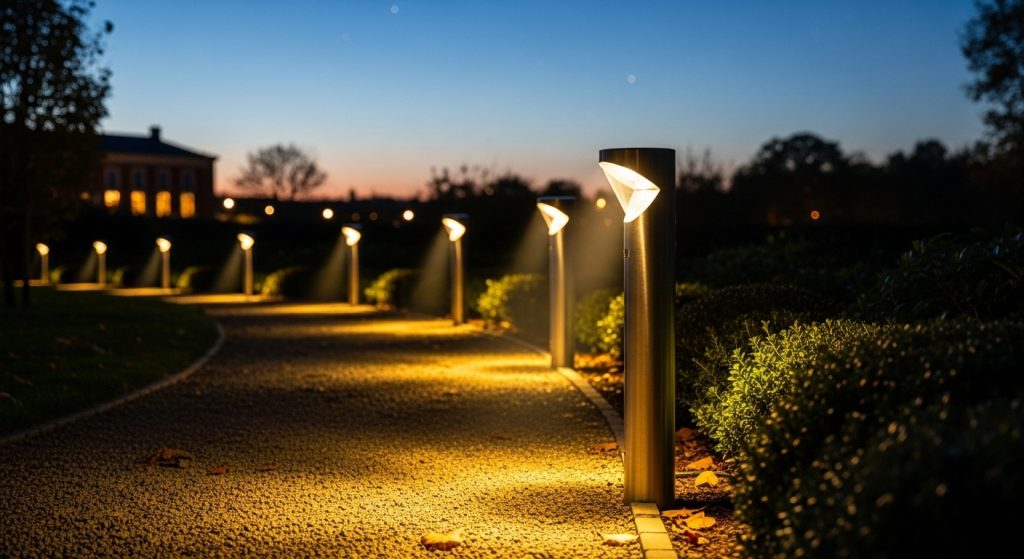
For most residential yards and shared community spaces, a well-placed solar bollard offers excellent visual comfort and reliable illumination. You must ensure that each post is positioned to receive maximum sunlight to keep the energy reserves full. When these conditions are met, solar lighting provides a consistent, eco-friendly way to deter intruders and prevent accidents on your property.
By focusing on a systematic lighting plan that accounts for your specific environment, you can achieve a secure and welcoming atmosphere. While they may not replace high-intensity floodlights for wide area coverage, they are a practical and powerful choice for keeping your walkways clear and navigable after the sun goes down.
What does “brightness” mean for bollard lights and how is it measured
In the world of lighting, “brightness” is officially measured as lumens output, which tells you the total amount of light visible to your eyes. It is a much more accurate way to judge a fixture than looking at wattage, especially with LEDs. However, raw power is only half the story; beam distribution is what actually determines how well you can see the ground. A bollard that focuses its light downward and outward provides much better visual clarity on a path than one that scatters light in every direction.
When you look at different products, you should look for fixtures that direct their glow toward the walking surface. This prevents wasted light and ensures that the “hot spot” of the lamp doesn’t cause blinding glare. Proper optics can make a 200-lumen solar light feel more effective for safety than a poorly designed 500-lumen unit. By choosing hardware that prioritizes directional light, you ensure that every lumen helps you see exactly where you are stepping, making the outdoor space safer for everyone.
How solar bollard lights generate light and what limits their brightness
Every solar bollard is a miniature power plant. It relies on solar charging to gather photons during the day, which are then converted into DC electricity and held within the battery capacity. As night falls, a sensor triggers the light, using that stored energy to power the LEDs. The LED efficiency of modern units is remarkably high, allowing them to produce a significant amount of light while consuming very little power, which is vital for maintaining brightness throughout a long winter night.
The primary limit on brightness is the “energy budget” available from the sun. Since the fixture only has so much battery space and charging time, it cannot run at the same intensity as a hardwired street lamp. To manage this, many high-end solar bollards use smart controllers that may dim the light slightly during the late-night hours to conserve energy. This ensures that you have the highest brightness when you are most likely to be active, while still providing a baseline level of security until the morning sun returns to recharge the system.
What level of brightness is usually needed for nighttime safety on pathways
For effective safety illumination, you don’t need a blinding spotlight; you need a consistent glow that reveals the texture of the ground. Most safety experts recommend a pathway brightness of at least 100 to 300 lumens per bollard for residential areas. This range provides enough light for trip prevention, allowing you to spot uneven stones, stray garden tools, or changes in elevation before they become a hazard. It creates a “lighted corridor” that makes walking feel natural and stress-free.
In high-traffic areas or near stairs, you might choose fixtures at the higher end of the lumen scale to ensure maximum visibility. The key is to avoid deep, pitch-black shadows where risks can hide. By providing a steady, reliable source of light at the feet-level, you ensure that your guests and family can navigate the yard with complete confidence. This targeted approach to lighting puts the power exactly where it is needed most, keeping your paths secure without ruining the peaceful, nighttime ambiance of your garden.
How spacing and layout affect perceived brightness and safety
Your fixture spacing is just as important as the lumens of the bulb itself. If your bollards are too far apart, you will have “islands of light” surrounded by dark gaps, which is disorienting for the eyes. To achieve uniform coverage, you should plan your layout so that the edges of the light pools overlap slightly. This creates a continuous ribbon of brightness that helps with visibility planning, making the path feel like a single, safe route from the house to the street.
Spacing also interacts with the height of your bollards. Taller fixtures often cast a wider beam, allowing for a bit more distance between posts, while shorter units require a tighter arrangement. By mapping out your yard before you buy, you can decide how many lights you truly need to eliminate dark corners. A well-spaced layout ensures that the path remains bright and predictable, providing the safety you need without the cluttered look of having too many fixtures in one area.
When solar bollard brightness is enough for safety and when extra light helps
In a standard usage context, such as a private garden path or a small housing society walkway, solar bollards are more than sufficient. They provide a reliable, low-impact way to keep common areas bright. However, if your yard has “high-risk” zones—like a dark set of concrete stairs or a steep driveway—you might consider enhanced lighting. In these spots, you can use a combined system where solar bollards provide the general path light and a wired or motion-sensing floodlight provides a burst of high-intensity light for specific tasks.
This layered approach gives you the best of both worlds: the beauty and ease of solar lighting for everyday use, and the heavy-duty power of wired lighting for critical safety zones. By identifying the different activity levels in your yard, you can put the most powerful lights where the risks are highest. For most homeowners, solar bollards handle 90% of the safety work, keeping the property visible and welcoming for guests and family alike.
What common mistakes reduce safety even if lights are bright enough
One of the most frequent design errors is placing bollards where they create a light blockage. If a post is tucked behind a large bush or a decorative statue, it will cast a long, deep shadow across the path, creating new risk areas instead of fixing them. You must always prioritize the “sightline” between the light source and the ground. Another common blunder is ignoring the angle of the light; if the lamp head is not shielded, it can cause glare that actually makes it harder to see the path in front of you.
You should also watch out for cluttered layouts that confuse the eye. If the path is narrow, putting lights on both sides in a perfect line can create a “runway” effect that is hard on the night vision. Instead, staggering the lights on alternating sides of the path often creates a much softer and more effective glow. By avoiding these simple blunders, you can ensure that even a modest solar setup provides professional-level security and safety for your entire property.
Checklist for verifying safety before installing solar bollard lighting
Before you commit to a final installation, a thorough site readiness review is necessary to ensure your lighting plan will work in the real world. This safety checklist helps you catch minor issues before they become permanent problems. By verifying these factors now, you can set up a system that stays bright and reliable for years.
- Hazard Map: Identify all stairs, turns, and uneven surfaces that need extra light.
- Sunlight Audit: Does each location receive at least 4-6 hours of direct sun for solar charging?
- Lumens Check: Is the lumens output of your chosen fixture rated for safety (100-300+)?
- Overlap Plan: Have you marked the fixture spacing to ensure uniform coverage?
- Height Review: Will the bollard height clear nearby plants and snow?
- Visibility Test: Conduct a “night test” with a flashlight to see where shadows fall on the path.
- Maintenance Path: Is the solar panel easy to reach for occasional cleaning?
Lawn bollard pathway lighting includes in outdoor safety design
Lawn bollard pathway lighting is the broader category of bollard fixtures used for pathway illumination. These units are specifically designed to keep the light focused on the ground, making them a top choice for safety. They provide the necessary guide for your feet while ensuring the garden remains a beautiful, inviting place to spend time after dark.
How solar spiral bollard lights combine design and brightness for pathways
Choosing a Solar spiral bollard light adds a unique spiral design to your walkway. This shape isn’t just for looks; it helps with light spread, casting a 360-degree pattern on the ground that eliminates dark gaps. These fixtures are a great way to add modern style to your yard while still maintaining a high level of brightness for safe walking.
Why spacing guides are important for safety and even illumination
Following a professional Bollard light spacing guide is the only way to achieve uniform coverage. A clear spacing strategy helps you calculate exactly how many poles you need to avoid dark gaps. This prevents a “spotty” look and ensures that your path remains a safe, continuous route for your family and guests every night.
How bollard lights compare to post lights in safety and brightness applications
Reviewing a Bollard vs post lights fixture comparison helps you pick the right height for your needs. While bollards are better for direct path lighting, taller post lights are better for wide area illumination. Choosing the right bollard vs post height ensures that the light reaches the ground effectively without causing glare for anyone walking toward it.
What installers should know about positioning and practical setup of solar bollard lights
To Install solar bollard lights successfully, you must prioritize site prep. Proper installation tips involve identifying the sunniest spots and ensuring the ground is level for mounting. Because there are no wires, you can often finish the entire project in a fraction of the time, keeping your property safe and bright with minimal effort.


- 10 Meters Lamp Post
- 10 Meters Pole
- 1000w Led Projector
- 100W LED Tunnel Light
- 12 Meters Lamp Post
- 12 Meters Pole
- 1200w Led Projector
- 15 Light Pole
- 1500w Led Projector
- 150W LED Tunnel Light
- 1800w Led Projector
- 2 In 1 Solar Flood Light
- 200w Led Tunnel Light
- 50w Led Tunnel Light
- 6 Meters Lamp Post
- 6 Meters Pole
- 8 Meters Lamp Post
- 8 Meters Pole
- 800w Led Projector
- 80w Led Tunnel Light
- Colourful Decorative Light
- Conical post
- Courtyard Lamp
- courtyard light
- courtyard lighting fixture
- Decorative Landscape Light
- Decorative road Light
- Flood Light For Courtyard
- Flood Light for Garden
- Flood Light For Outdoor
- Foot Led High Bay Lights
- high bay led lights 100w
- industrial lampshade
- industrial LED shed lights
- industrial magnifying glass with light
- Integrated Solar Flood Light
- led courtyard lamp
- led courtyard light
- led high bay light 100w
- LED Projector For Stadium
- Led UFO High Bay 150W 5000k
- Lighting Plants Mining Price
- Maintenance Free LED Street Light
- Pic Controlling Tunnel Light
- PLC controlling tunnel light
- Post Top Garden Light
- RGB Landscape Light
- Rgbw Decorative Light
- Smart Tunnel Light
- solar courtyard lamp
- solar courtyard light
- Solar LED Road Light
- Solar Street Light For 10 Meter Pole
- Solar Street Light For 12 Meter Pole
- Solar Street Light For 6 Meter Pole
- Solar Street Light For 8 Meter Pole
- Split Type Solar Flood Light
- Sporting Projector
- Stadium Led Projector
- Street Lighting Post
