
 Request A Quote


Solar Garden Post Top Light for Parks and Pathways
 FACEBOOK
 TWITTER
 LINKEDIN
In the design of modern public spaces, solar garden post top lights have emerged as a cornerstone of sustainable outdoor illumination. These fixtures consist of an integrated solar panel, battery, and LED light source mounted atop a pole, specifically engineered to provide clear, reliable light for pedestrian environments. Unlike traditional streetlights that prioritize high-speed traffic, these solar-powered solutions focus on pedestrian safety and comfort. By capturing renewable energy during the day, they operate entirely independently of the electrical grid, making them an ideal choice for remote park sections or new pathway extensions where trenching for wires would be disruptive and costly.
Planners favor these systems because they combine solar-powered lighting with a diffused output that enhances the natural beauty of landscaped areas. The pole-mounted height is strategic; it elevates the light source just enough to provide a broad wash of light across walkways without creating the harsh, industrial feel of a highway lamp.
This approach ensures that shared outdoor areas remain vibrant and secure after sunset, encouraging community use while minimizing the carbon footprint. By selecting hardware based on site-specific sunlight conditions rather than a one-size-fits-all model, you ensure long-term performance and operational reliability. This thoughtful integration of technology and design turns dark, underused paths into inviting, safe routes for everyone.
What makes solar garden post top lights suitable for parks and pathways
Solar garden post top lights are ideal for parks because they offer 360-degree, uniform light that enhances visibility without the need for expensive electrical trenching. Their self-contained design captures renewable energy, providing consistent safety for walking routes while blending naturally into landscaped environments without disrupting the ground with cables.
The core appeal of post top lighting in shared spaces lies in its ability to provide comprehensive ambient illumination. Because the light source sits at the very top of the pole—often encased in a frosted or prismatic lens—it casts a soft, even glow that is easy on the eyes. This is particularly important for pedestrian areas where people are moving at a slower pace and need to see both the path ahead and their immediate surroundings clearly. The diffused nature of the light reduces the deep shadows that can make people feel uneasy in a park at night.
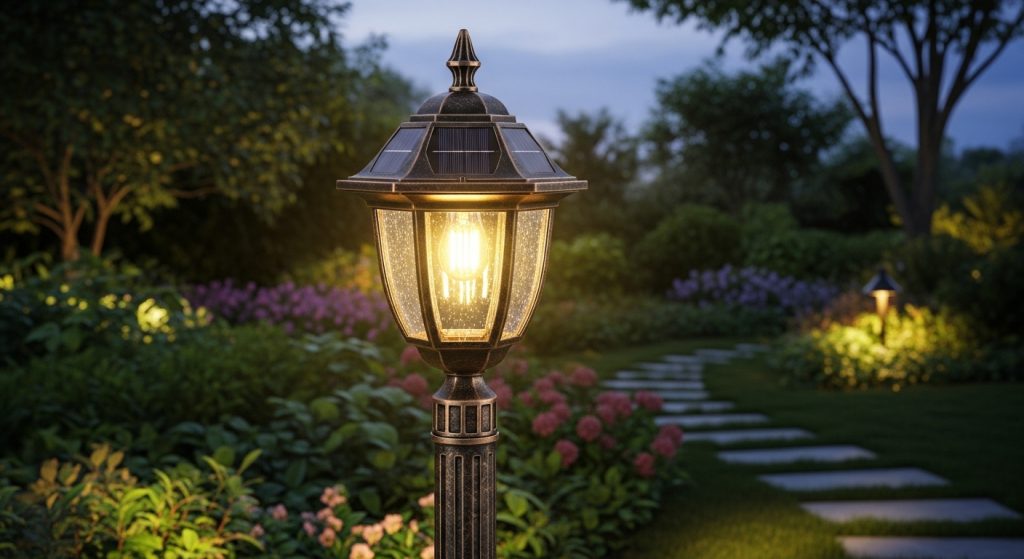
Structurally, these solar units are built to withstand the rigors of open, landscaped spaces. They are typically constructed from corrosion-resistant materials like aluminum, ensuring they do not rust when exposed to garden irrigation or humid park conditions. Because they are self-contained, they do not require external wiring cabinets or complex underground infrastructure, making them highly versatile for off-grid locations like forest trails or lakeside boardwalks.
Why parks and pathways require different lighting than roads or streets
Parks and walkways prioritize human-scale illumination, focusing on visual comfort and a sense of security for pedestrians rather than the high-intensity beams needed for vehicles. This involves using lower mounting heights and diffused lenses to eliminate glare, ensuring that walking routes feel welcoming and safe at night.
When you plan for a park, you have to prioritize human-scale lighting over the high-intensity beams required for vehicles. On a road, the goal is to see far ahead at high speeds, which often involves very tall poles and bright, focused light. In a park, the priority is pathway safety for walkers, joggers, and cyclists. This means using lower mounting heights—typically between 10 and 15 feet—to create a more intimate and secure feel.
The light needs to be bright enough to identify a face from a distance but soft enough to maintain visual comfort. Avoiding harsh brightness and glare is a critical part of this design. Intense lights can ruin your night vision and cause light pollution that disturbs local wildlife. By choosing post top fixtures that push light downward and outward in a controlled manner, you ensure the glow stays on the path and out of the trees or the sky.
How solar power availability affects park lighting performance
The performance of solar park lighting depends on direct sunlight exposure to charge internal batteries for night runtime. Since these systems rely on solar charging, placement is vital; fixtures must avoid heavy tree shade to ensure the battery capacity reaches a full charge for consistent year-round operation.
The success of any solar project depends entirely on sunlight availability. Since these fixtures rely on internal batteries, they must receive enough direct sunlight during the day to power the LED through the night. Planners must assess the solar window of each location—if a pole is placed deep in the shade of a large oak tree, the solar charging will be insufficient, leading to dim lights or a battery that dies long before dawn.
Battery capacity and seasonal changes also play a major role in performance. In the winter, when days are shorter and the sun is lower in the sky, a solar light has less time to charge but must run for more hours. High-quality solar post top lights are designed with smart controllers that can manage power if the charge is low. By understanding these environmental limits, you can choose fixtures with larger panels or more efficient batteries to ensure consistent performance year-round.
How post top height influences light spread along pathways
The height of a post top light dictates its coverage area, with taller posts providing a wider light distribution for broader paths. Matching the post height to the walkway width ensures uniform pathway coverage, preventing dark gaps between poles while maintaining a scale that feels comfortable for pedestrians.
The post height you choose is the primary factor in determining the light distribution on the ground. A taller pole will cast a wider, thinner wash of light, while a shorter pole creates a more concentrated and bright circle. For most park walkways, you want to find a balance where the light spreads far enough to reach the next pole without leaving dark gaps in between. This pathway coverage ensures that pedestrians never feel like they are stepping into a black hole as they walk from one light to the other. Matching the pole height to the walkway width is also essential for a professional look. On a narrow woodland path, shorter poles create a cozy, safe atmosphere. On a wide, paved promenade, taller poles are more appropriate to ensure the light reaches from edge to edge. By carefully selecting the height based on the physical dimensions of the park, you maximize the efficiency of each fixture and create a seamless, well-lit route.
How brightness levels should be planned for park walkways
Effective park lighting utilizes moderate lumen levels to ensure visibility and safety without over-lighting the environment. Consistent illumination along the entire path is more important than raw power, as it allows for better eye adjustment and prevents the high-contrast shadows that can cause safety concerns.
Choosing the right lumen levels is a delicate balance between functional visibility and environmental preservation. You want enough light to see potential hazards—like a tree root or a puddle—and to feel secure, but you must avoid over-lighting the space. In a park setting, the human eye adapts to lower light levels much better than it does on a city street.
Providing a consistent, moderate brightness is far more effective for safety than having a few extremely bright hot spots separated by total darkness. Lighting consistency is the real key to safety. If one part of a path is much brighter than the next, your pupils will constantly be dilating and constricting, which actually makes it harder to see. Planners aim for a steady glow along the entire route. By using post top lights with wide-angle optics, you can achieve this even glow with fewer fixtures.
What layout considerations help achieve even solar pathway lighting
A successful layout relies on a spacing strategy that prevents dark gaps while following the natural walking route. Proper coverage planning involves placing poles at path curves and intersections, ensuring that the lighting layout guides the pedestrian’s journey intuitively while maximizing solar panel exposure.
A successful lighting layout starts with a rigorous spacing strategy. You should not just place poles where they look good; you must calculate the distance between them based on the fixture’s light output and height. The goal is to have the edges of the light pools overlap slightly. This prevents the zebra stripe effect where the path alternates between bright and dark zones. A well-planned coverage planning map ensures that the walking route is clearly defined and easy to follow from any direction. Alignment with the actual walking route is also vital. In a park with winding paths, you must place poles at the apex of every curve to guide the eye and show the direction of the trail. You also need to prioritize conflict zones, such as intersections, stairs, or bridge entries, where extra light is needed for safety. Placing your solar poles in a way that respects the natural flow of traffic ensures the system feels intuitive.
What common mistakes reduce the effectiveness of solar post top lights
Common mistakes include poor placement under tree canopies, which causes performance loss, and incorrect spacing that creates a design imbalance. Ignoring seasonal sunlight availability or choosing inadequate brightness levels for the specific pathway context can lead to unreliable lighting and significant safety gaps.
One of the most frequent planning mistakes is ignoring the impact of nearby foliage. A pole might get perfect sun in the winter but be completely covered by leaves in the summer, leading to massive performance loss. Another common blunder is choosing the wrong height—if the poles are too short for the spacing, you end up with a design imbalance characterized by dark, dangerous gaps. Planners also sometimes select high-brightness fixtures without considering the battery’s ability to sustain that output through a long winter night. Underestimating the maintenance needs of solar panels is another gap. Dust or bird droppings can quickly block the sun and reduce charging. If a park is located in a dusty area, a regular cleaning schedule must be part of the plan. Using standard residential-grade solar lights in a public park often leads to failure, as they lack the structural durability needed for high-traffic public use.
What should be reviewed before selecting solar post top lights for parks
Before finalizing a selection, conduct a thorough design review using a selection checklist that accounts for pathway layout, sun exposure, and required lumen levels. This validation ensures that the project planning supports operational reliability and matches the specific structural needs of the public space.
Before finalizing a purchase, a thorough project planning review is necessary to ensure the hardware matches the site’s reality. This final check ensures that the project moves into the implementation phase with a high degree of operational reliability. By verifying the environment and the lighting goals one last time, you prevent expensive field modifications and ensure the park stays well-lit for years. Use this selection checklist to guide your final decision:
- Sunlight Check: Have you verified that each pole location receives 4-6 hours of unshaded, direct sunlight?
- Pathway Review: Does the proposed lighting layout provide overlap to prevent dark gaps?
- Height Check: Is the post height appropriate for the width of the walkway and the scale of the park?
- Brightness Level: Are the lumen levels sufficient for safety without causing excessive light pollution?
- Battery/Panel Match: Does the battery capacity allow for multiple nights of runtime in case of cloudy weather?
- Material Durability: Are the fixtures rated for high-humidity or corrosive outdoor environments?
- Maintenance Access: Is there a plan to keep the solar panels clean and clear of debris?
What are garden post top landscape lighting systems
Garden post top landscape lighting refers to the category of fixtures designed to sit on top of vertical posts to provide 360-degree light. These post top fixtures are the primary tool for creating a safe and inviting landscape lighting environment. They are specifically shaped to push light outward and downward, making them far more effective for wide area illumination than low-level ground spots or upward-facing lights.
How do solar landscape lamp posts support pathway lighting
Using Solar landscape lamp post units is a sustainable way to achieve consistent pathway illumination. These solar lamp posts capture energy during the day to provide a reliable glow all night without the need for trenching or electrical bills. Because they are independent of the grid, they are particularly useful for historical parks or remote trails where installing traditional power lines would be too invasive or expensive.
How should garden lamp post height be selected for parks and walkways
Following a Garden lamp post height guide ensures that the fixture matches the park scale. A lamp post height that is too tall can feel industrial and cold, while one that is too short will not provide enough light spread to cover a wide promenade. Matching the height to the surrounding trees and the width of the walkway is the only way to achieve a balanced and effective lighting design.
How many lumens are appropriate for garden and park pathways
The Garden pathway lighting lumens guide suggests that light intensity should be focused on uniformity rather than raw power. For most park pathways, pathway lumens between 1,000 and 3,000 are usually sufficient to provide excellent visibility without causing glare. Keeping the light at a moderate level helps maintain the natural ambiance of the park while ensuring that pedestrians feel secure.
How does sunlight availability affect solar garden post top light performance
For any solar project, Solar garden lights sunlight is the most critical factor. The solar efficiency of the panel depends on direct sunlight exposure to fully charge the battery. If a park has many old-growth trees, planners must be very careful about pole placement, as even partial shade can significantly reduce the light’s runtime and overall reliability during the winter months.
Final Thought
Integrating solar post top lights into parks and pathways is a smart, sustainable way to keep your community moving safely after dark. By focusing on the unique needs of pedestrian spaces—like human-scale height and diffused, uniform light—you create environments that feel natural and secure. When you prioritize site-specific sun exposure and a well-planned layout, these solar solutions provide a high-performance lighting system that stands the test of time while protecting your local ecology.



- 10 Meters Lamp Post
- 10 Meters Pole
- 1000w Led Projector
- 100W LED Tunnel Light
- 12 Meters Lamp Post
- 12 Meters Pole
- 1200w Led Projector
- 15 Light Pole
- 1500w Led Projector
- 150W LED Tunnel Light
- 1800w Led Projector
- 2 In 1 Solar Flood Light
- 200w Led Tunnel Light
- 50w Led Tunnel Light
- 6 Meters Lamp Post
- 6 Meters Pole
- 8 Meters Lamp Post
- 8 Meters Pole
- 800w Led Projector
- 80w Led Tunnel Light
- Colourful Decorative Light
- Conical post
- Courtyard Lamp
- courtyard light
- courtyard lighting fixture
- Decorative Landscape Light
- Decorative road Light
- Flood Light For Courtyard
- Flood Light for Garden
- Flood Light For Outdoor
- Foot Led High Bay Lights
- high bay led lights 100w
- industrial lampshade
- industrial LED shed lights
- industrial magnifying glass with light
- Integrated Solar Flood Light
- led courtyard lamp
- led courtyard light
- led high bay light 100w
- LED Projector For Stadium
- Led UFO High Bay 150W 5000k
- Lighting Plants Mining Price
- Maintenance Free LED Street Light
- Pic Controlling Tunnel Light
- PLC controlling tunnel light
- Post Top Garden Light
- RGB Landscape Light
- Rgbw Decorative Light
- Smart Tunnel Light
- solar courtyard lamp
- solar courtyard light
- Solar LED Road Light
- Solar Street Light For 10 Meter Pole
- Solar Street Light For 12 Meter Pole
- Solar Street Light For 6 Meter Pole
- Solar Street Light For 8 Meter Pole
- Split Type Solar Flood Light
- Sporting Projector
- Stadium Led Projector
- Street Lighting Post
