
 Request A Quote


Solar Spiral Bollard Light Modern Pathway Design
 FACEBOOK
 TWITTER
 LINKEDIN
Solar spiral bollard lights represent a fusion of avant-garde design aesthetics and sustainable technology, making them a standout choice for contemporary landscapes. Unlike traditional cylindrical bollards, these fixtures feature a distinct spiral design that wraps around the light source, creating a dynamic visual profile even during daylight hours.
They function as independent units, utilizing an integrated solar module to capture energy, which is then held in local energy storage for nighttime use. This self-contained nature eliminates the need for complex wiring, allowing you to prioritize the creative flow of your pathway illumination without being restricted by power outlet locations.
In modern outdoor settings, the goal is often to balance high-functionality with a clean, artistic look. Spiral bollards achieve this by providing clear wayfinding and safety while adding a sculptural element to garden borders and walkways.
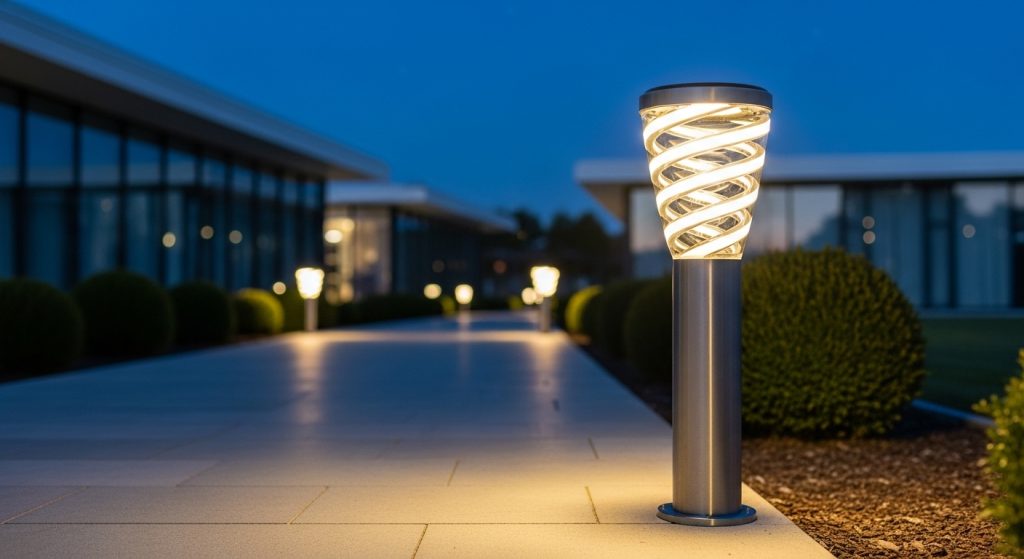
Because they rely on solar lighting, the installation strategy is significantly simplified, reducing site disruption and long-term utility costs. Choosing this style reflects an informed approach to landscape planning where the play of light and shadow is as important as the brightness itself. By selecting spiral forms, you ensure your property remains navigable and visually compelling, supporting a high-quality user experience from the moment the sun sets.
What are solar spiral bollard lights and how do they work
A solar spiral bollard is a vertical lighting fixture characterized by its twisting outer frame. Inside this spiral design, a high-efficiency LED sits protected by a clear or frosted lens. The top of the fixture typically houses the solar module, which is precisely angled to capture photons. During the day, these photons are converted into DC electricity and moved into a battery for energy storage. As evening approaches, a built-in photosensor triggers the light, using that stored power to provide a steady glow.
The way light interacts with the spiral structure is what sets these fixtures apart. Instead of a flat wash of light, the twisting fins or bars break up the beam, casting a unique 360-degree pattern on the ground. This creates a focused but soft illumination that is perfect for identifying path edges and potential obstacles. Because they are self-regulating, you don’t need to worry about manual switches or timers; the system manages its own charging and discharge cycles based on the natural light levels of your garden.
How spiral design changes the look and feel of pathways
The primary appeal of a spiral bollard lies in the visual interest it adds to a flat or linear landscape. In modern design, repetition and rhythm are used to guide the eye; a row of spiral lights creates a sense of movement along a path. The twisting geometry breaks away from the rigid straight lines often found in traditional architecture, adding a softer, more organic feel to the design aesthetics of your yard.
Shadow play is another significant advantage. As light passes through the spiral frame, it creates a series of highlights and dark accents on the grass or pavement below. This shadow play adds depth and texture to the surface, making a simple concrete or gravel path look like a designed feature. It creates an atmosphere that is both safe and artistic, moving the lighting from a purely “utility” role to a “decorative” one. This makes the space feel more luxurious and well-considered, enhancing the overall mood of your outdoor evening environment.
Why solar options matter for flexible installation
One of the greatest benefits of solar-powered fixtures is the complete installation flexibility they offer. Traditional wired lights require you to dig trenches across your lawn, navigate around tree roots, and potentially hire an expensive electrician. With solar spiral bollards, you have total site freedom. You can place a light exactly where it is needed—whether that is at the end of a long woodland trail or in the middle of a finished stone patio—without disturbing the existing ground.
This power autonomy is particularly useful for urban or residential projects where site disruption must be kept to a minimum. You can install a full set of pathway lights in a single afternoon with nothing more than a few basic tools. This “plug-and-play” nature also means you can easily move the lights if you decide to change your garden layout in the future. By removing the need for a physical grid connection, solar bollards provide a low-impact way to upgrade your home’s security and beauty on your own terms.
How brightness and lumens affect visibility on pathways
Achieving the right light output is vital for maintaining visual comfort on your walkways. You want enough brightness to clearly see the ground, but not so much that it causes blinding glare. For most residential and park pathways, a lumens guidance of 100 to 300 is ideal. This provides a soft, guiding light that is easy on the eyes while ensuring every step is safe.
Spiral fixtures are excellent at distributing this light effectively. Because the light source is typically shielded by the spiral fins, the beam is directed downward where it is needed most. This prevents light from spilling into the sky or into neighbors’ windows, adhering to “dark sky” principles. By selecting the correct lumen level for your specific path width, you ensure that the illumination is functional for safety without being aggressive, creating a secure environment that remains peaceful and inviting.
What spacing logic keeps pathway lighting even and consistent
Proper fixture spacing is the key to creating a professional-looking uniform illumination. If your bollards are too far apart, you will have “black holes” along the path that can be dangerous. If they are too close, the yard looks cluttered. A standard coverage planning strategy for spiral bollards usually involves placing them every 6 to 10 feet, depending on their height and the width of the walkway.
The goal is to have the edges of the light pools overlap just enough to create a continuous ribbon of light. Since the spiral design creates a unique light pattern, you should test the placement at night before final mounting. Ensuring a consistent lighting rhythm helps the brain process the path quickly, making walking more intuitive and less stressful. By balancing the height of the bollard with the distance between them, you maximize the safety of your property while maintaining a clean, orderly design.
How materials and finishes support long-term outdoor performance
Outdoor fixtures are in a constant battle with the elements, making material choice the most important factor for long-term performance. High-quality spiral bollards are usually made from aluminum or stainless steel, providing the weather durability needed to resist rust and corrosion. These materials handle rain, snow, and intense UV rays much better than plastic alternatives, ensuring the spiral frame doesn’t become brittle or fade over time.
The finish of the bollard also contributes to its visual longevity. Powder-coated finishes in black, bronze, or silver can complement different architectural styles while adding another layer of protection. Because bollards are often near irrigation systems or low-growing plants, they must be able to withstand constant moisture without pitting or peeling. By investing in durable materials, you ensure that your pathway lighting remains a reliable and attractive feature of your home for many years.
Common mistakes when using spiral bollard lights in designs
A frequent design error is placing spiral bollards in areas with too much shade. Because these rely on sun, putting them under a thick tree canopy or on the north side of a tall wall leads to performance gaps where the lights fail to turn on or die shortly after dusk. Another common blunder is ignoring the lumen level; using a decorative low-lumen light for a primary security path can leave users in the dark.
Installation issues also arise from poor spacing. Placing bollards in a perfectly straight “runway” line can feel cold and industrial; staggering them often creates a much more natural and pleasing look. Planners must also account for the ground level; if a bollard is placed in a low spot where water pools, it can lead to internal electrical failure. Avoiding these blunders requires a quick site survey and a commitment to matching the hardware to the actual environmental conditions of your yard.
What should be reviewed before installing solar spiral bollard lights
Before you commit to a final installation, a thorough site assessment is necessary to ensure the project meets your installation readiness goals. This design checklist acts as a final validation step to ensure your pathways stay bright and safe for the long haul. By checking these variables now, you can avoid expensive field modifications later.
- Sunlight Mapping: Does the location receive at least 4-6 hours of direct sun?
- Path Measurements: Have you measured the path width to determine the required light spread?
- Spacing Plan: Are the fixtures far enough apart to be subtle but close enough to overlap?
- Material Check: Is the metal rated for your local climate (e.g., salt-air resistance)?
- Brightness Review: Does the lumen count match the safety needs of the walkway?
- Ground Level: Is the mounting surface stable and well-draining?
- Visual Harmony: Does the spiral style complement your home’s modern architecture?
Lawn bollard pathway lighting includes in modern outdoor design
Lawn bollard pathway lighting is a broad category that covers all vertical bollard fixtures used for pathway illumination. Whether you choose a spiral, square, or round design, these units are essential for defining the edges of your lawn and keeping your walkways safe. They serve as the functional backbone of any professional outdoor design.
How geometric outdoor lawn lights offer a design alternative to spiral forms
If you prefer sharp lines over curves, a Geometric outdoor lawn light is a fantastic design variation. These geometric lighting units use squares, triangles, and rectangles to create a high-tech, contemporary look. They offer the same safety benefits as spiral bollards but cater to a more minimalist, architectural aesthetic for modern homes.
Why spacing guides help achieve even pathway illumination
Following a Bollard light spacing guide is the best way to ensure uniform lighting. A clear spacing strategy helps you calculate the exact number of fixtures needed to bridge dark gaps. This prevents the “zebra stripe” effect and ensures that your path remains a safe, continuous route for your family and guests.
How brightness recommendations inform solar bollard light design for pathways
Solar bollard lights brightness is a key consideration for solar brightness planning. By checking the lumens reference, you can ensure that your spiral lights have the power to illuminate the walking surface effectively. Choosing the right brightness ensures that the lights stay on all night without draining the battery too quickly.
What installers should know before placing solar bollard lights
To Install solar bollard lights successfully, you must prioritize site prep. Proper solar installation involves identifying the sunniest spots and ensuring the ground is firm for mounting. Because there is no wiring involved, you can often finish the entire project in a fraction of the time required for a traditional wired system.



- 10 Meters Lamp Post
- 10 Meters Pole
- 1000w Led Projector
- 100W LED Tunnel Light
- 12 Meters Lamp Post
- 12 Meters Pole
- 1200w Led Projector
- 15 Light Pole
- 1500w Led Projector
- 150W LED Tunnel Light
- 1800w Led Projector
- 2 In 1 Solar Flood Light
- 200w Led Tunnel Light
- 50w Led Tunnel Light
- 6 Meters Lamp Post
- 6 Meters Pole
- 8 Meters Lamp Post
- 8 Meters Pole
- 800w Led Projector
- 80w Led Tunnel Light
- Colourful Decorative Light
- Conical post
- Courtyard Lamp
- courtyard light
- courtyard lighting fixture
- Decorative Landscape Light
- Decorative road Light
- Flood Light For Courtyard
- Flood Light for Garden
- Flood Light For Outdoor
- Foot Led High Bay Lights
- high bay led lights 100w
- industrial lampshade
- industrial LED shed lights
- industrial magnifying glass with light
- Integrated Solar Flood Light
- led courtyard lamp
- led courtyard light
- led high bay light 100w
- LED Projector For Stadium
- Led UFO High Bay 150W 5000k
- Lighting Plants Mining Price
- Maintenance Free LED Street Light
- Pic Controlling Tunnel Light
- PLC controlling tunnel light
- Post Top Garden Light
- RGB Landscape Light
- Rgbw Decorative Light
- Smart Tunnel Light
- solar courtyard lamp
- solar courtyard light
- Solar LED Road Light
- Solar Street Light For 10 Meter Pole
- Solar Street Light For 12 Meter Pole
- Solar Street Light For 6 Meter Pole
- Solar Street Light For 8 Meter Pole
- Split Type Solar Flood Light
- Sporting Projector
- Stadium Led Projector
- Street Lighting Post
