
 Request A Quote


How much does a solar street light cost per pole installed
 FACEBOOK
 TWITTER
 LINKEDIN
How much does a solar street light cost per pole installed depends on several key factors. You must look at the total capital investment, which includes parts and labor. The price covers the solar panel, LED lamp, battery, and the pole itself.
Different designs like all-in-one or split systems change the final price. Performance reliability is a major cost driver for professional projects. If you live in a cloudy area, you may need larger parts to keep the lights on.
This increases your initial cost but ensures the lights work every night. You also need to think about the road width, as wider roads need more power. Budgeting for a project involves looking at the lifecycle cost over many years. While solar might cost more at the start, you save money on monthly power bills.
This guide helps you understand the components and planning steps for your project. By following these tips, you can get a clear estimate for your specific site. Making a smart choice now helps you save on maintenance later.
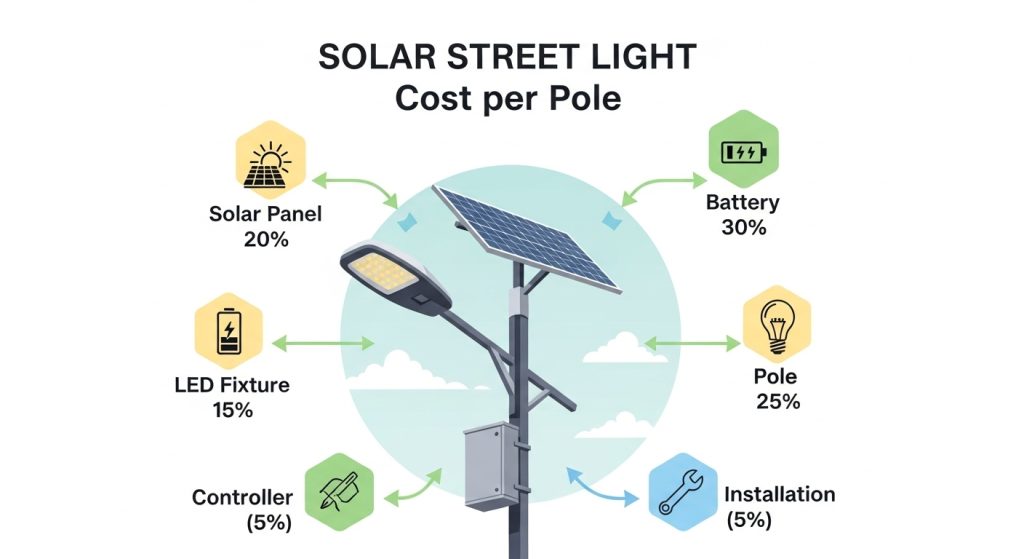
What does “cost per pole installed” include
When you look at the cost per pole installed, you are paying for more than just the light. This price covers everything needed to get the system working on your site. It includes the component cost of the solar panel, the LED fixture, and the battery. You also pay for the smart controller that manages the power flow.
You should expect the following parts to be in the price:
- Solar Panel: The piece that catches sunlight to make power.
- LED Lamp: The light fixture that provides outdoor illumination.
- Battery: The energy storage unit, usually kept in a box.
- Controller: The brain that turns the light on and off.
- Installation labor: The work done by crews to set the pole and wires.
- Hardware and mounting: Bolts, brackets, and the pole itself.
How system types affect installed cost
The system architecture you choose will change your total price per pole. All-in-one lights are often the cheapest to install. They have a compact modular design where everything is in one shell. This saves you money on installation labor because they are fast to put up. Split type systems cost more because they have separate parts that need wiring. However, they allow for much larger panels and batteries. You might also look at a hybrid configuration for critical areas. These use both solar power and a grid backup to stay on. While hybrid systems have a higher capital investment, they offer the best safety for busy roads. You must weigh the ease of setup against the power your site needs.
How panel size and battery life influence cost per pole
Panel sizing is a big part of your project budget. A larger panel catches more sun but costs more to buy and mount. You also need a stronger pole to hold a bigger panel in the wind. Battery capacity is another major factor in your costs. High-quality lithium batteries cost more upfront but last much longer. You must plan for battery degradation as part of your lifecycle planning. Replacing a cheap battery every two years is much more expensive than buying a good one once. A system that lasts five to eight years offers the best value for your money. Investing in better storage now saves you from high maintenance bills later.
How weather and performance expectations change cost
Your local weather will change how much you need to spend on each pole. If you live in a place with a lot of cloudy weather, you need a bigger system. You must have enough solar output to fill the battery on gray days. This increases the energy demand variability your system must handle. Performance reliability is non-negotiable for public safety on roads. To keep the lights on during a long storm, you need more battery storage. This makes the system more expensive than one built for a sunny desert. You should use the worst-case sun data for your area to get an accurate cost. Planning for the hardest months ensures your lights never fail.
How wattage and road width influence cost
The width of your road tells you how much light distribution you need to be safe. A wider road requires a higher wattage lamp to reach across the lanes. As the wattage goes up, the price of the lamp and the battery also increases. You must follow illumination standards to ensure roadway coverage is even and bright.
- Narrow Paths: Small lights (30W-50W) are cheap and use smaller poles.
- Standard Streets: Medium systems (60W-80W) balance cost and brightness.
- Major Highways: High-power systems (100W-150W) need the largest panels and batteries.
- Pole Height: Taller poles spread light further but cost more to ship and install.
Typical cost ranges and what drives variation
Typical costs vary based on your regional variables and the volume of your order. Buying 100 poles is usually cheaper per unit than buying just five. The capital investment for a professional pole can range from a few hundred to a few thousand dollars. Cost drivers include the quality of the LED chips and the type of battery used. You might find cheaper lights online, but they often lack the strength for long-term use. Shipping costs and local labor rates also change the final price in your area. You should ask for a quote that includes all fees to avoid surprises. Choosing high-quality parts ensures your system stays bright for a decade.
How buyers should budget and plan for cost per pole
Good budget planning starts with a detailed site survey. You need to know if the soil is hard or soft, as this changes the cost of the base. You should also check for site conditions like shade from trees or buildings. This helps you pick the right system reliability level for your needs.
- Check Sun Hours: Use the lowest sun data to size your system correctly.
- Plan for Labor: Include the cost of a crane or lift truck for installation.
- Add a Buffer: Keep a 10% contingency for unexpected site issues.
- Verify Shipping: Large poles and panels are expensive to move.
- Look at Warranty: A long warranty protects your investment for years.
Decision guidance: is solar street lighting cost-effective
To see if solar is right for you, look at the total cost of ownership. While the price per pole is higher than a grid light, you save on trenching. Digging long holes for wires is very expensive and messy. Solar lights need no wires, which leads to huge operational savings. You also pay $0 in monthly power bills for the life of the system. For most projects, the return on investment happens in just a few years. Solar is a wise investment for remote roads, parks, and new neighborhoods. It gives you clean, free light with very little work after it is installed. Your final choice should be based on long-term value, not just the lowest price today.
What are solar street lighting systems
A solar street lighting systems setup provides outdoor illumination using sun power. These units use high-efficiency LED street lights to keep roads and paths bright. They are a great choice for areas that want to be green and save money. Each pole works on its own, which makes the whole network very reliable.
When grid-connected solar hybrid lighting is used
You might choose grid connected solar hybrid lighting for areas that need total performance reliability. These systems use the sun most of the time but have a grid backup for stormy weeks. This ensures the light never goes dark, no matter the weather. It is the safest choice for busy city centers and main highways.
All-in-one versus split solar lights
The all-in-one vs split solar lights choice depends on your site. All-in-one units have a compact architectural difference that makes them easy to install. Split lights have separate parts that allow for more power. You should weigh the installation tradeoffs of each style against your brightness needs.
How long solar street light batteries last
Knowing the solar street light battery lifespan is key to your lifecycle cost. Most modern batteries last between five and eight years before they see battery degradation. Planning for this replacement is part of a smart budget. Using high-quality cells ensures your system stays reliable through many summers and winters.
How to size solar panels for street lighting projects
You must learn solar panel size street lighting steps to keep your lights on. The panel must be large enough to meet your daily energy demand even in the winter. If you pick a panel that is too small, your battery will wear out faster. A well-sized system ensures the best performance and the longest life for your parts.
How do solar street lights perform in cloudy weather
You should check solar street lights cloudy weather data for your area. Good systems are built to handle gray days using a large battery storage. Performance reliability is possible even in rainy places if you size the system correctly. A smart design keeps the road safe even when the sun is hidden for a few days.


- 10 Meters Lamp Post
- 10 Meters Pole
- 1000w Led Projector
- 100W LED Tunnel Light
- 12 Meters Lamp Post
- 12 Meters Pole
- 1200w Led Projector
- 15 Light Pole
- 1500w Led Projector
- 150W LED Tunnel Light
- 1800w Led Projector
- 2 In 1 Solar Flood Light
- 200w Led Tunnel Light
- 50w Led Tunnel Light
- 6 Meters Lamp Post
- 6 Meters Pole
- 8 Meters Lamp Post
- 8 Meters Pole
- 800w Led Projector
- 80w Led Tunnel Light
- Colourful Decorative Light
- Conical post
- Courtyard Lamp
- courtyard light
- courtyard lighting fixture
- Decorative Landscape Light
- Decorative road Light
- Flood Light For Courtyard
- Flood Light for Garden
- Flood Light For Outdoor
- Foot Led High Bay Lights
- high bay led lights 100w
- industrial lampshade
- industrial LED shed lights
- industrial magnifying glass with light
- Integrated Solar Flood Light
- led courtyard lamp
- led courtyard light
- led high bay light 100w
- LED Projector For Stadium
- Led UFO High Bay 150W 5000k
- Lighting Plants Mining Price
- Maintenance Free LED Street Light
- Pic Controlling Tunnel Light
- PLC controlling tunnel light
- Post Top Garden Light
- RGB Landscape Light
- Rgbw Decorative Light
- Smart Tunnel Light
- solar courtyard lamp
- solar courtyard light
- Solar LED Road Light
- Solar Street Light For 10 Meter Pole
- Solar Street Light For 12 Meter Pole
- Solar Street Light For 6 Meter Pole
- Solar Street Light For 8 Meter Pole
- Split Type Solar Flood Light
- Sporting Projector
- Stadium Led Projector
- Street Lighting Post
