
 Request A Quote


Do solar street lights work well in cloudy and rainy weather
 FACEBOOK
 TWITTER
 LINKEDIN
Do solar street lights work well in cloudy and rainy weather is a common concern for many buyers. You must understand that “working well” means the light stays on consistently every single night. Most systems are designed to capture solar output even when the sky is gray.
This process involves turning sunlight into power and saving it in battery storage. While rain can lower the amount of energy captured, it also helps by cleaning your panels. To ensure performance reliability, you should look at how your system is built.
Good designs include a buffer to handle several days of weather variability. You can choose between all-in-one, split, or semi-integrated models based on your local climate. Each type handles clouds and rain differently due to its unique setup.
This guide explains how to manage these factors for your project. You will learn what to expect from your lights during the stormiest months. By following these tips, you can pick a system that never goes dark. Planning for your specific site conditions is the best way to get long-term value.
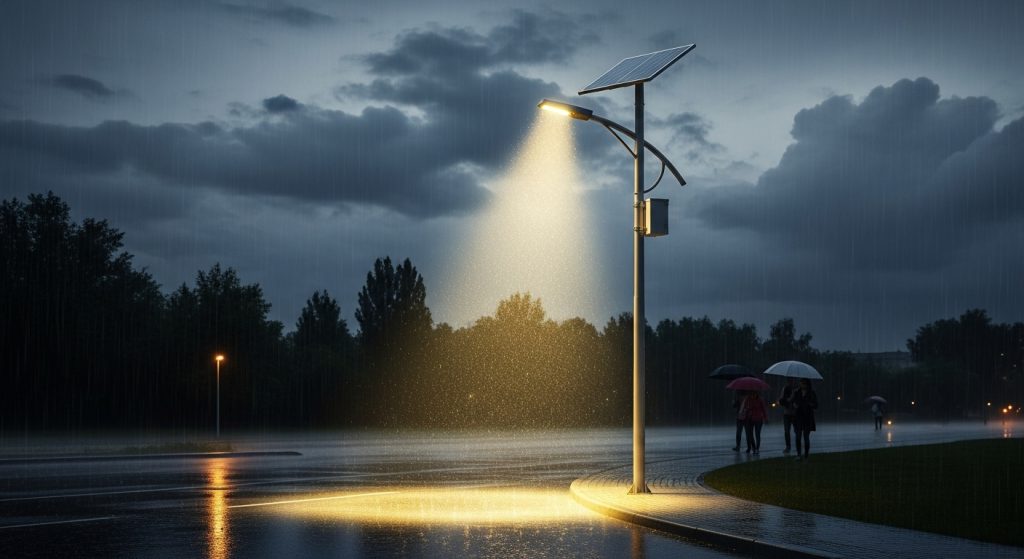
What “working well” means for solar street lights
For your project, “working well” means meeting your uptime reliability goals. You want your lights to provide steady daily illumination regardless of the weather. In professional planning, this is often measured by the number of nights the light stays on. These performance expectations vary depending on whether you are lighting a park or a highway.
For a major road, you might need the light to work 100% of the time. For a small garden path, a few dim nights might be okay. You should define your benchmarks clearly before you start buying.
A reliable system should not flicker or die just because it rained for one day. It must have enough stored power to survive typical local weather patterns. Knowing these goals helps you choose the right equipment for your site.
How solar charging normally works in street lighting
Solar charging is the engine that keeps your outdoor lights running. It starts with photovoltaic conversion, where the panel turns light into electricity. This energy capture happens all day long while the sun is up. The power then moves through a controller into your battery. Each night, the system goes through a charge cycle as it uses that power. On a bright day, your battery can often fill up in just five or six hours.
On a cloudy day, this process just takes a bit longer. You do not need direct, hot sun to make electricity; you just need light. Even on a dim day, the panels are still working to fill your storage. Understanding this flow helps you see why panel size and battery health are so vital.
How cloudy and rainy weather affects solar output
Cloudy and rainy weather will change your daily solar output significantly. Thick clouds act like a filter that blocks some of the sun’s energy. This leads to performance variability where you might only get 20% to 50% of your normal power. Rain itself does not stop the panels from working, but it often comes with heavy clouds.
One benefit of rain is that it washes away dust and bird droppings. Clean panels are much better at catching light once the sun comes back out. You must think about short-term storms versus long-term seasonal weather. A system built for a desert will struggle if you move it to a rainy coast. Checking your local weather impact data helps you plan for these low-light periods.
How system design and battery buffers help performance
A smart system design is your best defense against bad weather. You can add a battery buffer to hold extra power for a “rainy day.” This energy storage acts like a backup tank that keeps the light on when the panel is weak. Many planners choose to oversize their panels to catch more light during short sunny breaks.
You also have choices in how the system is put together. Split systems often allow for much larger panels than all-in-one units. This extra size helps you gather more power when the sky is gray. Semi-integrated units offer a middle ground that balances ease and power. By picking the right setup, you ensure your lights stay bright through the winter.
Real-world performance expectations in cloudy or rainy regions
In the real world, your performance expectations must match your local climate. If you live in a very cloudy place, your lights will rely on their “autonomy” days. This is the number of nights the battery can run without any new charge. Most professional systems offer three to five days of autonomy. You might notice the lights get slightly dimmer late at night to save power.
This is a smart feature called “dimming control” that helps the battery last longer. Under real conditions, you should expect some change in how fast the battery fills. However, a well-built system will still provide enough light for safety. You should not expect the same power levels as a sunny desert, but the road will remain visible.
Cost and maintenance implications of weather performance
Planning for bad weather will change your cost drivers for the project. Larger panels and bigger batteries increase your capital investment for each pole. However, this extra cost is often cheaper than fixing failures later. Maintenance planning is also key in rainy areas where moisture can affect wires. You should look at the lifecycle value of a system that stays on versus a cheap one that fails.
Buying high-quality weather seals helps protect your parts from rain damage. You might also need a budget for cleaning panels if your area has “dirty” rain or a lot of dust. Investing in better equipment now reduces your long-term repair bills. It ensures your community stays happy with the lighting you provide.
What buyers should consider before installing in cloudy/rainy areas
Before you sign a contract, you must look at your site conditions carefully. A detailed site survey will show you if trees or buildings add to the shadow of the clouds. You should calculate your autonomy requirement based on the longest storm in your area. This ensures your system reliability stays high all year round.
Consider these points for your checklist:
- Check the average sun hours for the darkest month of the year.
- Ensure the battery is large enough for at least three nights of rain.
- Look for high-efficiency panels that work well in low-light spots.
- Verify the IP rating of the light to make sure it is fully waterproof.
- Ask if the system has smart power management to save energy on gray days.
Is a solar street light a good choice for cloudy and rainy regions
A solar street light is still a great choice for rainy areas if you pick the right one. It meets your operational needs without the cost of running wires through wet ground. For most project suitability, the key is matching the design to the local cloud cover. If you choose a system with a large panel and strong storage, it will work perfectly. In very dark regions, you might consider a hybrid system that uses the grid as a backup.
However, for most roads and parks, a standard solar light with a good buffer is enough. It provides clean, free light while keeping your site safe and bright. Your final decision should be based on your specific brightness goals and your local weather history.
What are solar street lighting systems
A solar street lighting systems setup provides outdoor illumination using sun power. These units use LED street lights to give you bright, clear light while saving energy. They are very popular for areas that want to be green and avoid high power bills. Each pole works on its own, which makes installation very simple and fast.
What is an all-in-one solar street light
Using an all-in-one solar street light guide helps you see how these compact units work. Everything is kept in a single housing, which offers great integration simplicity. They are very easy to put on a pole because there are no extra wires to connect. These are best for smaller paths or areas that get a lot of direct sun.
What is a split type solar street light
A split type solar street light uses a modular architecture where the parts are separate. This allows for better panel placement to catch the most sun possible. Because the panel and battery are separate, you can use much larger sizes for better power. These are the top choice for main roads and areas with a lot of clouds.
What is a semi-integrated solar street light
A semi integrated solar street light offers a middle ground in configuration balance. It keeps the battery and light together but has a separate solar panel. This partial integration makes it easier to install than a full split system while still providing great power. It is a smart choice for city streets that need reliable lighting.
How long solar street light batteries last
The solar street light battery lifespan is vital for your project’s lifecycle expectancy. Most modern lithium batteries last between five and eight years. You will notice some battery degradation over time, which is a natural part of the aging process. Picking a high-quality battery ensures your lights stay on through every season and every storm.


- 10 Meters Lamp Post
- 10 Meters Pole
- 1000w Led Projector
- 100W LED Tunnel Light
- 12 Meters Lamp Post
- 12 Meters Pole
- 1200w Led Projector
- 15 Light Pole
- 1500w Led Projector
- 150W LED Tunnel Light
- 1800w Led Projector
- 2 In 1 Solar Flood Light
- 200w Led Tunnel Light
- 50w Led Tunnel Light
- 6 Meters Lamp Post
- 6 Meters Pole
- 8 Meters Lamp Post
- 8 Meters Pole
- 800w Led Projector
- 80w Led Tunnel Light
- Colourful Decorative Light
- Conical post
- Courtyard Lamp
- courtyard light
- courtyard lighting fixture
- Decorative Landscape Light
- Decorative road Light
- Flood Light For Courtyard
- Flood Light for Garden
- Flood Light For Outdoor
- Foot Led High Bay Lights
- high bay led lights 100w
- industrial lampshade
- industrial LED shed lights
- industrial magnifying glass with light
- Integrated Solar Flood Light
- led courtyard lamp
- led courtyard light
- led high bay light 100w
- LED Projector For Stadium
- Led UFO High Bay 150W 5000k
- Lighting Plants Mining Price
- Maintenance Free LED Street Light
- Pic Controlling Tunnel Light
- PLC controlling tunnel light
- Post Top Garden Light
- RGB Landscape Light
- Rgbw Decorative Light
- Smart Tunnel Light
- solar courtyard lamp
- solar courtyard light
- Solar LED Road Light
- Solar Street Light For 10 Meter Pole
- Solar Street Light For 12 Meter Pole
- Solar Street Light For 6 Meter Pole
- Solar Street Light For 8 Meter Pole
- Split Type Solar Flood Light
- Sporting Projector
- Stadium Led Projector
- Street Lighting Post
