
 Request A Quote


Split type solar street light for large projects
 FACEBOOK
 TWITTER
 LINKEDIN
Selecting a split type solar street light is a smart way to bring reliable solar power to your next big job. These systems use separate parts to capture and store energy, making them quite different from all-in-one units. You will find they work well for large-scale infrastructure because they handle high energy needs and allow you to point panels exactly where the sun hits best.
While other photovoltaic lighting types exist, the split design offers more power and freedom for wide roads or big parking lots. You must look at LED street lights with the right wattage and battery size to meet your goals.
Sizing these parts involves checking your local sun hours to ensure the lights stay on all night. You also need to think about how weather and age affect the parts over many years. Even though the upfront price for off-grid infrastructure can be high, the long-term value helps your budget. By following a simple checklist and looking at your site, you can pick the best setup. This guide gives you the steps to make a good choice for your specific needs.
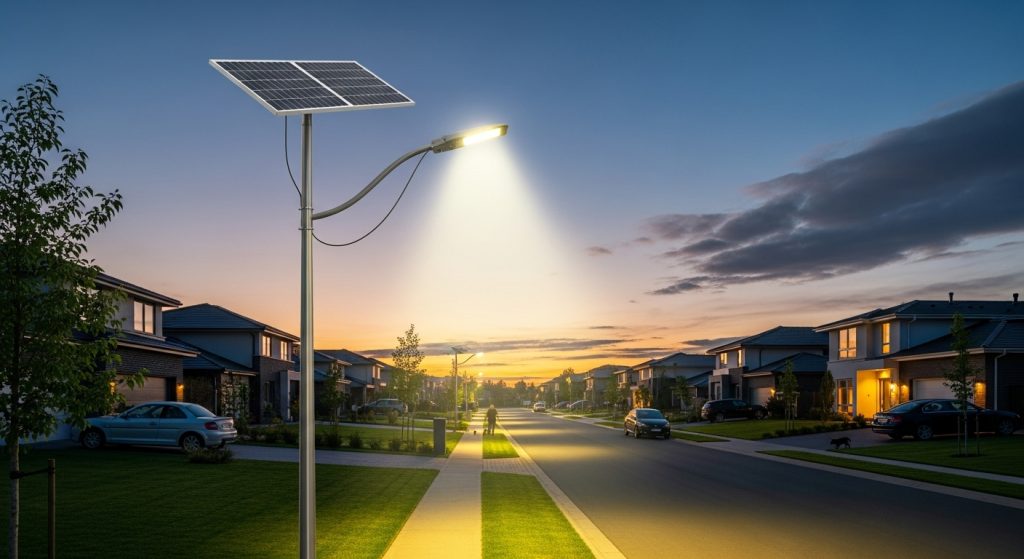
What is a split type solar street light
A split type solar street light is a lighting system where the main parts are kept in different spots on the pole. Instead of having everything in one casing, you get a separate panel, a battery box, and the light fixture itself. This modular solar lighting setup means the solar panel sits at the very top, while the battery might stay in a box higher up or even buried underground. You connect these parts using wires that run inside or outside the pole. This separate panel and battery design is the classic way to build solar lights. It gives you the chance to use a very large panel that would be too heavy for an all-in-one unit. Because the parts are not stuck together, you have an off-grid configuration that is easy to fix. If one part breaks, you just replace that one piece instead of the whole light.
Why split type solar street lights are suited for large projects
You should choose these lights for large-scale infrastructure because they offer more power than smaller models. Big projects often need high-power lighting to keep wide areas safe and bright. Since the panel is separate, you can use a much larger one to catch more sun and power a brighter lamp. This deployment flexibility is a big plus when your project has many different light pole heights or locations. You can tilt the solar panel at the perfect angle to get the most sun, no matter which way the road turns. All-in-one lights often face one way, which might not be the best for the sun. With a split system, you can also use bigger batteries to keep the lights running for many days if it gets cloudy. This makes them a dependable choice for city roads, highways, and big industrial sites where you cannot afford to have the lights go dark.
How split type systems compare to other solar street light types
When you look at system architecture, split lights are the most versatile option you can buy. All-in-one lights are easier to put up because they are just one piece, but they usually have smaller panels and batteries. This means they might not be bright enough for a big highway. Semi-integrated lights put the battery and light together but keep the panel separate, which is a middle ground. There are also grid-connected options that use the sun but have a backup wire to the city power. These modular design choices come with installation tradeoffs you must think about.
- Split lights give you the most power for tall poles and wide roads.
- All-in-one units work better for small parks or garden paths.
- Semi-integrated systems save some work but still limit your battery size.
- Hybrid systems are good if you already have power wires in the ground.
Key features and specifications for large-project split systems
For your large project, you need to check the illumination level to make sure it meets safety rules. Most big jobs use a high power rating between 60 watts and 150 watts for the LED lamp. You will also need to pick a solar panel that matches this power. For a big light, your panel might be 150 watts or even 300 watts to keep up. The energy storage part is just as vital. You should look for lithium batteries because they last a long time and hold a lot of power in a small space. Make sure the battery box is strong and can handle heat or cold. The wires should be thick enough to carry the power without losing energy. Good controllers are also needed to manage how the battery charges and when the light turns on.
How to size panels and batteries for split type systems
Sizing your system starts with knowing your energy demand. You need to calculate how many watts your light uses and how many hours it will stay on each night. Once you know that, look at the sun exposure in your area. Some places get a lot of sun, while others are cloudy often. You want a panel wattage that can fill the battery even on a short winter day. A good rule is to have enough energy storage to keep the lights on for three to five nights without any sun. This is called autonomy. If you live in a place with many rainy days, you might want to oversize the panel by twenty percent. This extra power ensures the battery stays healthy and the lights never fail. You should work with a pro to get these numbers right for your specific map location.
Performance considerations for large-project deployments
You must think about how cloudy weather will affect your lights over the long haul. A split system is good here because you can use a big panel to catch weak light. Another thing to watch is battery degradation. All batteries lose some power as they get older, so you should pick ones that can handle many cycles. Heat can also hurt batteries, so putting the battery box in a shady spot on the pole or underground helps. Performance reliability is the goal for any big public project. You should also check if the lights have smart dimming. This lets the light get a bit dimmer when no one is around, which saves battery power for later. Dirt and dust on the panels can also slow down charging, so you may need a plan to clean them once a year.
Cost and value implications for large installations
The capital investment for a split type system is often higher at the start compared to grid lights. You have to pay for the poles, panels, batteries, and the work to put them together. But you save money because you do not have to dig long trenches for wires or pay a monthly power bill. When you look at the lifecycle cost, these lights often pay for themselves in a few years. Maintenance planning is still needed, as you might need to change the battery after five to eight years. Buying high-quality parts at the start saves you money later because you will have fewer repairs. For a big project, the total value comes from having reliable lights that do not cost anything to run. You should compare the price of the parts with how long they are expected to last.
What buyers should evaluate before specifying split type systems
Before you start your project, you must do a full site survey to see where the sun hits. You also need to look at the project feasibility to see if solar is the right fit for your budget and goals. Think about the wind in your area, as big panels on tall poles need to be very strong to stay up. Your operational planning should include who will fix the lights if something goes wrong.
- Check the average sun hours for the darkest month of the year.
- Make sure the pole can hold the weight of a large solar panel.
- Look for a supplier that offers a long warranty on the battery and LED.
- Verify that the light levels meet the local rules for your type of road.
Is a split type solar street light right for your large project
Deciding if this light is the right fit depends on your operational needs. If you are building a big road or a large parking lot far from power lines, the split type is usually the best choice. It gives you the high brightness and long-lasting power that smaller solar lights cannot match. If your project suitability includes a need for tall poles and very bright light, then the split design is what you want. But if you are just lighting a small walkway or have a very tight budget, you might look at other options. For most big infrastructure jobs, the strength and flexibility of the split system make it the top pick. You get a system that you can customize to fit your exact site and sun levels.
What are solar street lighting systems
A solar street lighting systems setup is a group of lights that run on power from the sun. Each unit has its own power source, so you do not need to connect them to the main city power grid. This creates a solar lighting network that works on its own. These systems are great for outdoor illumination because they turn on by themselves when it gets dark. They use a panel to turn sunlight into electricity and store it in a battery for later. This makes them a green choice for cities and businesses that want to save energy and money.
What semi-integrated solar street lights are
A semi integrated solar street light is a mix between an all-in-one light and a split light. In this design, the battery and the LED lamp are often in the same box, but the solar panel is separate. This gives you a partial integration that is easier to install than a full split system. You still get some flexible layout options because you can move the panel to face the sun. It is a good choice for projects that need more power than a small light but want to save on installation time.
When grid-connected solar hybrid lighting is appropriate
You might choose grid connected solar hybrid lighting when you need absolute energy reliability. These lights use a solar panel most of the time, but they also have a wire to the city power grid. If the battery runs low after many cloudy days, the grid backup kicks in to keep the light on. This is perfect for places where the light must never go out for safety reasons. It gives you the saving of solar power with the safety of a standard light.
All-in-one versus split solar lights
The choice between all-in-one vs split solar lights usually comes down to how much power you need. An all-in-one light has the panel, battery, and light in one small unit, which is very easy to put on a pole. However, the architectural difference means the parts are smaller. A split light has separate pieces, allowing for a much larger panel and battery. While the installation tradeoffs mean the split light takes more work to set up, it provides much more light for big areas.
How long solar street light batteries last
The solar street light battery lifespan is a key part of your project planning. Most modern lithium batteries will last for five to eight years depending on how you use them. The battery life depends on the number of charge cycles and the temperature of the area. If the battery gets too hot or too cold, it might not last as long. Using a split system helps because you can put the battery in a protected spot to help it live longer.
How to size solar panels for street lighting projects
Learning the right solar panel size street lighting needs is vital for success. You must choose a panel wattage that is high enough to charge your battery even on short, cloudy days. This depends on the solar exposure at your site. A panel that is too small will leave your battery empty, and the light will turn off early. For large projects, it is often better to pick a slightly larger panel to make sure you have enough power all year round.


- 10 Meters Lamp Post
- 10 Meters Pole
- 1000w Led Projector
- 100W LED Tunnel Light
- 12 Meters Lamp Post
- 12 Meters Pole
- 1200w Led Projector
- 15 Light Pole
- 1500w Led Projector
- 150W LED Tunnel Light
- 1800w Led Projector
- 2 In 1 Solar Flood Light
- 200w Led Tunnel Light
- 50w Led Tunnel Light
- 6 Meters Lamp Post
- 6 Meters Pole
- 8 Meters Lamp Post
- 8 Meters Pole
- 800w Led Projector
- 80w Led Tunnel Light
- Colourful Decorative Light
- Conical post
- Courtyard Lamp
- courtyard light
- courtyard lighting fixture
- Decorative Landscape Light
- Decorative road Light
- Flood Light For Courtyard
- Flood Light for Garden
- Flood Light For Outdoor
- Foot Led High Bay Lights
- high bay led lights 100w
- industrial lampshade
- industrial LED shed lights
- industrial magnifying glass with light
- Integrated Solar Flood Light
- led courtyard lamp
- led courtyard light
- led high bay light 100w
- LED Projector For Stadium
- Led UFO High Bay 150W 5000k
- Lighting Plants Mining Price
- Maintenance Free LED Street Light
- Pic Controlling Tunnel Light
- PLC controlling tunnel light
- Post Top Garden Light
- RGB Landscape Light
- Rgbw Decorative Light
- Smart Tunnel Light
- solar courtyard lamp
- solar courtyard light
- Solar LED Road Light
- Solar Street Light For 10 Meter Pole
- Solar Street Light For 12 Meter Pole
- Solar Street Light For 6 Meter Pole
- Solar Street Light For 8 Meter Pole
- Split Type Solar Flood Light
- Sporting Projector
- Stadium Led Projector
- Street Lighting Post
