
 Request A Quote


How to choose the right beam angle for effective sports field lighting
 FACEBOOK
 TWITTER
 LINKEDIN
Choosing the ideal beam angle for sports field lighting is a technical process that determines how effectively light is distributed across an athletic surface. In LED optics, the beam angle is the measurement of the spread of light from the center of the fixture to the point where the intensity drops to 50%. Selecting the correct spread is critical for achieving high uniformity and ensuring that athletes can track fast-moving objects without encountering dangerous “blind spots.” For a professional stadium, this means balancing narrow beams that “pierce” the distance from tall poles with wider beams that fill in the foreground, creating a seamless, high-contrast environment for both players and spectators.
The logic of beam selection is heavily influenced by the mounting height and the specific coverage goals of the facility. Taller poles allow for narrower, more concentrated angles that drive light deep into the center of the pitch, whereas lower poles require wider spreads to prevent harsh shadows near the sidelines. By coordinating the beam angle with the field’s unique geometry and competitive requirements, you can maximize visual comfort and minimize light spill into the surrounding community. Proper planning transforms a simple collection of lights into a high-performance system that supports athlete safety, broadcast quality, and an immersive game-day experience.
What “beam angle” means in sports lighting and why it matters
In sports illumination, the beam concept refers to the physical shape of the light cone emitted by the LED fixture. Unlike standard household bulbs that scatter light in all directions, sports-grade LEDs use precision lenses to direct photons into a specific, measurable arc. This parameter is critical because light spread dictates the efficiency of the entire system; if the angle is too wide, light is wasted on the sky or the stands, while an angle that is too narrow will leave the field looking like a checkerboard of bright and dark spots.
Precise beam management is what allows modern facilities to meet the rigorous lighting standards required for competitive play. It enables designers to “sculpt” the light to match the rectangular or oval shape of the field, ensuring that every square foot receives the same intensity. By understanding that the beam angle is the primary tool for controlling the light path, you can ensure that your investment provides the maximum possible visibility for athletes who rely on split-second reactions in high-pressure environments.
How beam angle affects coverage, uniformity, and shadows
The relationship between beam angle and uniform illumination is one of contrast and overlap. Narrow beams (15°–30°) produce a high-intensity “throw” that is excellent for reaching targets far from the pole, but they have very sharp edges that can create deep field shadows if not properly layered. Wide beams (60° and above) provide a soft, broad coverage pattern that is easier to overlap, making them ideal for creating a consistent wash of light near the perimeter of the field.
To eliminate dark spots, a professional lighting plan uses “cross-lighting,” where beams from different poles meet and overlap. If the beam angles are poorly chosen, the field will suffer from a high “max-to-min” ratio, meaning some areas are much brighter than others. This inconsistency causes the pupils of an athlete’s eyes to constantly adjust, leading to fatigue and reduced reaction times. By mastering the interplay between narrow and wide beams, you can eliminate dark valleys and ensure a safe, high-quality playing surface.
Typical beam angle ranges used in field lighting and when they apply
Angle ranges are typically selected based on the size of the field and the distance the light must travel. Low angles (15°–30°) are the “spotlights” of the industry, reserved for high-mast stadium poles where the light must pierce through 60 to 100 feet of air to reach the center of the pitch. These narrow beams are essential for maintaining high lux levels at the primary task lighting zones of a large stadium.
Mid-range angles (30°–60°) are the most versatile, commonly used for medium-sized local parks or multi-purpose courts. They provide a balanced spread that handles both the distance and the width of the field effectively. Wide angles (over 60°) are generally used for smaller surfaces like tennis courts or as “fill lights” on lower poles. By matching the angle to the field size, you ensure that the light is concentrated where it belongs, providing a professional and efficient environment for every tier of competition.
How mounting height and pole placement shape beam angle choice
Your mounting strategy is the ultimate regulator of your beam choice. Due to the geometric “cone” of light, the higher you mount a fixture, the larger the footprint it creates on the ground. Therefore, a tall pole height requires a narrower beam angle to prevent the light from becoming too thin and dim by the time it reaches the grass. If you use a wide beam at a great height, you end up with “hazy” light that fails to provide the high contrast needed for sports.
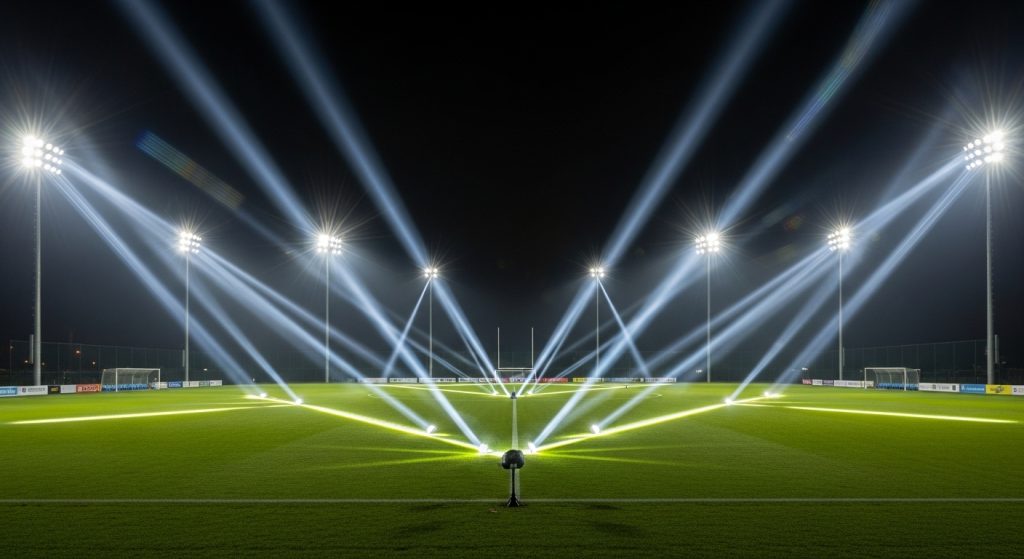
Conversely, lower mounts require wider beam selection to ensure that the light spreads quickly enough to cover the target area before it hits the ground. If a low-mounted pole uses a narrow beam, it will create a blinding, concentrated “hot spot” that is dangerous for players and useless for general visibility. By coordinating your pole locations—whether at the sidelines or corners—with the appropriate mounting heights, you can ensure that the beam angles work in harmony with the physical layout of your venue.
Why lumen output and beam angle must be chosen together
In output coordination, lumens and beam angles are two sides of the same coin. Lumens represent the total volume of light, while the beam angle determines the density of that light. For lumens planning, a narrower beam angle will always result in higher footcandles (brightness on the surface) because the light is more concentrated. This beam balance is the key to achieving the extreme lux levels required for professional sports without over-investing in massive electricity bills.
If you have a limited lumen budget, choosing a slightly narrower beam can help you hit your target brightness in the most critical areas of the field. However, this must be balanced against the need for uniformity; if the beam is too tight, you will need more fixtures to cover the dark gaps. Successful design involves finding the “sweet spot” where the lumen density and beam spread create a bright, even, and efficient environment that meets all the functional goals of the athletic facility.
Where COB flood light technology supports sports lighting needs
For projects requiring the highest levels of beam precision, COB lighting (Chip-on-Board) is often the preferred technology. COB fixtures pack multiple LED chips into a single, high-density module, creating a powerful “point source” of light. This high intensity lighting is much easier to focus with reflectors and lenses than traditional SMD arrays, allowing for incredibly sharp and well-defined beam angles that are perfect for high-mast stadium applications.
The COB output is particularly useful when you need to drive light over long distances with minimal “spill.” Because the source is so concentrated, the resulting beam is tighter and more coherent, providing the “punch” needed for professional-grade sports illumination. By integrating COB technology into your tailored beam plan, you can achieve a level of clarity and control that ensures the focus remains entirely on the field of play, enhancing both the player experience and the quality of the visual environment.
What errors should be avoided when choosing beam angles for fields?
One of the most frequent planning errors is a “one-size-fits-all” approach, where a single beam angle is used for all poles on a field. This almost always results in a visual imbalance, as the corner poles have different distance requirements than the sideline poles. Another common blunder is using only wide beams on tall poles, which leads to significant coverage gaps and a dim, hazy appearance that makes it difficult for spectators to follow the ball.
Ignoring spectator sightlines is another major pitfall. If beam angles are too wide and not properly shielded, they will cause aggressive glare in the stands, ruining the fan experience. To avoid these blunders, a professional photometric study is essential. By visualizing the “light map” before installation, you can identify where shadows fall and where glare might occur, allowing you to fine-tune your beam angles for a professional, comfortable, and high-performance result.
How to decide the best beam angle for your sports field setup
Before you commit to a field planning project, a thorough performance criteria review is necessary to ensure the hardware is a perfect fit for your venue. Use this selection checklist as a final safeguard to ensure your athletic facility is bright, safe, and efficient.
- Field Dimensions: Is the pitch a large stadium (Narrow Beams) or a local court (Mid/Wide)?
- Pole Height: Are your masts tall enough to support narrow-throw optics?
- Lux Level Goals: Does your beam selection achieve the uniformity required for your level of play?
- Sightline Audit: Have you checked for glare from the perspective of both players and fans?
- Neighborhood Impact: Does the beam stay on the field, or is it spilling into the sky or nearby windows?
- Fixture Count: Can you achieve uniform illumination with fewer fixtures by optimizing angles?
- Future-Proofing: Is the system flexible enough to handle changes in field usage or competitive levels?
How flood lights, high bay and sports lighting systems relate to beam angle planning
Flood lights, high bay and sports lighting represent the three pillars of wide-area illumination. In professional uniformity planning, these categories use beam angles differently: flood lights for broad washes, high bays for vertical punch, and sports lighting for the most extreme precision and long-range throw.
Where high-intensity COB flood lights fit into sports lighting setups
Choosing an LED COB flood light provides the necessary high output for professional stadiums. The concentrated light source allows for superior beam control, making it the top choice for high-mast projects where intense, clear light is required to ensure athlete safety and broadcast-quality visibility.
How sports light pole design influences beam angle and coverage choices
The design of Sports light pole stadiums is the primary factor in your mounting height strategy. Taller poles allow you to use narrower beam angles, which improves uniformity and reduces glare. Coordinating your pole placement with your beam planning is the only way to achieve a professional and safe athletic environment.
How lumen planning guides beam angle decisions in large outdoor areas
A Flood lighting lumens guide is your roadmap for output planning. Understanding how many lumens are needed for specific beam angles is essential for creating a bright and efficient layout. Accurate lumen planning ensures that you don’t waste energy while still providing the necessary intensity for competitive action.
How high bay height insights inform beam angle choices in tall venues
Following a High bay lights ceiling height guide provides valuable angle strategy crossover for indoor sports facilities. The distance between the ceiling and the floor dictates whether you need a narrow optic to drive light down or a wide lens for broad coverage, ensuring consistent visibility in any tall athletic venue.



- 10 Meters Lamp Post
- 10 Meters Pole
- 1000w Led Projector
- 100W LED Tunnel Light
- 12 Meters Lamp Post
- 12 Meters Pole
- 1200w Led Projector
- 15 Light Pole
- 1500w Led Projector
- 150W LED Tunnel Light
- 1800w Led Projector
- 2 In 1 Solar Flood Light
- 200w Led Tunnel Light
- 50w Led Tunnel Light
- 6 Meters Lamp Post
- 6 Meters Pole
- 8 Meters Lamp Post
- 8 Meters Pole
- 800w Led Projector
- 80w Led Tunnel Light
- Colourful Decorative Light
- Conical post
- Courtyard Lamp
- courtyard light
- courtyard lighting fixture
- Decorative Landscape Light
- Decorative road Light
- Flood Light For Courtyard
- Flood Light for Garden
- Flood Light For Outdoor
- Foot Led High Bay Lights
- high bay led lights 100w
- industrial lampshade
- industrial LED shed lights
- industrial magnifying glass with light
- Integrated Solar Flood Light
- led courtyard lamp
- led courtyard light
- led high bay light 100w
- LED Projector For Stadium
- Led UFO High Bay 150W 5000k
- Lighting Plants Mining Price
- Maintenance Free LED Street Light
- Pic Controlling Tunnel Light
- PLC controlling tunnel light
- Post Top Garden Light
- RGB Landscape Light
- Rgbw Decorative Light
- Smart Tunnel Light
- solar courtyard lamp
- solar courtyard light
- Solar LED Road Light
- Solar Street Light For 10 Meter Pole
- Solar Street Light For 12 Meter Pole
- Solar Street Light For 6 Meter Pole
- Solar Street Light For 8 Meter Pole
- Split Type Solar Flood Light
- Sporting Projector
- Stadium Led Projector
- Street Lighting Post
