
 Request A Quote

Steel Light Pole Manufacturers: Polygonal Engineering for 2026
 FACEBOOK
 TWITTER
 LINKEDIN
The global carbon steel light pole market is projected to reach $2.98 billion by 2032, growing at a 4.4% CAGR as infrastructure modernization accelerates worldwide. For procurement professionals and civil engineers, selecting the right Steel Light Pole Manufacturers has become more critical than ever. The difference between a pole that performs for 25 years and one that fails prematurely comes down to engineering fundamentals—wall thickness, cross-sectional geometry, flange design, and corrosion protection.
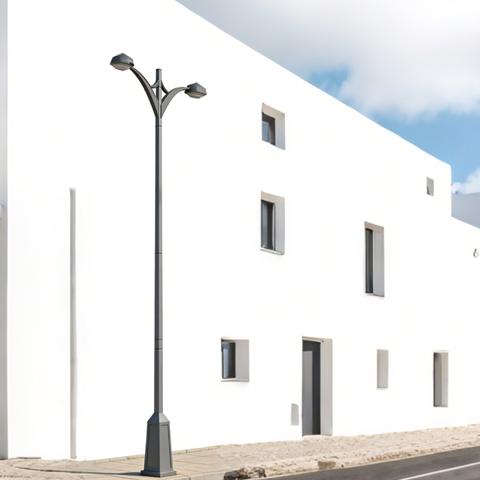
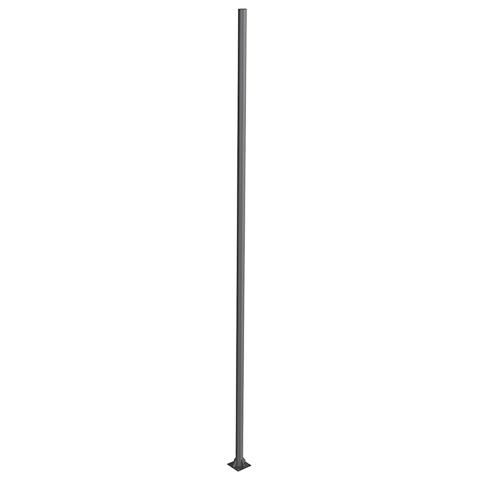
Manufacturers, like Dawn Lighting, develop poles that exceed the job of just holding the light, to meet the demand. The DL01-A01A03-039 model pole is an 11-meter polygonal lighting pole with a 4.0mm thick Q235B steel wall and has a base that is expanded to Ø212mm. This model offers marked improvements over typical round poles. Below is a detailed analysis of the model and the reasons why this model is a preferred choice for industrial transit hubs and multi-lane expressways.
Engineering Feature 1: 4.0mm Q235B Steel Wall
Q235B steel is a cheaper, flexible, and high-strength building material that is ideal for outdoor lighting applications.
•Reliable in the most extreme weather: Q235B steel holds up to a variety of climates. The material has the ability to maintain strength through a variety of harsh conditions that include both of the poles’ use oceans and the poles’ use in the arctic. The material’s reliable outdoor strength makes this material a tightly trusted choice for the engineers that have them use pole’s in high rises, commercial industrial buildings.
•4.0mm is the ideal thickness for high-wind zones: The wall was set to be 4.0mm thick; this is the most economical thickness for high-wind conditions. This thick wall was designed to enhance the strength of the pole; to achieve the objectives of the designers, to uphold the arms and lights, and to protect the pole from failure. This negates the pole from deflecting beyond engineering failure.
•Weldability for defect-free fabrication: With low carbon levels, Q235B achieves strong, clean welds. With positive welds, the pole shaft is defect-free of porosity and undercut. This is important as these defects cause failure in inferior poles. To ensure no gaps, every weld should be visually inspected to ensure that no gaps remain which will weaken the weld.
•Compatible with global material standards: Q235B is aligned with international standards, such as ASTM A36, EN S235JR, and JIS SS400, easing cross-border procurement as well as procurement. This greatly simplifies the specification documentation of global material procurement in international projects.
Engineering Feature 2: Polygonal Cross-section Wind Resistance
Round poles are poor from an aerodynamic standpoint as their smooth surfaces shed alternating low-pressure vortices. This causes vibrations that loose bolts and fatigues welds. Polygonal geometry has been increasingly adopted by Steel Light Pole Manufacturers to offer an alternative solution.
•Higher section modulus than round tubes: Press-braked polygonal geometry such as 8, 12, or 16-scale that sheds steel throughout its cross-section, acts as a longitudinal stiffener throughout the steel shaft. This ultimately leads to a pole that is of greater strength, able to support a greater bending moment, with a lesser material weight.
•Vortex shedding: The angular cross section reduces wind dragging and essentially the oscillation or fatigue failure with the trade-off of alternative wind directions. Therefore, negative fatigue and luminaires will be further extended.
•High Strength with Material Efficiency: Thanks to higher strength-to-weight ratio, polygonal sections can use thinner sheet metal, making poles lighter. Thinner sheet metal can withstand the same wind loads, and using thinner sheet metal results in lighter poles that are cheaper to transport, and significantly cost-optimized. These thinner poles can be made economically to satisfy the demands of large-scale infrastructure projects.
•Torsional Rigidity for Long Outreach Arms: Typically, long outreach arms of expressway lighting are extended for about 2 to 3 m over the carriageway. In such cases, polygonal shafts can provide the necessary torsional rigidity. The shafts can stop the fixture from turning away from the intended orientation of the photometric instrument, thus ensuring the light is uniformly distributed over the roadway.
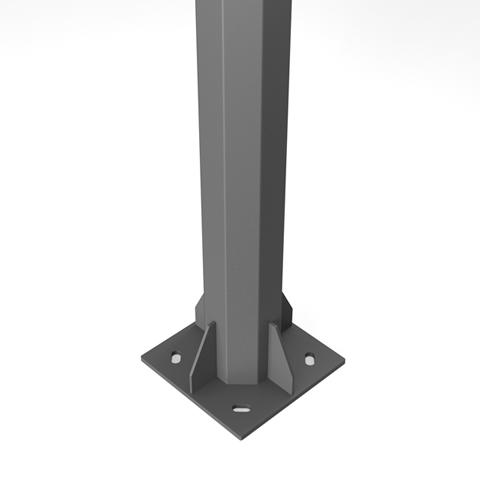
Engineering Feature 3: 20mm Anti-Cupping Base Flange
At 11 m tall, the poles have a large overturning moment. The lateral wind loads, coupled with the weight of the luminaires, create a bending moment that delivers a large force to the base plate. If the design of the flange is not adequately done, the plate is likely to yield, a phenomenon referred to as “cupping”, which causes bolts to loosen and the whole structure to fail.
•Oversized 400x400mm Flange for Uniform Load Distribution: The DL01-A01A03-039 is founded on an oversized 400x400mm square flange plate with an extreme 20mm thickness. This large flange prevents localized stresses and concrete foundation failures by equalizing lateral forces and distributing them uniformly onto the concrete foundation.
•Vertical Stability Under Constant Vibration: The pole remains convenient and vertically stable for a safe and accurate photometric pole lining.
•Ease of Installation: This more accommodating bolt-hole pattern integrates more easily with various foundation templates. This reduces foundation orientation and eliminates any concerns of anchor bolt clashes.
•Weld Seam Not Cracking: The increased thickness of the base means that weld seam failures due to wind loading (the primary mode of failure for other thin based pole designs) will not occur.
Engineering Feature 4: ≥ 85μm Hot Dip Galv. (to ISO 1461) due to Corrosion.
For paudo-assets, nothing is more damaging or deteriorating than poor corrosion resistance in the marketing of somewhere near a decade. Thin poor products, and then in Years 3 or 5, depending on the marketing, products begin to rust and structurally collapse in 15 years. Thin poor products, especially Thin Thin, Collapsing, Poor and Thin Fibrous Products (for Structures and Lights) poor products, Corners, and Crumbs Fibrous products stand by good, sponsored, and thin products.
•Metallurgical Bond for Permanent Protection: The 450°C+ hot dip process is the only method that can create a permanent bond between zinc and steel. This process outperforms spray coatings that are known to peel over time. For steel that is over 6mm thick, ISO 1461 requires a mean coating of 85μm, which guarantees that interior surfaces will receive a coating regardless of the complexity of the shape.
•Galvanic Cathodic Protection: The outer protection layer that is ≥60μm of powder coat may be physically compromised due to things like roadway debris or abrasion but the underlying layer of Q235B carbon steel is still sacrificially protected by the zinc layer. This type of galvanic protection prevents oxidation from spreading which effectively “self-heals” scratches over time.
•No need to repaint for over 25 years: Combined HDG and secondary powder coating means poles never need to undergo costly repainting. Infrastructure owners and municipalities see significantly lower total cost of ownership.
•Smart controllers that integrate seamlessly: With the appropriate sealing, the electrical access door maintains IP protection. Maintaining corrosion protection for the internal modules.
Re-engineering Improvements: What Buyers Want
The shifts taking place within the global pole lighting industry is significant. The steel pole lighting industry holds a 45% market share and the addition of smart lights, 5G small cell, and equipment for environmental monitoring is spurring adjustments for poles that can support more and heavier top loads but still maintain their structural integrity.
•Smart Design: With a standardized top tenon of Ø80mm, the DL01-A01A03-039 is smart design for future smart city needs. Dawn Lighting manufacturing’s poles conform to a range of supplementary brackets, intelligent sensor collections, and other communication modules.
•Certifications: International clients experience easy purchasing, thanks to CE, RoHS, and SGD certs.
•Customization Flexibility: Custom designs aren’t just limited to heavy duty industrial corridors and residential subdivisions. Walls, arms, heights, and even color powder are adjustable.
•Global shipping: Steel Light Pole Manufacturers, like Dawn Lighting, support infrastructure projects across Europe, Asia, Africa, and even the Americas with an annual capacity of over a million poles.
Conclusion
Round tapered lighting poles have no future. Engineering steel poles is a must depending on the requirement of sophisticated, multi-functional street lights in urban areas, an expressway system development, and the impact of the weather in the coastal infrastructure. A 4.0mm Q235B steel wall combined with spaced anti-cup poly with a 20mm Base flange and with a great enough thickness of 85μ m to be Hot Dip Galvanized, the DL01-A01A03-039 is an illustration of how Steel Light Pole Manufacturers are fulfillment to engineers’ needs. The design parameters and features are things the civil engineers and procurement experts need to note on highway and industrial lighting poles to meet the needs of 2026.
FAQs
Q1: How thick should walls be for high-mast expressway lights?
A: Leading Steel Light Pole Manufacturers recommend 4.0mm Q235B steel walls to resist bending and fatigue. This wall thickness is optimal for 11 meter high poles for high-wind zones.
Q2: Why would a polygonal pole last longer than a rounded pole?
A: Damping vortex shedding improves sectional modulus and cuts the loosening that occurs from vibration. Experienced Steel Light Pole Manufacturers have added this technology.
Q3: Will a dip galvanization be sufficient?
A: Hot dip galvanizing will protect the pole from galvanizing corrosion for its lifetime. However, top Steel Light Pole Manufacturers recommend its addition with a≥60μmpowder coat to protect for the double the life.
Q4: Will your poles carry smart sensors and 5G?
A: Yes. The DL01-A01A03-039 is insertable for IoT, with a standard Ø80mm top tenon and a flush electrical access door included.
Q5: What is good practice for flange to limit base plate cupping?
A: A 400mm x 400mm flange plate of 20mm thickness provides good practice coupling of the overturn. Localized yielding is eliminated by this practice from steel light pole manufacturers.

- 10 Meters Lamp Post
- 10 Meters Pole
- 1000w Led Projector
- 100W LED Tunnel Light
- 12 Meters Lamp Post
- 12 Meters Pole
- 1200w Led Projector
- 15 Light Pole
- 1500w Led Projector
- 150W LED Tunnel Light
- 1800w Led Projector
- 2 In 1 Solar Flood Light
- 200w Led Tunnel Light
- 50w Led Tunnel Light
- 6 Meters Lamp Post
- 6 Meters Pole
- 8 Meters Lamp Post
- 8 Meters Pole
- 800w Led Projector
- 80w Led Tunnel Light
- Colourful Decorative Light
- Conical post
- Courtyard Lamp
- courtyard light
- courtyard lighting fixture
- Decorative Landscape Light
- Decorative road Light
- Flood Light For Courtyard
- Flood Light for Garden
- Flood Light For Outdoor
- Foot Led High Bay Lights
- high bay led lights 100w
- industrial lampshade
- industrial LED shed lights
- industrial magnifying glass with light
- Integrated Solar Flood Light
- led courtyard lamp
- led courtyard light
- led high bay light 100w
- LED Projector For Stadium
- Led UFO High Bay 150W 5000k
- Lighting Plants Mining Price
- Maintenance Free LED Street Light
- Pic Controlling Tunnel Light
- PLC controlling tunnel light
- Post Top Garden Light
- RGB Landscape Light
- Rgbw Decorative Light
- Smart Tunnel Light
- solar courtyard lamp
- solar courtyard light
- Solar LED Road Light
- Solar Street Light For 10 Meter Pole
- Solar Street Light For 12 Meter Pole
- Solar Street Light For 6 Meter Pole
- Solar Street Light For 8 Meter Pole
- Split Type Solar Flood Light
- Sporting Projector
- Stadium Led Projector
- Street Lighting Post
