
 Request A Quote


How Far Apart Should Street Lights Be Spaced for Even Coverage
 FACEBOOK
 TWITTER
 LINKEDIN
Determining the correct street light spacing is a core design variable that dictates the success of your public infrastructure. You must view spacing as a precise calculation rather than a fixed or universal rule. Getting this distance right ensures even illumination across the entire pavement, which is essential for road visibility. If your lights are too far apart, you create a strobe effect that tires the eyes of drivers. Conversely, placing them too close increases your project costs without adding safety value.
Your lighting layout must be based on the specific performance of your chosen fixtures and the conditions of the site. Coverage consistency is what allows pedestrians to feel secure and drivers to spot hazards from a distance. Planners approach these decisions by analyzing how light pools overlap to form a continuous ribbon of brightness.
Spacing fits into your overall design by balancing the height of the poles with the spread of the beam. You are not just counting fixtures; you are engineering a safety net of light. By following a structured planning process, you can achieve a professional result that protects the community while staying within budget.
What does street light spacing mean in lighting design
In your technical plan, street light spacing refers to the exact pole distance between two consecutive fixtures. This measurement is the foundation of your lighting layout, as it determines how the illumination spread of one lamp meets the next. You should never treat spacing as guesswork or a matter of habit.
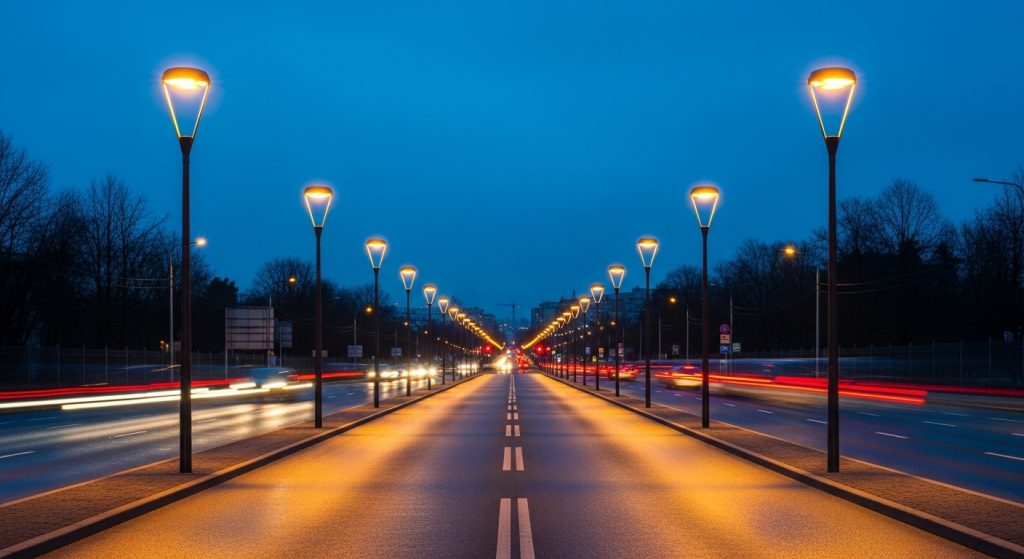
Spacing is a strategic decision that depends on the road’s geometry and the optic power of the LED. If you change the height of the pole or the lens of the light, the required spacing changes as well. You use this metric to ensure that every square foot of the driving lane and sidewalk receives adequate light. A well-calculated distance prevents “zebra stripping” on the asphalt, which can be disorienting for high-speed traffic. Your goal is to create a seamless flow of light that supports natural human vision.
Why even coverage depends more on spacing than brightness alone
You might assume that buying a brighter light can fix a poorly spaced layout, but this is a common error. Uniform lighting is far more important for safety than raw power. If your poles are too far apart, even the most powerful lamp will leave dangerous dark spots between the cones of light.
These gaps force the driver’s pupils to constantly dilate and constrict, leading to visual fatigue and slower reaction times. Proper spacing ensures the right amount of overlap, which enhances visual comfort for both drivers and pedestrians. You want a consistent level of light so that objects on the road maintain their contrast and visibility. Brighter lights in a bad layout often just create more glare without fixing the underlying coverage issues. Stability in the light level is what truly makes a street feel safe at night.
How road width and layout influence street light spacing
Your road width is a primary factor that changes how you calculate your pole placement. A narrow residential street might only need a single row of lights spaced further apart. However, a wide six-lane boulevard often requires a staggered or opposite-sided lighting layout to cover the center lanes.
Complex intersection design also forces you to adjust your standard spacing. You usually need to move poles closer together at crossings and merge points to ensure maximum visibility for turning vehicles. Coverage planning for curves and hills requires even more precision to prevent the beam from overshooting the road. You must adapt your spacing to the physical reality of the street to ensure the safety of every user. Each turn and junction in your city requires a specific look at the spacing to avoid creating hidden hazard zones.
How mounting height affects the distance between street lights
You will find that the mounting height of your fixture is the main tool for controlling the light spread on the ground. As you move the light higher up the pole, the coverage radius naturally expands. This is why taller poles allow for much wider spacing between fixtures.
However, you must balance this height with the intensity of the light. While a very tall pole covers more ground, the light hitting the pavement will be weaker unless you increase the power. There is a technical trade-off between the number of poles you want to install and the uniformity you need to reach. If you use poles that are too short, you will be forced to buy many more units and place them very close together. Finding the “sweet spot” between height and distance is key to an efficient and cost-effective city project.
How beam angle changes optimal street light spacing
The beam angle of your LED determines the specific shape of the light distribution on the asphalt. A narrow beam focuses most of its energy directly under the pole, while a wide beam pushes light further out to the sides. You must pick an angle that allows for effective overlap control based on your pole locations.
If you use a wide beam, you can typically increase the distance between your poles while still maintaining a smooth glow. Narrow beams are excellent for highlighting specific areas but require much tighter spacing to avoid dark gaps. You should consider the beam pattern early in your design phase to ensure it matches your physical pole layout. Using the wrong angle for your spacing can lead to excessive glare for drivers or light shining into bedroom windows. Precise optics allow you to stretch your spacing without compromising on the quality of the light.
How lumen output influences spacing without causing over-lighting
Your lumen output dictates the total amount of light available to cover a specific area. However, more lumens do not always mean you can move your poles further apart. You must maintain an illumination control strategy that prevents “hot spots” of extreme brightness.
If you try to use very high lumens to fix a wide spacing gap, you often end up with an illumination level that is too intense directly under the lamp. This causes a brightness balance issue where the transition between poles is still too sharp. You should match the lumen count to the mounting height and the desired overlap to reach your safety targets. The goal is to use the right amount of light to meet visibility standards without wasting energy or causing glare. Proper planning ensures that every watt contributes to a safer road rather than just creating an over-lit environment.
What spacing mistakes commonly lead to uneven street lighting
One of the most frequent design mistakes is simply copying a lighting layout from a different project without checking the new road’s width. This leads to uneven lighting because every street has its own unique geometry and traffic needs. Another error is over-spacing the lights just to reduce the total pole count and save on initial costs.
This creates coverage gaps that can lead to more accidents and higher insurance liabilities for the city. You should also avoid ignoring the effect of trees and buildings on your light spread. If a large tree blocks half your beam, your “calculated” spacing will fail in the real world. Many planners also forget to account for how the light will age and dim over time. Taking the time to avoid these errors keeps your street bright and your community happy with the results.
What should be checked before finalizing street light spacing
You should conduct a thorough performance review before you commit to a final pole layout. This spacing validation ensures that your city’s road visibility goals are met across every block. Use this design checklist to verify your plan:
- Confirm the road classification and the speed of the traffic.
- Measure the exact road width including any bike lanes or sidewalks.
- Verify the pole height and the reach of the mounting arms.
- Review the photometrical files for your chosen LED beam angle.
- Check for any physical obstacles like large trees or utility signs.
- Ensure the overlap between poles is sufficient for uniform brightness.
- Validate that the layout meets local safety and glare standards.
What are LED road and street lights and how do they affect spacing design
LED road and street lights provide the versatile LED technology needed for modern street lighting systems. Unlike old bulbs, these fixtures allow you to pick specific lenses that change your spacing options. You can use their precise control to stretch the distance between poles while keeping the road bright. This flexibility is what makes them the best choice for both new city builds and old street upgrades.
How should a street lighting lumens guide be used when planning spacing
A Street lighting lumens guide helps you manage your lumen planning to meet high brightness standards. It shows you how many lumens you need for different road types, which tells you how much area each light can cover. You can use this guide to ensure your spacing is not too wide for the power of the fixture. It is a vital tool for making sure your city roads are safe and your energy use is low.
Why does LED street light beam angle matter for spacing decisions
The LED street light beam angle determines the light spread of your fixture on the ground. You need a specific beam angle to ensure your light pools meet in the middle of a gap. A wide angle helps you use fewer poles, while a narrow angle provides more intense light for specific zones. Choosing the right angle is the only way to avoid dark spots in a widely spaced layout.
How do LED and sodium street lights differ in spacing requirements
A technology comparison shows that LEDs offer much better spacing efficiency than old sodium lamps. Sodium lights have a messy spread that requires you to place poles closer together to avoid dark zones. LEDs give you total control over where the light goes, allowing you to move poles further apart. This switch helps you save money on both the fixtures and the cost of installing the poles themselves.


- 10 Meters Lamp Post
- 10 Meters Pole
- 1000w Led Projector
- 100W LED Tunnel Light
- 12 Meters Lamp Post
- 12 Meters Pole
- 1200w Led Projector
- 15 Light Pole
- 1500w Led Projector
- 150W LED Tunnel Light
- 1800w Led Projector
- 2 In 1 Solar Flood Light
- 200w Led Tunnel Light
- 50w Led Tunnel Light
- 6 Meters Lamp Post
- 6 Meters Pole
- 8 Meters Lamp Post
- 8 Meters Pole
- 800w Led Projector
- 80w Led Tunnel Light
- Colourful Decorative Light
- Conical post
- Courtyard Lamp
- courtyard light
- courtyard lighting fixture
- Decorative Landscape Light
- Decorative road Light
- Flood Light For Courtyard
- Flood Light for Garden
- Flood Light For Outdoor
- Foot Led High Bay Lights
- high bay led lights 100w
- industrial lampshade
- industrial LED shed lights
- industrial magnifying glass with light
- Integrated Solar Flood Light
- led courtyard lamp
- led courtyard light
- led high bay light 100w
- LED Projector For Stadium
- Led UFO High Bay 150W 5000k
- Lighting Plants Mining Price
- Maintenance Free LED Street Light
- Pic Controlling Tunnel Light
- PLC controlling tunnel light
- Post Top Garden Light
- RGB Landscape Light
- Rgbw Decorative Light
- Smart Tunnel Light
- solar courtyard lamp
- solar courtyard light
- Solar LED Road Light
- Solar Street Light For 10 Meter Pole
- Solar Street Light For 12 Meter Pole
- Solar Street Light For 6 Meter Pole
- Solar Street Light For 8 Meter Pole
- Split Type Solar Flood Light
- Sporting Projector
- Stadium Led Projector
- Street Lighting Post
