
 Request A Quote


What Is a Tapered Light Pole and When Should You Use It
 FACEBOOK
 TWITTER
 LINKEDIN
A tapered light pole is a structural column designed with a cross-section change, where the diameter is widest at the base and gradually narrows toward the top. Unlike uniform poles that maintain the same width throughout their length, this structural geometry is specifically engineered to handle physical stress more effectively. By placing more material at the bottom—where the leverage and bending forces are most intense—and reducing it at the top, the pole achieves a high degree of load efficiency. This makes it an incredibly popular choice for modern streetscapes and infrastructure projects that require a balance of strength and material economy.
Choosing a tapered design is a strategic move for design optimization. It isn’t just about a sleek, modern appearance; it’s about how the pole behaves under the pressure of wind and the weight of heavy LED fixtures. Tapering allows the pole to remain rigid while being lighter than a solid uniform pole of the same height, which can simplify both shipping and installation. Planners typically turn to tapered poles when they need to maximize outdoor durability in exposed areas or when mounting lights at significant heights. By understanding the relationship between the pole’s shape and its mechanical performance, you can move away from default selections and choose a structure that truly fits the demands of your specific site.
What does tapering mean in light pole design
In the context of pole geometry, tapering refers to a gradual, consistent reduction in the diameter or width of the pole as it rises from the base plate to the tenon. This creates a conical or pyramidal structural form that differs significantly from straight poles, which look like a uniform pipe. While a straight pole has a constant cross-section, the tapered pole is built to follow the natural distribution of stress. This design allows for a much more efficient use of metal, as the structure is only as “thick” as it needs to be at any given height.
Tapering is used in structural design primarily to manage the physics of a vertical cantilever. Because a street light is basically a long lever attached to the ground, the most pressure is felt at the bottom. By increasing the base width, manufacturers provide the pole with a broader “stance” to resist tipping. This visual and functional narrowing helps the pole blend into a variety of environments, from busy urban boulevards to quiet park paths, providing a clean vertical line that looks as stable as it actually is.
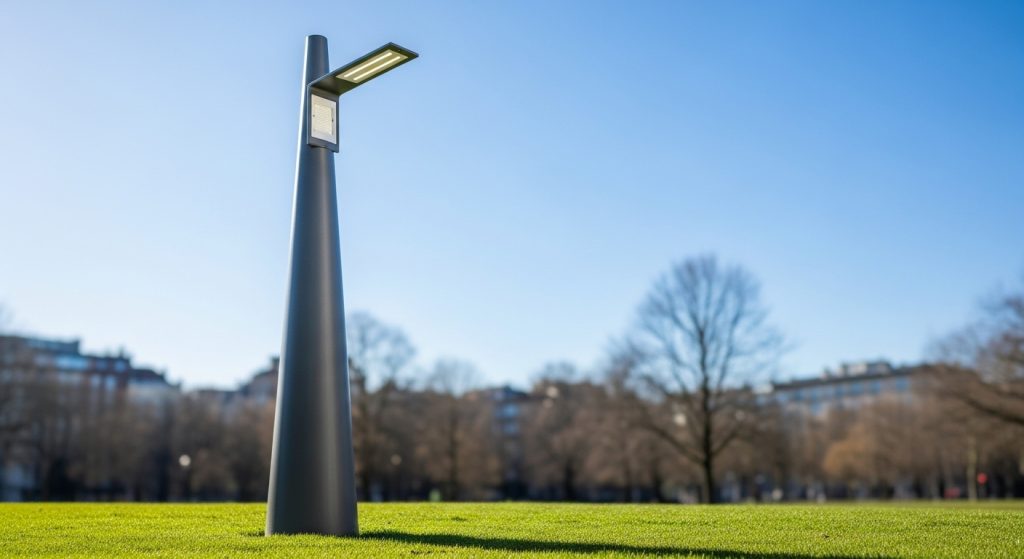
How does a tapered shape improve structural performance
The primary benefit of a tapered shape is the way it manages load distribution across the entire height of the pole. When a light fixture is mounted at the top, it creates a “turning moment” or leverage that is strongest at the foundation. Because the tapered pole is wider at the bottom, it has a much higher resistance to this bending stress exactly where it is needed most. This efficiency means the pole can support heavier luminaires or longer outreach arms without requiring excessively thick walls, which would make the pole unnecessarily heavy.
This structural efficiency also extends to how the pole handles vibration. Tapered structures have a natural ability to dampen the shaking caused by wind or passing heavy trucks. Because the mass of the pole changes with height, it doesn’t have a single “resonance frequency” that allows it to sway wildly. Instead, the tapering disrupts the vibration patterns, keeping the fixture steady. This stability is vital for protecting the internal electronics of your LED lights and ensuring that the light beam remains focused on the road rather than jumping around.
Why tapered light poles are commonly used for highways and open areas
In open environments, such as vast highway interchanges or large parking lots, poles are subjected to much higher and more consistent wind exposure than they are in a sheltered downtown area. Tapered poles are the industry standard for these locations because their aerodynamic profile and base-heavy design allow them to stand firm against high-velocity gusts. When you are dealing with a high mounting height of 30 feet or more, the stability of a tapered pole becomes a critical safety factor for motorists traveling at high speeds.
Highways also demand consistent lighting over multiple lanes, which often requires large, heavy fixtures that put immense pressure on the mounting structure. A tapered pole can handle these heavy loads while maintaining a professional, streamlined appearance. Planners favor this design for large-scale roads because it provides the best performance-to-cost ratio for tall installations. The natural strength of the taper allows for longer spacing between poles, reducing the total number of units required to light a highway and making the entire project more economically viable.
When is a tapered light pole unnecessary or over-engineered
Despite their benefits, tapered poles are not always the best choice for every project. For many low-height urban installations, such as 10-foot pedestrian lamps or garden lighting, the extra strength of a taper is often unnecessary. In these cases, a straight, uniform pole is perfectly capable of handling the load and is often more cost-effective. Achieving a cost balance means choosing a pole that meets the safety requirements without paying for specialized structural geometry that the environment doesn’t demand.
In sheltered environments, like narrow alleyways or areas surrounded by tall buildings, wind loads are significantly reduced. Here, design efficiency might lead you toward a simpler straight pole that fits the aesthetic of the neighborhood. Using a heavy-duty tapered pole for a small fixture in a wind-protected zone is a classic example of over-engineering. Planners must assess the application suitability of each site to decide if the structural advantages of a taper are worth the investment or if a simpler, uniform design will provide the same long-term results.
How do arms and bracket configurations affect tapered pole selection
The arm load created by a fixture extending away from the pole adds a significant amount of “eccentric weight” to the structure. This means the pole isn’t just holding weight up; it’s resisting the urge to be pulled to one side. Because a tapered pole is so strong at its base, it can handle a longer fixture reach or a wider overhang than many uniform poles. The taper helps to counteract the structural leverage that a long arm exerts, keeping the entire assembly vertical and preventing the pole from developing a permanent lean over time.
Planners must carefully coordinate the degree of tapering with the intended arm configuration. If you are using a double-arm setup to light two sides of a road, the loads are balanced, but the total weight on the pole is doubled. In these scenarios, the wide base of a tapered pole is essential for managing the increased downward pressure on the foundation. By matching the pole’s structural geometry to the specific reach and weight of the arms, you ensure that the light stays positioned exactly where the engineers intended, even during heavy storms.
How wind forces influence the decision to use tapered poles
Wind is a variable force that changes as you move higher off the ground; typically, wind speeds are much higher at the top of a pole than at the base. A tapered pole is perfectly suited for this because its wind load is minimized at the top, where the diameter is smallest. This reduces the total overturning force that the wind can apply to the structure. By presenting a smaller profile to the wind at higher elevations, the tapered pole protects the foundation from being pried out of the ground.
Maintaining structural stability in windy locations is a matter of calculating the “Effective Projected Area” (EPA) of the pole and all its attachments. Because the tapered pole has less surface area at the top, it naturally has a better EPA rating than a uniform pole of the same height. This provides a larger safety margin, giving planners confidence that the pole won’t fail during peak wind events. In regions prone to hurricanes or high-velocity gusts, the structural physics of a tapered pole make it the most responsible choice for public safety.
What common mistakes occur when specifying tapered light poles
A frequent cause of specification errors is selecting a tapered pole solely for its “modern look” without verifying if it can actually handle the intended equipment. This leads to a design mismatch where a thin-walled decorative tapered pole is paired with a heavy high-mast fixture, creating a dangerous performance risk. You must always ensure that the structural ratings of the pole—not just its shape—match the weight and wind sail area of the lamps you plan to use.
Another mistake is pairing tapered poles with incompatible arms or brackets. Because the diameter of the pole changes with height, a bracket designed for the bottom won’t fit the top. Planners sometimes fail to specify the exact mounting height on the taper, leading to hardware that slips or fails to secure correctly. To avoid these blunders, you must treat the pole, arm, and bracket as a single integrated system and confirm that every component is sized specifically for the tapered geometry at the exact point of installation.
What should be checked before deciding to use a tapered light pole
Before you finalize your order, you must conduct a thorough design validation to ensure that a tapered pole is the right fit for your site conditions. This final check helps ensure project readiness and prevents costly errors during the construction phase. By reviewing the structural needs of the project, you can decide with confidence whether tapering is the right solution.
Use this decision checklist to guide your final choice:
- Confirm the pole height is sufficient for the required light spread.
- Verify the wind load rating for your specific geographic region.
- Ensure the weight of your fixture and arm does not exceed the pole’s capacity.
- Check that all brackets and mounting hardware are sized for the taper’s diameter.
- Validate the foundation specs to ensure they can handle the pole’s overturning force.
- Assess if the environment is “open” enough to justify a tapered structural design.
- Review municipal or DOT standards for structural stability requirements.
What specifications should street light poles and brackets meet when using tapered designs
When using tapered poles, you must ensure they meet specific pole standards that account for the changing diameter. This makes bracket compatibility more complex; you need to know the exact “top diameter” (tenon size) to ensure the light sits securely. If the bracket doesn’t match the taper perfectly, vibrations can cause the fixture to shift over time. For more on these requirements, see Street light poles brackets.
Why polygon light poles are sometimes chosen instead of tapered poles
A design comparison shows that while tapered poles are usually round or square, polygon geometry offers even more stiffness for extremely tall installations. In highway lighting, polygon poles (which are also tapered) use their faceted sides to resist buckling better than a smooth round surface. If you are mounting massive banks of lights, a polygon design might be the superior structural choice. Learn more in Polygon light pole highways.
How do lighting pole arms and brackets influence tapered pole design
The Lighting pole arm bracket is the primary source of weight that the tapered pole must resist. Because the fixture mounting is often offset from the center of the pole, it creates a twisting force. The wide base of the tapered pole is what provides the necessary counter-torque to keep the structure upright. Choosing the right bracket is essential for a permanent, wiggle-free connection on a tapered surface.
Why wind load calculation is critical when selecting tapered light poles
A rigorous Light pole wind load calculation is the only way to ensure structural safety. Because tapered poles are often used in high, exposed areas, you must calculate how the wind will push against the changing surface area of the pole. This wind load calculation ensures that the “hinge point” at the base won’t fail during a major storm, keeping the public safe.
When should single or double arm brackets be used on tapered poles
The choice between a single arm or a double arm depends on the road width and the structural balance of the pole. On tapered poles, a double-arm setup helps to equalize the load, pushing the weight directly down through the center of the wide base. However, if the pole is on the side of a narrow road, a single arm is often sufficient. See more on configuration in Single vs double arm bracket.
Final Thought
A tapered light pole is a masterclass in functional design, using geometry to provide maximum strength exactly where the laws of physics demand it. By prioritizing structural efficiency and wind resistance, these poles provide a safer and more durable foundation for our roads and highways. When you match the pole’s taper to the specific needs of your environment, you create a lighting system that is as reliable as it is efficient.


- 10 Meters Lamp Post
- 10 Meters Pole
- 1000w Led Projector
- 100W LED Tunnel Light
- 12 Meters Lamp Post
- 12 Meters Pole
- 1200w Led Projector
- 15 Light Pole
- 1500w Led Projector
- 150W LED Tunnel Light
- 1800w Led Projector
- 2 In 1 Solar Flood Light
- 200w Led Tunnel Light
- 50w Led Tunnel Light
- 6 Meters Lamp Post
- 6 Meters Pole
- 8 Meters Lamp Post
- 8 Meters Pole
- 800w Led Projector
- 80w Led Tunnel Light
- Colourful Decorative Light
- Conical post
- Courtyard Lamp
- courtyard light
- courtyard lighting fixture
- Decorative Landscape Light
- Decorative road Light
- Flood Light For Courtyard
- Flood Light for Garden
- Flood Light For Outdoor
- Foot Led High Bay Lights
- high bay led lights 100w
- industrial lampshade
- industrial LED shed lights
- industrial magnifying glass with light
- Integrated Solar Flood Light
- led courtyard lamp
- led courtyard light
- led high bay light 100w
- LED Projector For Stadium
- Led UFO High Bay 150W 5000k
- Lighting Plants Mining Price
- Maintenance Free LED Street Light
- Pic Controlling Tunnel Light
- PLC controlling tunnel light
- Post Top Garden Light
- RGB Landscape Light
- Rgbw Decorative Light
- Smart Tunnel Light
- solar courtyard lamp
- solar courtyard light
- Solar LED Road Light
- Solar Street Light For 10 Meter Pole
- Solar Street Light For 12 Meter Pole
- Solar Street Light For 6 Meter Pole
- Solar Street Light For 8 Meter Pole
- Split Type Solar Flood Light
- Sporting Projector
- Stadium Led Projector
- Street Lighting Post
