
 Request A Quote


How tower high bay lights transform lighting in warehouses and industrial facilities
 FACEBOOK
 TWITTER
 LINKEDIN
Tower high bay lights are the specialized workhorses of industrial lighting, engineered to solve the unique challenges of cavernous interior spaces. Unlike standard fixtures, a tower high bay is designed with a specific focus on verticality and high-altitude warehouse illumination, making them indispensable for facilities with ceilings exceeding 20 to 40 feet. These units are not merely about raw power; they utilize advanced optics to drive light through the “air gap” of tall interiors, ensuring that floor-level operations remain bright and safe. This high bay performance is critical in environments where precision, speed, and worker safety are the primary operational metrics.
The transition to tower-style high bays allows for a more strategic light distribution that traditional low bay or standard industrial lamps cannot achieve. By utilizing a narrow-to-medium beam focus, these fixtures minimize light “spill” onto upper walls and ceilings, directing the maximum amount of energy toward the workstations and inventory racks below. This results in significant energy efficiency gains and a noticeable improvement in performance uniformity. When properly planned, tower high bays transform a dim, shadowy warehouse into a high-visibility hub of productivity. Selecting the right fixture requires a careful balance of lumen density, mounting strategy, and thermal management, ensuring the system remains a reliable asset for years in the demanding environment of a 24/7 industrial facility.
What distinguishes tower high bay lights from other industrial fixtures
The primary differentiator of a tower high bay is its optimized fixture type, specifically built for extreme mounting height. While low bay fixtures are designed for heights under 20 feet with wide, diffused spreads, tower high bays are built to concentrate their output to pierce through the distance. They often feature a more aerodynamic or vertical “tower” heat sink design, which allows for better thermal dissipation—a crucial factor in maintaining LED longevity in the trapped heat common near industrial ceilings.
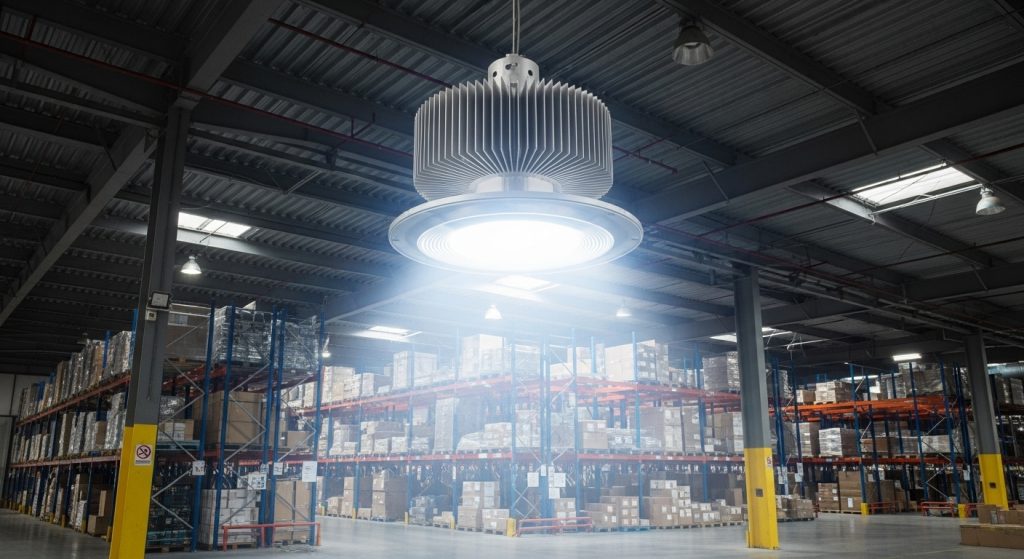
The beam focus of these units is also unique. Rather than a generic 120-degree flood, tower high bays often offer 60-degree or 90-degree options. This specialized light path prevents the beam from dissipating before it reaches the floor, ensuring that the “lux” (the light that actually hits the surface) remains high enough for complex industrial tasks. This architectural distinction makes them a superior choice compared to standard wall-mounted solutions, which often leave the centers of large warehouses in a dangerous “twilight” zone.
How ceiling height affects tower high bay lighting decisions
In industrial planning, the ceiling clearance is the ultimate regulator of your lighting success. As the height of a warehouse increases, the “inverse square law” dictates a rapid light loss if the fixture isn’t powerful enough. For facilities with 30-foot ceilings, you must select fixtures with enough “punch” to overcome the distance. If the height is ignored during the planning phase, the result is often a dim floor that fails to meet safety standards, regardless of how many watts the fixtures consume.
Achieving performance uniformity across a massive floor also becomes harder as you go higher. Taller ceilings allow the pools of light from individual fixtures to overlap more broadly, which can be an advantage for creating a seamless wash of light. However, it requires a precise mounting height strategy to ensure that these overlaps don’t create “hot spots” followed by dark gaps. By coordinating the height of the mounting point with the fixture’s optic angle, you ensure that the light reaches every corner of the factory floor with consistent intensity.
Why lumen output and beam distribution matter in industrial spaces
The lumen requirements for a warehouse are strictly tied to the nature of the work being performed. For general bulk storage, 150–200 lux on the floor might be sufficient, but for detailed assembly or packing zones, you may need 500 lux or more. Choosing a tower high bay with a high lumen-per-watt ratio ensures that you meet these targets without ballooning your utility costs. Sizing the output correctly is the foundation of task lighting efficiency.
Beam angle selection is the second half of the performance equation. In narrow-aisle warehouses with tall racking, a narrow beam is essential to drive light deep into the aisles without being blocked by the top of the racks. In open factory floors, a wider beam might be preferable to create a more expansive and comfortable environment. Finding the right balance ensures that light is delivered precisely to the “working plane,” minimizing shadows and maximizing the safety and productivity of the entire workforce.
Where tower high bay lights work best in warehouses and factories
Tower high bays are the definitive choice for wide space lighting where the ground-level activity is separated by high-clearance vertical space. Their primary use cases are found in high-cube storage facilities where the “canyon” of the aisle requires specialized light penetration. In these layouts, the lights act as guides, illuminating the vertical face of inventory racks and the floor simultaneously, which is vital for forklift operators and pickers.
Beyond the aisles, they are ideal for large assembly lines and conveyor corridors. In these zone definition scenarios, the high bays provide the broad, shadow-free light needed to spot defects or manage moving machinery safely. Because they are mounted high above the fray, they stay out of the way of cranes and high-reach equipment, providing a “sky of light” that supports the entire industrial workflow without interfering with the physical operations of the factory.
How glare control influences industrial and tall-space lighting
In a large facility, glare mitigation is a major factor in maintaining visual comfort and worker safety. Glare occurs when a high-intensity light source is directly visible against a dark background, a constant risk with powerful LEDs mounted at high altitudes. If a worker looks up to check a high-shelf inventory and is blinded by an unshielded LED, it creates a temporary safety risk and increases long-term eye fatigue.
Modern optics design in tower high bays addresses this by using recessed LEDs or specialized prismatic diffusers that “soften” the light before it leaves the fixture. This ensures that while the output remains high, the “dazzle” is minimized. Prioritizing visual clarity ensures that employees can focus on their tasks for long shifts without the discomfort associated with poor-quality industrial lighting. High-quality glare control turns a powerful fixture into a helpful tool rather than a source of distraction.
How modular flood lights relate to tower high bay installations
While high bays manage the interior, modular lighting systems often take over for the exterior and loading docks. The primary difference is the coverage planning; while high bays are strictly downward-pointing, flood lights are designed for angled, wide-area illumination. Integrating these two types is common in large industrial layouts to ensure a seamless transition from the bright factory floor to the outdoor logistics yard.
Understanding the flood vs high bay distinction helps you allocate the right technology to the right zone. Modular flood lights offer the flexibility to tilt and swivel, making them perfect for illuminating the “face” of a building or a dark loading bay from a distance. By coordinating your tower high bays with exterior modular units, you create a 360-degree safety envelope for your facility, ensuring that no dark zones exist at the critical transition points where goods enter and exit the building.
What common mistakes weaken high bay lighting performance
One of the most frequent installation errors is undersizing the lumen output to save on initial hardware costs. This leads to performance gaps that eventually require the addition of costly auxiliary lighting later. Another common blunder is ignoring the beam distribution; using a wide-angle light in a narrow aisle warehouse results in most of the light being absorbed by the tops of the racks, leaving the floor—the place you actually need the light—in total darkness.
Layout issues also occur when mounting heights are inconsistent. If fixtures are placed at varying levels without adjusting the beam angles, the light uniformity will be destroyed, creating a “checkerboard” of bright and dark spots. To avoid these blunders, you should always perform a photometric study before purchasing. By mapping the “light throw” of each fixture on a digital model of your facility, you can guarantee a professional, high-performance result that meets all industrial standards.
How to choose the right tower high bay light for your facility
Before finalizing your lighting planning, a thorough assessment of your facility needs is necessary to ensure the hardware is a perfect fit. Use this selection checklist as a final guide to ensure your warehouse is bright, safe, and energy-efficient. By verifying these factors now, you can avoid expensive field modifications in the future.
- Ceiling Check: Confirm the exact mounting height and available ceiling clearance.
- Lumen Mapping: Calculate the required lux levels for your specific task zones (storage vs. packing).
- Aisle Width: Do you need a narrow beam (aisles) or a wide beam (open areas)?
- Thermal Environment: Does the fixture have a robust “tower” heat sink for high-ceiling heat?
- Glare Audit: Does the optics design provide adequate visual comfort for workers?
- Control Integration: Will the fixtures work with motion sensors or “daylight harvesting” systems?
- Maintenance Goal: Is the driver easily accessible for long-term service without high-lift equipment?
How flood lights, high bay, and sports lighting solutions support large spaces
Flood lights, high bay and sports lighting refer to the primary industrial lighting categories used for wide area illumination. Understanding how these systems differ is the key to creating a balanced environment. While high bays handle the interior, flood and sports lights ensure that the surrounding exterior and high-traffic yards remain safe and productive.
When modular flood lights complement tower high bay installations
Choosing an LED modular flood light provides the necessary wide coverage for loading docks and perimeter walls. These flood lighting units allow you to direct light with precision, ensuring that the “blind spots” outside your factory are illuminated. They work in tandem with your interior high bays to provide a comprehensive safety plan for the entire site.
How sports lighting poles and stadium lighting compare to industrial setups
While similar in power, Sports light pole stadiums offer a much more bathed coverage than industrial fixtures. Pole lighting is designed to eliminate shadows across a massive field, whereas high bays are focused on the “task zones” of a warehouse. Recognizing this difference helps you choose the right “throw” and mounting strategy for your specific large-scale project.
How lumen planning impacts performance in tall industrial spaces
A Flood lighting lumens guide provides the technical output planning needed for high-altitude projects. This lumens guide helps you calculate the exact “punch” needed to reach the floor from a 40-foot ceiling. Accurate lumen planning ensures that your industrial facility is both safe and compliant with modern labor and productivity standards.
How glare reduction strategies can improve comfort in high bay facilities
Reviewing techniques to Reduce glare sports lighting is vital for industrial glare mitigation. By prioritizing visual comfort through shielded optics and strategic placement, you can create a high-visibility environment that doesn’t strain the eyes of your workers. Comfortable lighting is a direct contributor to reduced errors and increased employee morale.


- 10 Meters Lamp Post
- 10 Meters Pole
- 1000w Led Projector
- 100W LED Tunnel Light
- 12 Meters Lamp Post
- 12 Meters Pole
- 1200w Led Projector
- 15 Light Pole
- 1500w Led Projector
- 150W LED Tunnel Light
- 1800w Led Projector
- 2 In 1 Solar Flood Light
- 200w Led Tunnel Light
- 50w Led Tunnel Light
- 6 Meters Lamp Post
- 6 Meters Pole
- 8 Meters Lamp Post
- 8 Meters Pole
- 800w Led Projector
- 80w Led Tunnel Light
- Colourful Decorative Light
- Conical post
- Courtyard Lamp
- courtyard light
- courtyard lighting fixture
- Decorative Landscape Light
- Decorative road Light
- Flood Light For Courtyard
- Flood Light for Garden
- Flood Light For Outdoor
- Foot Led High Bay Lights
- high bay led lights 100w
- industrial lampshade
- industrial LED shed lights
- industrial magnifying glass with light
- Integrated Solar Flood Light
- led courtyard lamp
- led courtyard light
- led high bay light 100w
- LED Projector For Stadium
- Led UFO High Bay 150W 5000k
- Lighting Plants Mining Price
- Maintenance Free LED Street Light
- Pic Controlling Tunnel Light
- PLC controlling tunnel light
- Post Top Garden Light
- RGB Landscape Light
- Rgbw Decorative Light
- Smart Tunnel Light
- solar courtyard lamp
- solar courtyard light
- Solar LED Road Light
- Solar Street Light For 10 Meter Pole
- Solar Street Light For 12 Meter Pole
- Solar Street Light For 6 Meter Pole
- Solar Street Light For 8 Meter Pole
- Split Type Solar Flood Light
- Sporting Projector
- Stadium Led Projector
- Street Lighting Post
