
 Request A Quote

UNOPS-Backed Africa Solar Projects Benefit From Smarter, Low-Maintenance Lighting
 FACEBOOK
 TWITTER
 LINKEDIN
When a UNOPS-style project team reviews a solar lighting supplier for African deployment, the real question is rarely just wattage. It is whether the system can stay productive in dusty, remote, resource-constrained environments where maintenance is difficult, budgets are tight, and lighting failure quickly becomes a public-service problem.
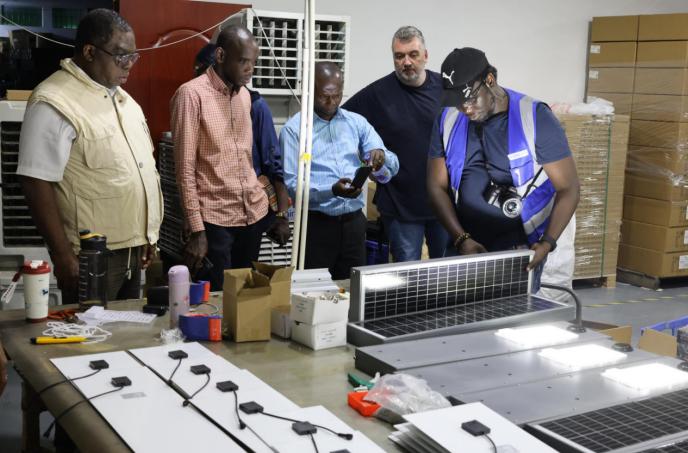
That question matters more than ever. According to the Tracking SDG7: The Energy Progress Report 2025, more than 666 million people worldwide still lacked basic access to electricity, and Sub-Saharan Africa now accounts for 85% of the global population without electricity. The same reporting makes clear that current progress is still too slow to achieve universal access by 2030.
The Real Sourcing Challenge Starts After Installation
For project owners, municipalities, EPC contractors, and procurement teams working on African renewable infrastructure, this creates a practical sourcing challenge. A solar street light may look competitive on paper, yet still underperform in the field because:
• Panels become dirty over time
• Charging efficiency declines
• Battery cycling becomes deeper and less stable
• Service calls become more frequent and expensive
In other words, the bottleneck is often not installation. It is long-term operational resilience.
Why Maintenance Has Become the Real Pain Point in African Solar Lighting Projects
Across Africa, distributed renewable energy is no longer a fringe option. UNOPS has been supporting energy access initiatives such as the Africa Minigrids Program, a country-led effort launched to help scale renewable electricity access across more than 20 African countries. UNOPS also continues to back country-level projects, from rural electrification in Mauritania to solar generation in Zambia and mini-grid deployment in Zimbabwe.
At the same time, the market reality is becoming more demanding. The IEA notes that in Africa, universal electricity access will depend not only on grid extension, but also heavily on mini-grids and stand-alone systems, especially in locations where conventional grid expansion is too slow or too costly.
That shift raises the standard for solar lighting manufacturers. Buyers increasingly need products that can:
• Reduce manual maintenance in remote areas
• Preserve charging performance under dust, rain, and irregular service cycles
• Lower life-cycle cost rather than just initial procurement cost
• Support transparent technical review under public or development-finance procurement frameworks
This is exactly where many conventional all-in-one solar street lights begin to show weakness. In dry or mixed-weather environments, panel soiling can quietly cut power generation. Once charging declines, the lighting schedule becomes less reliable, the battery is pushed harder, and the project’s economics begin to deteriorate.
What UNOPS-Style Procurement Really Looks For
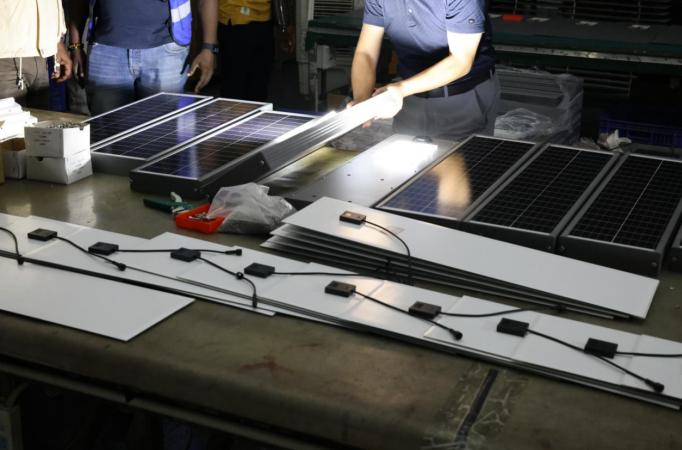
UNOPS procurement is guided by principles such as best value for money, fairness, integrity, transparency, and effective competition. For public-interest energy projects, that means vendors are judged on more than a headline specification. Procurement frameworks also emphasize supplier qualification, conduct, and the ability to meet technical and operational requirements in a credible way.
For solar lighting suppliers, this has an important implication: a product must be defensible not only in marketing language, but also in project evaluation, technical comparison, and long-term service logic.
That is why a factory-level review today tends to focus on questions like these:
• How does the product protect charging performance over time?
• What design features reduce dependence on manual cleaning?
• How does the supplier control the PV, battery, metalwork, and system integration process?
• Can the manufacturer support government, donor-funded, or infrastructure-grade projects at scale?
How Dawn Lighting Aligns With This New Project Demand
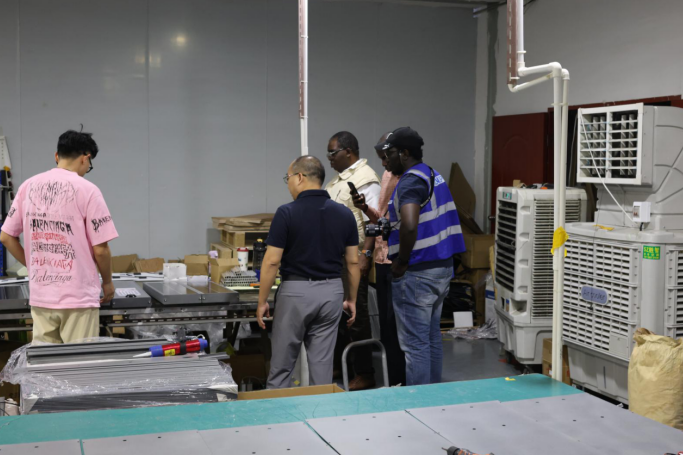
Founded in 2011, Dawn Lighting is a solar and LED lighting manufacturer backed by a broader group structure covering lighting, photovoltaic, battery, and metal manufacturing. The company has delivered more than 500 international projects, operates through an integrated supply chain, and has experience in government-oriented work.
Dawn also presents itself as a UN-designated supplier, which supports its relevance in public-sector project discussions, although buyers should still confirm project-specific qualification requirements during the tendering process.
From a technical standpoint, Dawn Lighting’s Clean The Solar Panels All In One Solar Street Light is built around a pain point many project planners know well but few product pages address seriously: maintenance-driven energy loss.
According to Dawn’s published product materials, the system includes several features designed to address this issue directly:
• Bilateral solar panels that capture sunlight from multiple directions
• Up to 20% higher charging efficiency compared with comparable single-sided concepts
• Automatic PV sweeper for daily panel cleaning
• Auto open-close cleaning mechanism to reduce self-shading
• Rain-triggered cleaning response to keep the panel surface clearer without routine manual intervention
• High-lumen brand LEDs with luminous efficacy above 190 lm/W
For African solar infrastructure projects, that design logic is commercially relevant for several reasons.
Better Charging Stability in Real Outdoor Conditions
A bilateral PV layout helps capture sunlight across changing angles and reflected conditions, rather than relying on a narrower collection profile. In practical deployment, that can improve charging consistency in locations where daylight conditions are variable or where installation orientation is not always ideal.
Dawn’s self-cleaning architecture adds another layer of protection by helping to:
• Reduce dust-related charging loss
• Maintain more stable energy harvest over time
• Limit the slow efficiency drift that often appears in outdoor installations
• Support more dependable dusk-to-dawn lighting performance
• Lower Maintenance Pressure For Remote Or Resource-Limited Projects
For municipalities and contractors managing dispersed assets, every service trip matters. A system that cleans its own PV surface can reduce ladder work, truck rolls, and the need for frequent manual intervention.
That matters especially in:
• Rural roads
• Peri-urban corridors
• Parks and public spaces
• Infrastructure projects with limited maintenance staff
• Installations spread across large geographic areas
In these environments, a lower-maintenance lighting solution can help improve uptime while reducing field-service pressure.
Stronger Life-Cycle Value, Not Just Lower First Cost
UNOPS and other development-oriented procurement frameworks emphasize value, transparency, and suitability over simplistic price comparison. A solar street light that protects daily energy harvest can reduce battery stress, improve runtime reliability, and lower long-term operating cost.
From a buyer’s perspective, that means the value proposition is not limited to purchase price. It also includes:
• Fewer maintenance interventions
• More stable charging performance
• Reduced risk of early light output decline
• Better long-term operating economics
• Stronger justification in project evaluation and tender comparison
That makes the procurement case stronger than one based on nominal power alone.
Why This Matters for the Future of Africa Solar Projects
Africa’s energy-access gap is still large, but the investment logic is changing fast. The IEA’s Africa analysis shows that the region still faces major imbalances in electricity investment, with much of Sub-Saharan Africa receiving too little capital relative to need. In that environment, project owners cannot afford equipment choices that create hidden maintenance burdens later.
This is why the next generation of solar street lighting procurement will favor manufacturers that think beyond the luminaire itself. They will need to combine:
• Charging resilience
• Maintenance reduction
• Integrated manufacturing capability
• Project-grade credibility
• Stronger alignment with real deployment conditions
That is the direction Dawn Lighting appears to be following. By combining LED and solar expertise with vertically linked PV and manufacturing resources, and by engineering around one of the field’s most common failure points—dirty panels and unstable charging—the company positions itself in line with what African infrastructure buyers increasingly need: solar lighting that is easier to trust after installation, not just at the quotation stage.
For buyers tracking UNOPS-backed or Africa-focused solar opportunities, that is the real benchmark now. The winning product is no longer the one with the loudest specification sheet. It is the one that keeps generating, keeps lighting, and keeps maintenance pressure under control when the project enters the hard part: daily operation.
- 10 Meters Lamp Post
- 10 Meters Pole
- 1000w Led Projector
- 100W LED Tunnel Light
- 12 Meters Lamp Post
- 12 Meters Pole
- 1200w Led Projector
- 15 Light Pole
- 1500w Led Projector
- 150W LED Tunnel Light
- 1800w Led Projector
- 2 In 1 Solar Flood Light
- 200w Led Tunnel Light
- 50w Led Tunnel Light
- 6 Meters Lamp Post
- 6 Meters Pole
- 8 Meters Lamp Post
- 8 Meters Pole
- 800w Led Projector
- 80w Led Tunnel Light
- Colourful Decorative Light
- Conical post
- Courtyard Lamp
- courtyard light
- courtyard lighting fixture
- Decorative Landscape Light
- Decorative road Light
- Flood Light For Courtyard
- Flood Light for Garden
- Flood Light For Outdoor
- Foot Led High Bay Lights
- high bay led lights 100w
- industrial lampshade
- industrial LED shed lights
- industrial magnifying glass with light
- Integrated Solar Flood Light
- led courtyard lamp
- led courtyard light
- led high bay light 100w
- LED Projector For Stadium
- Led UFO High Bay 150W 5000k
- Lighting Plants Mining Price
- Maintenance Free LED Street Light
- Pic Controlling Tunnel Light
- PLC controlling tunnel light
- Post Top Garden Light
- RGB Landscape Light
- Rgbw Decorative Light
- Smart Tunnel Light
- solar courtyard lamp
- solar courtyard light
- Solar LED Road Light
- Solar Street Light For 10 Meter Pole
- Solar Street Light For 12 Meter Pole
- Solar Street Light For 6 Meter Pole
- Solar Street Light For 8 Meter Pole
- Split Type Solar Flood Light
- Sporting Projector
- Stadium Led Projector
- Street Lighting Post
