
 Request A Quote


What wattage solar street light do I need for different road widths
 FACEBOOK
 TWITTER
 LINKEDIN
What wattage solar street light do I need for different road widths is a question you must answer to ensure safety. You must match your project to local illumination standards so drivers can see clearly at night. A narrow path requires much less power than a wide four-lane highway. Proper light distribution ensures that no dark spots remain on the pavement.
You will find that your solar output directly limits how much energy demand you can meet. A higher wattage light needs a bigger battery and a larger solar panel to work well. System design changes how you pick your wattage. Some units are compact while others have separate parts for more power. You must also consider how cloudy days affect performance.
If your area is rainy, you might need a system with more storage. Cost per pole goes up as you choose higher wattage. Smart buyers look at both the price and the long-term value. This guide helps you pick the right lamp for your specific road size. Following these steps prevents wasting money on lights that are too weak. You can build a reliable system by checking your road needs first.
Why road width matters for solar street light wattage
The width of your road is the main factor in picking the right light. Wide roads need more light to reach from one side to the other. If you pick a wattage that is too low, the center of the road will stay dark. This creates a risk for drivers and people walking at night. You should follow illumination standards to make sure the light is bright enough for safety.
Good light distribution means the beam spreads out evenly across the pavement. You do not want bright spots directly under the pole and darkness in between. Roadway visibility helps everyone see obstacles or turns in the road. When you know your road width, you can calculate how much area you need to cover. This helps you avoid buying a light that is too small for the job.
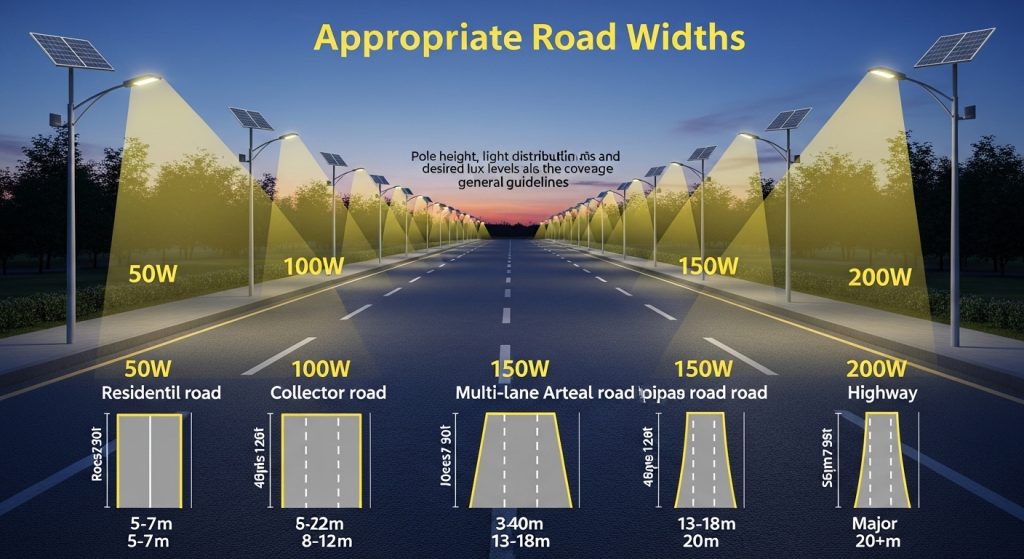
Basic rule: wattage vs illumination needs
You can use these general rules to see which brightness range fits your needs. Higher lumen output is needed when the distance between poles is large or the road is very wide. Each road type has a different energy demand that you must meet.
- 30W to 50W: Best for narrow park paths or small residential alleys.
- 60W to 80W: Good for standard two-lane city streets and neighborhood roads.
- 100W to 120W: Works well for wider arterial roads with medium traffic.
- 150W or more: Required for major highways and large industrial zones.
How system design affects actual wattage choice
Your choice of system configuration changes how much light actually reaches the ground. A modular design often allows for higher wattage because it has a separate, larger solar panel. Component separation means the light fixture can be small while the battery stays big. This is different from a compact unit where everything must fit in one box. In some sites, a split system is the only way to get enough power for a wide road. You must look at how the light is mounted to see if it fits your pole height. Higher poles need more wattage to push the light all the way to the street. Your system design should match the brightness goals of your specific road.
How battery life and weather performance influence wattage plans
Picking a high wattage means you need a battery that can keep up. Your battery lifespan depends on how deeply you drain it every night. If you use a 150W light with a small battery, it will wear out very fast. Solar output also changes with the seasons. During cloudy months, your panels might not gather enough power for a very bright light. You need performance reliability so the lights stay on during a long storm. Sometimes it is better to pick a lower wattage with smart dimming to save your battery. This ensures you have light all night even when the sun is hidden. You must balance your power needs with the weather at your site.
How cost per pole ties to higher wattage and road width
A higher wattage system will increase your capital investment for each pole. You will need a bigger solar panel and a more expensive battery box. The installation cost also goes up because the parts are heavier and larger. You must look at the lifecycle cost to see the true value of your choice. While a 100W light costs more than a 50W light, it might be the only way to meet safety rules. Buying a light that is too weak is a waste of money because you will have to fix it later. You should weigh the visibility needs of the road against your total budget. Smart planning helps you find the right wattage without overspending on parts you do not need.
Practical selection steps for different road widths
Follow these steps to build your lighting plan. You should always check the road classification before you buy your equipment to meet performance criteria.
- Measure the total width of the road from curb to curb in meters.
- Check the local safety rules for required light levels on the ground.
- Look at your pole height to see how far the light will spread.
- Pick a wattage that provides clear roadway visibility without wasting power.
- Verify that your battery can run that wattage for at least three nights.
Common mistakes when matching wattage to road width
Many people make planning errors by looking only at the wattage number. You should know that wattage is about power use, not always about brightness. High-efficiency LEDs can be brighter than old lamps with the same wattage. Site variability like trees or tall buildings can also block your light. If you ignore these things, your road might still have dark spots. Another mistake is underestimating the weather in your area. A 100W light might work in the summer but fail in the winter if your panel is too small. You should always use worst-case data to pick your wattage. This keeps your project running smoothly all year long.
Buyer checklist before finalizing wattage
You should complete a site survey to understand the sun and shade at your location. This helps you check the project feasibility before you spend your budget. Operational planning ensures someone is ready to maintain the lights later.
- Verify the road width and the distance between your light poles.
- Check the average sun hours for your site during the winter.
- Ensure your system reliability meets the safety needs of the road.
- Look for a light with high lumens per watt to save battery power.
- Ask your supplier for a light distribution map for your wattage.
What are solar street lighting systems
A solar street lighting systems setup is a modern way to provide outdoor illumination. These units use clean sun power to run LED lighting at night. You can save a lot of money on power bills because they do not use the city grid. Each pole works on its own, which makes the whole system very easy to install. They are a great choice for any road project that wants to be green and save money.
What is an all-in-one solar street light
Using an all-in-one solar street light guide helps you see if this integrated design fits your road. These lights have the panel, battery, and lamp in a single box. This offers great installation simplicity because you just slide it onto the pole. They are best for narrow paths or small residential streets. While they look clean, they usually have lower wattage limits than other types.
What is a split type solar street light
A split type solar street light uses a modular architecture where the parts are separate. This gives you great panel placement flexibility to catch the most sun. Because the parts are separate, you can use a much larger solar panel and battery. This is the best choice for wide highways that need high wattage and very bright light. It takes more work to install but provides the most power.
What is a semi-integrated solar street light
A semi integrated solar street light offers a partial integration for your project. It keeps the battery and light together but has a separate solar panel. This gives you a great balance of flexibility and simplicity. You can tilt the panel to face the sun while the light faces the road. It is a smart choice for medium-sized city streets that need reliable power.
How long solar street light batteries last
The solar street light battery lifespan is a key part of your lifecycle expectancy. Most modern lithium batteries last between five and eight years. You will see some battery degradation as the unit gets older. Proper wattage selection helps the battery stay healthy because it does not drain too deeply. Picking a high-quality battery ensures your lights stay on through every season.
How do solar street lights perform in cloudy weather
You should consider solar street lights cloudy weather performance before you pick a wattage. Even on gray days, the panels gather some solar output. However, your lights will mostly run on the battery during a storm. Performance fluctuations are normal when the sun is hidden for many days. A good system is sized to handle these dark periods without turning off.
How much does a solar street light cost per pole
The solar street light cost per pole varies based on the wattage you choose. Higher wattage means a larger battery and panel, which are the main cost drivers. You should also think about installation variability like soil type and pole height. While the initial price is higher than grid lights, you save money over time because there are no power bills.


- 10 Meters Lamp Post
- 10 Meters Pole
- 1000w Led Projector
- 100W LED Tunnel Light
- 12 Meters Lamp Post
- 12 Meters Pole
- 1200w Led Projector
- 15 Light Pole
- 1500w Led Projector
- 150W LED Tunnel Light
- 1800w Led Projector
- 2 In 1 Solar Flood Light
- 200w Led Tunnel Light
- 50w Led Tunnel Light
- 6 Meters Lamp Post
- 6 Meters Pole
- 8 Meters Lamp Post
- 8 Meters Pole
- 800w Led Projector
- 80w Led Tunnel Light
- Colourful Decorative Light
- Conical post
- Courtyard Lamp
- courtyard light
- courtyard lighting fixture
- Decorative Landscape Light
- Decorative road Light
- Flood Light For Courtyard
- Flood Light for Garden
- Flood Light For Outdoor
- Foot Led High Bay Lights
- high bay led lights 100w
- industrial lampshade
- industrial LED shed lights
- industrial magnifying glass with light
- Integrated Solar Flood Light
- led courtyard lamp
- led courtyard light
- led high bay light 100w
- LED Projector For Stadium
- Led UFO High Bay 150W 5000k
- Lighting Plants Mining Price
- Maintenance Free LED Street Light
- Pic Controlling Tunnel Light
- PLC controlling tunnel light
- Post Top Garden Light
- RGB Landscape Light
- Rgbw Decorative Light
- Smart Tunnel Light
- solar courtyard lamp
- solar courtyard light
- Solar LED Road Light
- Solar Street Light For 10 Meter Pole
- Solar Street Light For 12 Meter Pole
- Solar Street Light For 6 Meter Pole
- Solar Street Light For 8 Meter Pole
- Split Type Solar Flood Light
- Sporting Projector
- Stadium Led Projector
- Street Lighting Post
