
 Request A Quote

who invented the street light
 FACEBOOK
 TWITTER
 LINKEDIN
One of the most revolutionary inventions in the history of the city is street lighting. What used to be a mere fire light has now become energy efficient smart illumination that covers the contemporary cities. Street lights are not only making roads brighter today, but they are also making them safer and aiding in the development of smart infrastructure as well as sustainable development.
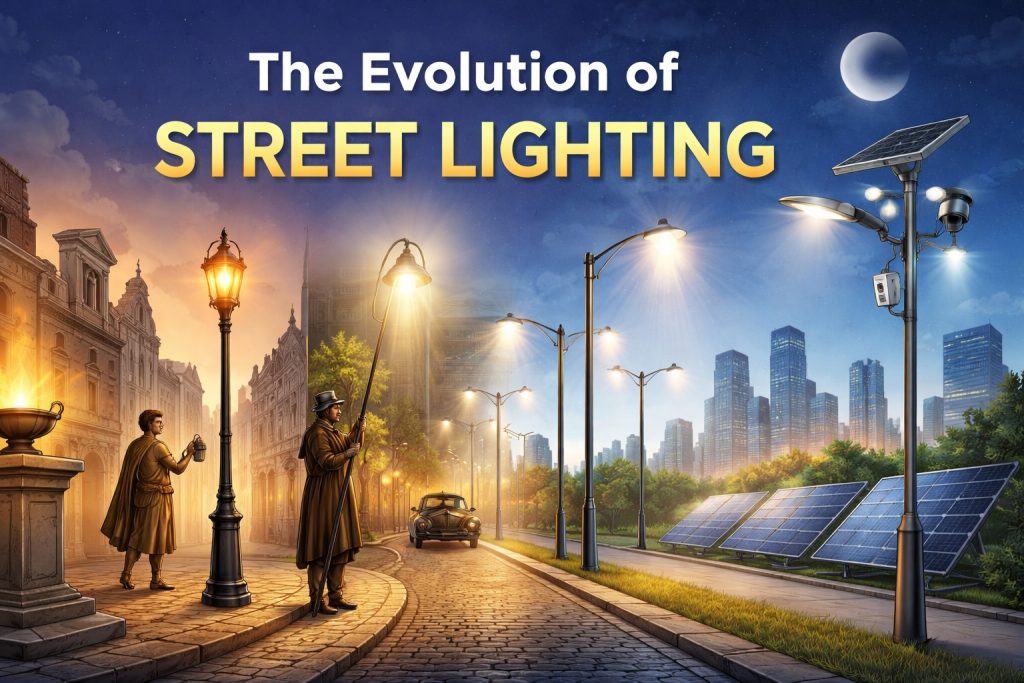
This paper delves into the entire history of street lighting, back to ancient times, high-tech solar and intelligent lighting systems.
The Early Street Lighting: Fire, Oil and Primitive lighting.
The first types of street lighting were in use thousands of years ago. Early civilization used natural and primitive artificial sources of light including fire, torches, candles and oil lamps to lighten up corridors.
History tells us that the Ancient Romans lit the streets with oil lamps and this was primarily due to safety and night navigation. On the same note, Chinese records dating back to 500 BC indicate that the fixed lighting systems were already in existence with simple flame based systems.
There was however a lack of adequate lighting and inconsistency. Most cities in the middle ages were dark and tourists used to carry lanterns or guides in their hands to navigate the streets at night time.
The major distinguishing features of Early Lighting:
- Lighting by hand (torches, candles).
- Lack of brightness and coverage.
- It was mainly used as a safety and navigation tool.
- No unified systems of street lighting.
The Emergence of Organized Street Lighting (16 th -18 th Century)
In Europe, street lighting was more organized over the 16th and 17th centuries. Governments started to realize the need to have illuminated streets as a way of minimizing crime and enhancing life in the cities.
For example:
- In Paris, the government ordered intersections to be illuminated in the streets in the late 1500s.
- The lights of lanterns by the end of the 17th century made Paris one of the first cities in the world to be well-lit.
There were also other innovations that came during this period like glass-enclosed lanterns that enhanced brightness and longevity. The lighting systems in the communities became more structured so that there were workers assigned to do the lighting and take care of the lamps.
Impact on Society:
Lighting in the streets was a factor that impacted proper city reform:
- Reduced crime rates
- Nightlife and economic activity are encouraged.
- Better transportation and security.
These transformations heralded the start of the modern urban life.
Gas Lighting Revolution (19 th Century)
The gas-powered street lighting came as a big breakthrough in the 19 th century.
Such cities as London and Los Angeles started to install gas lamps in streets, which were fed by centralized gas systems. By mid 1800s, urban areas were lit with gas-lamps in thousands.
An example is that by the 1870s Los Angeles had installed more than 130 gas street lamps, which were lit by lamplighters every night. Equally, such cities as Cincinnati installed gas lighting systems, and thousands of lamps were interconnected by pipelines.
Advantages of Gas Lighting:
- The candles or oil lamps were faint and unreliable compared to the brighter and more reliable light.
- Facilitated massive city light.
- Backed up developing industrial cities.
Even though it was a good idea, gas lighting demanded a lot of maintenance and infrastructure, and the next innovation came.
The Breakthrough of Electric Lighting (Late 19th -Early 20th Century).
Electricity was invented and has brought a revolution in the street lighting.
The first arc lamp street lighting based in Paris in 1878 was one of the first electric lighting systems and began to change lighting technology. Within a short period, the world switched to electric lighting as it was much brighter and more efficient.
The inventions in electric lighting included:
- Arc lamps: These are very bright and are applied in large spaces.
- Incandescent bulbs: Safer and more viable to be used over a wide area.
- Moonlight towers: High buildings which provided light to whole neighborhoods.
Gas systems were rapidly phased out by electric street lighting, which was now the international standard at the beginning of the 20th century.
Advantages of Electric Lighting:
- Greater visibility and security.
- Reduced maintenance as compared to gas lamps.
- Scalable to larger urban centres.
This was the time of actual urbanization of cities.
High-Intensity Lighting and Automation (20 th Century).
With the improvement of the technological level, the systems of street lights became more efficient and automated.
As early as the 1900s, automatic lighting systems were developed in the streets, which used photoelectric sensors to switch lights on and off depending on the amount of daylight available.
Subsequently, it was developed as follows:
- Mercury vapor lamps
- High Intensity Discharge Lighting.
- Several better lamp designs that are more energy efficient.
Cities also extended lighting systems to a great extent whereby the streets were lit even at night.
Urban Transformation:
The lighting in the streets redefined the urban life by:
- Extending business hours
- Favoring night life and entertainment.
- Increasing the level of trust and security.
LED Revolution and energy efficiency (21 st Century).
One of the most important innovations that lighting has brought in the 21 st century is Light Emitting Diode (LED) technology.
LED street lights offer:
- Lower energy consumption
- Longer lifespan
- Reduced maintenance costs
- Better light quality
There has been a move by cities in the world to switch to LED systems as a way of being green. To illustrate, in the year 2009 Los Angeles started installing large volume of LED which has greatly enhanced efficiency and saved on energy consumption.
A Sustainable Future of solar street lighting.
As more people are concerned about climate change and energy usage, solar-powered streetlights have become a disrupter.
Solar street lights utilize photovoltaic panels to produce electricity when the sun is out and use it in the batteries when it is dark. These systems are:
- Eco-friendly
- Cost-effective
- Remote or off-grid Applicable.
They do not require any form of traditional power infrastructure, and as such, they are gaining popularity across the world.
Intelligent Street Lighting and iOT.
The light in the street is not merely a question of light anymore, it constitutes the smart city infrastructure.
The smart street lights will have technologies that include:
- Sensors and cameras
- Wireless communication networks.
- Brightness control adaptive.
- Environmental monitoring
Such cities as San Diego and Copenhagen have deployed smart lighting systems that are able to identify traffic, check on air quality as well as enhance emergency response .
The main characteristics of Smart Lighting:
- Dimmer and scheduling automatically.
- Real-time data collection
- Encroachment with city management systems.
- Enhanced public safety
Conclusion: Intelligent Lighting Systems Flames to Intelligent Lighting Systems.
The history of the street lighting traces back the development of human civilization. Since it was a simple torch and oil lamp, to a high tech smart and solar powered systems, street lights have kept evolving to satisfy the demands of the society.
It is now of critical importance in:
- Urban safety
- Energy efficiency
- Environmental sustainability
- Smart city development
With the ever-evolving technology, the future of street lighting will most probably be on increased automation, integration of renewable energy, and smart and connected urban lives.
- 10 Meters Lamp Post
- 10 Meters Pole
- 1000w Led Projector
- 100W LED Tunnel Light
- 12 Meters Lamp Post
- 12 Meters Pole
- 1200w Led Projector
- 15 Light Pole
- 1500w Led Projector
- 150W LED Tunnel Light
- 1800w Led Projector
- 2 In 1 Solar Flood Light
- 200w Led Tunnel Light
- 50w Led Tunnel Light
- 6 Meters Lamp Post
- 6 Meters Pole
- 8 Meters Lamp Post
- 8 Meters Pole
- 800w Led Projector
- 80w Led Tunnel Light
- Colourful Decorative Light
- Conical post
- Courtyard Lamp
- courtyard light
- courtyard lighting fixture
- Decorative Landscape Light
- Decorative road Light
- Flood Light For Courtyard
- Flood Light for Garden
- Flood Light For Outdoor
- Foot Led High Bay Lights
- high bay led lights 100w
- industrial lampshade
- industrial LED shed lights
- industrial magnifying glass with light
- Integrated Solar Flood Light
- led courtyard lamp
- led courtyard light
- led high bay light 100w
- LED Projector For Stadium
- Led UFO High Bay 150W 5000k
- Lighting Plants Mining Price
- Maintenance Free LED Street Light
- Pic Controlling Tunnel Light
- PLC controlling tunnel light
- Post Top Garden Light
- RGB Landscape Light
- Rgbw Decorative Light
- Smart Tunnel Light
- solar courtyard lamp
- solar courtyard light
- Solar LED Road Light
- Solar Street Light For 10 Meter Pole
- Solar Street Light For 12 Meter Pole
- Solar Street Light For 6 Meter Pole
- Solar Street Light For 8 Meter Pole
- Split Type Solar Flood Light
- Sporting Projector
- Stadium Led Projector
- Street Lighting Post
