
 Request A Quote


Metal Halide High Bay Lights: Decide Between Continued Maintenance and LED Replacement
 FACEBOOK
 TWITTER
 LINKEDIN
Metal halide high bay lights continue to be used in warehouses, workshops and other tall industrial buildings. If lamps do start to fail, or if visibility is not even, replacing individual lamps can seem like an easy task. But if access is to be quoted several times, it can escalate to a question of operating cost.
The real decision on the table for a facility manager and electrical contractor is to either keep the current system that is compatible or to make a planned for a verified replacement. The proper choice begins with the equipment installed, work done under it and time allowed for changes.
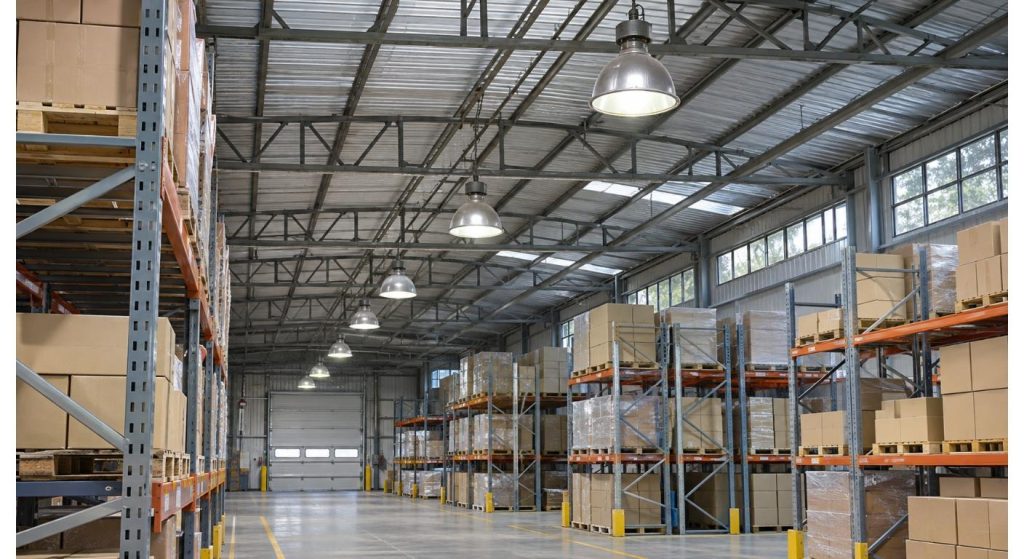
Always identify the Installed System Before Ordering Parts.
Metal halide lamps are a system, consisting of a lamp and a ballast, rather than just a bulb in a housing. Before ordering replacements, note the lamp type, wattage, ballast type, voltage at the source, lamp socket, lamp fixture enclosure and allowable operating position.
Similar appearance and matching base does not make compatible. Lamp and ballast must match and the lamp must be appropriate for either an open or enclosed fixture type as indicated on the lamp.
For replacement talks, choose from Dawn Lighting’s high bay lighting collection. While the high bay pages reviewed do not create a separate offering for metal halide replacement lamps, it does help differentiate maintenance of existing systems from the purchase of a new LED luminaire.
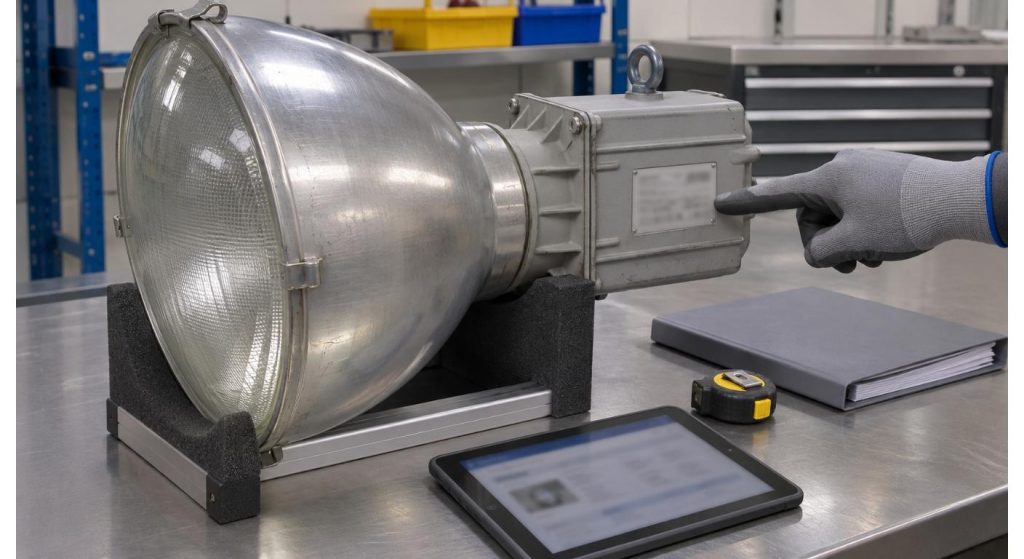
Differentiate between a Failed Lamp and a Declining Lamp Installation.
Explore the reasons for the lack of satisfactory performance of the area. A failed lamp is not the same as dirty reflectors, ageing lamps, worn out control gear, or a no longer applicable layout. The replacement of one component will not solve all problems.
Document the failures, by location and date, as well as maintenance visits and operating time. If a light keeps shorting out in the same location, the cause of the short circuit should be determined, and not merely replaced with a new light.
If the existing system is able to be maintained and is serviceable and sufficient for the job, planned maintenance can be a viable short-term option. If multiple issues intersect, think about an “upgrade” versus multiple repairs, and coordinate purchases.
Check whether the starting behaviour is suitable for the operations.
Metal halide lamps require warmup time to get to lamp output and hot lamps may require a cool down period before lamp starts again. Lamp warm up or restrike time is dependent on the lamp and control system, and this one universal time should not be used for all installations.
This is important in production or inspection processes where the power is out, or in goods moving if they are short outages. Inquire about the existing lighting recovery, and if there is a need for stand-alone emergency lighting.
Replacement bulbs are available in LED technology, which can provide quick light output, but the full control system is yet to be confirmed. Confirm switching, dimming, sensor compatibility and emergency operation on the proposed model, do not assume that these options are part of all LED fixtures.
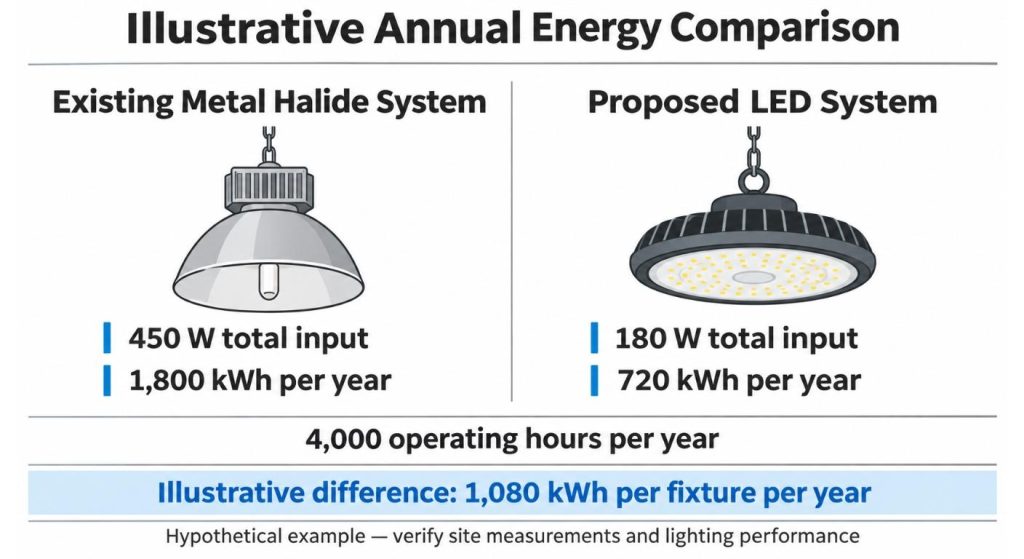
A comparison of the energy use in complete systems.
When calculating electricity consumption use the actual luminaire input power. Not all ballast losses are considered in the nominal wattage of a metal halide lamp. Similarly, compare the total input (of the desired LED luminaire) not the LED chip rating.
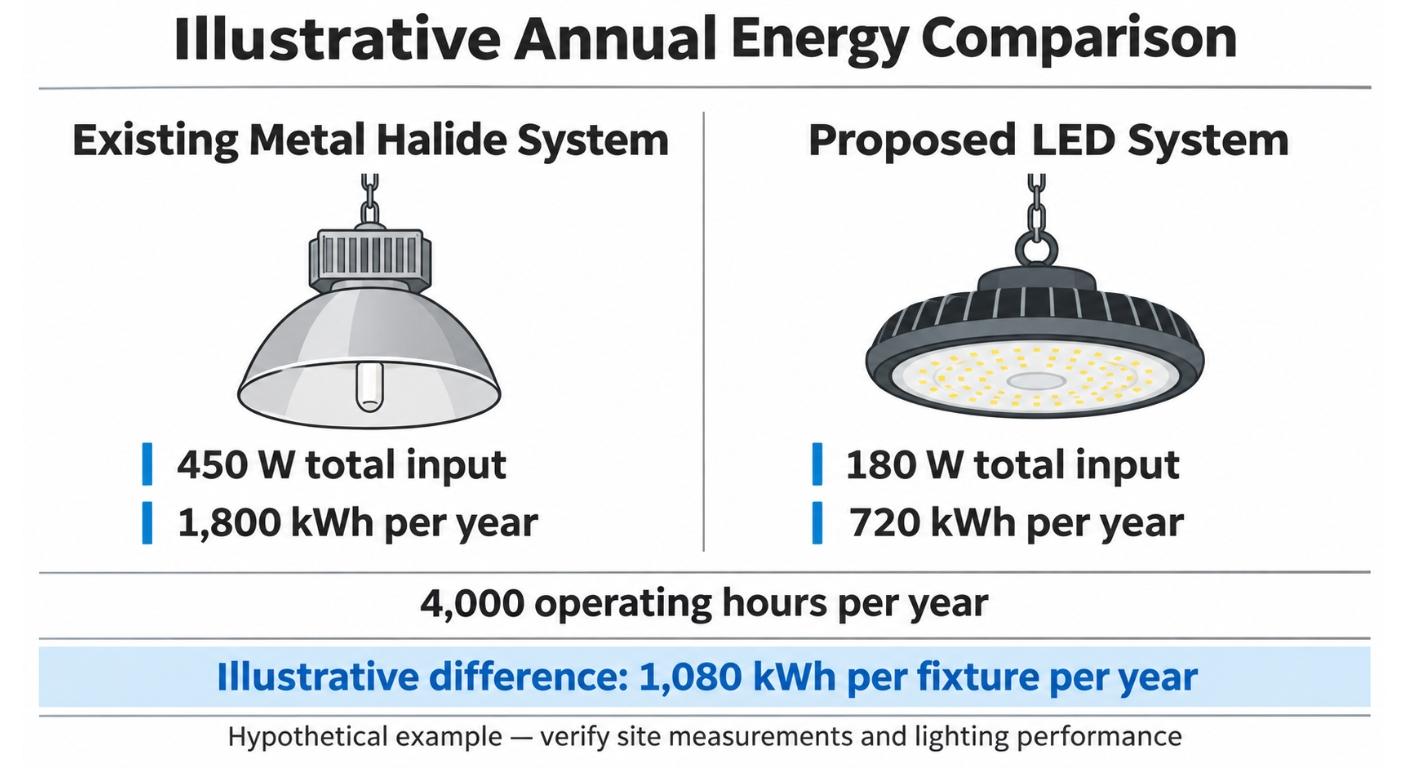
An existing 450W system and a proposed 180W LED system use 1,800kWh per 4,000 hours and 720kWh per 4,000 hours, respectively. A difference of 1080kWh per fixture. These are not Dawn Lighting replacement guarantees, but are hypothetical inputs.
Calculate the difference multiplied by the cost of electricity for the site, plus installation, controls and maintenance and access cost. Be sure to separate any incentives until eligibility is established.
Indicate Replacement Lighting in the Work Area
The wattage of an older fixture is not enough information to determine the correct size for the new fixture. Determine the lighting level needed for assembly, inspection and storage aisles and circulation. Lighting distributions and/or additional lighting may be required depending on the task.
Consider the height of the mount, the location of the rack, obstructions and the typical line of sight for the workers. Do not just compare lighting conditions that are ‘set-up’ the first time a sample is installed; compare conditions throughout the duration of the lighting.
Dawn Lighting has a small family of UFO high bay to test. Ask to view the photometric file of the selected configuration and a calculation on the actual floor plan. Mounting points may have been used before but may need to be spaced out differently with the new distribution.
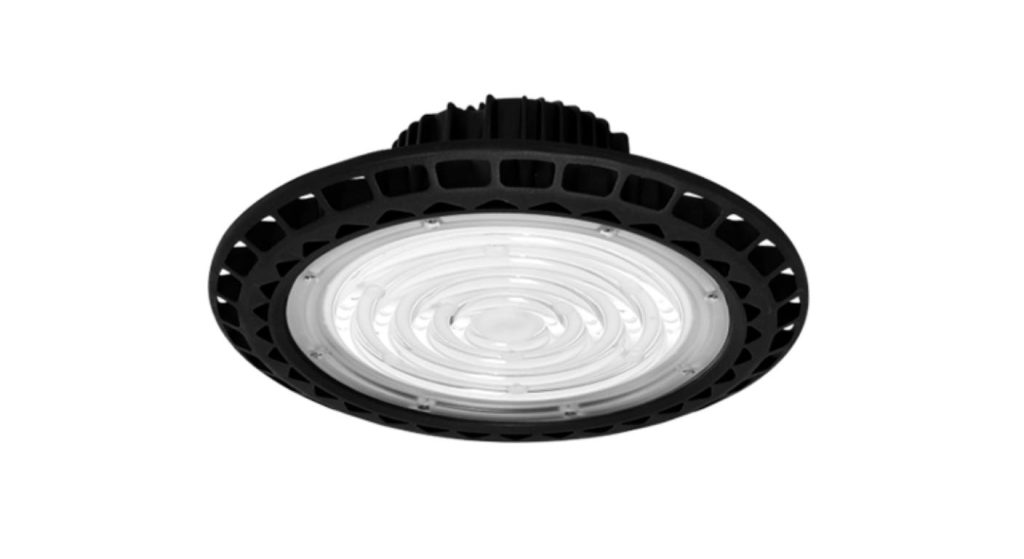
Select New Luminaire OR Approved Retrofit Route
Changing the entire luminaire, and the installation of an LED retrofit lamp or kit, are distinct projects. Existing housing and electrical configuration has to be approved for retrofit. Not all types of metal halide ballast will work with an LED lamp.
The complete replacement allows for the examination of the driver, optical, thermal, suspension and enclosure as a total package. It may even be a change in a mounting hardware or connections. Before comparing the price with a lamp-only repair, make sure that the items included are the same.
Customized LED high bay product of Dawn Lighting: Thermal management, surface treatment and DIALux support. Discuss these features and then have a uniform model-specific specification. Check in the final quotation for available power, optics, input voltage and mounting information.
Include Ceiling Conditions and Access in the Budget
Assess or measure the environment at the mounting altitude because it may not be the same as the floor the device is located on. The selection of a luminaire depends on the classification of the hazardous area, heat, dust, moisture and cleaning practices. Don’t use a general industrial description as evidence for all environments.
Inquire about the changing of parts like drivers and other serviceable parts, what parts the warranty covers, and what spare parts are available. Upgrading to LED eliminates routine relamping, but drivers, controls and so forth still require maintenance planning.
Installation to be planned around Access Equipment and Operating Schedule. Discuss with the contractor arrangements for isolation, removal and disposal – this should include provisions for the handling of discharge lamps removed from the ceiling.
Before scaling, check the validity of One Representative Area.
If you are in a large facility, test a representative aisle and/or production zone before placing the order. Test lighting at specified measurement points, visibility on surfaces of interest, glare, control response and measured input power.
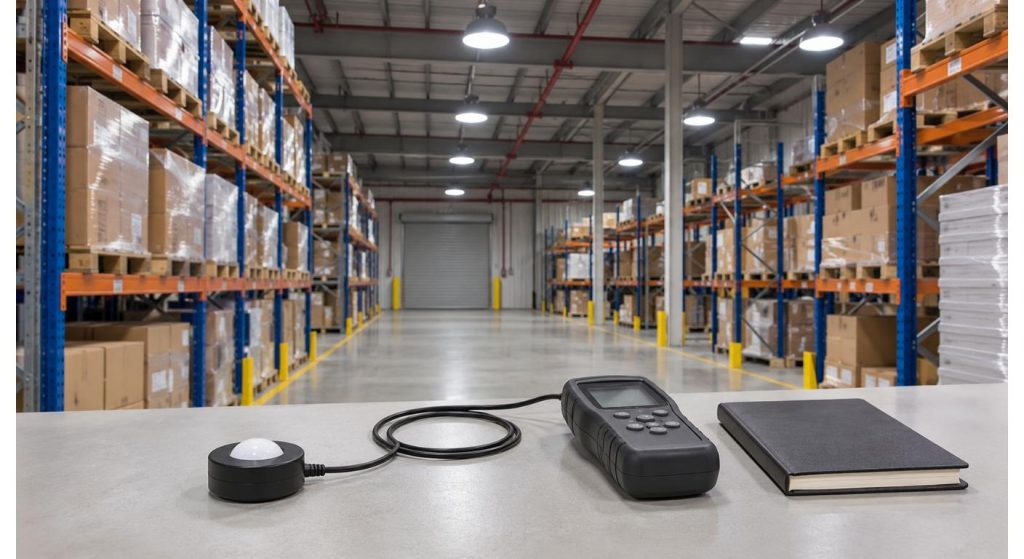
Submit your current fixture schedule, fixture heights, floor plan, fixture hours and photos of the site via Dawn Lighting’s contact page. Make the Request for Proposal (RFP) based on those inputs and note any changes that need to be vetted. Test the entire setup before implementing it throughout the rest of the building.
| Decision Point | Evidence Needed |
| Continue maintenance | Compatible parts and acceptable lighting |
| Repair recurring faults | Documented diagnosis and repair scope |
| Evaluate LED replacement | Photometric proposal and complete quotation |
| Approve pilot area | Recorded measurements and operating settings |
| Release remaining order | Approved configuration and installation programme |
Conclusion
Metal halide high bay lights need to be evaluated as a complete installation. Check the compatibility when operating them and consider the energy usage, lighting performance and access cost when replacing them. Having a documented LED trial supports a broad upgrade proposal into a determined decision based upon facility needs.
FAQs
Q1. Is it OK to convert a metal halide lamp to another lamp with the same wattage?
Not just on watts! Verify the lamp designation, compatibility of ballast, fixture enclosure, socket and operating position.
Q2. If a metal halide lamp is rated at 400W does it consume 400W at the supply?
Not necessarily. Account for ballast losses and use proven system-input power for energy calculations.
Q3. Will one LED wattage lamp be able to take the place of every 400W metal halide fixture?
No. The LED configuration will vary according to the distribution, mounting geometry and lighting task.
Q4. Does LED retrofit require changing of the existing ballast?
When using retrofit products that allow for such. Different electrical set up and professional installation for other products.
Q5. Are the suspension points available to be reused?
Perhaps after looking at load capacity, mountability, condition and new lighting arrangement. Please make sure that re-use is confirmed prior to ordering.
- 10 Meters Lamp Post
- 10 Meters Pole
- 1000w Led Projector
- 100W LED Tunnel Light
- 12 Meters Lamp Post
- 12 Meters Pole
- 1200w Led Projector
- 15 Light Pole
- 1500w Led Projector
- 150W LED Tunnel Light
- 1800w Led Projector
- 2 In 1 Solar Flood Light
- 200w Led Tunnel Light
- 50w Led Tunnel Light
- 6 Meters Lamp Post
- 6 Meters Pole
- 8 Meters Lamp Post
- 8 Meters Pole
- 800w Led Projector
- 80w Led Tunnel Light
- Colourful Decorative Light
- Conical post
- Courtyard Lamp
- courtyard light
- courtyard lighting fixture
- Decorative Landscape Light
- Decorative road Light
- Flood Light For Courtyard
- Flood Light for Garden
- Flood Light For Outdoor
- Foot Led High Bay Lights
- high bay led lights 100w
- industrial lampshade
- industrial LED shed lights
- industrial magnifying glass with light
- Integrated Solar Flood Light
- led courtyard lamp
- led courtyard light
- led high bay light 100w
- LED Projector For Stadium
- Led UFO High Bay 150W 5000k
- Lighting Plants Mining Price
- Maintenance Free LED Street Light
- Pic Controlling Tunnel Light
- PLC controlling tunnel light
- Post Top Garden Light
- RGB Landscape Light
- Rgbw Decorative Light
- Smart Tunnel Light
- solar courtyard lamp
- solar courtyard light
- Solar LED Road Light
- Solar Street Light For 10 Meter Pole
- Solar Street Light For 12 Meter Pole
- Solar Street Light For 6 Meter Pole
- Solar Street Light For 8 Meter Pole
- Split Type Solar Flood Light
- Sporting Projector
- Stadium Led Projector
- Street Lighting Post
