
 Request A Quote

why are some street lights purple
 FACEBOOK
 TWITTER
 LINKEDIN
In cities of the United States, Canada, and even in some areas of Europe, people have begun to realize something is wrong: the glow in the streetlights appears in a sickly purple rather than the normal white. On the one hand, these lights may appear as an odd design decision or a lighting experiment. In practice, however, even purple is normally a technical failure in the modern LED lighting systems.
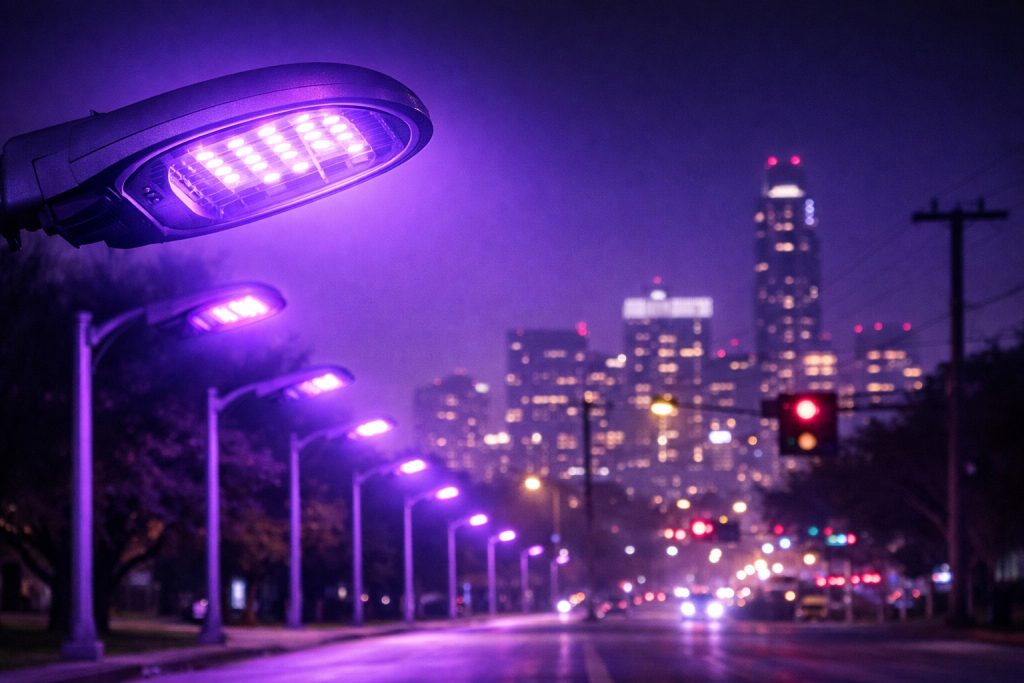
Why, then, are Streetlights going purple? The solution is in the science of the LED technology, the matter degradation, and the way in which cities modernized their lighting systems during the last ten years.
This paper describes the phenomenon, the technical aspects of the LED streetlights, and the connotation of the purple glow on the safety and city infrastructure.
The International Mode to LED Streetlights.
The trend of the last decade or so, as experienced in the cities of the world has seen the replacement of the older streetlights (like the high pressure sodium lamps) with the energy saving lights (LED). The rationale of these upgrades was a number of benefits:
- Lower energy consumption
- Longer lifespan
- Reduced maintenance costs
- Better lighting quality
The lights of LED in the street are usually crisp white and thus more visible than the yellow-orange light of old lamps. Energy experts also say that LEDs are some of the most efficient lighting technologies in the market right now.
Due to such advantages, LED streetlights were quickly implemented by municipalities as smart city and sustainability programs.
However, when purple streetlights showed up it was already too late to realize that some LED lighting systems had a defect.
The White LED Streetlights: The reality.
In order to explain why streetlights become purple, it is better to know how white LEDs are made.
Naturally, LEDs do not emit white light. Rather, two primary ways to generate the illusion of white light are employed by manufacturers:
1. Adding More than one LED of a Color.
There are systems that use the red, green, and blue lights to give a white light when mixed.
2.Blue LED having Phosphor Coating (Most popular method)
The streetlights are mostly a blue LED chip, covered with a phosphor coating, which is a fluorescent substance that converts a portion of the blue light to a reddish red and yellow color.
The combination of these colors leaves a white hue to the human eye.
The reason this phosphor-based technique has become a standard of operation is due to the fact that the technique is less expensive and conserves more energy than using multiple colored LEDs.
Nevertheless, it also brings about a possible failure point.
The Actual Reason Streetlights Go Purple.
The most common failure mode is the failure of phosphor coating within the LED module when the streetlights begin to glow purple.
In the event that the coating is starting to degrade, crack, or peel away, or the process is called delamination, then the underlying blue LED light is exposed. As the blue color is prevailing in the output, the lamp starts showing bluish or purple.
Purple streetlights are not usually deliberate, in other words they are broken LEDs.
This failure can be caused by a number of factors:
1.Heat Buildup
LED lamps have long durations of operation and overheating in the enclosure may have negative effects of undermining the phosphor.
2.Environmental Stress
The material may be degraded faster due to the effect of temperature changes, humidity, and UV.
3.Manufacturing Defects
Certain batches of LEDs manufactured during the late 2010s seem to have been quality-controlled improperly, and the resulting premature failures occur in some areas.
4.Physical Stress
The peeling off of the coating of an LED chip may be caused by road vibrations, traffic movement and gravity.
When the coating fails, the color of the light becomes very different which changes drastically to blue or purple.
Where the Purple Streetlights Are Said to Fall.
Purple streetlights were reported to be common after 2021. There was strange light in different areas to the notice of the residents which included:
- Florida
- Texas
- Massachusetts
- Utah
- Parts of Canada
- Ireland
The citizens of many municipalities were the first to complain that the color change was not accidental. However, it was discovered that the purple lights were faulty lights.
The faulty units that were under warranty of manufacturers were replaced by the cities in most instances.
Purple Streetlights: Are They a Hazard?
Purple lighting may not seem dangerous at first glance or look interesting. But the experts note that the change in color has the potential to cause actual safety issues.
Reduced Visibility
The Streetlights are created to achieve certain brightness. In case of failure of phosphor coatings, the amount of light could reduce, ensuring lowering the intensity of light on the roads and sidewalks.
Poor Color Recognition
The light that is dominated by purple or blue would render the human eye less functional in differentiating the colors. The things can be darker or be mixed, and this can influence the motorists and pedestrians.
Eye Perception Issues
Two primary photoreceptors are involved in human eyes:
- Cones: These are used in color vision when in bright light.
- Rods: low-light vision vision.
The blue light is more sensitive in rods cells hence bluish can be bright in the periphery vision. But when an object enters to the central vision, the details might be difficult to observe when subjected to blue or purple lights.
Such mixture is capable of deteriorating visual perception during the dark.
Why Majority of LED Streetlights do not go purple.
Even though the problem has been highlighted, it is worth mentioning that a majority of the LED streetlights operate as usual.
According to the experts in the field of lighting, phosphor materials incorporated in LEDs tend to be very stable. The purple-light effect is often associated with certain bad batches or production problems and not with an inherent defect in LED technology.
The use of LED lighting in cities is still continuing due to its efficiency, economical nature, and environmental advantages.
The way Cities are correcting the situation.
Municipalities typically react by changing the defective fixtures when they see purple streetlights.
Common solutions include:
- Manufacturers replacement warranty.
- Replacement with newer LED models with better materials.
- Tracking color variations with time.
- Enhancing thermal control in lamp housings.
Installing companies are also making efforts to improve phosphor, durability and quality to avoid such installation failure in the future.
The Bottom Line
Purple streetlights are usually a symptom of a malfunctioning LED light-fitting, or even a hint of a future dystopian society.
It occurs when the phosphor coating that converts the blue LED light to the white light disintegrates, revealing the blue diode underneath. This makes the lamp offer a purple or bluish light rather than the desired white light.
Although the concern has cast doubt on the reliability of LEDs, most issues have (specifically) occurred in certain batches and not the LEDs in general.
With the cities still modernizing their infrastructure, it is probable that with the increase in manufacturing standards and the quality of the materials used, purple streetlights will remain little more than a passing fad and not a future issue.

- 10 Meters Lamp Post
- 10 Meters Pole
- 1000w Led Projector
- 100W LED Tunnel Light
- 12 Meters Lamp Post
- 12 Meters Pole
- 1200w Led Projector
- 15 Light Pole
- 1500w Led Projector
- 150W LED Tunnel Light
- 1800w Led Projector
- 2 In 1 Solar Flood Light
- 200w Led Tunnel Light
- 50w Led Tunnel Light
- 6 Meters Lamp Post
- 6 Meters Pole
- 8 Meters Lamp Post
- 8 Meters Pole
- 800w Led Projector
- 80w Led Tunnel Light
- Colourful Decorative Light
- Conical post
- Courtyard Lamp
- courtyard light
- courtyard lighting fixture
- Decorative Landscape Light
- Decorative road Light
- Flood Light For Courtyard
- Flood Light for Garden
- Flood Light For Outdoor
- Foot Led High Bay Lights
- high bay led lights 100w
- industrial lampshade
- industrial LED shed lights
- industrial magnifying glass with light
- Integrated Solar Flood Light
- led courtyard lamp
- led courtyard light
- led high bay light 100w
- LED Projector For Stadium
- Led UFO High Bay 150W 5000k
- Lighting Plants Mining Price
- Maintenance Free LED Street Light
- Pic Controlling Tunnel Light
- PLC controlling tunnel light
- Post Top Garden Light
- RGB Landscape Light
- Rgbw Decorative Light
- Smart Tunnel Light
- solar courtyard lamp
- solar courtyard light
- Solar LED Road Light
- Solar Street Light For 10 Meter Pole
- Solar Street Light For 12 Meter Pole
- Solar Street Light For 6 Meter Pole
- Solar Street Light For 8 Meter Pole
- Split Type Solar Flood Light
- Sporting Projector
- Stadium Led Projector
- Street Lighting Post
