
 Request A Quote

why are street lights purple
 FACEBOOK
 TWITTER
 LINKEDIN
When you have been driving at night recently, and found some whole streets properly lit up in that weird purple light, you are not dreaming. In cities across the globe, old fashioned streetlights that are white or yellow are suddenly becoming purple–the surreal effect of the somewhat futuristic scene.
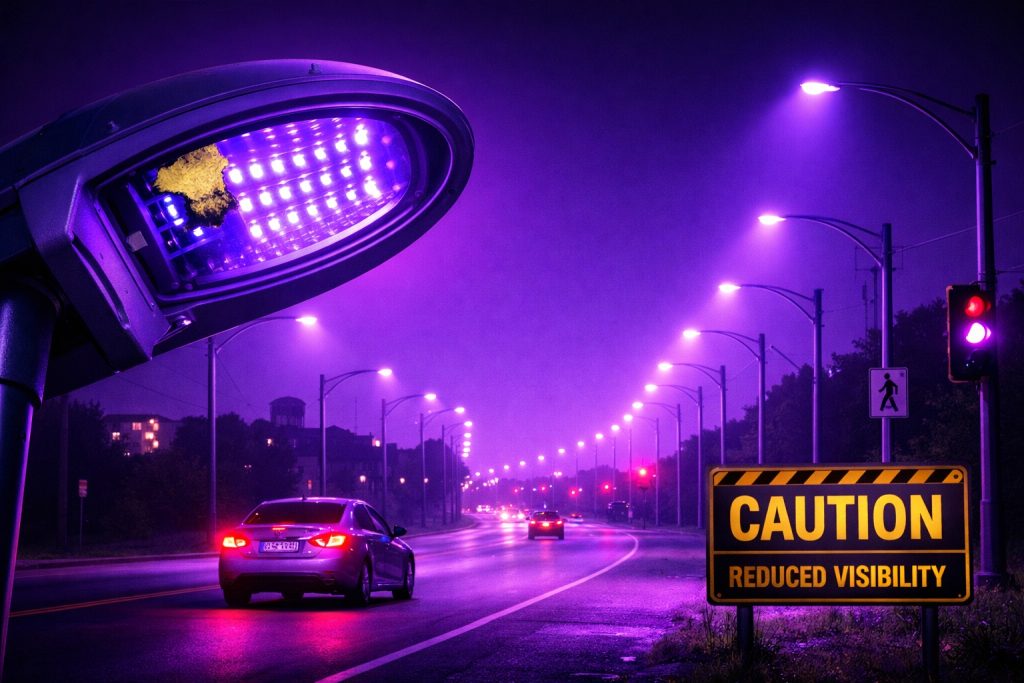
But what is actually making this happen? Is it planned, a new technology phenomenon or has gone wrong?
The technical reply to which you might have anticipated is more interesting and technical than you imagine.
The LED Streetlights Switchover.
To have an explanation as to why streetlights become purple you must first have a clue of how the modern street lighting functions.
In the last ten years, cities are fast swapping the old sodium-vapor lamps (which produce a warm orange glow) with LED (light emitting diode) streetlights. The reasons behind this shift are as follows:
- Lower energy consumption
- Reduced maintenance costs
- Longer lifespan
- Clarke daylight in the world.
But in contrast to the conventional bulbs, LEDs do not emittance white light on its own.
Mostly, though, streetlights work around it: a blue LED with a yellow phosphor coating. This coating changes some of the blue light into longer wavelength and when combined they look white by the human eye.
Why Are the Streetlights Purple?
The point is as follows: purple streetlights are not a design, but a malfunction.
The purple glow is weird when the phosphor coating starts failing or degrading.
When that coating is damaged:
- It has become incapable of turning blue light into white.
- More blue light does escape straight off.
- The rest mixture is purple or violet.
This is frequently referred to as phosphor delamination where the layer actually peels off or disintegrates with age.
What is the Problem with the Phosphor Coating?
This failure can be due to a number of factors:
- Heat and Aging
The LED streetlights operate through extended durations whereby they produce heat which may ultimately deteriorate the internal materials.
- Manufacturing Defects
Certain batches of LEDs, in particular those being installed since 2017 but before 2019, were known to have quality problems that predisposed them towards failures.
- Environmental Stress
The coating can be weakened with vibrations of traffic, contact with moisture and temperature changes, to name a few.
- Material Breakdown
Some situations involve cracking, separation, or chemical degradation of the phosphor layer and it is no longer capable of filtering light appropriately.
Why Does It Color Purple and Not Blue?
You may assume that the failed LEDs will be blue and not purple. So why the violet tone?
The phosphor layer does not fade away even in the case of deterioration. The remaining mix of:
- Unfiltered blue light
- Unspent red/yellow light.
gives it a purple or magenta color as opposed to pure blue.
Purple Street Lighting: Is it dangerous?
On the face of it, purple streetlights may look harmless at best–or even beautiful. They are even called by some as cool or dystopian.
They are however problematic from the point of safety.
Reduced Visibility
Eyes of human beings cannot capture blue and violet light particularly during night. This makes it harder to:
- Detect objects
- Recognize faces
- Judge distances
Poor Color Accuracy
The color perception is distorted with purple lighting. All this can be bluish or dark, and it is hard to differentiate:
- Traffic signs
- Road markings
- Pedestrians
Lower Effective Brightness
Although the lamp may technically be releasing the same amount of energy, the brightness available is less making the lamp less visible.
Where do purple street lights keep on appearing?
This has been documented in various parts of the world and it includes:
- United States (Florida, Texas, Massachusetts, California)
- Canada (Vancouver)
- Parts of Europe
It is as simple as to buy streetlights in bulk with one manufacturer, hence the reason it is found in clumps. When a batch is faulty, it can happen to whole neighbourhoods.
Do Purple Streetlights Wear Deliberate?
Purple streetlights have numerous myths and rumors on the Internet. Some people believe they are:
- Used to reduce crime
- Designed to prevent drug use
- One of a new lighting strategy.
This is not true when it comes to the street lighting.
Although blue lighting may be used in some restricted areas (such as in a restroom) to achieve a particular purpose, purple community lighting in the street is practically always the consequence of failed LEDs- not design.
Will Cities Fix the Problem?
Yes–the majority of cities are busily changing faulty lights.
The utility companies and manufacturers have realized the problem and in most instances:
- Broken light fixtures are repaired on warranty.
- Whole batches are being eliminated.
- Later LEDs are made of better materials.
Replacements may be time consuming however because of:
- Budget constraints
- Labor availability
- Scale of infrastructure
So in places You can leave the purple streetlights months–or years.
Why This Problem has turned out so commonplace.
Timing is one of the reasons why the issue is so sudden.
Several cities were made to make the LED streetlights upgrades around the same time. As the age of those lights approaches failures are occurring at the same time giving the impression of a large coordinated event.
As a matter of fact, it is nothing but a matter of coordinated aging and production errors.
The Bottom Line
Purple streetlights may seem cool, but this is an indication that there is not something running fine.
In short:
- Failure of phosphor coating in led bulbs causes the lights in the streets to be purple.
- The problem generally is brought about by old age, heat or production flaws.
- The use of purple lighting may lower visibility and safety.
- Cities are slowly substituting hit lights.
Next time you pass through a purple street, then, it is not actually a futuristic upgrade that you are seeing: you are seeing a demonstration of the way, even minor material failures, can revolutionize whole city-scapes.

- 10 Meters Lamp Post
- 10 Meters Pole
- 1000w Led Projector
- 100W LED Tunnel Light
- 12 Meters Lamp Post
- 12 Meters Pole
- 1200w Led Projector
- 15 Light Pole
- 1500w Led Projector
- 150W LED Tunnel Light
- 1800w Led Projector
- 2 In 1 Solar Flood Light
- 200w Led Tunnel Light
- 50w Led Tunnel Light
- 6 Meters Lamp Post
- 6 Meters Pole
- 8 Meters Lamp Post
- 8 Meters Pole
- 800w Led Projector
- 80w Led Tunnel Light
- Colourful Decorative Light
- Conical post
- Courtyard Lamp
- courtyard light
- courtyard lighting fixture
- Decorative Landscape Light
- Decorative road Light
- Flood Light For Courtyard
- Flood Light for Garden
- Flood Light For Outdoor
- Foot Led High Bay Lights
- high bay led lights 100w
- industrial lampshade
- industrial LED shed lights
- industrial magnifying glass with light
- Integrated Solar Flood Light
- led courtyard lamp
- led courtyard light
- led high bay light 100w
- LED Projector For Stadium
- Led UFO High Bay 150W 5000k
- Lighting Plants Mining Price
- Maintenance Free LED Street Light
- Pic Controlling Tunnel Light
- PLC controlling tunnel light
- Post Top Garden Light
- RGB Landscape Light
- Rgbw Decorative Light
- Smart Tunnel Light
- solar courtyard lamp
- solar courtyard light
- Solar LED Road Light
- Solar Street Light For 10 Meter Pole
- Solar Street Light For 12 Meter Pole
- Solar Street Light For 6 Meter Pole
- Solar Street Light For 8 Meter Pole
- Split Type Solar Flood Light
- Sporting Projector
- Stadium Led Projector
- Street Lighting Post
