
 Request A Quote

Why LED Streetlights Turn Purple?
 FACEBOOK
 TWITTER
 LINKEDIN
Over the past few years, the world has seen cities reporting a bizarre and unexplained event of LED streetlights, which are not glowing white, but rather turn purple. Although it might seem futuristic- or rather aesthetically pleasing- this color change is unintentionally. Actually, it is an indicator of a bigger problem in contemporary lighting infrastructure.
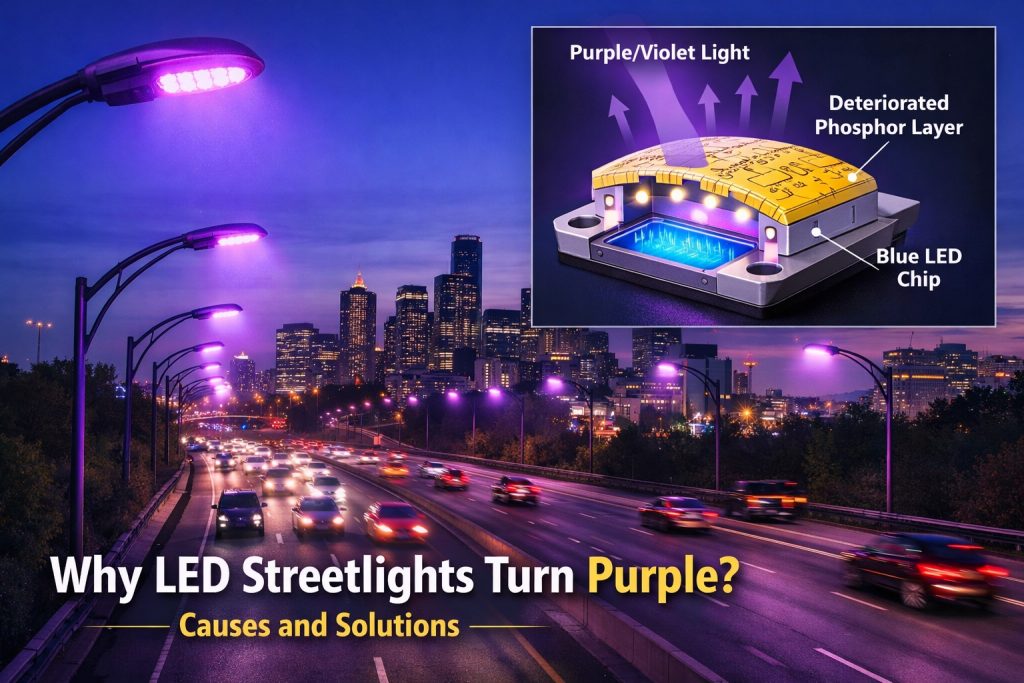
The article discusses the reasons and science of the problem of LED streetlights turning purple, the potentially unsafe consequences, and how cities and manufacturers are addressing the problem.
What Is Making LED Streetlights Purple?
Phosphor coating failure within the LED module is the primary cause of LED streetlights becoming purple.
Not all the white LED streetlights are really white sources of light. They instead employ blue LED chips with a yellow phosphor layer. This mixture is what results in the white light that is used in road lights.
But as this phosphor layer starts to decay, crack, or peel off, the balance is disturbed, a process called delamination. Consequently, the blue or violet light is more likely to escape resulting in a purple appearance of the streetlight.
It is a common problem in LED streetlights produced in 2017-19, and has been reported worldwide since circa 2020.
The Purple Glow: the Science.
To understand the purple shift, it’s important to know how LED lighting works:
- Short-wavelength light is emitted by blue LED chip.
- Phosphor coating is used to convert blue light to a wider spectrum of white light.
- When compounded, it seems white.
Upon failure of the phosphor layer:
- The amount of yellow light generated is less.
- There are blue and violet overwhelming.
- The light is purple or bluish.
Technically, this is a spectral shift due to material degradation in the LED package.
Studies have revealed that this problem can be caused by cracks, chemical degradation or removal of the phosphor layer.
What is the Cause of the Phosphor Layer Failure?
The phosphor coating may degrade too soon due to several causes:
- Manufacturing Defects
Streetlights that have fallen victim to many of them belong to certain batches of production where materials or processes were defective.
- Degradation of materials with time.
Even well produced LEDs may deteriorate as a result of long-term exposure to the environment.
- High Temperature and Environmental Stress.
The phosphor layer can be deteriorated by heat accumulation, traffic vibrations and exposure to weather over time.
- Poor Quality Control
Thousands of fixtures are fitted in large municipal lighting projects. When defects occur in a single batch, the entire neighborhoods can share the problem at the same time.
Is Purple Street Lighting Dangerous?
Although purple streetlights might appear to be harmless, they can have a negative effect on visibility and safety.
Reduced Color Accuracy
Purple light also makes the perception of color harder to differentiate objects, road signs, and hazards.
Impaired Night Vision
Low light situations necessitate the use of various photoreceptors in the human eyes. The light of blue tones may influence our perception of contrast and depth, making the image less clear.
Pedestrian/Driver Safety Hazards.
The lack of the quality of the lighting can result in:
- Difficulty identifying obstacles
- Reduced reaction times
- Increased accident risk
Despite the current studies, there is consensus among experts that purple streetlights are not up to the standard of roadway lighting.
Where Hath this Occurred?
The purple streetlight effect has been observed in:
- United States (various states)
- Canada
- Parts of Europe
There have been reports in certain areas of blocs of purple lights along highways and residential roadways causing people to pay attention and even conspiracy theories. But professionals assure that the reason is just technical, not deliberate.
Is Purple Streetlights an LED Failure?
Yes–purple lighting is typically regarded as a failure mode of LED systems.
LEDs tend to fade instead of burning out as is the case with the traditional bulbs. The change of purple color is an early alert that:
- The LED module is deteriorating
- Quality of light is deteriorated.
- There might be a need to be replaced soon.
In most instances, the affected lights continue to work but no longer at the performance standard.
The response of Cities.
Municipalities and utilities are working to tackle the problem with:
- Warranty Replacements
Under manufacturer warranties, many faulty LED streetlights are being replaced.
- Quality Control Improvements
To avoid future failures, manufacturers are enhancing materials and test standard.
- Monitoring and Maintenance Programs.
Cities are setting up inspection systems to detect faulty lights in their early stages.
The purpose of these efforts is to minimize the maintenance in the long term and to reestablish uniformity in the quality of lighting.
Is this Evil Preventable?
Yes–what will happen may be decreased by superior design and testing:
Use LED Components of high quality.
The risk of degradation is lowered by the use of reliable phosphor materials and stable packaging.
Follow Industry Standards
Testing conditions like LM-80 are used to guarantee the stability of performance and color over time.
Improve Thermal Management
Stress of LED components is minimized by better heat dissipation.
Complete Long-Term Reliability Testing.
Making simulations of real-life situations aids in detecting possible failures during pre-deployment.
The Bigger Picture: LED Lighting Challenges.
The use of LED streetlights has gained popularity due to its ability to provide:
- Energy efficiency
- Long lifespan
- Lower maintenance costs
Nevertheless, the purple light problem points to a significant fact:
High-technology continues to rely on the reliability of materials and quality of manufacturing.
During the deployment of smart lighting systems in cities, durability and consistency will be an essential element.
Conclusion
The purple LED streetlights do not look like that, it is an indication of component failure, mostly due to wear of the phosphor coating of the LED module.
Although the problem might seem relatively small, it can influence the visibility, security, and trust in the urban infrastructure by the population. Luckily, this issue is being solved internationally with better quality manufacturing and proactive maintenance.
With LED technology advancing, what we have learned out of this phenomenon will be used to develop better, more efficient, and safer lighting systems in the future.


- 10 Meters Lamp Post
- 10 Meters Pole
- 1000w Led Projector
- 100W LED Tunnel Light
- 12 Meters Lamp Post
- 12 Meters Pole
- 1200w Led Projector
- 15 Light Pole
- 1500w Led Projector
- 150W LED Tunnel Light
- 1800w Led Projector
- 2 In 1 Solar Flood Light
- 200w Led Tunnel Light
- 50w Led Tunnel Light
- 6 Meters Lamp Post
- 6 Meters Pole
- 8 Meters Lamp Post
- 8 Meters Pole
- 800w Led Projector
- 80w Led Tunnel Light
- Colourful Decorative Light
- Conical post
- Courtyard Lamp
- courtyard light
- courtyard lighting fixture
- Decorative Landscape Light
- Decorative road Light
- Flood Light For Courtyard
- Flood Light for Garden
- Flood Light For Outdoor
- Foot Led High Bay Lights
- high bay led lights 100w
- industrial lampshade
- industrial LED shed lights
- industrial magnifying glass with light
- Integrated Solar Flood Light
- led courtyard lamp
- led courtyard light
- led high bay light 100w
- LED Projector For Stadium
- Led UFO High Bay 150W 5000k
- Lighting Plants Mining Price
- Maintenance Free LED Street Light
- Pic Controlling Tunnel Light
- PLC controlling tunnel light
- Post Top Garden Light
- RGB Landscape Light
- Rgbw Decorative Light
- Smart Tunnel Light
- solar courtyard lamp
- solar courtyard light
- Solar LED Road Light
- Solar Street Light For 10 Meter Pole
- Solar Street Light For 12 Meter Pole
- Solar Street Light For 6 Meter Pole
- Solar Street Light For 8 Meter Pole
- Split Type Solar Flood Light
- Sporting Projector
- Stadium Led Projector
- Street Lighting Post
