
 Request A Quote

when the street lights go on?
 FACEBOOK
 TWITTER
 LINKEDIN
Have you ever strolled on busy streets in New York City right before the night and came across the street lights that light up the avenues, bridges and sidewalks? Urban beacons are more than just the ornamental pieces, they are extremely important in public safety, energy consumption and city living. But the great one people are asking is:
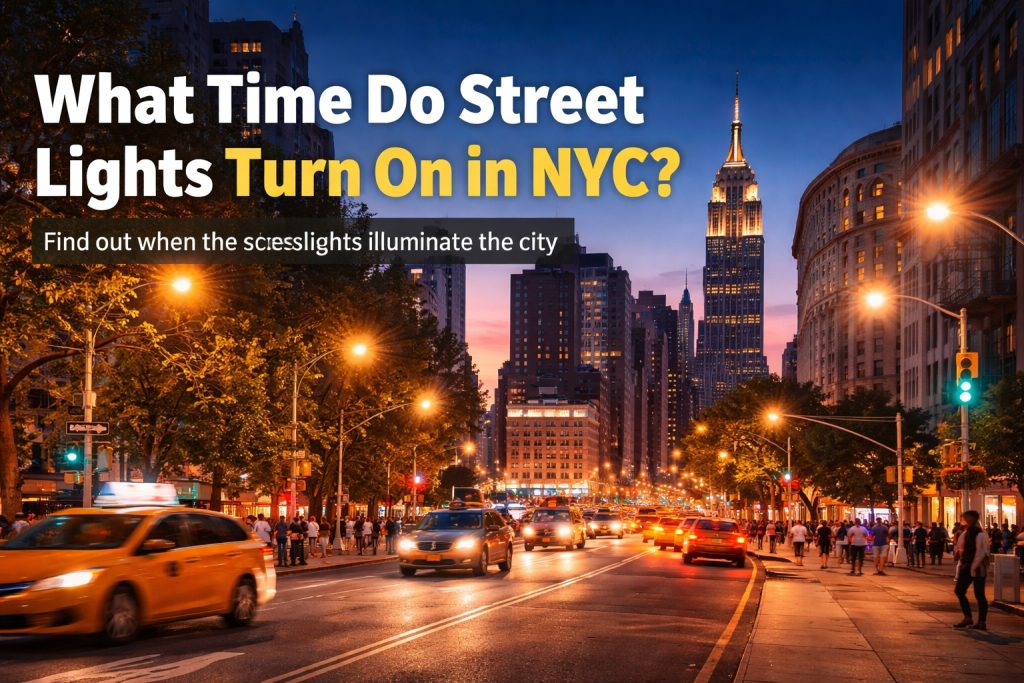
When do street lights go on in NYC?
We will divide the process of street lighting control in New York City, how and when street lights are activated, how seasonal changes can affect street lighting timing, and why the use of modern lighting systems such as LED street lights is transforming the street lighting system in the city of New York in this comprehensive guide.
How Street Lights in NYC Turn on When it gets Dark.
In New York City, streetlights do not work according to a fixed time schedule like a classroom bell ringing at a specific time, say 7:00 PM. Rather, they are normally operated by light sensing technology referred to as photocells or dusk to dawn sensors. These sensors automatically activate the lights when the natural ambient light is less than some predetermined level – basically they are activated at dusk and switched off at dawn.
With this system, the lights are sensitive to the real light conditions as opposed to the time set on the clock i.e.
- During hot summer nights, the lights may be activated later- towards the end of the day at about 8:00 PM or later.
- During winter with the shorter daylight they tend to turn on earlier – as early as 4:30 PM.
- In foggy or stormy and cloudy weather, lights can turn on sooner since the sensitivity of the lights is lower.
This responsive, light-sensitive system is much more efficient and safer to citywide lighting as opposed to fixed schedules.
Reasons why NYC Uses Automatic Light Sensors.
The majority of the modern urban light systems (as in NYC) are integrated with photocell sensors, smart city controls, and energy-efficient fixtures in order to optimize the time lights go on and off. Primary controls of NYC street lights are:
🔦 Photocell Sensors (Dusk‑to‑Dawn Switches)
These are tiny sensors fitted in every lighting unit which are used to measure the quantity of natural light. The sensor notifies the light when daylight dims to a predetermined level and the light is switched on.
🕒 Smart Control Systems
There are also sections of the city that incorporate centralized lighting control that can remotely change light patterns and schedules based on real-time information, traffic flow or even special occasions.
📅 Astronomical Timers
Some of the networks continue to operate timers set to particular sunset and sunrise times on a given date and latitude, but these are being phased out in cities replacing their systems with LEDs.
Environmental and Seasonal Factors that influence Lighting Times.
The exact time that NYC street lights are lit up in a year depends on the time of the year due to the orbit of the earth, the changes in seasons, and the weather.
🗓 Winter
- Days are shortest.
- Sunset comes earlier.
- Lights may turn on around 4:30–5:00 PM.
☀️ Summer
- Days are longest.
- Sunset occurs late.
- At around 8:00 PM or later lights may be turned on.
☁️ Weather Impacts
Evening time, when the air is cloudy, stormy or foggy, may have lights that come on earlier since the sensors will sense a lower light level than you would expect at that time at sunset.
This seasonal change implies that the lights on the streets of NYC are adjusting to the circumstances in real time – they help to maintain the safety and visibility throughout the year, without wasting energy.
The functions of LED Street Lights in New York City.
The City of New York has led in the modernization of its infrastructure to LED street lighting – replacing tens of thousands of old-fashioned lamps with energy-saving LED lighting.
🔋 Energy Savings
The power consumption of LED street lights is much lower than old high-pressure sodium or metal-halide lamps, thereby leading to a reduction in electricity costs to the city and the overall energy consumption.
🔧 Longer Lifespan
LEDs will outlive traditional bulbs by far – up to 5 or more times – and save on maintenance and labor expenses.
👁️ Brighter Illumination
LEDs are more visible and less diffused, making the streets of NYC more visible by pedestrians, cyclists, and drivers.
🌍 Environmental Benefits
LED lamps are greener, they generate less heat, waste compared to the older technologies, and contain no toxic substances such as mercury.
📱 Smart Integration
Most LED street lights are adaptive and remote-monitored, enabling NYC to dim lights when there is less traffic or pattern adjustments to city requirements.
LED lighting is not only efficient but part of a larger plan by New York to enhance the sustainability of energy and population safety across the five boroughs.
Private & Public Safety Considerations
In addition to lighting, lit streets enhance the security of the neighborhood, deter crime and the general well being of the city that does not sleep. When the lighting is good and properly planned:
- Walkers are not afraid of the dark.
- Drivers are able to notice hazards earlier.
- The urban areas keep on being used later in the night.
Striking the balance between public safety and energy conservation remains to be one of the concerns of the NYC planners as technologies advance.
Summary: NYC Street Lights Timing, Technology and Efficiency.
And what is the time that street lights go on in New York City? The simple reason is that they switch on when the natural light becomes dimmed to a set point because of the fall of the night instead of a specified clock time. It is important to note that with the help of advanced technologies such as photocell sensors, smart lighting controls, and LED fixtures, NYC can guarantee that its street lights are not only responsive but also efficient and adjust to the seasonal variations and real-life conditions.
Since winter nights when lights are turned on at an early time to summer nights when they are turned off until later, the street lighting system in NYC is a prototype of the contemporary urban lightings. And with LED upgrades being made in the city, both residents and visitors enjoy safer nights, brighter streets, and smarter energy use.
- 10 Meters Lamp Post
- 10 Meters Pole
- 1000w Led Projector
- 100W LED Tunnel Light
- 12 Meters Lamp Post
- 12 Meters Pole
- 1200w Led Projector
- 15 Light Pole
- 1500w Led Projector
- 150W LED Tunnel Light
- 1800w Led Projector
- 2 In 1 Solar Flood Light
- 200w Led Tunnel Light
- 50w Led Tunnel Light
- 6 Meters Lamp Post
- 6 Meters Pole
- 8 Meters Lamp Post
- 8 Meters Pole
- 800w Led Projector
- 80w Led Tunnel Light
- Colourful Decorative Light
- Conical post
- Courtyard Lamp
- courtyard light
- courtyard lighting fixture
- Decorative Landscape Light
- Decorative road Light
- Flood Light For Courtyard
- Flood Light for Garden
- Flood Light For Outdoor
- Foot Led High Bay Lights
- high bay led lights 100w
- industrial lampshade
- industrial LED shed lights
- industrial magnifying glass with light
- Integrated Solar Flood Light
- led courtyard lamp
- led courtyard light
- led high bay light 100w
- LED Projector For Stadium
- Led UFO High Bay 150W 5000k
- Lighting Plants Mining Price
- Maintenance Free LED Street Light
- Pic Controlling Tunnel Light
- PLC controlling tunnel light
- Post Top Garden Light
- RGB Landscape Light
- Rgbw Decorative Light
- Smart Tunnel Light
- solar courtyard lamp
- solar courtyard light
- Solar LED Road Light
- Solar Street Light For 10 Meter Pole
- Solar Street Light For 12 Meter Pole
- Solar Street Light For 6 Meter Pole
- Solar Street Light For 8 Meter Pole
- Split Type Solar Flood Light
- Sporting Projector
- Stadium Led Projector
- Street Lighting Post
