
 Request A Quote

Spot Lights Outdoor for Facades and Landscapes
 FACEBOOK
 TWITTER
 LINKEDIN
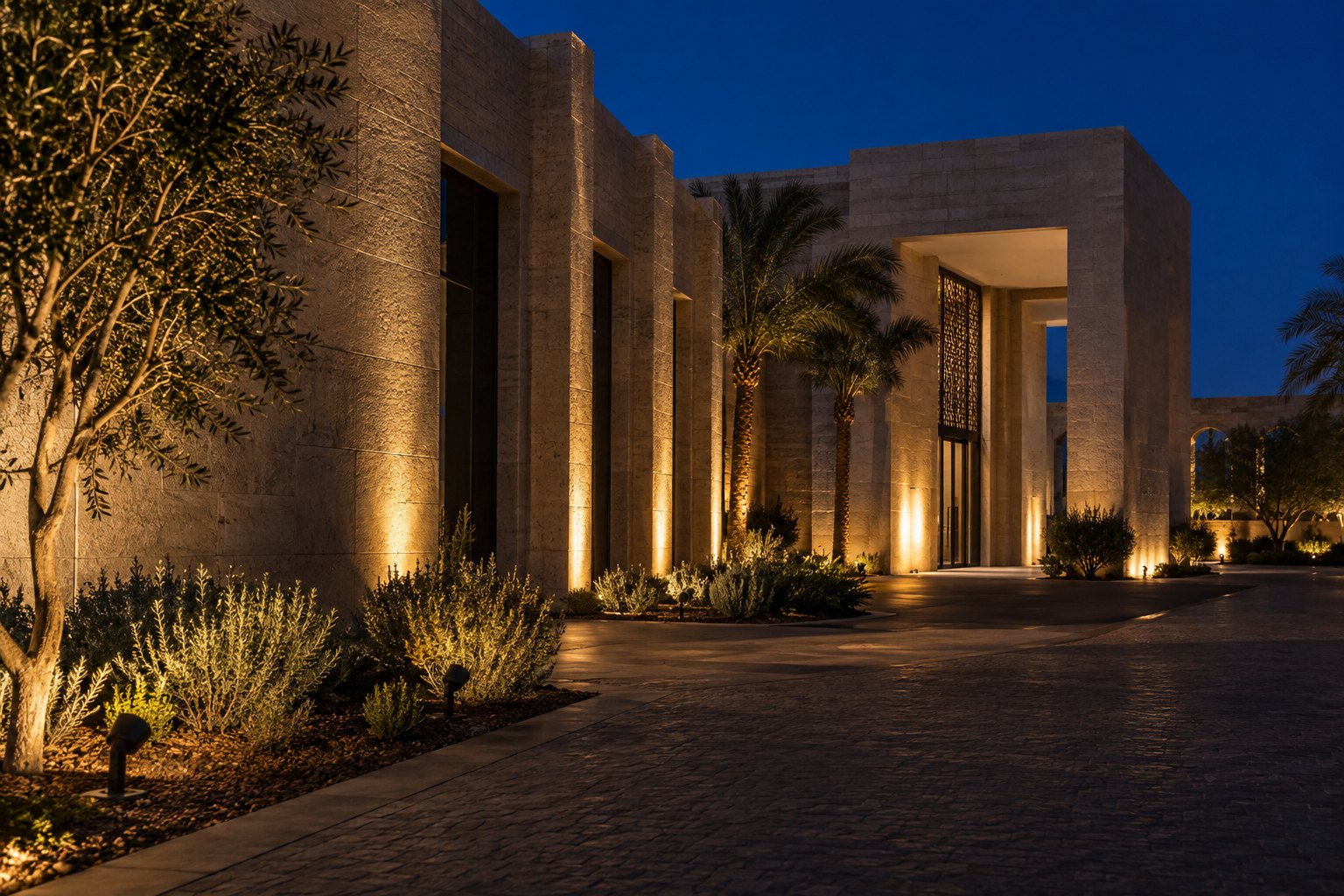
Spot lights outdoor should put a controlled beam on a defined target, not flood the whole property. Facades, trees, sculptures and signs each need a different beam angle, throw distance and aiming point. The fixture must also survive water, soil, irrigation, heat and maintenance activity. A useful design records every target and viewing direction, then verifies beam coverage and spill in DIALux.
Direct answer. Start with target size and throw distance. Use narrow beams for tall or distant features, medium beams for columns and trees, and wider beams for short walls or broad planting. Keep the source out of normal sightlines, limit upward spill, verify IP66 protection and drainage, and document the bracket, cable gland, aiming angle, corrosion system and maintenance access.
Match Beam Angle to the Target
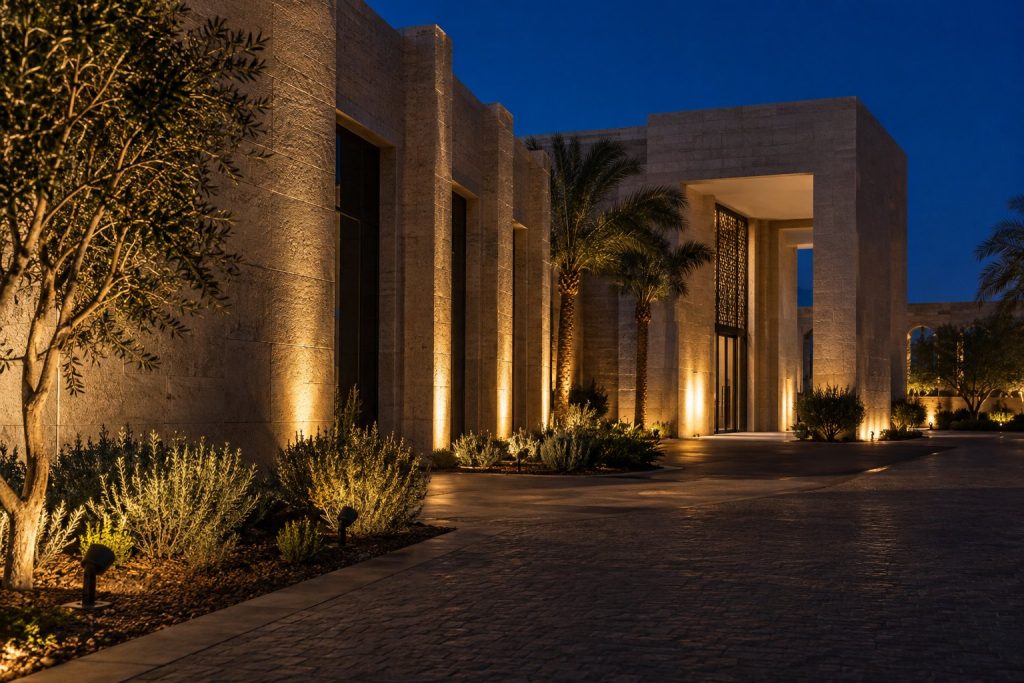
Beam angle describes the central usable cone, but field angle and candela distribution also affect the result. A 10-degree optic can carry intensity farther but is sensitive to aiming. Medium optics around 20 to 40 degrees suit many columns, palms and sculptures. Wide optics can wash low walls, but they may spill into windows if the fixture is too close.
| Optical approach | Typical target | Main advantage | Risk to control |
| Narrow beam about 8 to 15 degrees | Tall tree or distant facade detail | Long throw and visual emphasis | Hot spots and aiming sensitivity |
| Medium beam about 20 to 40 degrees | Column, sculpture or medium tree | Balanced coverage and intensity | Spill beyond target edges |
| Wide beam about 45 to 60 degrees | Low wall or broad planting | Soft wash at short distance | Glare and wasted upward light |
| Elliptical or asymmetric optic | Linear wall or sign | Fits rectangular target shape | Orientation must be documented |
Set the Fixture Distance Before Wattage
Moving a spotlight changes beam size and intensity even when wattage stays fixed. For a facade, start with the desired illuminated width and use the photometric file to test setback and tilt. For a tree, consider trunk diameter, canopy height and growth. One high-output fixture at the base often creates a bright trunk and dark crown; two lower-output positions may provide better depth.
Our testing approach is to model the exact Dawn Lighting landscape or flood-light optic, then create an aiming schedule with target name, fixture coordinates, horizontal direction and vertical angle. The schedule prevents installers from pointing every fitting at the centre of the wall after construction.
Control Glare and Sky Spill
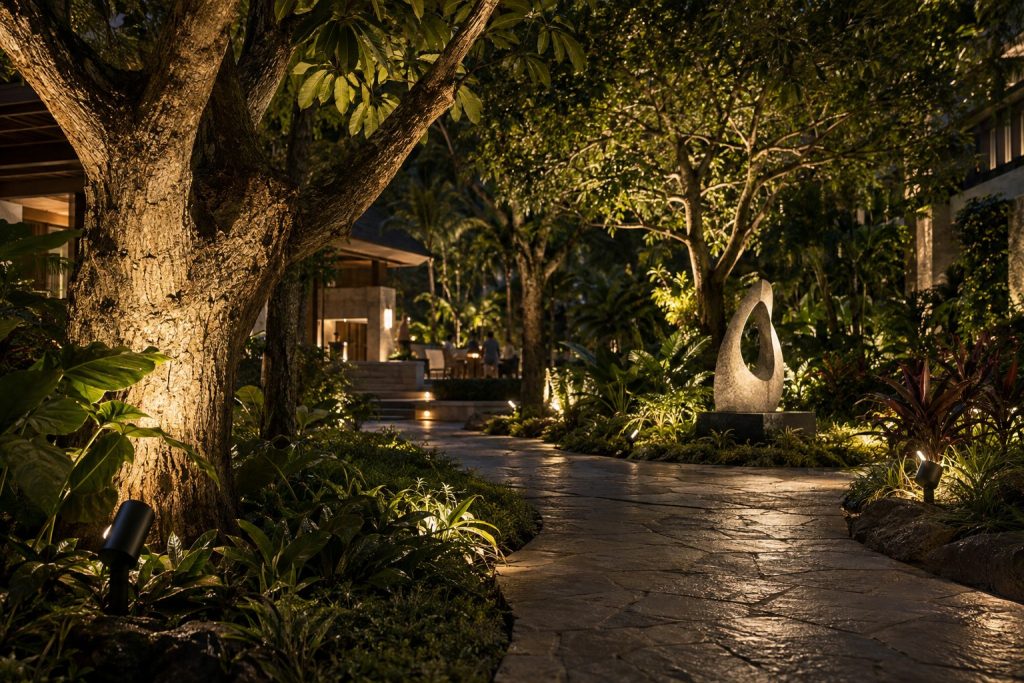
A source hidden from one viewpoint may be visible from another. Review paths, seating, balconies, nearby roads and guest-room windows. Use snoots, shields or honeycomb louvres only after checking their effect on output and temperature. Keep tilt low where possible and stop the beam on the target surface. Dark-sky control is an optical design task, not only a low-wattage claim.
Choose CCT and CRI for Materials
Warm light around 2700K to 3000K usually complements stone, timber and foliage. Cooler light can make warm materials appear flat and may disturb the intended hospitality atmosphere. CRI 80 is a reasonable baseline for most architectural work; higher CRI can improve artwork, premium finishes and camera colour. Mock up one representative wall or tree before approving a large quantity.
Engineer the Mounting and Cable Route
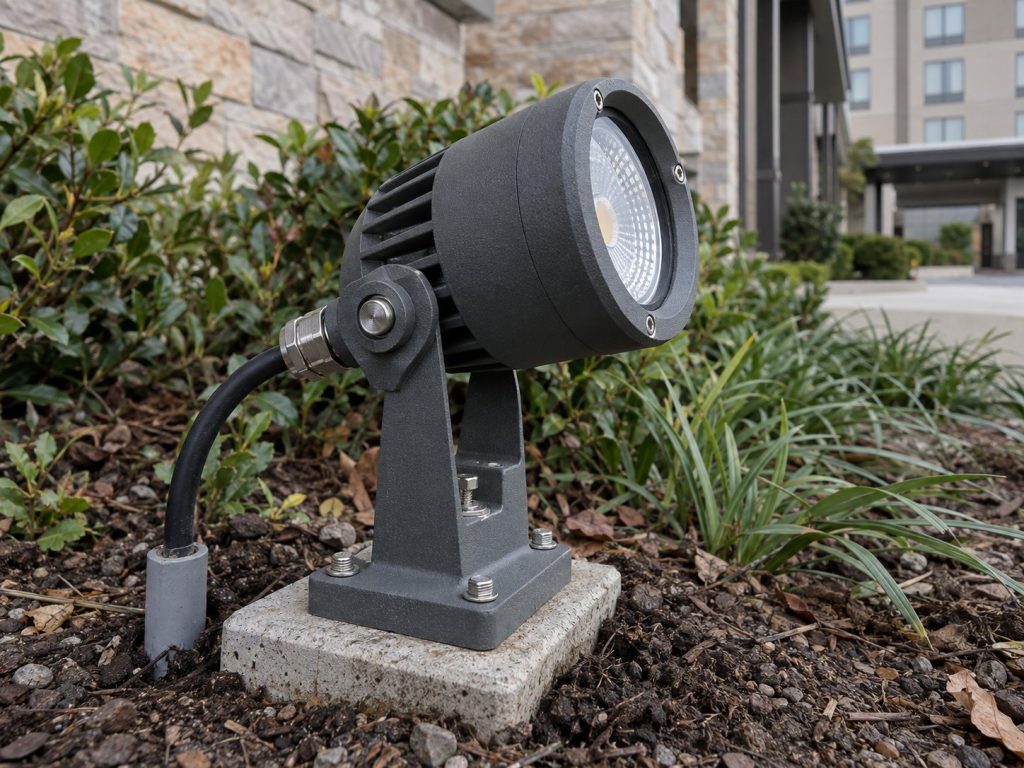
A landscape spotlight needs a rigid bracket that will hold its aiming angle after cleaning and storms. Ground stakes are convenient in light-duty gardens but can lean in soft soil. Commercial projects are better served by a stable base, locking hardware and a cable route protected from gardeners, roots and standing water. Avoid exposed flexible cable where tools can damage it.
Manage Water Heat and Corrosion
IP66 is a practical target for exposed fixtures, but the rating does not solve poor drainage. Never place a non-submersible spotlight in a depression that fills with irrigation water. Check gasket compression, cable gland orientation and condensate control. Coastal sites need compatible fasteners, durable coatings and periodic cleaning. Heat sinks should remain clear of mulch and leaves.
Select Mains or Low Voltage Supply
Low-voltage systems can reduce shock risk in accessible landscapes, but long cable runs create voltage drop and high current. Mains systems reduce current yet require appropriate protection, burial, joints and earthing. Transformers and drivers should be accessible, ventilated and grouped logically. Every buried connection needs a known location and suitable enclosure.
Outdoor Spotlight Procurement Checklist
- Target schedule with dimensions, material, viewing directions and required appearance
- Exact beam distributions, output, CCT, CRI and approved accessories
- DIALux or equivalent model plus fixture-by-fixture aiming schedule
- IP, IK, thermal, corrosion, driver and surge documentation
- Base, bracket, locking hardware, gland, conduit and drainage details
- Night aiming session, mock-up approval and maintenance plan
Mistakes That Flatten the Design
Using the same beam on every object produces a repetitive result. Other problems include placing fixtures too close to walls, aiming beyond the roofline, hiding fittings where plants block them within one season and relying on high wattage instead of correct setback. Unrecorded aiming changes make future maintenance almost impossible.
Frequently Asked Questions
What beam angle is best for outdoor spot lights
Narrow beams suit tall or distant targets, medium beams suit many trees and columns, and wider beams suit short walls. Use the exact photometric file and target geometry.
Are outdoor spotlights waterproof
Check the delivered IP rating. IP66 is common for exposed products, but drainage, glands, joints and installation orientation remain critical.
How far should a spotlight be from a tree
Distance depends on canopy size, beam angle and the desired shadow pattern. Model or mock up the tree instead of using a universal spacing rule.
What colour temperature is best for landscape spotlights
Warm white around 2700K to 3000K often suits hotels, stone and planting. The architecture and client brief should control the final choice.
Request a Project Lighting Review
For a facade or landscape project, provide elevations, target dimensions, fixture locations, viewing directions, environmental exposure, supply voltage and desired appearance. Dawn Lighting can review suitable products from its current Landscape Lighting and Flood Light categories.
Send the site drawings and operating requirements through the Dawn Lighting official inquiry page. The engineering team can prepare a project-specific DIALux proposal and B2B quotation.
- 10 Meters Lamp Post
- 10 Meters Pole
- 1000w Led Projector
- 100W LED Tunnel Light
- 12 Meters Lamp Post
- 12 Meters Pole
- 1200w Led Projector
- 15 Light Pole
- 1500w Led Projector
- 150W LED Tunnel Light
- 1800w Led Projector
- 2 In 1 Solar Flood Light
- 200w Led Tunnel Light
- 50w Led Tunnel Light
- 6 Meters Lamp Post
- 6 Meters Pole
- 8 Meters Lamp Post
- 8 Meters Pole
- 800w Led Projector
- 80w Led Tunnel Light
- Colourful Decorative Light
- Conical post
- Courtyard Lamp
- courtyard light
- courtyard lighting fixture
- Decorative Landscape Light
- Decorative road Light
- Flood Light For Courtyard
- Flood Light for Garden
- Flood Light For Outdoor
- Foot Led High Bay Lights
- high bay led lights 100w
- industrial lampshade
- industrial LED shed lights
- industrial magnifying glass with light
- Integrated Solar Flood Light
- led courtyard lamp
- led courtyard light
- led high bay light 100w
- LED Projector For Stadium
- Led UFO High Bay 150W 5000k
- Lighting Plants Mining Price
- Maintenance Free LED Street Light
- Pic Controlling Tunnel Light
- PLC controlling tunnel light
- Post Top Garden Light
- RGB Landscape Light
- Rgbw Decorative Light
- Smart Tunnel Light
- solar courtyard lamp
- solar courtyard light
- Solar LED Road Light
- Solar Street Light For 10 Meter Pole
- Solar Street Light For 12 Meter Pole
- Solar Street Light For 6 Meter Pole
- Solar Street Light For 8 Meter Pole
- Split Type Solar Flood Light
- Sporting Projector
- Stadium Led Projector
- Street Lighting Post
