
 Request A Quote

Post Lights for Hotels and Residential Compounds
 FACEBOOK
 TWITTER
 LINKEDIN
Post lights work best when the luminaire, pole, foundation and landscape plan are treated as one assembly. For hotel entrances, housing estates and public courtyards, the goal is not simply to make the space bright. The system must reveal people, kerbs and route changes while preserving visual comfort and the architectural character of the site. A DIALux model should confirm maintained lux and uniformity before pole positions become part of the civil drawing.
Direct answer. Use post lights mainly for pedestrian plazas, entrances, gardens and low-speed internal roads. Match mounting height and optical distribution to the route width, then verify glare, vertical illumination, pole spacing, wind load and foundation reactions. Exposed projects should also check IP65 or IP66 protection, IK rating, surge coordination, thermal limits and coastal corrosion resistance.
Define the Role of the Post Light
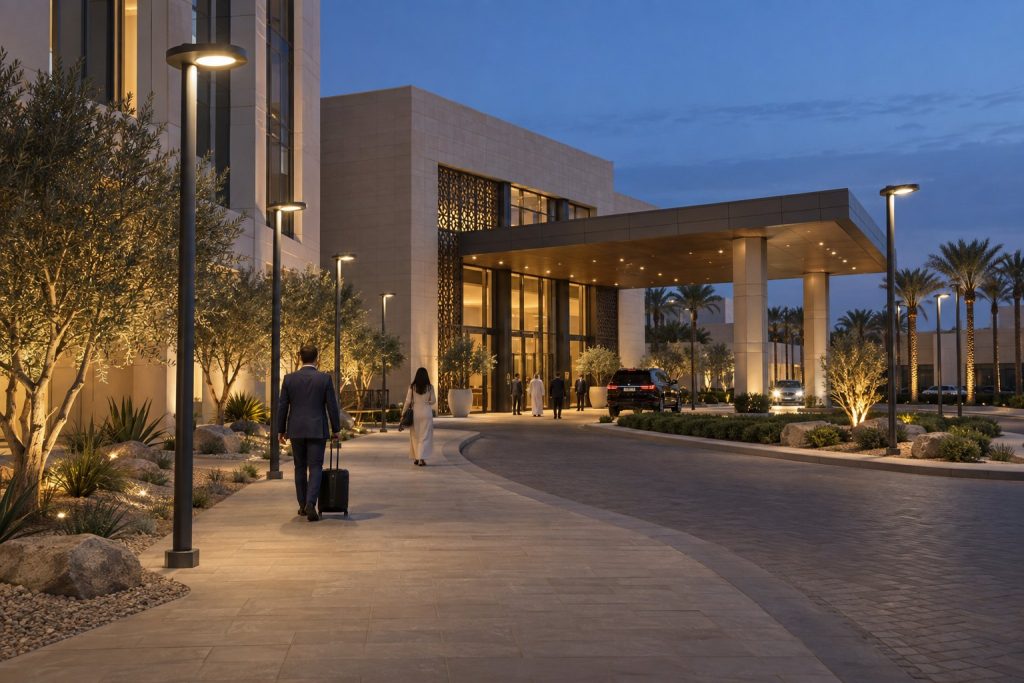
When discussing projects with clients, I separate decorative identity from safety lighting. A post-top fixture may contribute to both, but it should not be expected to light a busy vehicle road if its distribution is designed for a small plaza. Map pedestrian routes, drop-off lanes, seating, security cameras, steps, ramps and property boundaries before selecting the head style.
| Application zone | Concept range | Typical mounting | Primary check |
| Garden and quiet path | 5 to 15 lux | 2.5 to 3.5 metres | Glare and path-edge visibility |
| Residential plaza | 10 to 20 lux | 3 to 4 metres | Uniformity and facial recognition |
| Hotel entrance | 20 to 50 lux locally | 3 to 5 metres | Vertical light and adaptation |
| Low-speed internal road | 10 to 30 lux | 4 to 6 metres | Distribution, spacing and driver glare |
These are preliminary design ranges. The local code, accessibility requirements, security brief and client standard govern final values.
Select Height and Distribution Together
A taller post can cover more area, but it also increases wind moment and can expose the light source to distant viewers. A short post may reduce visual scale but needs closer spacing. The optical file is decisive. Symmetrical distributions suit open plazas; asymmetric distributions can push light along a path or away from guest-room windows.
Use the exact IES or LDT file for the selected Dawn Lighting post light. Model the real post height, path width, wall reflectance, trees and canopies. Apply a maintenance factor for dust, insects, cleaning and LED depreciation. Check minimum-to-average uniformity rather than approving the average lux alone.
Control Glare and Spill Light
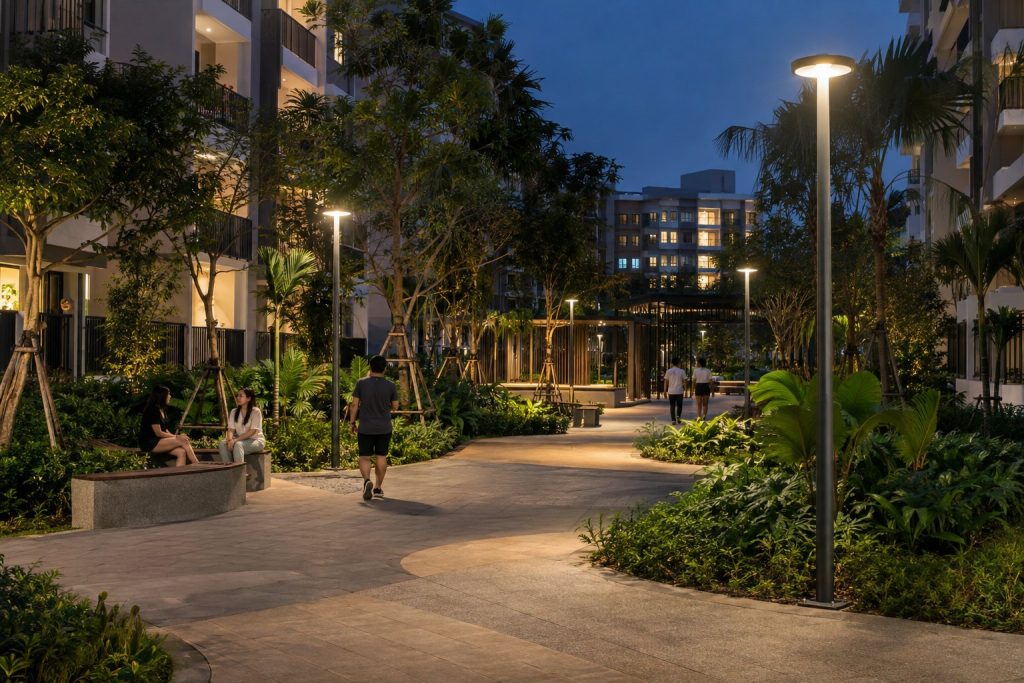
The LED source in a post-top head can sit close to normal sightlines. A bright exposed aperture may cause discomfort even when the measured horizontal lux is modest. Use shielding, diffusers or controlled lenses and review views from benches, balconies, vehicle approaches and CCTV cameras. Keep light out of bedroom windows and above the horizontal plane where possible.
Specify Colour and Visual Quality
Warm white around 2700K to 3000K is often appropriate for hotels and landscaped housing, while 3000K to 4000K may suit busier mixed-use areas. CRI 80 is a practical project target where faces, planting and finishes should look natural. If security cameras depend on colour identification, confirm camera performance with the proposed CCT and spectral output.
Engineer the Pole and Foundation
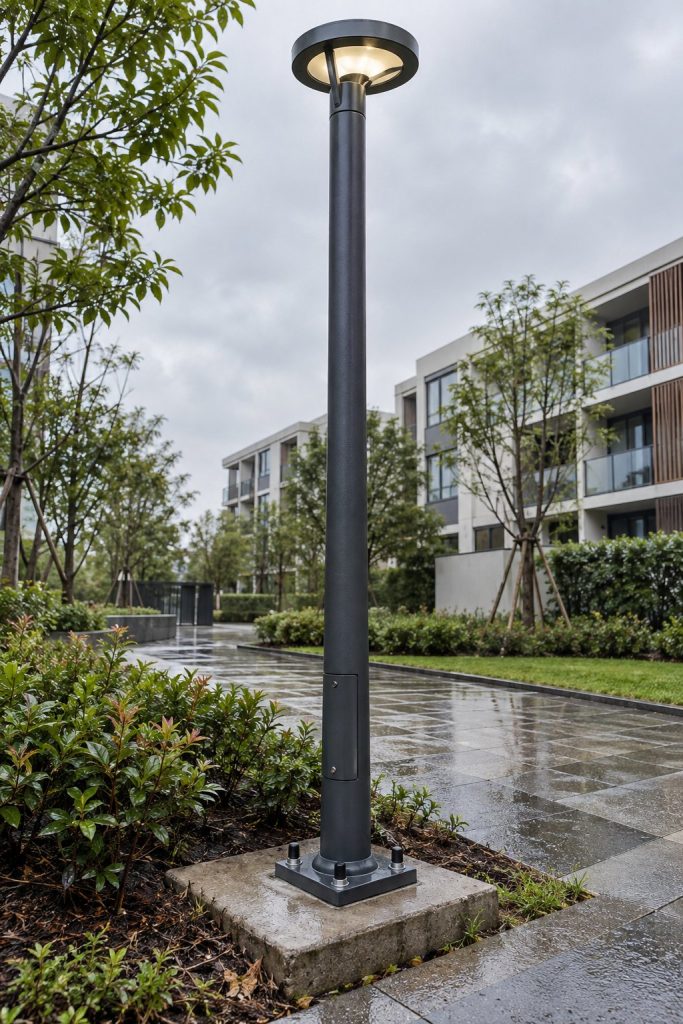
Post lights are structural assemblies. The calculation should include pole height, shaft section, luminaire mass and effective projected area, bracket geometry, governing wind speed and terrain category. Foundations need verified soil assumptions, anchor templates and drainage. Place bases outside vehicle overhang and make sure the flange, bolts and concrete do not become a trip hazard.
Protect the Electrical System
IP65 may suit many garden and courtyard products; IP66 can be selected for stronger dust and water-jet exposure. The gland, access door, connector and underground junction must preserve the intended protection. IK08 is useful where carts, tools or vandalism create impact risk. Surge protection may begin around 10 kV on exposed networks, but the luminaire SPD, distribution board, earthing and bonding must be coordinated.
Plan for Heat Salt and Maintenance
High ambient temperature and direct sun raise the housing temperature before the LEDs switch on. Request thermal limits for the actual product configuration. Coastal projects need a defined powder-coating or anodizing system, compatible stainless fasteners and isolation between aluminium and dissimilar metals. Leave enough access to clean lenses, replace drivers and test earthing without damaging planting.
Post Light Procurement Checklist
- Scaled site and landscape plan with routes, levels, windows, trees and CCTV locations
- Maintained lux, minimum lux, uniformity, vertical-light, CCT, CRI and glare criteria
- DIALux calculation using exact photometric files and final post height
- Pole drawing with shaft, flange, access door, cable entry and projected area
- Wind and foundation calculation using project soil and terrain inputs
- IP, IK, thermal, surge, corrosion, earthing and maintenance documentation
Common Selection Errors
Common errors include choosing the post only by appearance, copying one spacing dimension across different path widths, using a decorative diffuser with no verified photometry and locating foundations after irrigation has been installed. Another costly mistake is adding cameras, banners or flower baskets later without checking wind load.
Frequently Asked Questions
How tall should outdoor post lights be
Pedestrian post lights commonly fall around 2.5 to 5 metres, while low-speed roads may use taller assemblies. The final height depends on distribution, spacing, glare and structural design.
How far apart should post lights be
There is no universal spacing. Calculate it from the exact photometric file, mounting height, route width, maintained lux and uniformity target.
Are IP65 post lights suitable outdoors
IP65 can suit many outdoor locations. More severe dust, rain or washdown may justify IP66, and cable entries plus underground joints also need protection.
What foundation is needed for a garden post light
Foundation size depends on post height, wind load, projected area, soil capacity and anchor arrangement. A structural calculation should define it.
Request a Project Lighting Review
For a hotel, housing estate or public courtyard, provide the site plan, landscape layout, mounting limits, wind data, soil information, environmental exposure and lighting criteria. Dawn Lighting can review suitable products from its current Residential and Garden Lighting category.
Send the site drawings and operating requirements through the Dawn Lighting official inquiry page. The engineering team can prepare a project-specific DIALux proposal and B2B quotation.
- 10 Meters Lamp Post
- 10 Meters Pole
- 1000w Led Projector
- 100W LED Tunnel Light
- 12 Meters Lamp Post
- 12 Meters Pole
- 1200w Led Projector
- 15 Light Pole
- 1500w Led Projector
- 150W LED Tunnel Light
- 1800w Led Projector
- 2 In 1 Solar Flood Light
- 200w Led Tunnel Light
- 50w Led Tunnel Light
- 6 Meters Lamp Post
- 6 Meters Pole
- 8 Meters Lamp Post
- 8 Meters Pole
- 800w Led Projector
- 80w Led Tunnel Light
- Colourful Decorative Light
- Conical post
- Courtyard Lamp
- courtyard light
- courtyard lighting fixture
- Decorative Landscape Light
- Decorative road Light
- Flood Light For Courtyard
- Flood Light for Garden
- Flood Light For Outdoor
- Foot Led High Bay Lights
- high bay led lights 100w
- industrial lampshade
- industrial LED shed lights
- industrial magnifying glass with light
- Integrated Solar Flood Light
- led courtyard lamp
- led courtyard light
- led high bay light 100w
- LED Projector For Stadium
- Led UFO High Bay 150W 5000k
- Lighting Plants Mining Price
- Maintenance Free LED Street Light
- Pic Controlling Tunnel Light
- PLC controlling tunnel light
- Post Top Garden Light
- RGB Landscape Light
- Rgbw Decorative Light
- Smart Tunnel Light
- solar courtyard lamp
- solar courtyard light
- Solar LED Road Light
- Solar Street Light For 10 Meter Pole
- Solar Street Light For 12 Meter Pole
- Solar Street Light For 6 Meter Pole
- Solar Street Light For 8 Meter Pole
- Split Type Solar Flood Light
- Sporting Projector
- Stadium Led Projector
- Street Lighting Post
