
 Request A Quote

Solar Powered Street Lights for Remote Roads
 FACEBOOK
 TWITTER
 LINKEDIN
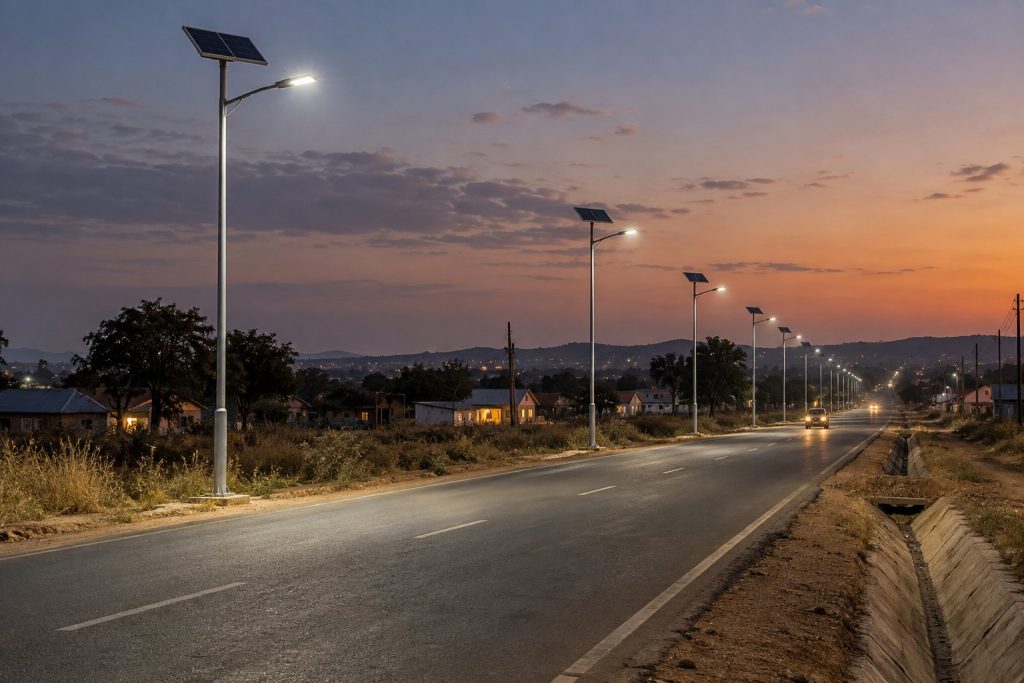
Solar powered street lights succeed when the road-lighting duty and the energy budget are designed together. A large panel does not compensate for the wrong optical distribution, and a bright luminaire is not reliable if the battery reaches its discharge limit before dawn. Start with the road class and dimming profile, then size the panel, battery and controller from verified solar-resource and temperature data.
Direct answer. Calculate maintained road lux and uniformity in DIALux using the exact luminaire photometry. Convert the approved nightly power profile into watt-hours, then size the photovoltaic panel for the site’s worst design month and the battery for the required autonomy, allowable depth of discharge and temperature. Verify pole wind load, panel orientation, foundation, controller settings, surge protection, theft risk and maintenance access.
Design the Road Lighting First
Do not start by choosing a panel wattage from a catalogue. Define road width, traffic speed, conflict areas, pedestrian use and the authority’s lighting class. Record pole height, outreach, spacing and restrictions on panel orientation. Use the IES or LDT file for the exact Dawn Lighting solar street luminaire and check maintained illuminance or luminance, uniformity and glare.
| Design input | Why it matters | Evidence required | Engineering output |
| Road class and geometry | Defines useful light on the road | Survey, authority criteria and layout | Optic, height and spacing |
| Nightly dimming profile | Sets daily energy demand | Operating schedule by hour | Watt-hours per night |
| Worst-month solar resource | Controls panel recovery | Site irradiation and shading data | Panel size and tilt |
| Autonomy and temperature | Controls usable battery energy | Risk requirement and climate data | Battery capacity and enclosure |
Build an Hour-by-Hour Energy Budget
Use the luminaire’s real input power at each dimming level. Multiply power by operating hours for every step and add controller and conversion losses. For example, a system running at full output during the evening peak, reduced output overnight and full output before dawn will consume less energy than a constant-power system, but the lower level must still meet the agreed safety criterion.
Daily load in watt-hours is the sum of each power level multiplied by its duration. Do not use LED chip wattage when driver input power is the relevant value. Include seasonal night length and control behaviour after motion or fault events.
Size the Panel for the Worst Design Month
Annual average sunshine can hide a weak rainy or dusty season. Use project-specific peak-sun-hour or irradiation data for the worst design month, then apply losses for module temperature, controller conversion, cable drop, dirt and battery charging. Panel tilt and azimuth should support seasonal energy yield and cleaning access, not only visual symmetry.
Size Usable Battery Energy
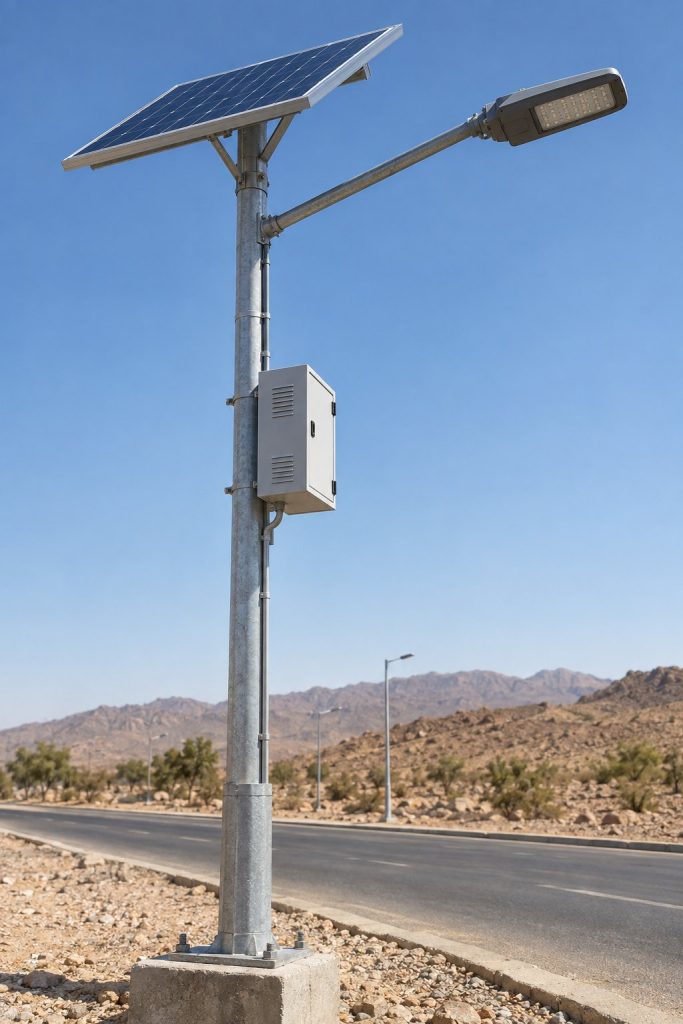
Battery capacity must cover the nightly load multiplied by the required autonomy, then account for allowable depth of discharge, round-trip efficiency and temperature. A simple conceptual relationship is: required nominal energy equals nightly load times autonomy divided by usable depth of discharge and system efficiency. Convert watt-hours to ampere-hours only after confirming nominal system voltage.
LiFePO4 batteries are widely considered for solar lighting because of cycle life and usable depth of discharge, but they still need a compatible battery-management system and temperature protection. High heat accelerates ageing. Locate the enclosure away from direct solar gain where the design allows, provide safe service access and verify the manufacturer’s operating limits.
Set Controls for Reliability
A good controller protects the battery before it becomes deeply discharged. Define dusk detection, staged dimming, motion response, low-voltage cut-off, recovery behaviour and fault logging. The emergency fallback profile should preserve minimum route visibility during poor solar recovery instead of switching off early without warning.
Engineer Wind Load and Foundations
The photovoltaic panel adds substantial projected area above the pole. Structural calculations must use the final panel dimensions, angle, bracket, luminaire, outreach, governing wind speed and terrain category. The foundation requires soil assumptions, drainage and an anchor template. Avoid placing the cabinet where floodwater, vehicles or unauthorised access create predictable damage.
Protect Against Lightning Corrosion and Theft
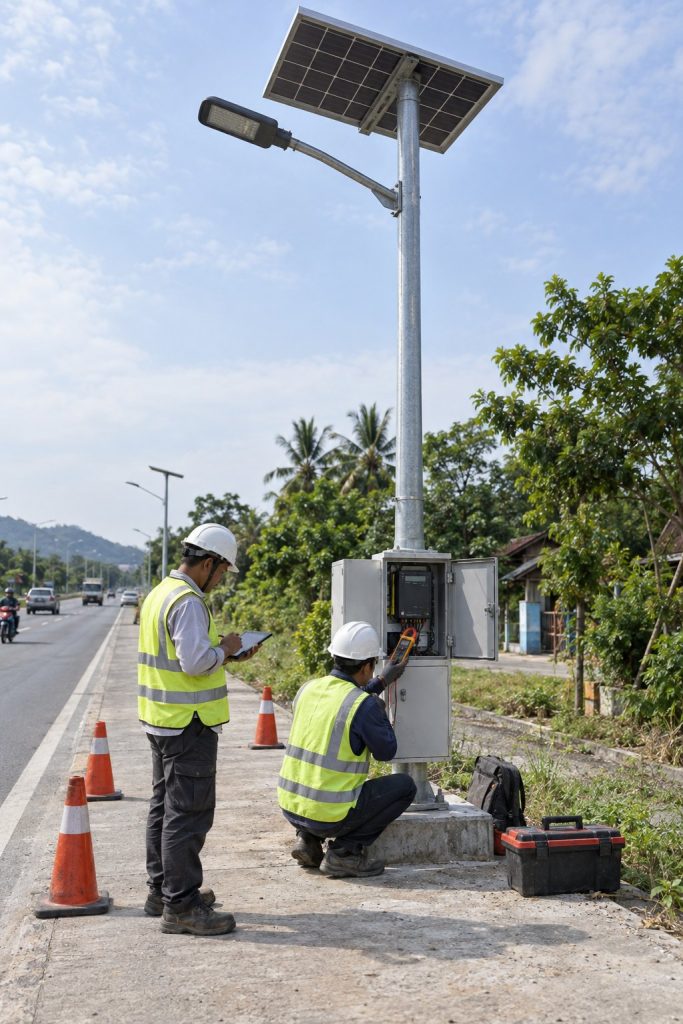
Off-grid operation removes a long mains feeder but not lightning risk. Bond metal components, coordinate surge protection and provide an effective earth path where required by the design. Coastal or humid projects need defined coatings, compatible fasteners and sealed connectors. Anti-theft bolts, lockable cabinets and asset marking should be agreed without blocking battery ventilation or maintenance.
Commission the Complete Night Cycle
Daytime checks should record module open-circuit voltage, charging current, battery state, polarity, controller settings and earthing. The night inspection verifies switch-on level, dimming stages, road lux, uniformity and shutdown behaviour. Sample several poles after a representative discharge period; checking one newly charged unit does not prove the whole route.
Solar Street Light Procurement Checklist
- Road survey, lighting class and DIALux file using exact luminaire photometry
- Hourly operating and dimming schedule with daily watt-hour calculation
- Worst-month solar-resource data, shading review, panel size, tilt and loss assumptions
- Battery chemistry, nominal energy, usable depth of discharge, autonomy and temperature limits
- Controller settings, protections, monitoring, cable sizes and sealed connectors
- Pole, panel bracket, wind and foundation calculations plus commissioning procedure
Mistakes That Shorten Autonomy
Frequent errors include sizing from annual average sunshine, quoting nominal battery capacity without usable depth of discharge, ignoring dust losses, changing luminaire wattage after the energy calculation and placing panels where new trees or buildings create shade. Another warning sign is a three-night autonomy claim with no defined dimming profile or temperature.
Frequently Asked Questions
How many rainy days should a solar street light support
Autonomy is a project risk decision. Two or three nights are common discussion points, but local weather, safety importance, dimming strategy and budget determine the requirement.
How is solar street light battery capacity calculated
Start with nightly watt-hours and autonomy, then account for allowable depth of discharge, conversion efficiency, temperature and battery ageing.
What pole height is used for solar powered street lights
Many road projects use roughly 6 to 10 metre poles, but road class, width, optic, spacing, panel wind area and maintenance control the final height.
Do solar street lights need surge protection
Yes. Off-grid systems can still experience lightning-induced transients. Protection, bonding and earthing should be coordinated for the complete assembly.
Request a Project Lighting Review
For a remote-road solar project, provide the road survey, lighting criteria, operating profile, worst-month solar data, autonomy requirement, temperature range, wind speed, soil information and security risks. Dawn Lighting can review suitable products from its current Solar Street Light range.
Send the site drawings and operating requirements through the Dawn Lighting official inquiry page. The engineering team can prepare a project-specific DIALux proposal and B2B quotation.

- 10 Meters Lamp Post
- 10 Meters Pole
- 1000w Led Projector
- 100W LED Tunnel Light
- 12 Meters Lamp Post
- 12 Meters Pole
- 1200w Led Projector
- 15 Light Pole
- 1500w Led Projector
- 150W LED Tunnel Light
- 1800w Led Projector
- 2 In 1 Solar Flood Light
- 200w Led Tunnel Light
- 50w Led Tunnel Light
- 6 Meters Lamp Post
- 6 Meters Pole
- 8 Meters Lamp Post
- 8 Meters Pole
- 800w Led Projector
- 80w Led Tunnel Light
- Colourful Decorative Light
- Conical post
- Courtyard Lamp
- courtyard light
- courtyard lighting fixture
- Decorative Landscape Light
- Decorative road Light
- Flood Light For Courtyard
- Flood Light for Garden
- Flood Light For Outdoor
- Foot Led High Bay Lights
- high bay led lights 100w
- industrial lampshade
- industrial LED shed lights
- industrial magnifying glass with light
- Integrated Solar Flood Light
- led courtyard lamp
- led courtyard light
- led high bay light 100w
- LED Projector For Stadium
- Led UFO High Bay 150W 5000k
- Lighting Plants Mining Price
- Maintenance Free LED Street Light
- Pic Controlling Tunnel Light
- PLC controlling tunnel light
- Post Top Garden Light
- RGB Landscape Light
- Rgbw Decorative Light
- Smart Tunnel Light
- solar courtyard lamp
- solar courtyard light
- Solar LED Road Light
- Solar Street Light For 10 Meter Pole
- Solar Street Light For 12 Meter Pole
- Solar Street Light For 6 Meter Pole
- Solar Street Light For 8 Meter Pole
- Split Type Solar Flood Light
- Sporting Projector
- Stadium Led Projector
- Street Lighting Post
