
 Request A Quote

Stadium Lighting Design Guide: From Field Requirements to Final Commissioning
 FACEBOOK
 TWITTER
 LINKEDIN
When designing stadium lighting, it’s not about how many powerful floodlights you can put around a field.
Must be able to observe the ball and movement around them. The spectators must be able to see comfortably. Cameras need adequate vertical lighting and consistent colors and nearby residents may want glare and spill light to be controlled.
When a design is successful, it considers the field, poles, luminaires, optics, the electrical system, controls, and maintenance access. All decisions at the venue need to be tested and not given approval individually.
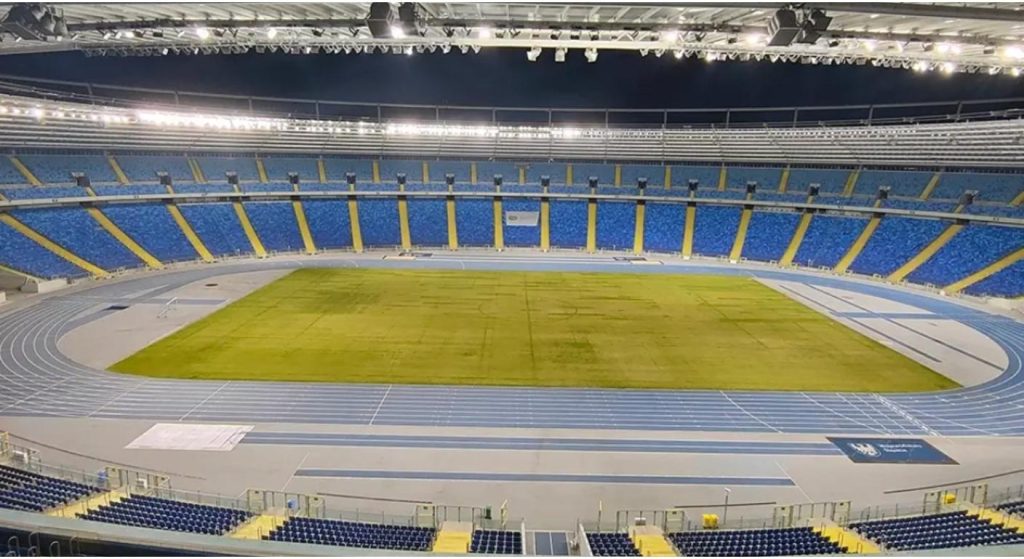
When planning the fixtures for a venue, determine the level of the space first.
There should be no common design brief for a community training field and a broadcast stadium.
The typical characteristics of training venues include safe visibility, low cost of operation and easy maintenance. Need more uniformity and control of glare at the competition venues. Vertical illuminance, colour quality, flicker performance, camera-position requirements are added to broadcast facilities.
Prior to modelling, agree:
- The size of the sport and field.
- Use for training, competition or broadcast.
- Opt for horizontal and vertical lighting
- Required uniformity
- Need for camera and slow motion
- Seating and viewing directions for spectators
- Running scenes and schedules of events
- Local spill-light restrictions
Project-specific requirements for relevant federation, broadcasters, venue owners and local authorities should be verified. The generic lux values are intended for use as initial planning targets and not as a fixed requirement.
The sport lighting line consists of high output systems for sports fields, arenas, stadiums and broadcast sensitive applications from Dawn Lighting.
| Design Stage | Required Deliverable | Approval Purpose |
| Project brief | Venue level and performance targets | Defines the design basis |
| Site survey | Field, pole, electrical, and access data | Confirms existing conditions |
| Concept design | Preliminary layout and fixture strategy | Compares feasible options |
| Detailed design | Photometric and structural documentation | Supports technical approval |
| Installation | Aiming and wiring schedules | Guides contractors |
| Commissioning | Measurements and as-built report | Verifies final performance |
Use Real Site Geometry to construct the Model.
An effective/practical photometric model requires good input data.
It should involve real field dimensions, pole co-ordinates, mounting height, positions of crossarms, tilt of fixtures, aiming points, luminaire photometric files, surface reflectance and settings for the calculation-grid.
Existing poles (if to be used again) should be surveyed with respect to their true locations. Beam overlap can vary due to small differences between assumed and actual coordinates, causing dark areas or too much bright.
Average, minimum, and maximum illuminance, uniformity ratios and the point-by-point results and relevant vertical planes should be displayed in the report. A colour map should not be used in place of the numerical results, but can help to identify patterns.
The guide to an LED stadium light retrofit from Dawn Lighting discusses the need for a site survey and accurate modelling to ensure uniformity during an LED stadium light retrofit.
Use a Mixture of Beam Angles: You can use a combination of beam angles.
An angle of one beam is not generally sufficient to cover a whole field.
High poles can reach out with narrow beams to faraway areas. Central coverage is by medium beams, wider or asymmetric distributions fill the area closer to the poles. Beam mixing can be done by mixing optics without using extreme fixture tilt.
It is all a matter of the correct combination, depending on the direction of aim, fixture output, pole layout, setback distance and mounting height. A tight beam misaligned can produce a hot spot. Too wide a beam set too far out from the face can result in increased glare and spill without helping the far side.
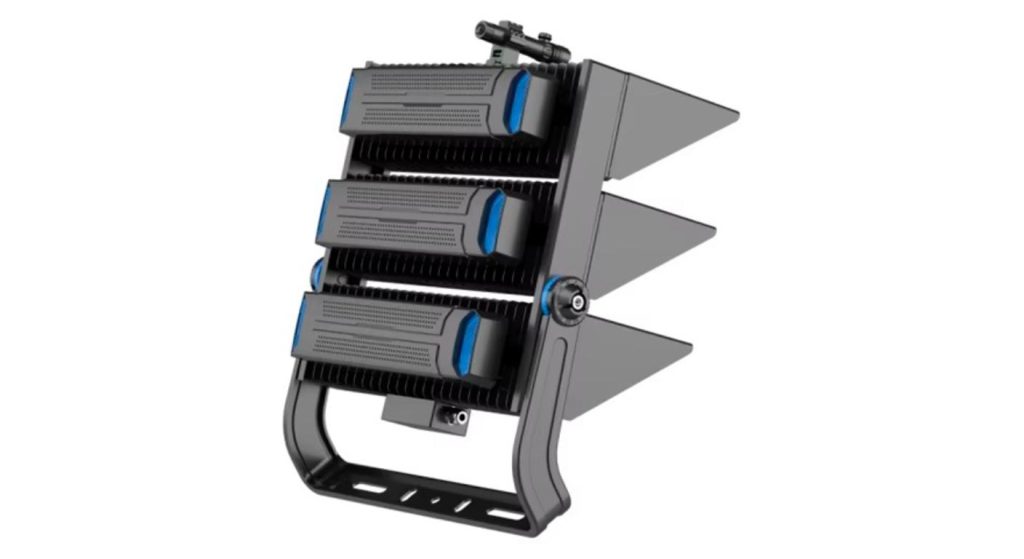
Offering high-power scalable LED modular projectors with symmetrical and asymmetrical beams, the projector range is ideal for stadium and large area lighting.
In addition to the average lux, uniformity is also important.
A field may have an average illuminance of the field and a poor performance.
Players’ eyes have to constantly adapt if one area is very bright and another area is relatively dark. The cameras can also have exposure issues when shooting action that is transitioning across the frame.
Beam overlap, fixture aiming, pole layout, lumen packages and maintenance factors are the requirements for uniformity. There’s no reliable way to correct it by boosting the wattage of each fixture.
It is important for designers to consider minimum-to-average and minimum-to-maximum ratios, in addition to the average lux. Shadowing close to the goal structures, stands, scoreboards and edges of roofs should also be assessed.
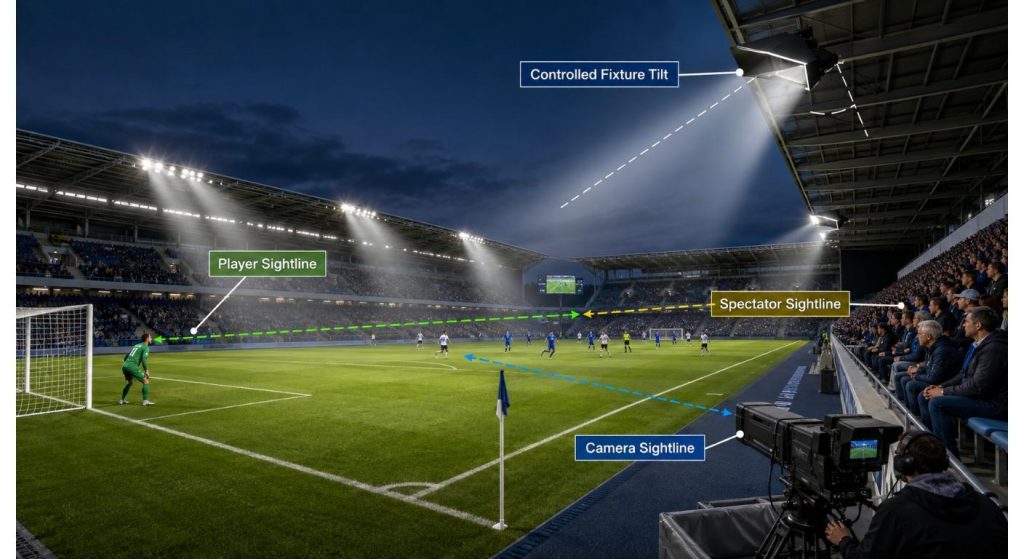
User’s perspective of controlling glare.
The position of players, goalkeepers, spectators, officials, cameras and surrounding residents must be taken into account when assessing glare.
Fixtures installed at low levels or at steep angles to the horizon can give intense light in strong beam directly into the eye of users. It could be as bright as the field yet uncomfortable.
There are several glare control strategies, which involve:
- Suitable mounting height
- Controlled optics
- Lower fixture tilt
- Accurate aiming
- Shields or visors
- Additional controlled output fixtures.
- Careful positioning of poles in relation to play direction
Aiming to be reviewed in the 3D model and to be checked again during the nighttime commissioning.
More than High CRI is required for broadcast lighting.
Light should illuminate players’ faces and bodies, as well as the horizontal field, in a broadcast project.
Vertical illuminance is to be measured from the primary positions of the camera. The following parameters should be agreed with the broadcaster or venue operator: Colour temperature consistency, CRI, TLCI, colour tolerance, flicker performance.
Even if the driver and the dimming behaviour of the LED fixture do not correspond to the camera frame rate and shutter settings, the LED fixture can still be seen flickering in high-speed video. Ask for driver test information and verify scene settings prior to venue hosting a recorded event.
Install Coordinate Poles, Crossarms and Foundations
The placement of the fixtures, direction of the lights, how many and weights of the fixtures are determined by the lighting model. These are outputs that are used as structural inputs.
The entire crossarm assembly, luminaires, drivers, cables, platforms, ladders, cameras and other accessories should be accounted for in pole and foundation calculations. Size of exposure to the wind can be as significant as the weight of equipment.
The sports light pole solution can be a starting point, with the final pole height, wall thickness, base plate, anchor bolts and foundation being dependent on the actual project and local structural requirements.
Ensure the Electrical System and Event Schedule are protected
Stadium lights are frequently mounted on ungrounded or above ground poles where lightning and switching surges can be a major hazard.
The design shall be compatible and coordinate circuit capacity, voltage drop, power factor, surge protection, grounding, cable routing, distribution panels, controls, emergency operation, and generator capacity if required.
Lighting controls should be able to individually control the scenes for training, competition, broadcast, cleaning and security. Dimming reduces energy and hours of operation when the full output isn’t required.
Drivers, surge-protection devices and critical modules should be able to be accessed for maintenance without causing extended venue closures.
Send an order for the installation with measurements
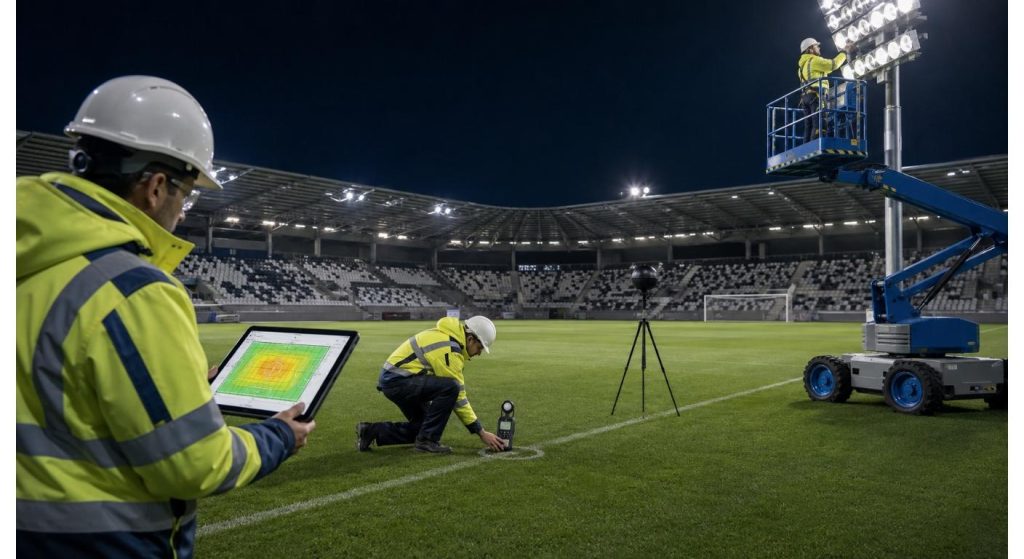
A computer model is just a prediction until the field is measured once it is installed.
Fixtures after installation should be aimed as per design records. A calibrated lux meter is then to be used under documented operating conditions, on the approved field grid.
Commissioning should confirm the Illuminance, Uniformity, Glare, Spill Light, Colour Consistency, Controls, Flicker (if applicable) and Camera Performance. Update Final Aiming Schedule and as-built report if aiming changes are made.
Final Design Check
A good stadium lighting design ties in with actual stadium construction and operation.
| Verification Item | Measurement or Check | Final Record |
| Horizontal illuminance | Approved field grid | Average, minimum, maximum |
| Vertical illuminance | Required camera planes | Directional results |
| Uniformity | Calculated from measured values | Final ratios |
| Glare and spill | Critical viewpoints and boundaries | Observations and readings |
| Control scenes | Each programmed operating mode | Output and circuit status |
| Fixture aiming | Tilt and direction | As-built aiming schedule |
The system should be able to accommodate the venue’s playing and camera requirements, be able to manage glare, integrate with supporting structures, stand up to the electrical environment, and be easy to maintain. The project will not be finished until the installed project results have been measured, not when the project fixtures are delivered.
FAQ
Q1. How many lux will be required in a stadium?
The required illuminance will be as per the sport, competition level, broadcasting requirement and applicable standards. Ensure target is agreed with the federation, the broadcaster, the venue owner and local authority.
Q2. Why is uniformity important?
A uniform texture will diminish extreme contrasts between bright and dark field regions. Optimizes visual comfort for the players and enables to keep cameras at a stable exposure level.
Q3. Which stadium lighting beam angle is best?
The optimum angle is not one size fits all. Most stadium designs make use of narrow, medium, wide or asymmetric optics depending on the height of the pole and the distance of the aim.
Q4. Are there any stadium lights that need flicker testing?
Yes, if the venue has the capability to be broadcast, photographed or slow motion. The performance of driver/dimming has to be tested against the desired camera settings.
Q5. Does the simulation with DIALux suffice for the approval?
No indeed – simulation is important during design, but once the installation is completed, it should also be aimed, measured and documented via field commissioning.

- 10 Meters Lamp Post
- 10 Meters Pole
- 1000w Led Projector
- 100W LED Tunnel Light
- 12 Meters Lamp Post
- 12 Meters Pole
- 1200w Led Projector
- 15 Light Pole
- 1500w Led Projector
- 150W LED Tunnel Light
- 1800w Led Projector
- 2 In 1 Solar Flood Light
- 200w Led Tunnel Light
- 50w Led Tunnel Light
- 6 Meters Lamp Post
- 6 Meters Pole
- 8 Meters Lamp Post
- 8 Meters Pole
- 800w Led Projector
- 80w Led Tunnel Light
- Colourful Decorative Light
- Conical post
- Courtyard Lamp
- courtyard light
- courtyard lighting fixture
- Decorative Landscape Light
- Decorative road Light
- Flood Light For Courtyard
- Flood Light for Garden
- Flood Light For Outdoor
- Foot Led High Bay Lights
- high bay led lights 100w
- industrial lampshade
- industrial LED shed lights
- industrial magnifying glass with light
- Integrated Solar Flood Light
- led courtyard lamp
- led courtyard light
- led high bay light 100w
- LED Projector For Stadium
- Led UFO High Bay 150W 5000k
- Lighting Plants Mining Price
- Maintenance Free LED Street Light
- Pic Controlling Tunnel Light
- PLC controlling tunnel light
- Post Top Garden Light
- RGB Landscape Light
- Rgbw Decorative Light
- Smart Tunnel Light
- solar courtyard lamp
- solar courtyard light
- Solar LED Road Light
- Solar Street Light For 10 Meter Pole
- Solar Street Light For 12 Meter Pole
- Solar Street Light For 6 Meter Pole
- Solar Street Light For 8 Meter Pole
- Split Type Solar Flood Light
- Sporting Projector
- Stadium Led Projector
- Street Lighting Post
