
 Request A Quote

Best Lighting Solution for Industrial Facilities: A Zone-by-Zone Guide
 FACEBOOK
 TWITTER
 LINKEDIN
No single fixture can offer the most appropriate lighting for the whole industrial facility.
The different types of visual tasks and operating risks are associated with a high bay warehouse, assembly line, quality-control station, loading dock, cold room and outdoor storage yard. Placing the same wattage and beam angle in all locations can lead to glare, shadowing, wasted energy and maintenance issues.
It’s much better to break down the facility into areas and concept each zone around the work that’s done in that zone.
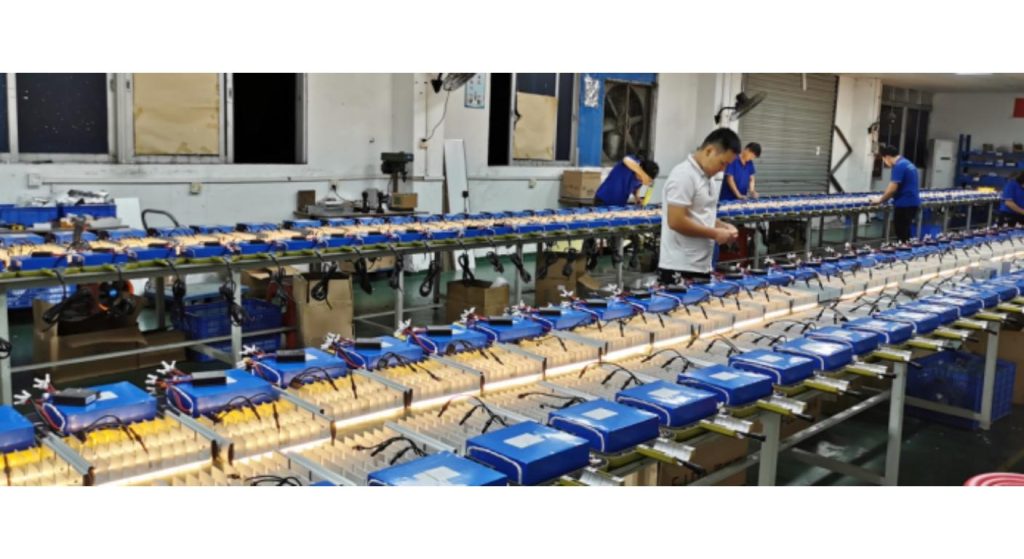
Begin with Tasks and not Fixture Wattage.
Industrial lighting should be used to complement people, vehicles, cameras and equipment that will be using the space.
Clear visibility of aisle and labels may be necessary for general storage. The task requirements for precision assembly require better task illumination and colour rendering. Pedestrian walkways, edges of vehicles, ramps and wet surfaces should be visible from the loading docks. Controlled light is needed in inspection areas for small defects, but not reflecting the lights.
Document: before choosing fixtures:
- The amount of work done in each zone
- The height of the ceiling and the mounting height.
- Position in the rack, machine and conveyor.
- The amount of light required and uniformity
- The visual demand and the age of the workers are related.
- Work schedules and work hours
- Dust, heat, moisture, chemical or vibration.
- In emergency and maintenance situations.
Occupational, electrical, fire and lighting standards should be checked to ensure they are applicable for the project location and activity.
High bays form the core of the large indoor areas.
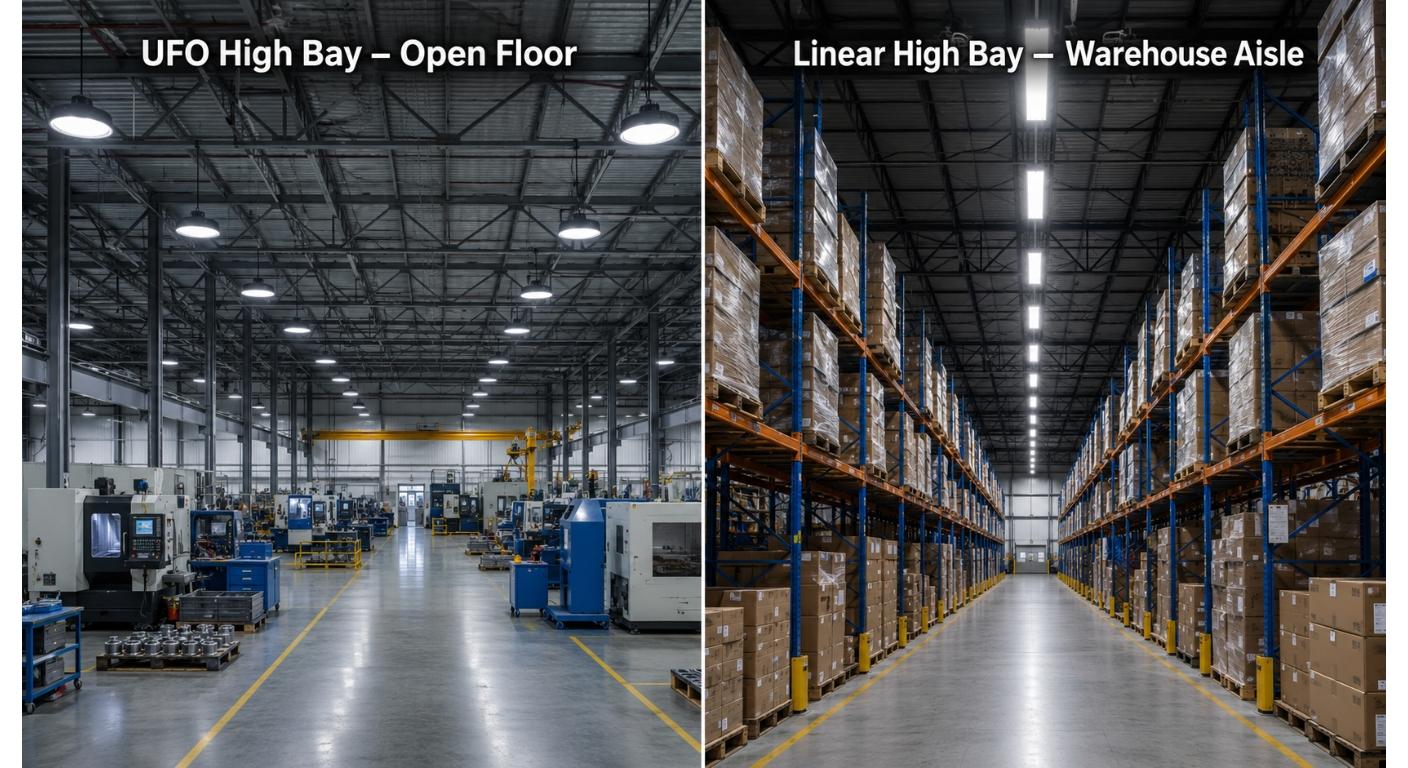
High Bay LED Lights are widely used in the warehouses, factories, workshops, hangars, and large production halls that have high ceilings.
UFO high bays offer are small in size and can be used in open spaces where wide, flat coverage is needed. Long, narrow bays (linear bays) or tower bays are more suited to long aisles, production lines or areas where the distribution is more controlled.
Dawn Lighting’s high bay lighting systems come in various shapes and sizes, such as UFO and tower lights for warehouses, factories, exhibition halls and other high ceiling facilities.
The quantity of fixtures should be calculated on the basis of a photometric simulation. The only way to determine if light is evenly distributed between machines and racks is to use wattage.
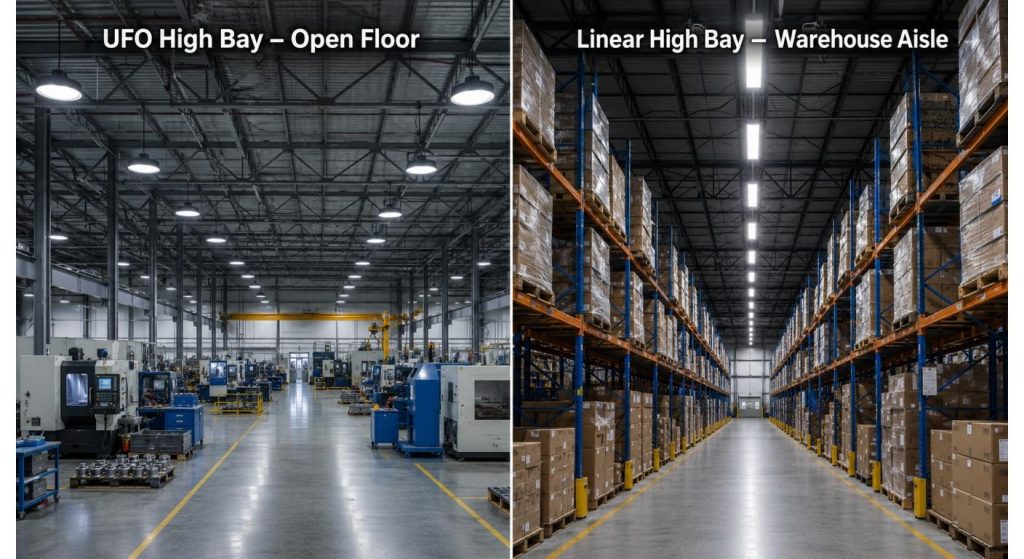
The Optic needs to be matched up to the Building Geometry.
The height of mounting and beam angle should be coordinated.
Distributions with a smaller width are used to focus light in high ceilings or tall racks. Open production floors are available with wider beams from below. Aisle optics guide more light down the storage aisles, and minimize top loss.
The wide beam with too high position is liable to weak at the floor level. The narrow beam placed low will produce bright circles and dark areas in between.
Racks, large machines, platforms, cranes, ducts and structural beams are example items that should be included in the design model. These objects can absorb light, even if there is no object in the room.
Dawn Lighting’s tower high-bay line is designed for large, high industrial and commercial environments where many working areas need to be lighted and yet a high degree of output is desired.
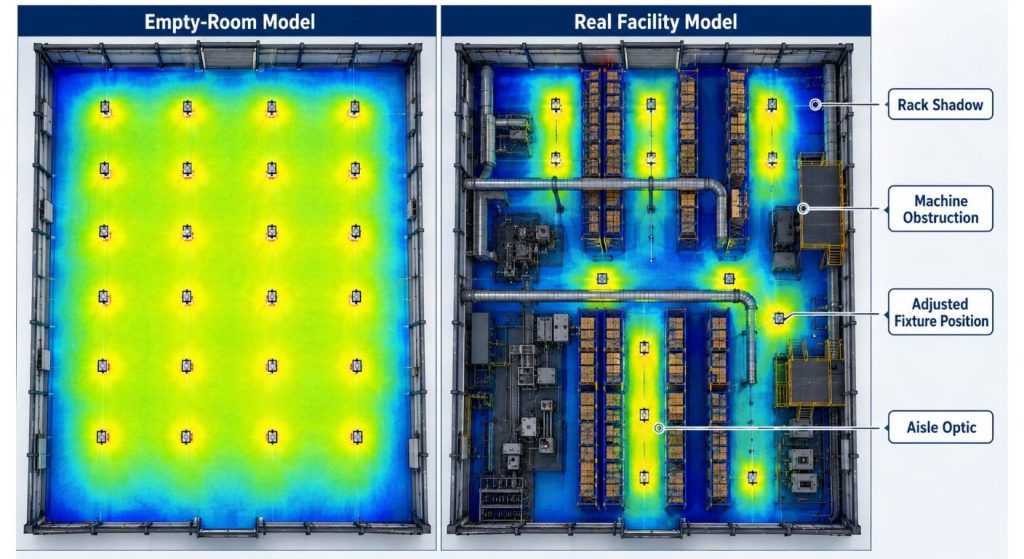
Include Task Lighting – Where Detail Matters
To make a small work area better by increasing the output of each ceiling fixture isn’t always a good approach.
Task lighting can be required for inspection benches, machine controls, assembly areas, cutting tables and packing lines. Local fixtures can offer greater visibility just where it counts and permit the overall system to run more efficiently.
Task lights should provide control of reflections, shadows and direct glare. They should also have a colour rendering and colour temperature that are appropriate to the materials to be inspected.
Carefully place them so that workers’ hands, tools or machine frames are not in the light.
Give Outdoor Floodlights for Yards and Loading Areas
The lighting plan for exterior industrial areas is different from that of interior halls.
Yards, storage areas, gates, vehicle routes and building perimeters must be equipped with weather-proof components that have an appropriate beam control. You can cover a wide area with floodlights, but if the lights are not properly positioned, they could reflect into drivers’ eyes or light outside the property.
Dawn Lighting’s LED floodlights are designed to work across a variety of industrial, commercial, façade, security and outdoor wide area applications.
Pole or wall height, camera placement, vehicle direction, nearby property, corrosion, wind loading, surge protection and maintenance access are all factors to take into account when designing the exterior.
| Facility Zone | Suitable Lighting Approach | Main Design Priority |
| Open warehouse | UFO high bays | Uniform floor coverage |
| High-rack aisles | Linear high bays with aisle optics | Vertical rack visibility |
| Production floor | High bays plus local task lights | Safe machine operation |
| Inspection station | Controlled high-CRI task lighting | Defect and colour recognition |
| Loading dock | Canopy lights and floodlights | Vehicle and pedestrian visibility |
| Outdoor yard | Pole- or wall-mounted floodlights | Coverage and glare control |
| Classified area | Certified hazardous-location fixtures | Explosion and fire safety |
The need for High Lumens in Harsh Environments.
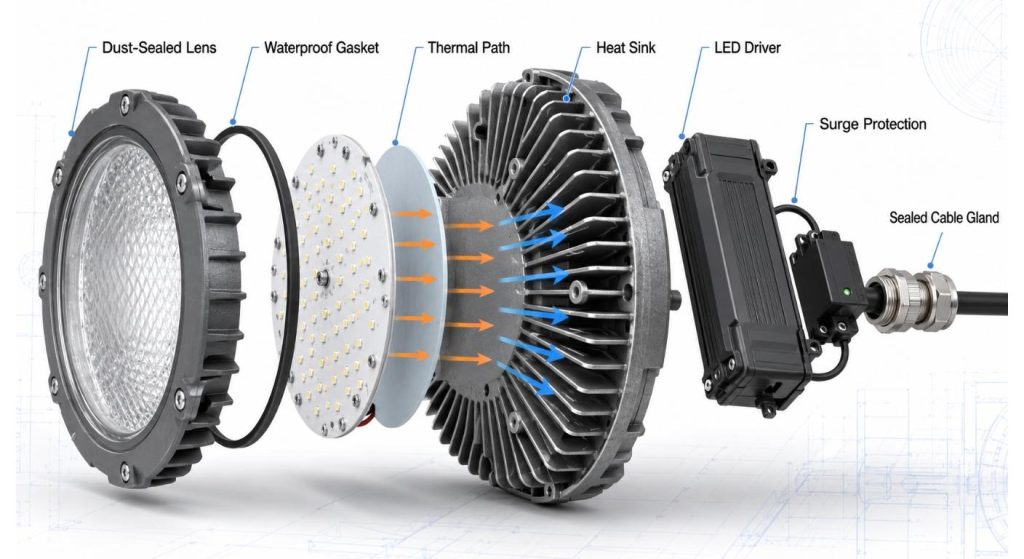
Vibration, chemicals, moisture, oil mist, and heat are all factors that contribute to the life of the fixture.
When considering an industrial luminaire, the following points must be taken into account:
- Ambient operating temperature
- Dust and water ingress protection.
- Impact resistance
- Exposure to corrosion and chemicals
- Thermal protection and protection against surges in the driver.
- Design of heat-sink and airflow.
- Fastener, gasket and cable-gland quality
Depending on the setting, make sure that the machine you choose is suitable for washdown or food applications.
Hazardous-location fixtures may be required for facilities that have flammable gases, vapours, fibres or combustible dust. High bays should not be fitted in classified areas unless a formal risk assessment has been carried out.
Dawn Lighting’s guide to industrial high-bay lighting in hot warehouses covers ceiling height, lux target, optics, glare, enclosure protection and thermal performance in hot facilities.
Reduce reflections and enhance vertical viewability.
Industrial visibility is not a given with bright floors.
Vertical surfaces like labels on the racks, machine panels, boxes, vehicle sides, people crossing intersections must be visible to workers. These surfaces can be left in a dark shade if just horizontal lux is applied.
Another problem is glare, particularly in shiny floors, around metal surfaces, car windshields and high beam fixtures. Additional improvements in comfort may be achieved through better optics, diffusion, fixture placement, shielding and uniform fixture spacing.
Take a look at the design from normal work stations, forklift paths, mezzanines and inspection stations, not just the plan view.
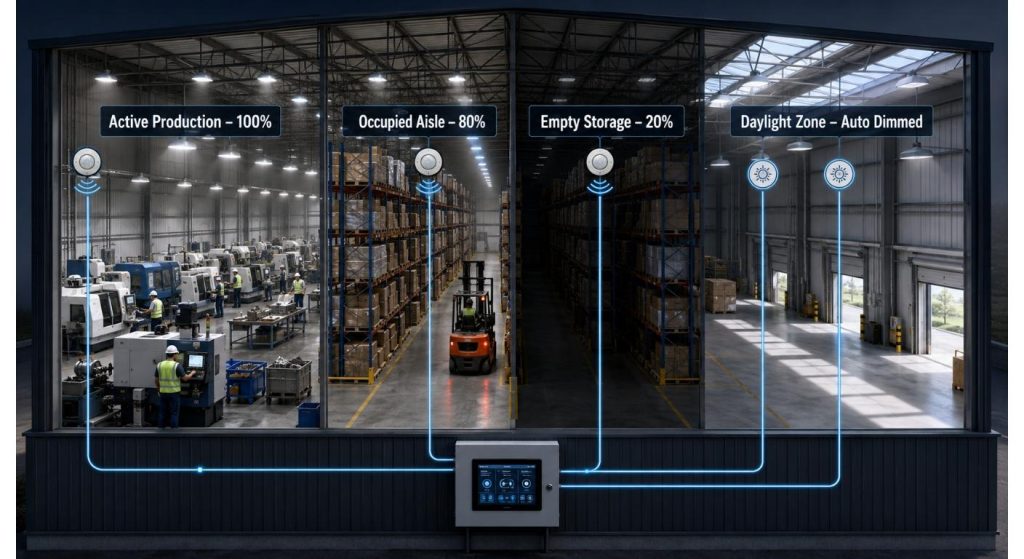
Smart Controls should follow Facility Activity.
It is not common for all the zones to be operating at maximum capacity on all shifts to all industrial facilities.
Low-traffic aisles and storage areas can have their lighting reduced by occupancy sensors. Daylight sensors can reduce the light levels of fixtures close to skylights or perimeter windows. Time schedules can be used to assist production, cleaning, security and maintenance shifts.
Controlled areas may be useful such as:
- Active production lines
- Individual warehouse aisles
- Loading docks
- Areas of operation and assistance rooms
- Outdoor yards
- Emergency circulation routes
Controls should be able to cut back energy and not cause unsafe switching. The delay in the sensors, sensor coverage, minimum background levels and sensor interactions with moving vehicles need to be evaluated on site.
For any questions regarding maintenance access please consult the Design.
If the replacement part is cheap, but the fixture is costly, the fixture may have to be serviced and the cost may be quite high.
Prior to installation check out lift access, production shutdown requirements, driver replacement, cleaning intervals, spare parts, connector type and emergency-light testing.
If compatible drivers and LED assemblies are available, modular drivers and assemblies may facilitate repairs. Similar fixtures and controls can also be grouped, which decreases the number of spare parts.
The maintenance plan should be documented with the information given below:The maintenance plan should be documented with the following information:
| Survey Item | Information to Record | Design Impact |
| Existing fixtures | Type, wattage, quantity, condition | Retrofit baseline |
| Ceiling structure | Height, beams, ducts, skylights | Mounting and optics |
| Operating schedule | Shifts and inactive periods | Control strategy |
| Electrical supply | Voltage, circuits, panel capacity | Driver selection |
| Environment | Heat, dust, moisture, chemicals | Fixture protection |
| Maintenance access | Lifts, machinery, shutdown limits | Service planning |
Check out the Design before Full Installation.
The preparation of a photometric model should be based on accurate fixture files, racks, machines, reflectance values, workplane positions and ceiling heights.
If a facility is large or you have a large visual need, install a sample zone prior to approval of the entire project. The mock-up can be used to detect glare, shadows, colour variations, sensor issues or inadequate vertical light which may not be captured in drawings.
Once installed, check light levels, uniformity, controls, emergency operation and actual visibility of workers during normal production.
Final Recommendation
When it comes to lighting, no one product is the best fit for an industrial facility – it’s a coordinated system.
Have high-bay lights for large interior spaces, task lighting for fine work, controlled lighting for exterior spaces, and smart controls for changing activity. Correlate each fixture with the space, environmental risk and maintenance plan.
This zone-based method will enhance safety and visibility, and eliminate overlighting of areas that don’t need the full output of the lights.
FAQ
Q1. What type of lighting is best in a high ceilinged warehouse?
These fixtures are often appropriate, as they focus the light into the racks while maximizing space utilization and creating a bright, concentrated light source. Distance between fixtures, fixture output and beam angle should be determined by photometric simulation.
Q2. Are the high bays with ufo or linear better?
UFO fixtures work well in many open areas and linear or tower fixtures work well for aisles and production lines. It is recommended to select according to the building geometry.
Q3. What should be the colour temperature to use in factories?
Neutral or cool white is often chosen for its clarity in the industrial field. Colour rendering, worker comfort and task should also be taken into account when engaging in the final choice.
Q4. Are motion sensors suitable for use in warehouses?
Yes, especially in the non-contiguous aisles and storage areas. Forklift, pedestrian, background light conditions and detection coverage and delay settings should be taken into consideration.
Q5. How many watts does a 120mW bulb have?
Depends on conditions of dust, moisture, washdown and installation. The rating should be based on the entire installed fixture which includes the cable entry points and connections made.
- 10 Meters Lamp Post
- 10 Meters Pole
- 1000w Led Projector
- 100W LED Tunnel Light
- 12 Meters Lamp Post
- 12 Meters Pole
- 1200w Led Projector
- 15 Light Pole
- 1500w Led Projector
- 150W LED Tunnel Light
- 1800w Led Projector
- 2 In 1 Solar Flood Light
- 200w Led Tunnel Light
- 50w Led Tunnel Light
- 6 Meters Lamp Post
- 6 Meters Pole
- 8 Meters Lamp Post
- 8 Meters Pole
- 800w Led Projector
- 80w Led Tunnel Light
- Colourful Decorative Light
- Conical post
- Courtyard Lamp
- courtyard light
- courtyard lighting fixture
- Decorative Landscape Light
- Decorative road Light
- Flood Light For Courtyard
- Flood Light for Garden
- Flood Light For Outdoor
- Foot Led High Bay Lights
- high bay led lights 100w
- industrial lampshade
- industrial LED shed lights
- industrial magnifying glass with light
- Integrated Solar Flood Light
- led courtyard lamp
- led courtyard light
- led high bay light 100w
- LED Projector For Stadium
- Led UFO High Bay 150W 5000k
- Lighting Plants Mining Price
- Maintenance Free LED Street Light
- Pic Controlling Tunnel Light
- PLC controlling tunnel light
- Post Top Garden Light
- RGB Landscape Light
- Rgbw Decorative Light
- Smart Tunnel Light
- solar courtyard lamp
- solar courtyard light
- Solar LED Road Light
- Solar Street Light For 10 Meter Pole
- Solar Street Light For 12 Meter Pole
- Solar Street Light For 6 Meter Pole
- Solar Street Light For 8 Meter Pole
- Split Type Solar Flood Light
- Sporting Projector
- Stadium Led Projector
- Street Lighting Post
