
 Request A Quote

Outdoor Lighting for Parks and Streets: Designing One Safe Nighttime Network
 FACEBOOK
 TWITTER
 LINKEDIN
The light of the night sky has an impact on the safety and comfort of journeys across a city at night. Street need to be illuminated to provide the driver with a clear picture, parks need to be illuminated to provide human scale guidance without excess brightness.
The best design approach doesn’t consider these spaces as individual projects. It creates an integrated nighttime network of roads, sidewalks, crossings, park entrance, paths and activities.
Do not plan around fixtures and movements of individuals.
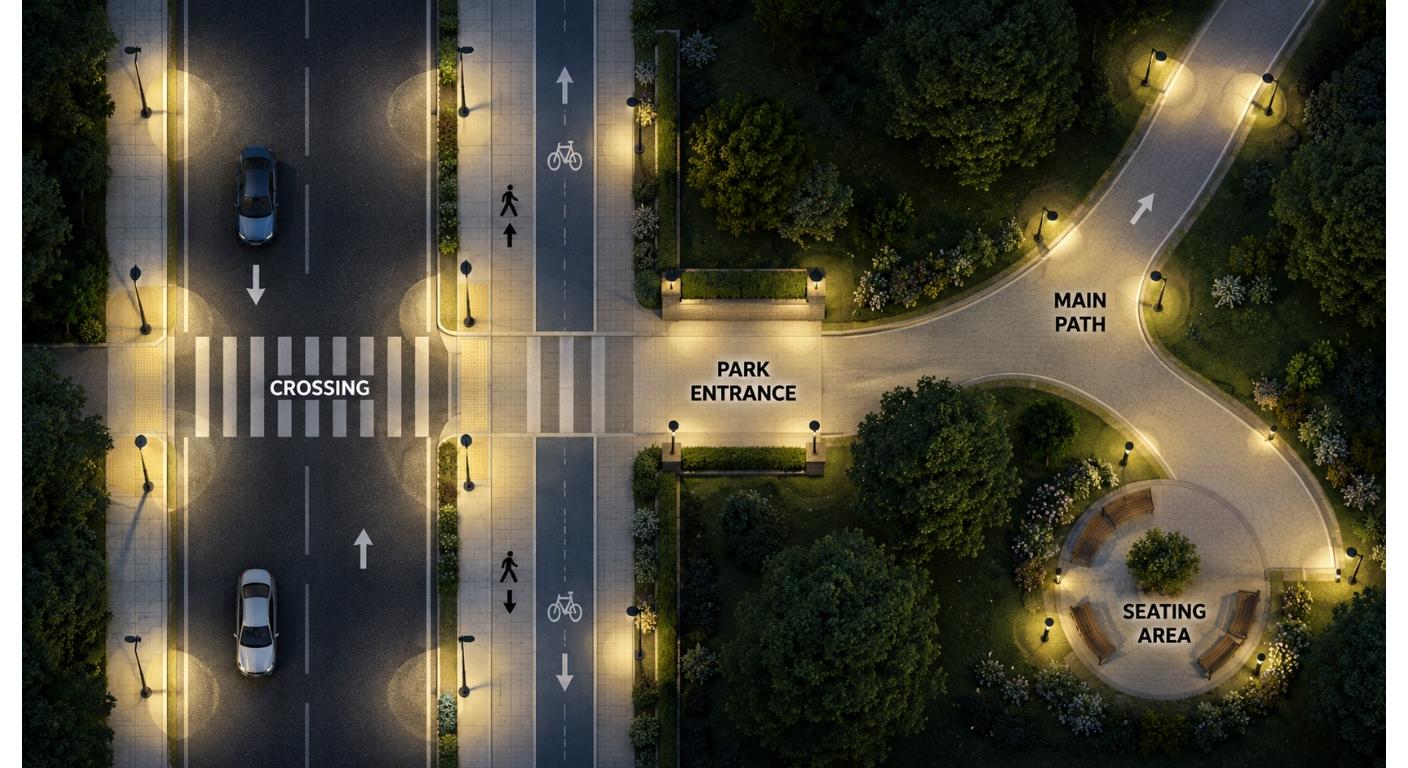
The first step to lighting design is to document the movement of vehicles, cyclists, pedestrians, maintenance and emergency services workers through the site. This shows the point of intersection of users and sudden change in their visibility.
A park entrance near a road might include turning of vehicles, people walking, road signs and markings, a change in surface elevation and trees. Often these areas of transition require more attention than a long simple stretch of road.
The lighting plan should therefore highlight:
- Main roads and trails for people to walk or cycle on.
- Points where crosses are crossed and conflict occurs
- Park at the parking areas and their entry/exit points
- Steps, ramps, bridges and water edges.
- When at the park, there are seating, recreation and gathering areas.
- Relatively dark areas that should not be affected.
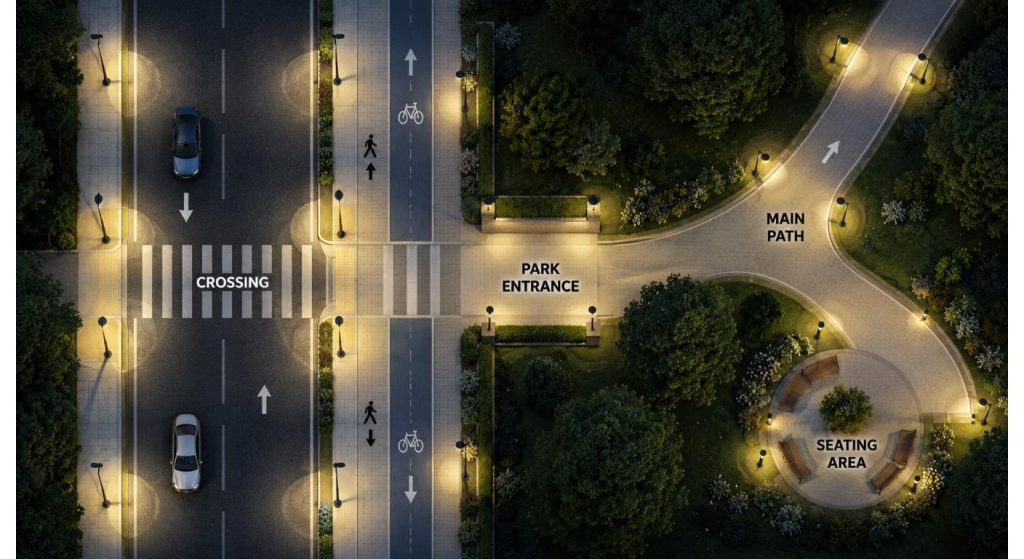
Provide a consistent visual information about the street.
Street lighting should enable drivers to see boundaries, curves, intersections, pedestrians and unexpected obstacles as soon as possible to allow them to respond. Generally, it is better to have a great deal of consistency than a few extreme bright spots.
Uniformity is impacted by fixture spacing, mounting height, beam distribution, road width, pole setbacks and obstructions. Dawn Lighting’s street and road lighting solutions feature solar and grid powered systems for urban roads, communities, parks and rural roads.
The appropriate level of lighting shall be based on road type, traffic volume, presence of pedestrians, local standards and risk assessment of the project.
Design Parks that are Human Scale.
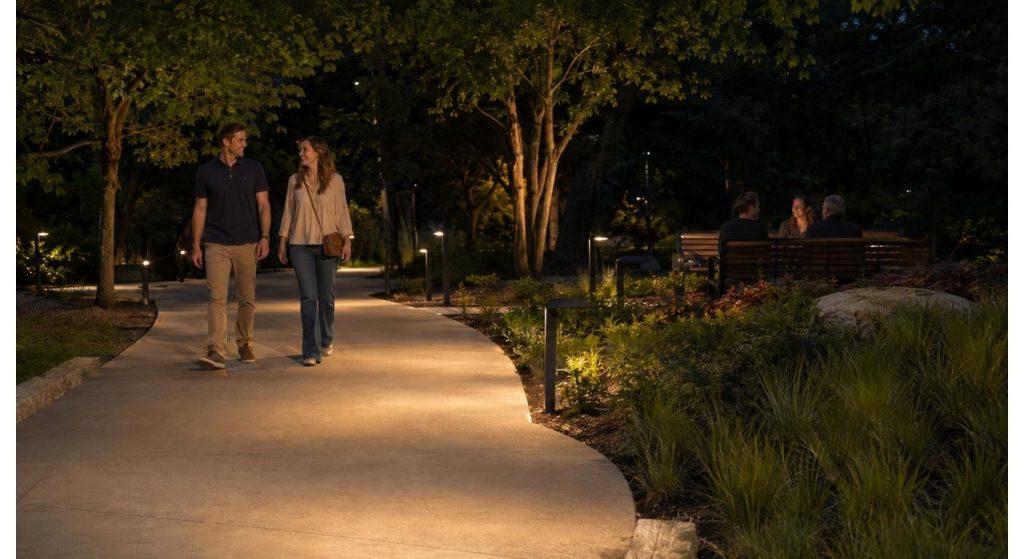
The light will be used in a different way in the park. It should be readable and allow for routes, faces, edges and destinations to be understood yet not light up the whole landscape.
Soft, controlled, light close to the eye level is good for pedestrian paths. The lighting in seating areas and gathering areas may need to be increased to provide greater visibility of the faces; the lighting for planting areas may be darker unless the planting area is a hazard or has an important visual element.
Low level bollard lights can help to create paths and boundaries to a landscape but need to have careful control of their optical distribution to avoid glare. Landscape lighting can enhance the identity of entrances, plazas, gardens or cultural spaces, while fitting into the existing site context.
Improve the safety of the connection between street and park.
A public road any place it enters a park is not just a boundary. It’s an environment for the user to enter a space from a higher speed and more intense light into a slower and sometimes dimmer environment.
Lighting in the entrance area should be sufficient to illuminate signs, gates, path direction and crossing points, and approaching users. Changes in brightness should also be avoided, as that also decreases visual comfort and may cause temporary difficulty in recognizing of darker details.
Consider using the same fixture shape, beam pattern, or consistent pole finish to provide visual continuity as roads and parks have different mounting heights and beam patterns.
| Location | Main Risk | Lighting Response |
| Park entrance | Sudden brightness change | Create a gradual visual transition |
| Pedestrian crossing | Vehicle–pedestrian conflict | Improve vertical visibility and contrast |
| Curved path | Hidden route direction | Illuminate the curve and path edge |
| Steps or ramps | Changes in level | Reveal surfaces without direct glare |
| Water edge | Poor boundary recognition | Use controlled low-level illumination |
| Bus stop near park | Mixed traffic and waiting users | Light faces, signs, and approach routes |
Relate Each Fixture to a Visual Task
Most often, a successful system is a blend of several families of fixtures, rather than one family of fixture everywhere.
Streetlights will provide wider area coverage of the roadway. Entrances, plazas and pedestrian areas are supported by post-top or garden fixtures. There are bollards to direct traffic at a smaller level and floodlights properly directed can be used in sports courts, monuments or selected architectural features.
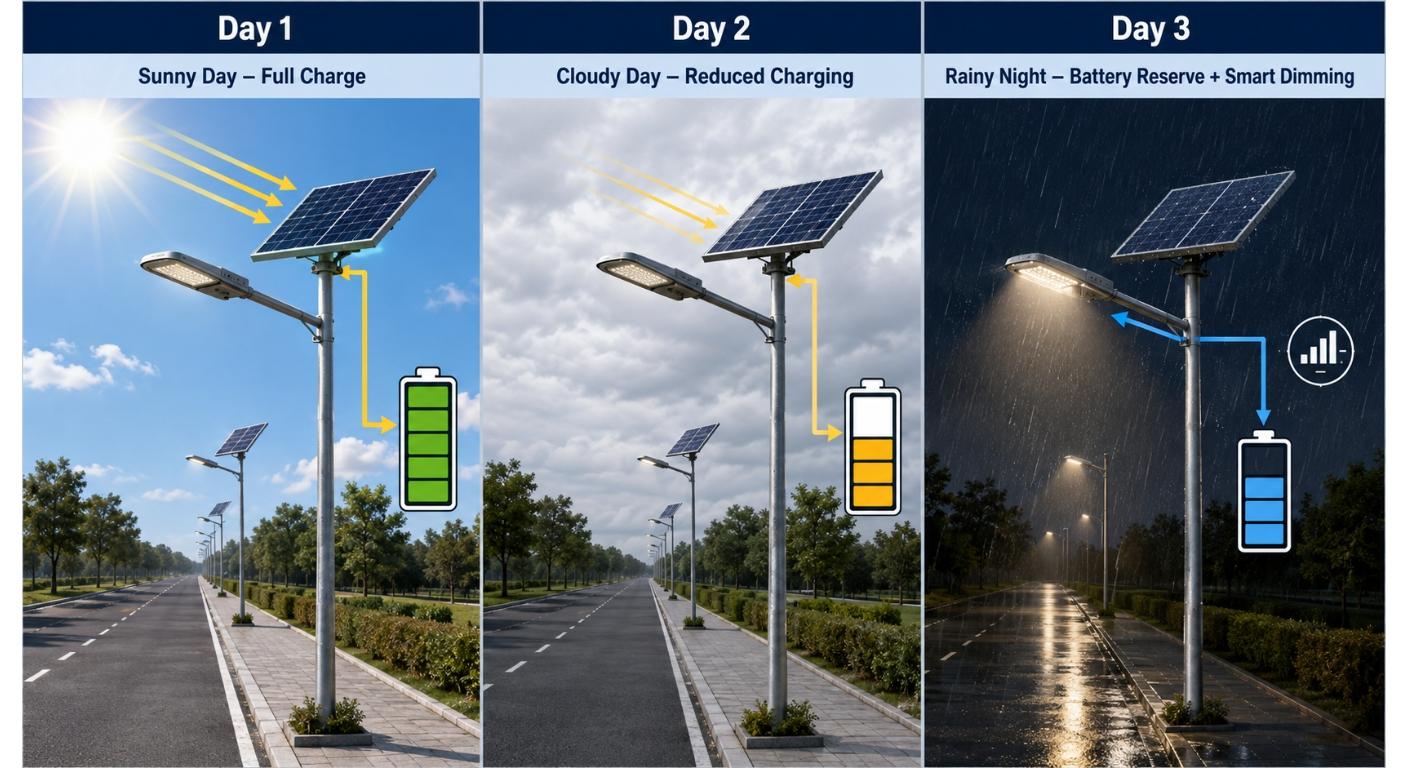
For off-grid areas, such as those where trenching or extending the grid would be challenging, LED solar street lights could be beneficial. But exposure to the sun, battery life, seasonal conditions, schedules and growth of trees around the panels should be inspected prior to selection.
Reduce glare, spill light and impact on the environment
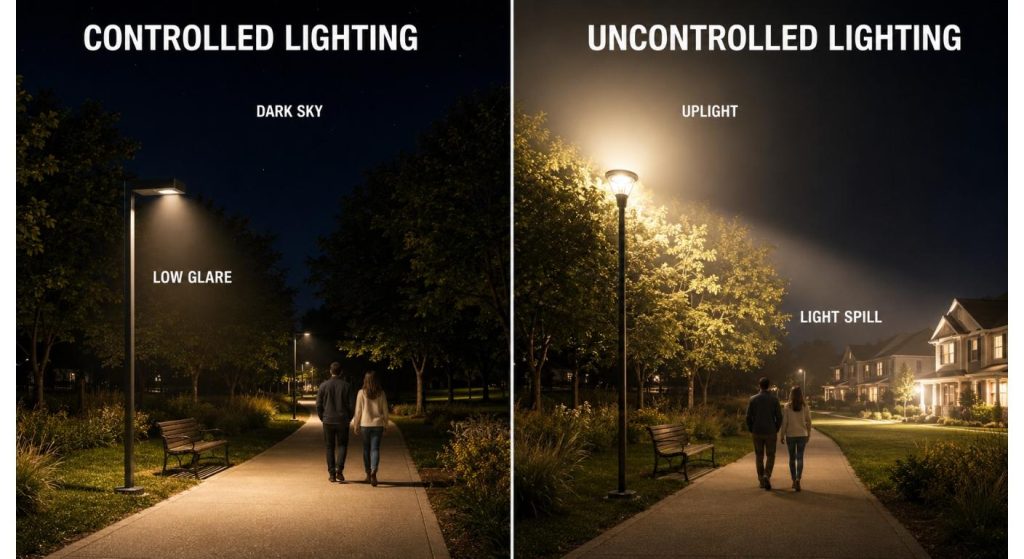
However, additional lighting does not necessarily result in increased visibility. The improper placement and intensity of fixtures can produce glare, deep shadows, light trespass and wasted energy.
Ensure the light remains on the desired surface by using covered lens and position of the lens. The design should minimize spill light and not light all landscape features near homes, waterways, mature trees or wildlife habitats.
Late night operation may be allowed in sensitive areas of the park, depending on local safety and environmental considerations, with color temperatures that are warmer.
Utilize Controls that follow Real Activity.
There is little activity on streets and parks at night. Energy can be saved, but still provide the required level of visibility, with the use of timers, photocells, dimming schedules and motion-responsive controls.
The stable output of main roads might be needed for longer periods. There can be a low level of background noise in secondary park paths and raised when movement is sensed. Any changes in controls should be gradual; users shouldn’t be dazzled by a sudden drop in darkness or in brightness.
Start from the ground up with a design that allows for maintenance.
When installing outdoor lighting, the performance of the light is determined not just by the installation itself. This can be diminished over time by dust, vegetation, moisture, corrosion, battery aging, driver error, and improper aiming of the fixture.
Where possible, project teams should standardise components and ensure maintenance vehicles have access to relevant poles safely and document settings for control. The following points are to be taken into account before ordering fixtures: Access to the fixtures, replacement procedure, warranty service, availability of spare parts.
| Item to Record | Why It Matters |
| Fixture model and optical code | Prevents incorrect replacements |
| Driver and control settings | Maintains intended output schedules |
| Pole access method | Supports safer servicing |
| Spare-part availability | Reduces long-term downtime |
| Solar battery replacement cycle | Supports lifecycle budgeting |
| Final aiming record | Prevents glare after maintenance |
Check the Design in advance of installation.
Photometric modeling can be used to assess illuminance, uniformity, glare exposure, pole spacing and light spill prior to placing equipment orders. Of special value it is at crossings, park entrances, curves and areas with dense trees.
A “mock up” can validate visual comfort, fixture appearance, color temperature, and control behavior for major projects at night. Final aiming and commissioning should then be done in actual night time conditions.
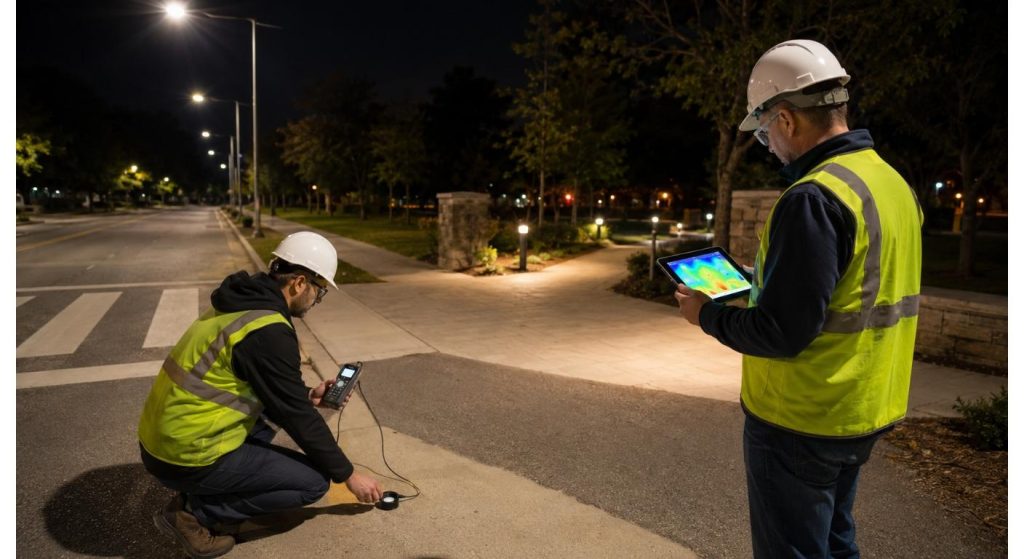
Develop a safer and more comfortable public space.
Park and street lighting for parks and streets is a balance of safety, orientation, atmosphere, energy and environmental responsibility. It’s not about how bright it is but about the appropriate light at the appropriate time and place.
Strategies that treat roads, pathways, entrance ways and public gathering areas as one interconnected system can lead to more navigable, welcoming and easier-to-maintain nighttime environments for cities.
FAQ
Q1. What is the optimum colour temperature of parks and streets?
The correct choice will depend on the requirements of the area and the environment. Pedestrian and landscape lighting often can be specified with a different performance and/or color temperature, whereas the roadway specification may need to meet different performance criteria.
Q2. To use bollards or pole mounted lighting in parks?
Bollards are appropriate for narrow paths and low scale guidance and are appropriate for pole-mounted fixtures. Both are employed to reduce visibility, comfort and spacing in many parks.
Q3. Is it possible to have solar lights in parks?
Yes, especially in areas where there is limited access to the grid. The first thing to be confirmed is the availability of the sun, shading, battery autonomy, operating hours and access for maintenance.
Q4. What are the ways to lessen glare?
Utilize shielded optics, proper mounting elevations, beam control and proper beam direction. Please don’t just choose fixtures based on wattage or the highest possible lumens.
Q5. Is this sensible to use motion sensors in parks?
They can be effective on secondary roads and low-volume roads. It is usually more comfortable to have a low background level, with gradual brightening.
- 10 Meters Lamp Post
- 10 Meters Pole
- 1000w Led Projector
- 100W LED Tunnel Light
- 12 Meters Lamp Post
- 12 Meters Pole
- 1200w Led Projector
- 15 Light Pole
- 1500w Led Projector
- 150W LED Tunnel Light
- 1800w Led Projector
- 2 In 1 Solar Flood Light
- 200w Led Tunnel Light
- 50w Led Tunnel Light
- 6 Meters Lamp Post
- 6 Meters Pole
- 8 Meters Lamp Post
- 8 Meters Pole
- 800w Led Projector
- 80w Led Tunnel Light
- Colourful Decorative Light
- Conical post
- Courtyard Lamp
- courtyard light
- courtyard lighting fixture
- Decorative Landscape Light
- Decorative road Light
- Flood Light For Courtyard
- Flood Light for Garden
- Flood Light For Outdoor
- Foot Led High Bay Lights
- high bay led lights 100w
- industrial lampshade
- industrial LED shed lights
- industrial magnifying glass with light
- Integrated Solar Flood Light
- led courtyard lamp
- led courtyard light
- led high bay light 100w
- LED Projector For Stadium
- Led UFO High Bay 150W 5000k
- Lighting Plants Mining Price
- Maintenance Free LED Street Light
- Pic Controlling Tunnel Light
- PLC controlling tunnel light
- Post Top Garden Light
- RGB Landscape Light
- Rgbw Decorative Light
- Smart Tunnel Light
- solar courtyard lamp
- solar courtyard light
- Solar LED Road Light
- Solar Street Light For 10 Meter Pole
- Solar Street Light For 12 Meter Pole
- Solar Street Light For 6 Meter Pole
- Solar Street Light For 8 Meter Pole
- Split Type Solar Flood Light
- Sporting Projector
- Stadium Led Projector
- Street Lighting Post
