
 Request A Quote

How Does a Solar Street Light Work from Daylight to Dawn?
 FACEBOOK
 TWITTER
 LINKEDIN
A solar street light is a small, stand-alone solar power system mounted on a post.
It uses its solar panel during the day to produce electricity from sunlight. This energy is regulated by a controller and put into the battery. The controller releases the stored energy to the LED luminary after sunset and turns it off again when it gets light again.
That simple process is easy to say, but it takes all of the components to be properly sized for the location, road, season and lighting schedule that is required for reliable operation.
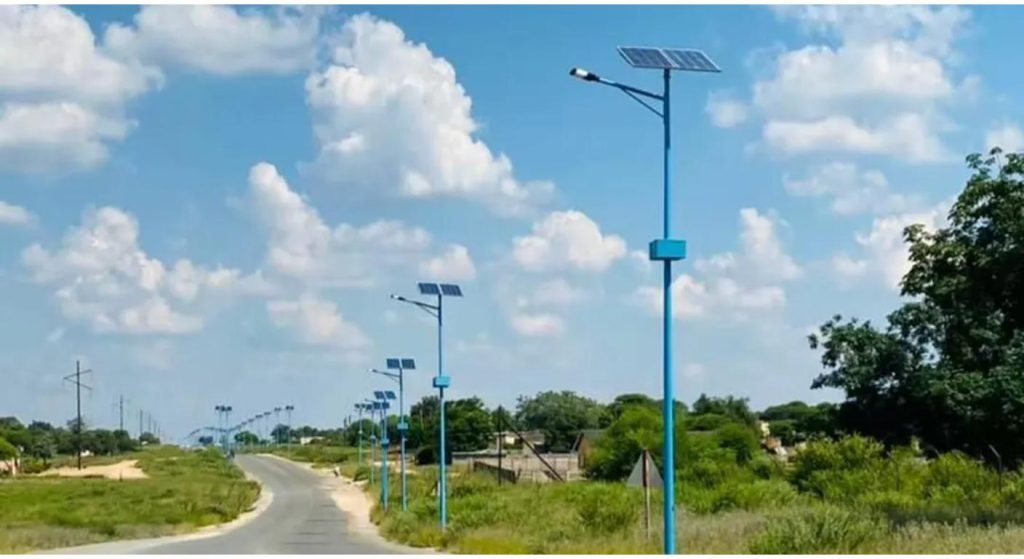
The Five Parts That Make the System Work
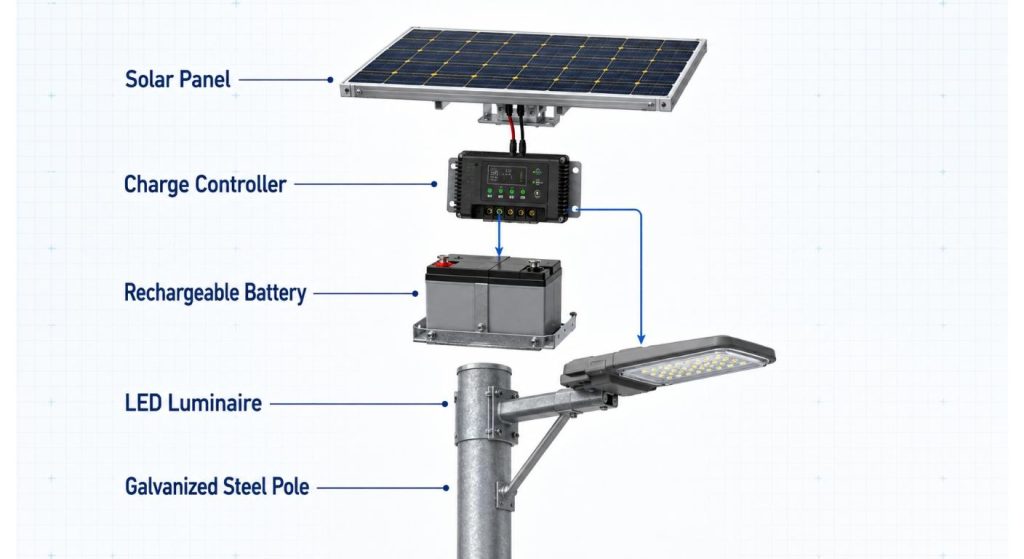
There are five basic components to most solar street lights:
- A solar energy collector (PV panel)
- A battery that can be used to store electricity.
- A device that controls charging and lighting.
- An efficient source of illumination in the form of an LED luminaire.
- A pole and a structure to support the equipment.
Others may have PIR or microwave intrusion sensors, remote monitoring, timers or grid back-up.
These can be used in a housing together or separately. Dawn Lighting’s LED solar street light line consists of all-in-one, separated and semi-integrated solutions for roads, communities, parks, parking areas and public works.
| Observed Problem | Possible Cause | First Check |
| Light does not turn on | Empty battery or controller fault | Battery voltage |
| Light switches off early | Insufficient charging | Panel shading and cleanliness |
| Light remains on in daylight | Sensor or controller issue | Daylight detection setting |
| Brightness is lower than expected | Low battery or dimming mode | Controller programme |
| Runtime declines over time | Battery ageing | Battery capacity test |
| Charging is inconsistent | Loose or damaged connection | Panel and cable connections |
During the morning hours, the LED will be turned off by Daylight.
Operating cycle starts when there is enough daylight and starts by the controller.
The controller switches the LED off, and the solar panel is able to start charging the battery. This switching is typically automatic, not requiring manual timers or a central power network.
Daylight setting should be set up correctly. If it is too sensitive, shadows or storms in the day may lead to switching when it is not needed. When it is too late, energy from batteries will be lost following sunrise.
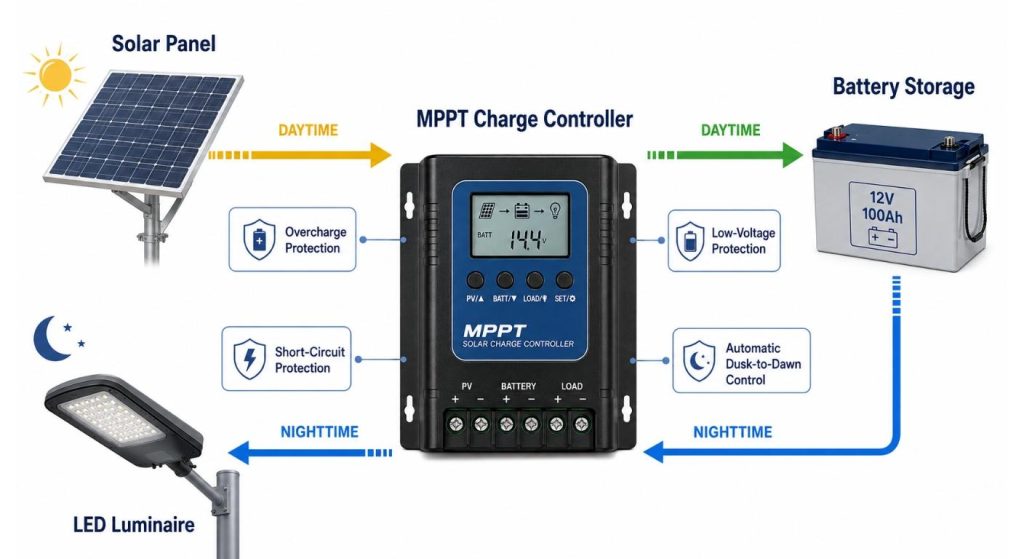
Daytime: Solar Panel generates DC power.
PV panels are made up of solar cells which generate direct current power when exposed to sunlight.
The energy output is related to the size of the panel, efficiency of the cells, intensity of sunlight, orientation and tilt of the panel, panel temperature, shading, dirt on the panel and season. The rated watts in the panel refers to the amount of energy it will generate under normal test conditions; it does not represent the amount of energy the panel will generate on a particular site.
Even if sky looks bright, trees, buildings, signs and utility lines can decrease charging. Therefore, it is important to consider a solar survey on site, not just the appearance of the poles, when deciding on the placement of a solar panel.
Dawn Lighting’s solar street lighting system guide describes how solar availability and battery storage, the width of the road and the lighting demand all affect system selection.
The charging is regulated by the Controller.
Unless controlled, no electricity can flow into the battery from the panel.
The charge controller controls the voltage and current, prevents overcharging and keeps the battery out of damaging operating conditions. PWM controllers are simple regulators and MPPT controllers always optimise the electrical operating point for better energy capture in varying sunlight.
The controller also monitors or reacts to battery voltage, load conditions, time and light levels. In fact, it’s the energy manager and system auto-switcher.
A good controller should be able to defend against:
- Battery overcharge
- Excessive discharge
- Reverse polarity
- Short circuits
- Excessive current
- Abnormal temperature
The controller chosen must have a maximum operating voltage that matches the voltage of the panel, battery chemistry and the LED load.
The Battery stores energy for later use.
The battery is responsible for the time difference that makes solar lighting possible; the energy is gathered by the light during the day, and consumed during the night.
Lithium-ion (Li-ion) batteries or LiFePO₄ are typically used in modern systems due to their beneficial properties of energy density, cycle life and compact installation. The actual battery life, however, will depend on the depth of discharge, quality of charge, cell balance, number of cycles and temperature.
The actual nightly load should be used to determine battery capacity. If a light operates at 100% for 12 hours, it will need more storage than a light that dims off after midnight.
The design should also allow for a night for cloudy or rainy days. During normal seasonal weather, it is not advisable to repeatedly discharge a battery to its protection level.
| Time Period | Solar Panel | Battery | LED Light | Controller Action |
| Sunrise | Begins generating | Starts charging | Switches off | Detects daylight |
| Midday | Highest typical output | Stores energy | Remains off | Regulates charge |
| Sunset | Output declines | Begins discharging | Switches on | Detects low light |
| Evening | No generation | Supplies LED | Higher output | Runs lighting schedule |
| Late night | No generation | Continues discharging | May dim | Conserves energy |
| Low battery | No generation | Reaches protection level | Dims or switches off | Prevents deep discharge |
The Controller turns the light on in the evening.
The controller detects dusk when light levels drop below the set limit, and turns on the LED luminaire.
The battery provides regulated DC power to the LED. LEDs are suitable to off-grid systems due to their relatively high light output with a limited amount of electrical energy.
This light is then spread out on the road by the lens. The illumination does not depend on the wattage and lumens but also depends on other factors such as mounting height, pole spacing, beam pattern, road width and fixture tilt.
The desired fixture and layout can be checked for suitability of coverage and uniformity using a DIALux or similar software program based on a photometric simulation.
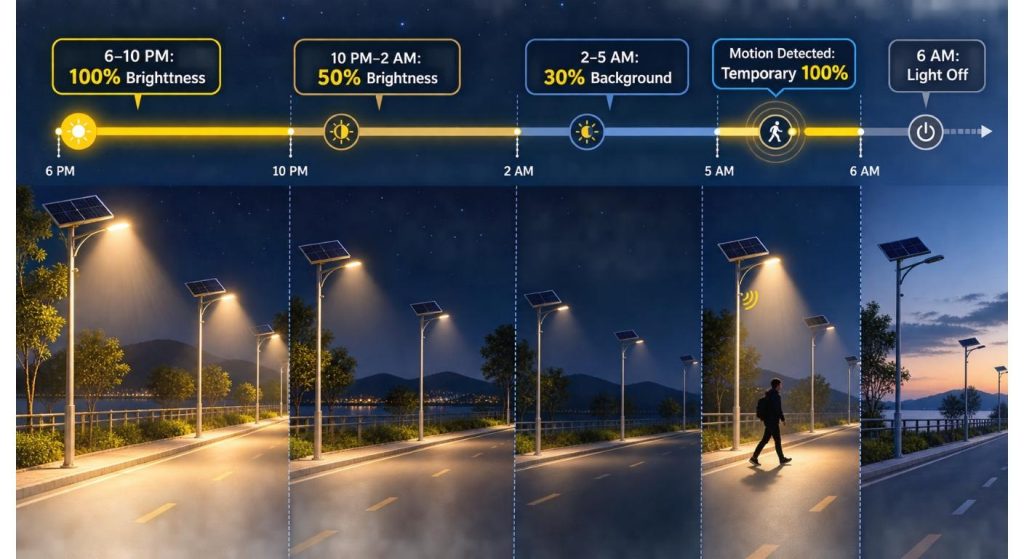
The light does not need to be at maximum intensity.
Some solar street lights have a programmed lighting schedule rather than lighting at full power for 24 hours.
A typical profile might be set to generate more output during peak evening traffic periods, dim down after traffic has subsided, turn on again when traffic is sensed and turn to a lower output before sunrise.
This helps to keep batteries charged while keeping the premises lighted. Dawn Lighting’s street and road lighting products feature solar panels, lithium batteries, controllers, and smart (optional) capabilities for outdoor lighting applications.
The lighting profile should be similar to what would actually occur in a real activity. The use of a common set of control settings is not appropriate for a highway, residential road, a path in a park, or an industrial perimeter.
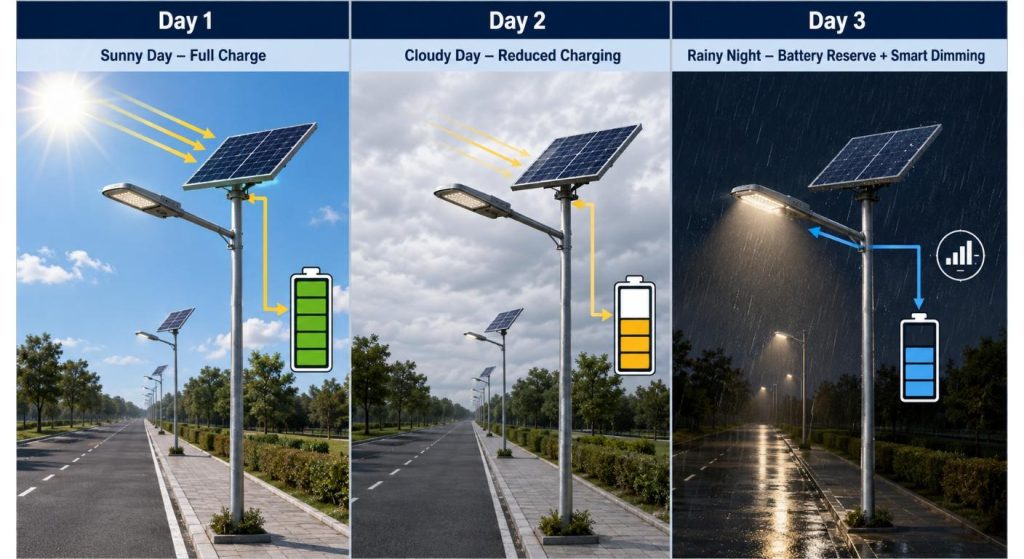
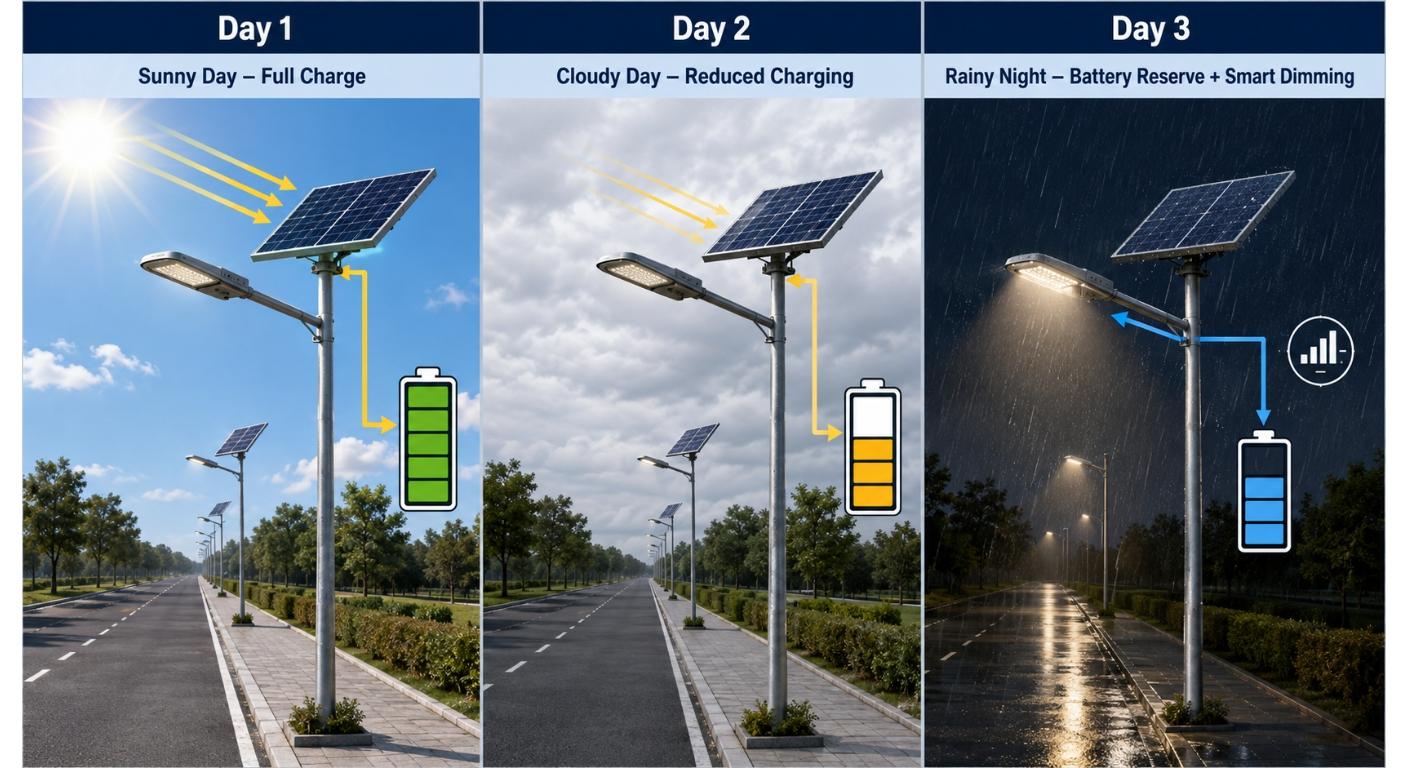
What do clouds do when it rains?
Diffuse daylight still produces electricity, although typically not as much as in clear daylight.
The battery reserve is a reserve battery for power when the daily charging is not adequate to meet the nightly power demand. Some smart controllers can also lower light output if there is a known state of charge in the battery, so as to help it last for a few days in a row when light is reduced.
In cloudy weather, these factors are important for reliability:
- Seasonal peak-sun hours
- The number of panels and batteries determine the capacity.
- Required backup nights
- Night length
- The lighting and dimming schedule shall be established.
- Temperature-related battery losses
- The cleanliness and shading of the panel.
Dawn Lighting’s guide to solar street lights in cloudy weather covers the amount of capacity needed in the solar panel, reserves in the battery, and power-saving control to ensure continued operation.
What Happens When the Battery Becomes Too Low?
The controller should not allow this discharge to go below a safe level.
Can dim LED output then turn off the light based on programming. A low voltage protection helps you protect the battery, but also means that the system is depleted of usable energy.
If the battery is already old, if the panel is getting too much lighting, or if the component sizes are too small, or if the batteries are improperly connected, or if the panel is shaded, this can be indicated by repeated early shut down.
Instead of just replacing the LED with a lower power LED, the cause should be diagnosed.
The sun rounds out the cycle.
The controller will turn the LED off and start another charging cycle when the ambient light increases during sunrise.
If it is a well-sized system, it does that automatically all year round. It requires no grid electricity or underground cabling or manual control each day.
Automatic doesn’t mean no maintenance, however. There is still work to do with panels inspection and cleaning, batteries will need replacement at some point, fasteners can loosen and vegetation can grow within solar path.
Final Working Principle
The working principle of solar street light is to generate energy during the day to use at night.
The panel gathers energy, the controller controls it, the battery stores it, and the LED transforms it into road light that is useful. If sized as one system the light will function safely dusk to dawn without any grid connection.
FAQ
Q1. If the solar street light is turned off, will it charge?
Yes. In daylight, the LED is off, and the panel produces power which is fed to the controller which in turn sends the power to the battery.
Q2. Is the solar street light effective in rainy days?
Yes, with the energy stored in the battery. The performance is dependent on the amount of reserve capacity, and the energy that the panel can receive even in cloudy weather.
Q3. Where does the light get the lights on time?
A voltage sensor on the solar panels or a light sensor controls the controller. Once the daylight is below the programmed level, it will automatically turn on the LED.
Q4. Is it possible for a solar street light to operate throughout the night?
Yes, provided the panel and battery capacity is matched to the LED load, the length of the night, the weather and the lighting program. Dimming can lengthen the run time and autonomy.
Q5. Is it necessary for a solar street light to use electricity?
Requires electricity, but produces electricity from sunlight instead of from a power grid. Power is provided by the battery after dark.

- 10 Meters Lamp Post
- 10 Meters Pole
- 1000w Led Projector
- 100W LED Tunnel Light
- 12 Meters Lamp Post
- 12 Meters Pole
- 1200w Led Projector
- 15 Light Pole
- 1500w Led Projector
- 150W LED Tunnel Light
- 1800w Led Projector
- 2 In 1 Solar Flood Light
- 200w Led Tunnel Light
- 50w Led Tunnel Light
- 6 Meters Lamp Post
- 6 Meters Pole
- 8 Meters Lamp Post
- 8 Meters Pole
- 800w Led Projector
- 80w Led Tunnel Light
- Colourful Decorative Light
- Conical post
- Courtyard Lamp
- courtyard light
- courtyard lighting fixture
- Decorative Landscape Light
- Decorative road Light
- Flood Light For Courtyard
- Flood Light for Garden
- Flood Light For Outdoor
- Foot Led High Bay Lights
- high bay led lights 100w
- industrial lampshade
- industrial LED shed lights
- industrial magnifying glass with light
- Integrated Solar Flood Light
- led courtyard lamp
- led courtyard light
- led high bay light 100w
- LED Projector For Stadium
- Led UFO High Bay 150W 5000k
- Lighting Plants Mining Price
- Maintenance Free LED Street Light
- Pic Controlling Tunnel Light
- PLC controlling tunnel light
- Post Top Garden Light
- RGB Landscape Light
- Rgbw Decorative Light
- Smart Tunnel Light
- solar courtyard lamp
- solar courtyard light
- Solar LED Road Light
- Solar Street Light For 10 Meter Pole
- Solar Street Light For 12 Meter Pole
- Solar Street Light For 6 Meter Pole
- Solar Street Light For 8 Meter Pole
- Split Type Solar Flood Light
- Sporting Projector
- Stadium Led Projector
- Street Lighting Post
