
 Request A Quote

Integrated vs Split Solar Street Lights: A Practical Selection Guide
 FACEBOOK
 TWITTER
 LINKEDIN
It’s not just the way the elements appear on the pole that makes all the difference between all-in-one and split solar street lights. They have an impact on energy collection, battery size, installation period, maintenance availability as well as aesthetics and project cost.
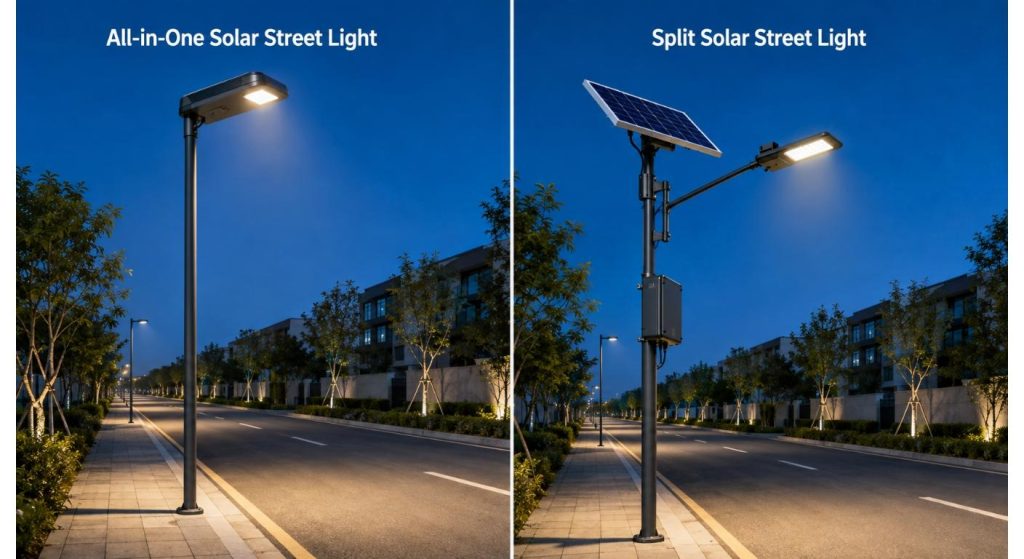
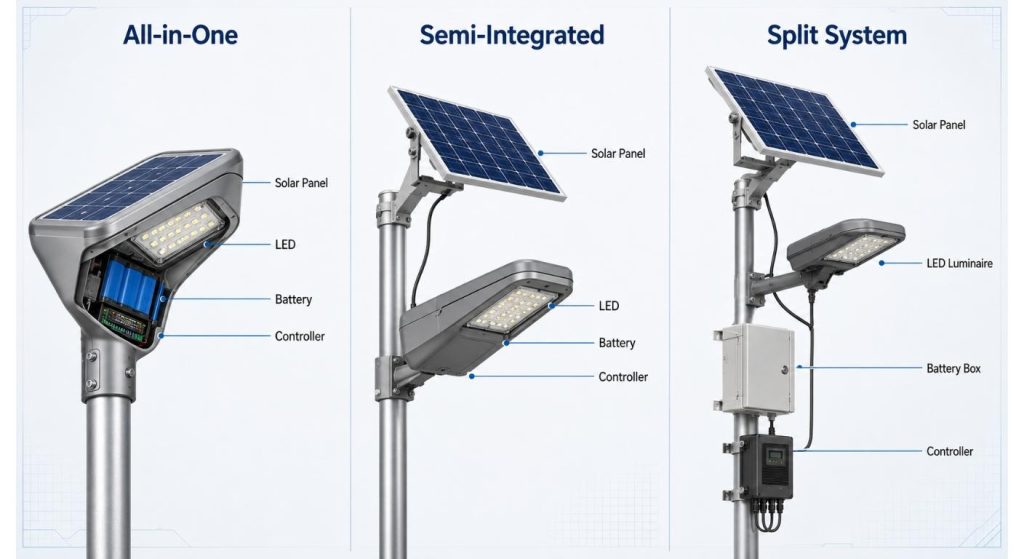
An all-in-one light is integrated with the solar panel, LED, battery and controller in a single fixture. A split system is where the panel, luminaire, battery and in some cases the controller are all installed separately.
There is no one, universal, superior design. The answer is dependent upon the road, the amount of sunlight available, the number of hours the project needs the poles to work, the height of the poles, maintenance schedule, and the size of the project.
Comprehend the Three Common System Layouts
An all-in-one solar street light is a solar light featuring the installation of the greatest part of its components inside a single casing. During production, the wiring is done internally, and during installation the installer will be required to do a lesser amount of wiring.
A split solar street light is a solar street light with a separate enclosure for the solar panel and enclosure for the luminaire. Each component may be arranged and/or dimensioned based on the project.
A semi-integrated system is in between these two designs. LED, battery and controller are often packaged together and the solar panel is detached and moveable.
LED Solar street light range from Dawn Lighting offers integrated, separated and semi-integrated street lights for roads, parks, communities, parking and public lighting applications.
In All-in-One Systems we value simplicity.
The benefit of an all in one design is that it is less parts.
Minimization of external cables and enclosures can make the transportation, inventory and installation much easier. The space-saving design can also be used in residential areas, parks, pathways, campus and other developments which require visual cleanliness.
Pre-assembled controls minimizes the chances of error in the field. Installation crews typically require less work at height, benefitting projects with numerous identical units.
But integration restricts the size of the panel and battery. The direction of the luminaire may also be related to the angle of the solar panel. If the direction of the road is different from the best direction for sunlight, the installation may need to be a compromise.
The all-in-one solar street light guide from Dawn Lighting discusses how the integrated system is possible to achieve both convenient installation and compact solar panel and battery configuration.
Split Systems allow flexibility of energy and positioning.
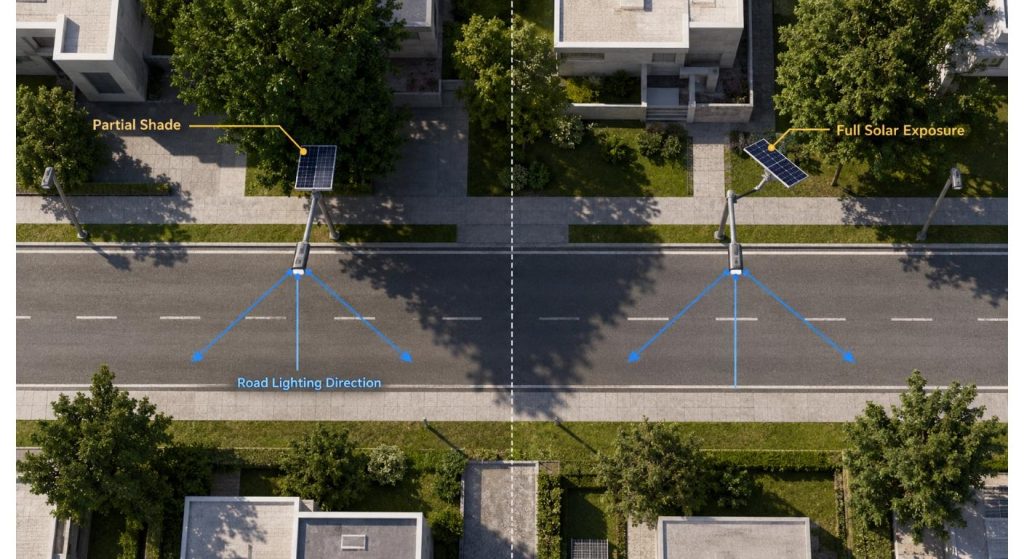
The split system enables the solar panel to track the most intense light from the sun while the LED luminaire is fixed to look down a road.
This flexibility is useful when poles are sited along east–west roads, on streets where there are adjacent buildings providing some shade, or when the preferred orientation of the panels is not the best lighting orientation.
Another benefit of split designs is that they do not have to be limited to the size of one fixture housing; larger panels and batteries can be used. This enables them to be used on broader streets, higher poles, longer hours, more light output, or in places that need more self-sufficiency when the clouds roll in.
This comes at the cost of extra equipment. More brackets, battery boxes, connectors, cables, and various brackets to mount mean more planning for installation. Dawn Lighting’s segmented solar street lighting solutions illustrate the modularity of individual solar, lighting and energy storage elements.
| Project Condition | Preferred Direction | Main Reason |
| Small residential road | All-in-one | Compact and fast to install |
| Wide municipal road | Split | Larger energy capacity |
| Panel and road face different directions | Split or semi-integrated | Independent panel orientation |
| Strong aesthetic requirement | All-in-one | Cleaner appearance |
| Frequent battery servicing | Split | Easier component access |
| Medium output with difficult solar angle | Semi-integrated | Balanced flexibility |
| High theft risk | All-in-one or secured split | Fewer accessible components |
Price is not the only factor: Solar Exposure can be the deciding factor.
A compact all-in-one fixture can function well in the event that the pole location is constantly getting the sunlight and the panel can be mounted at a suitable angle.
Issues occur if trees, facades, signs, power lines or the ground block the sun from the panel at critical charging times. The amount of energy the battery can obtain daily can be greatly diminished in partial shade.
A split system provides the installer with greater flexibility to vary the direction of the panel, tilt and/or, if allowed, install the panel separately from the luminaire.
Prior to choosing either of the designs, perform a solar survey, which documents:
- Peak-sun hours in the different seasons
- Shading throughout the day
- Best direction and tilt angle of a panel.
- Long winter nights
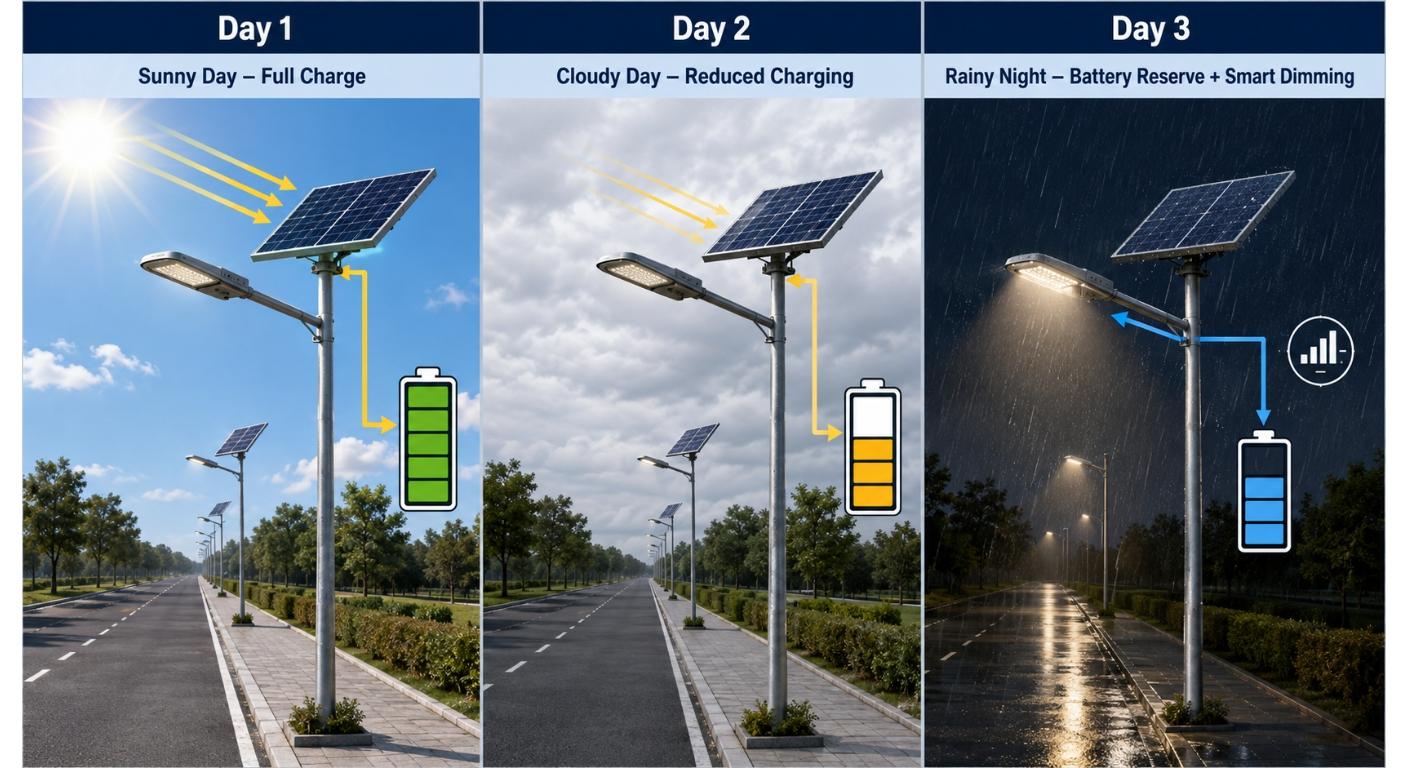
- Two days in a row when it is cloudy or raining.
- Accumulation of dust, snow or leaves
The size of the panel should be based on the worst season, not the best month, on the site.
Battery capacity should be equal to the actual lighting schedule.
The solar street lights are based on a daily energy budget.
The battery needs to power the LEDs, the hours they are running, the levels of dimming, the number of times they are switching on and off via sensors, the number of times the controller is losing power, the temperature, ageing and the number of backup nights.
When combined with high-efficacy LED and intelligent dimming, all-in-one is able to serve many residential and low-to-medium output applications. When expansion of the project requires a higher battery reserve or steady production levels, split systems are typically more easily expandable.
Battery chemistry, usable capacity, depth of discharge, cycle life, temperature range and replacement method should be specified. A figure for wattage does not guarantee night time performance.
The price of fixtures is not as high as the installation cost.
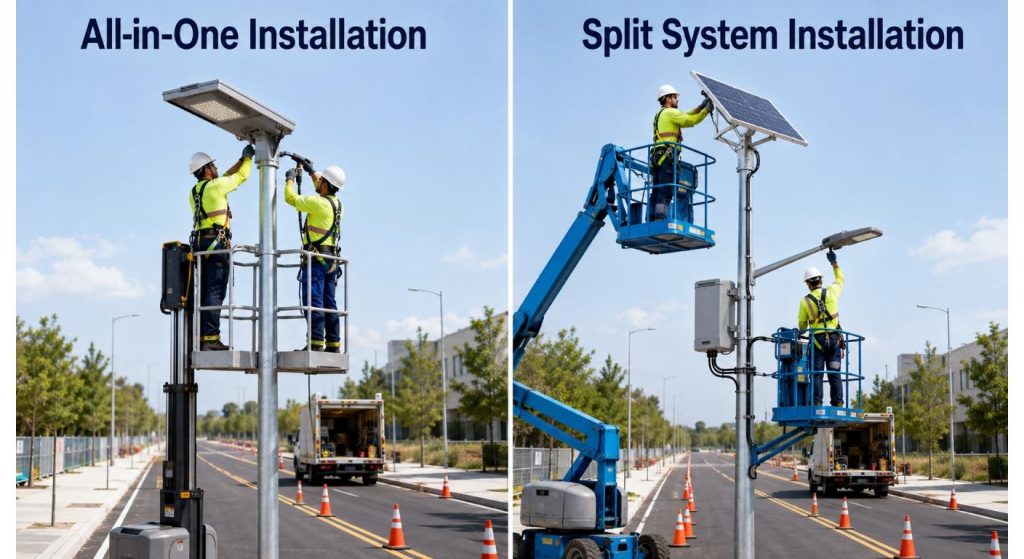
All-in-one models might be quicker to install as the primary components are already pre-assembled. They can decrease the number of brackets, battery boxes, outside connections and time spent working on each pole.
Split systems are more labor intensive. Installers need to install the panel, connect the luminaire and battery, run the cables, seal connectors, check the polarity and secure.
The lowest installation cost, however, does not necessarily result in the lowest project cost. If the split system will avoid the risk of under-sizing the solar system or would give the necessary output with greater reliability in different seasons, the extra labour might be worthwhile.
The unit price should not be the only element to be included in a procurement comparison, freight volume, installation tools, crane/lift access, commissioning, replacement parts and future maintenance should be evaluated as well.
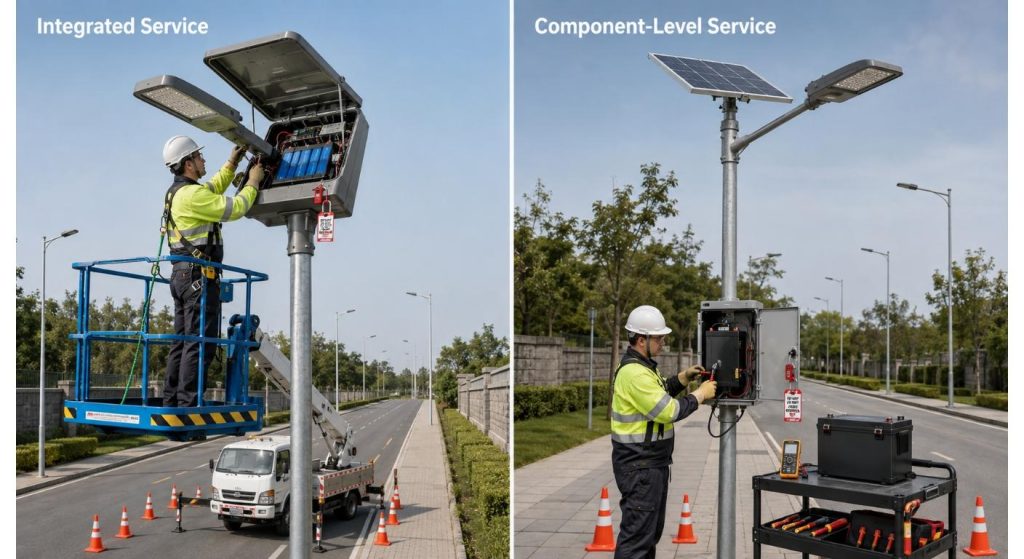
There are distinct patterns of maintenance and replacement.
Installation is easy with integration, but may focus a number of service activities within one elevated housing.
Technicians may need to move the full fixture up or down and open for service attention if the battery, the controller or the LED module needs attention. If the enclosure does not have a good thermal management system, heat from the LED and battery also has an impact on the life of components.
Split systems offer the advantage of individually inspecting or replacing the parts. A battery box lowered on the pole could allow for better access, but would also need to be more tamper resistant and weather proof.
A semi-integrated solar street light can provide a compromise, by maintaining the lamp, battery and controller as a single unit with the ability to orient the panel independently.
Check to see if replacement parts are still available, and if special servicing tools are needed for any layout.
Take into account Appearance, Wind Load and Theft Risk
All-in-one fixtures help to create a streamlined, contemporary look and reduce the amount of visible cabling. Can be used in built out areas such as planned residential developments, hotels, campuses or landscaped public areas.
Due to the larger panel and enclosures, split systems tend to look more industrial. These brackets and surface area should also be considered in wind-load calculations.
The level of security for components will depend on the project. Anti-theft fasteners, internal cable routing, locking enclosures and tamper-resistant installation of panels and cables may be required for a separate panel and battery box, or for a high mounted integrated unit that is hard to reach.
However, aesthetic preference must be weighed against energy performance and access to the services.
Choose According to the Site
In many cases, all-in-one systems can be used for smaller roads, parks, paths, residential areas and projects where installation and appearance are key.
Split systems are typically better suited for high roads, higher power applications, challenging solar orientations, greater autonomy and applications which require the ability to replace or independently size components.
Semi-integrated systems are best for projects requiring panel rotation rather than a total installation, but where the panels can be adjusted.
The final selection should be made after a solar-energy calculation and photometric design, and not based on the recommendation of a product-category.
| Cost Item | All-in-One System | Split System |
| Freight handling | Fewer separate parts | More components to organize |
| Installation labour | Generally lower | Generally higher |
| Brackets and cables | Limited external hardware | Additional hardware required |
| Battery replacement | May require fixture access | Can be separately accessible |
| Capacity expansion | Usually limited | Easier to scale |
| Spare-parts management | Product-specific modules | Multiple individual components |
Final Selection Check
It’s really just a matter of integration versus system flexibility when choosing between an all-in-one or split decision.
Select all-in-one when the amount of sunshine, output, battery storage and maintenance program is compatible with a small product. Opt for split in the project where independent positioning of the panels is required or a higher energy capacity is desired, or for serviceability at the component level.
A good result is achieved by pairing the system architecture to the real road and not the other way around.
FAQ
Q1. What is the main difference between all-in-one and split solar street lights?
An all in one LED model will include the fixture panel, the battery, the controller and the LED. A split system involves a separate installation of these components for increased flexibility in size and position of the system.
Q2. Which type is easier to set-up?
All in one lights are normally easier since the majority of wiring and assembly is done at the factory. Extra brackets, cables, connections and commissioning for split systems.
Q3. Which of the two systems is more suitable for wide roads?
A split system is usually a better choice since it can accommodate larger panels, batteries and the higher output luminaires. This should be finalized by lighting & solar calculations.
Q4. Will an all in one light work on a gloomy day?
If yes, its panel, battery, and operating mode are all the right size for the local climate. Required autonomy and seasonal solar conditions must be included in the design.
Q5. Solar street light is a semi-integrated light?
It is usually combined with the LED, battery and controller and the panel is separated. This offers flexible panel positioning, but is less complicated than a full split system.

- 10 Meters Lamp Post
- 10 Meters Pole
- 1000w Led Projector
- 100W LED Tunnel Light
- 12 Meters Lamp Post
- 12 Meters Pole
- 1200w Led Projector
- 15 Light Pole
- 1500w Led Projector
- 150W LED Tunnel Light
- 1800w Led Projector
- 2 In 1 Solar Flood Light
- 200w Led Tunnel Light
- 50w Led Tunnel Light
- 6 Meters Lamp Post
- 6 Meters Pole
- 8 Meters Lamp Post
- 8 Meters Pole
- 800w Led Projector
- 80w Led Tunnel Light
- Colourful Decorative Light
- Conical post
- Courtyard Lamp
- courtyard light
- courtyard lighting fixture
- Decorative Landscape Light
- Decorative road Light
- Flood Light For Courtyard
- Flood Light for Garden
- Flood Light For Outdoor
- Foot Led High Bay Lights
- high bay led lights 100w
- industrial lampshade
- industrial LED shed lights
- industrial magnifying glass with light
- Integrated Solar Flood Light
- led courtyard lamp
- led courtyard light
- led high bay light 100w
- LED Projector For Stadium
- Led UFO High Bay 150W 5000k
- Lighting Plants Mining Price
- Maintenance Free LED Street Light
- Pic Controlling Tunnel Light
- PLC controlling tunnel light
- Post Top Garden Light
- RGB Landscape Light
- Rgbw Decorative Light
- Smart Tunnel Light
- solar courtyard lamp
- solar courtyard light
- Solar LED Road Light
- Solar Street Light For 10 Meter Pole
- Solar Street Light For 12 Meter Pole
- Solar Street Light For 6 Meter Pole
- Solar Street Light For 8 Meter Pole
- Split Type Solar Flood Light
- Sporting Projector
- Stadium Led Projector
- Street Lighting Post
