
 Request A Quote

Stadium Light Pole Selection: An Engineering Guide for Sports Venue Projects
 FACEBOOK
 TWITTER
 LINKEDIN
A stadium light pole is more than just a tall structure with floodlights. It links the lighting design, structural calculation, electrical system, foundation and maintenance plan of a sports venue as a whole.
Therefore, the challenge for project contractors, lighting designers, project developers, or project procurement teams is not to find the tallest and heaviest light poles, but to select a structure that can support the lights at the appropriate height, bear the full weight of the lights, withstand local climate conditions, and is easy to maintain.
This buyer’s guide provides an overview of the considerations a buyer must consider prior to signing off on a stadium light pole specification.
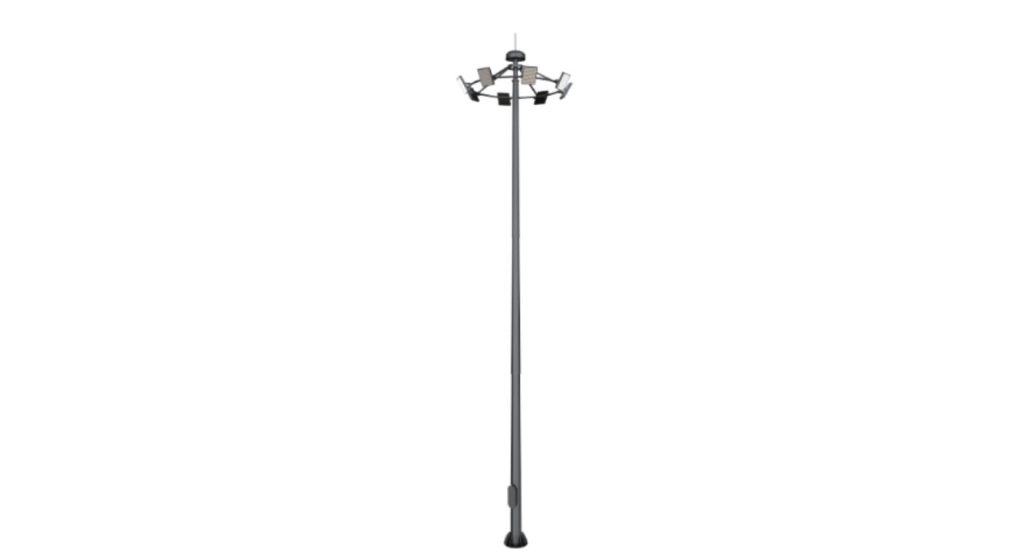
Use the Required Lighting Result as a starting point.
Field should be the first choice for selecting poles, not pole catalogue.
| Required Project Data | Used to Determine | Risk If Missing |
| Field dimensions and pole coordinates | Mounting height and beam reach | Dark zones or excessive spill light |
| Fixture model, quantity, and EPA | Pole and crossarm loading | Structural under-design |
| Local wind and terrain category | Pole strength and foundation load | Unsafe deflection or failure |
| Soil and groundwater information | Foundation dimensions | Settlement or anchor movement |
| Corrosion environment | Galvanizing and coating system | Premature surface deterioration |
| Maintenance access method | Pole accessories and site clearance | Higher lifecycle service costs |
In a community football field, professional stadium, tennis complex and athletics track, there can be significant differences in the amount of illuminance and uniformity required, glare control requirements and the performance of the cameras. These requirements dictate the height of mounting and positions of poles, quantity of luminaires and beam distributions.
This is because higher poles can throw light over longer distances and enhance an overlap of beams. But, the greater the height the higher the structural loading, foundation requirements, difficulty of installation, and maintenance difficulties.
The buyer shall prior to requesting a quotation specify:
•Field size and type of sport
•Recreational, competitive or broadcast purposes
•The illuminance to be targeted is the horizontal and vertical illuminance.
•Required lighting uniformity
•Number and suggested sites of poles
•Restrictions Glare and Light Spill
•Need for camera or slow motion/recording
Sport Lighting’s sport lighting solutions are a good place to begin to understand the relationship between sports venues, high output fixtures and uniform field lighting.
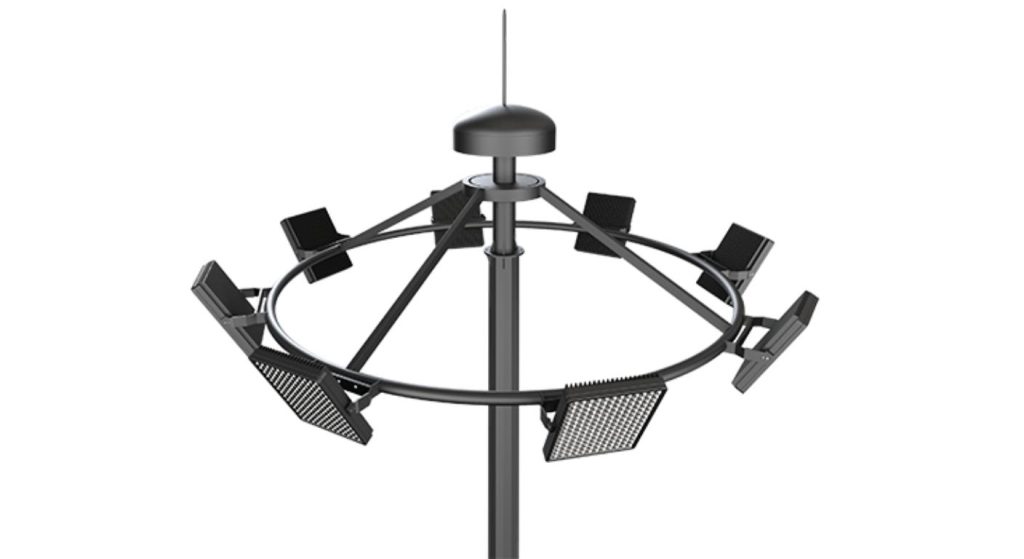
Pole Height should be the same as the field Geometry.
There is no one size fits all “best” height for stadium light poles. The correct height varies with the distance from each pole to the aiming area, the pole locations, fixture beam angle and acceptable level of glare.
Poles that are near the sidelines may need to be sufficiently high to ensure that the floodlights are not aligned with the primary direction of viewing of the players. For larger fields, higher poles and narrow-beam lights may be required to provide efficient lighting to remote areas.
For instance, Dawn Lighting sports light pole 65 foot is designed for stadiums, football fields, basketball court, running tracks and other wide outdoor areas. However, it must always be checked for its appropriateness in accordance with the specific lighting design and conditions.
Prior to the determination of the final pole height and quantity of fixtures, a photometric simulation should be carried out. This will help to avoid too much bright field near the Pole, too dark field at the centre of the field, and excessive light upward.
The entire Pole-Top Assembly must be included in the Structural Design.
A stadium pole is subjected to on-going and harsh environmental stresses. The weight of the pole is not all you should consider in structural verification.
Additional loads such as flood lighting, crossarms, brackets, cables, control boxes, maintenance platforms, ladders, and cameras can add up to the total load. They also provide more wind force at the top of the structure due to their exposed surface areas.
The engineering review should cover:
•Basic wind speed and local code to be followed
•The type of terrain and exposure
•The height of the poles, the thickness of the poles, the shape of the poles and the thickness of the walls
•Weight of the luminaire and bracket(s).
•The projected area in square feet that is in use by the equipment.
•Pole bending/fatigue
•Base plate and anchor-bolt layout
•The size of the foundations and the type of soil.
The buyer should provide the pole supplier with a fixture schedule based on the proposed fixture and not request a pole based on the height alone. This Dawn Lighting guide to light pole wind-load calculations outlines the impact of height, geometry, fixtures and brackets on structural loading.
All calculations should be checked by a competent engineer who is knowledgeable of the applicable local building and structure codes.
There is a difference in fixture configuration with regard to the Pole requirement.
The pole and floodlights have to be tested together as a unit.
| Required Project Data | Used to Determine | Risk If Missing |
| Field dimensions and pole coordinates | Mounting height and beam reach | Dark zones or excessive spill light |
| Fixture model, quantity, and EPA | Pole and crossarm loading | Structural under-design |
| Local wind and terrain category | Pole strength and foundation load | Unsafe deflection or failure |
| Soil and groundwater information | Foundation dimensions | Settlement or anchor movement |
| Corrosion environment | Galvanizing and coating system | Premature surface deterioration |
| Maintenance access method | Pole accessories and site clearance | Higher lifecycle service costs |
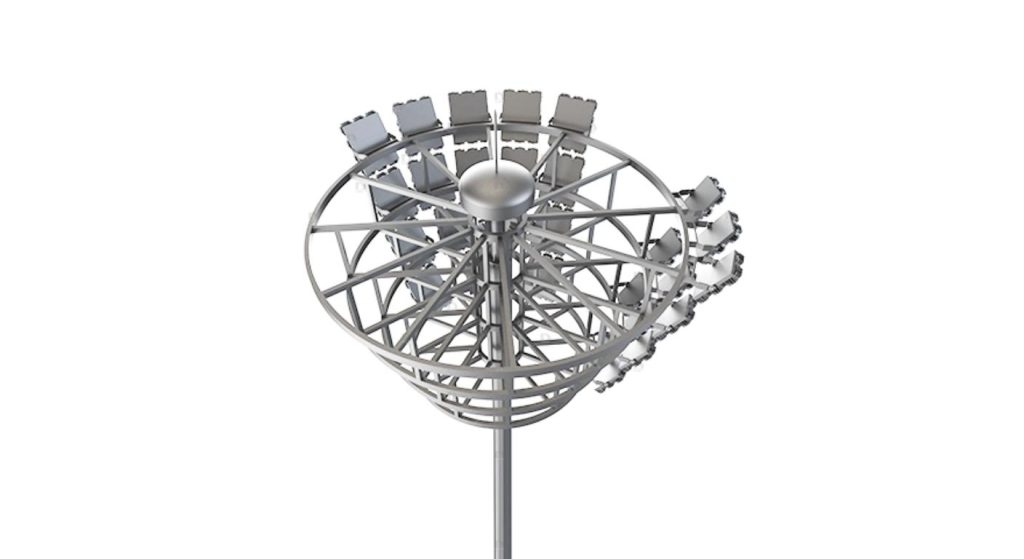
The tight grouping of a number of aerodynamic luminaires presents a different load to that of a large crossarm with a lot of heavy luminaires. The amount of fixtures, bracket extension, angle of aim, and driver-box location may alter the structural requirement and/or access for maintenance.
A combination of beam distributions are typically used in sports venues. Narrow beams hit out further to the field zones, medium and asymmetric beams fill closer in zones and can control spill.
The LED modular floodlight range comprises of high output stadium floodlights featuring various optical, aiming, driver and corrosion protection characteristics. Product photometric files should be put into a project specific simulation prior to final release of the crossarm design.
After the model of the fixture has been selected, Buyers should not change the fixture model after structural approval. A replacement luminaire may, even if the wattage is the same, weigh differently, have a different projected area, mounting interface or centre of gravity.
Protection against corrosion should be in line with the conditions of installation.
Stadium light poles are installed outside and are subject to rain, humidity, road salt, coastal air and even industrial pollution and aggressive soil conditions.
Hot dip galvanizing is widely employed in the protection of the steel poles due to the fact that it has covered both the external surface and the internal surface of the poles that can be accessed. Other coating systems can be necessary when the venue is on a coast, very corrosive industrial areas or when a particular colour is required.
The specification for purchase should clearly indicate:
•Steel grade
•The standard and required thickness of coating can be galvanized.
•Surface preparation
•Powder or Paint Coating is available as an option.
•Treatment of welds and drilled areas; abrasion and cleaning for all other parts.
•Bolts, brackets and accessories are protected.
•Site touch-up procedure for installation damage – for use on all glass surfaces.
The corrosion category should be determined at the project start time. The application of a decorative top coat without ensure that the protection system is correct may result in an attractive pole which deteriorates prematurely.
Planning and installation go hand-in-hand.
Even if the correct pole is chosen, it may fail due to improper foundation, anchor cage or erection.
Poles and foundation design is based on pole loading, soil bearing capacity, presence of ground water, frost depth, drainage and local construction requirements. Therefore, generic foundation drawings should be considered as a reference, and not as a blanket acceptance for all sites.
Also delivery length and section assembly, crane access, lifting points, anchor-bolt alignment, cable entry, grounding and installation tolerances will all have to be considered during the installation planning.
When height is a concern, customers can also make comparisons between conventional sports poles and Dawn Lighting’s high mast lighting systems. lowering mechanism and wider coverage solutions can be achieved with high-mast solutions, but they are associated with extra structural, electrical and maintenance planning.
The need for maintenance access should be determined prior to procurement.
The long-life of the LED stadium lights makes maintenance often get neglected. But inspection or replacement of individual modules, connectors, cables, and surge-protection devices or drivers may still be necessary.
The more common ways to access are:
•Elevated work platforms that are mobile.
•Ladders that feature safety systems and are fixed.
•Internal climbing systems
•Lowering headframes
•Distantly placed driver boxes
Depending on the height of the poles, accessibility of the venue, safety conditions, maintenance requirements and budget it is possible to operate them. A lowering system may be used to reduce work at height and a fixed system may be considered if suitable lifting equipment is always available.
The purchaser should also verify the dimensions of the access doors, routing of internal cables, grounding points, spare parts and the provision of individual lighting circuit isolation.
A stadium light pole RFQ should include several key details to ensure the chosen provider can deliver the necessary solutions.
A detailed RFQ will yield more accurate engineering and pricing than a RFQ with just height and quantity.
Include the following information with the supplier: Field plan, Pole coordinates, Mounting height, Model of fixtures, Configuration of the brackets, Wind conditions in the area, Corrosion conditions, Soil reports, Electrical voltage, Maintenance method, and Design requirements.
This enables the supplier to review the entire lighting-pole system and to pinpoint any missing technical information prior to the manufacturing process.
Final Project Check
A stadium light pole should be chosen as a part of a sports-lighting system.
The correct solution needs to meet the required lighting performance standards, be able to support the required structural loads for the particular site, be corrosion resistant, coordinate with the foundation and provide safe maintenance. Customers who verify these connections prior to ordering will experience less redesign, installation delays, incurring unforeseen civil costs, or inconsistent ground lighting.
FAQ
Q1. What is stadium light pole?
A stadium light pole is a long structure that supports sports floodlights, crossarms, cables and other equipment. Designed for wide area illumination and wind and foundation loads unique to project.
Q2. What should be the height of a light pole in a stadium?
Both dimensions of the field and locations of poles, beam angles, target illuminance and glare limits determine the height. The mounting height should be decided by a photometric simulation prior to finishing of structural design.
Q3. What about using galvanized steel for stadium light poles?
Yes. Hot dip galvanized steel is strong and offers a long-lasting protection against corrosion; an extra protection coating system may be necessary for coastal or industrial applications.
Q4. What can you find in a quotation?
Give site plan, pole height, coordinates, fixture programme, bracket design, wind speed in the area, corrosion conditions, soil data, electrical conditions and maintenance system.
Q5. Are stadium light poles customizable?
Yes. In terms of dimensions, steel quality, wall thickness, pole shape, crossarms, wall fixtures, access doors, ladders, lowering systems, and surface finishes, this can be adapted to the project.

- 10 Meters Lamp Post
- 10 Meters Pole
- 1000w Led Projector
- 100W LED Tunnel Light
- 12 Meters Lamp Post
- 12 Meters Pole
- 1200w Led Projector
- 15 Light Pole
- 1500w Led Projector
- 150W LED Tunnel Light
- 1800w Led Projector
- 2 In 1 Solar Flood Light
- 200w Led Tunnel Light
- 50w Led Tunnel Light
- 6 Meters Lamp Post
- 6 Meters Pole
- 8 Meters Lamp Post
- 8 Meters Pole
- 800w Led Projector
- 80w Led Tunnel Light
- Colourful Decorative Light
- Conical post
- Courtyard Lamp
- courtyard light
- courtyard lighting fixture
- Decorative Landscape Light
- Decorative road Light
- Flood Light For Courtyard
- Flood Light for Garden
- Flood Light For Outdoor
- Foot Led High Bay Lights
- high bay led lights 100w
- industrial lampshade
- industrial LED shed lights
- industrial magnifying glass with light
- Integrated Solar Flood Light
- led courtyard lamp
- led courtyard light
- led high bay light 100w
- LED Projector For Stadium
- Led UFO High Bay 150W 5000k
- Lighting Plants Mining Price
- Maintenance Free LED Street Light
- Pic Controlling Tunnel Light
- PLC controlling tunnel light
- Post Top Garden Light
- RGB Landscape Light
- Rgbw Decorative Light
- Smart Tunnel Light
- solar courtyard lamp
- solar courtyard light
- Solar LED Road Light
- Solar Street Light For 10 Meter Pole
- Solar Street Light For 12 Meter Pole
- Solar Street Light For 6 Meter Pole
- Solar Street Light For 8 Meter Pole
- Split Type Solar Flood Light
- Sporting Projector
- Stadium Led Projector
- Street Lighting Post
