
 Request A Quote

Motion Sensor Solar Street Light: Smarter Energy Use After Dark
 FACEBOOK
 TWITTER
 LINKEDIN
No Motion Sensor Solar Street Light should be dark until people approach it. Nor should it be running at full capacity all night when it is empty.
The true power of motion control is to keep the back light at a safe level in the background, sense when something meaningful is going on and then, when needed, bring the light up a bit without draining the battery. This renders the technology ideal for residential roads, parks, pedestrian paths, campuses, parking areas and remote facilities that have an irregular night traffic pattern.
Choosing the appropriate system isn’t as simple as seeing the word “motion sensor” written on the specification sheet for municipal buyers, developers and contractors. These elements of the sensing method, lighting profile, battery, detection coverage and installation environment should all complement one another.
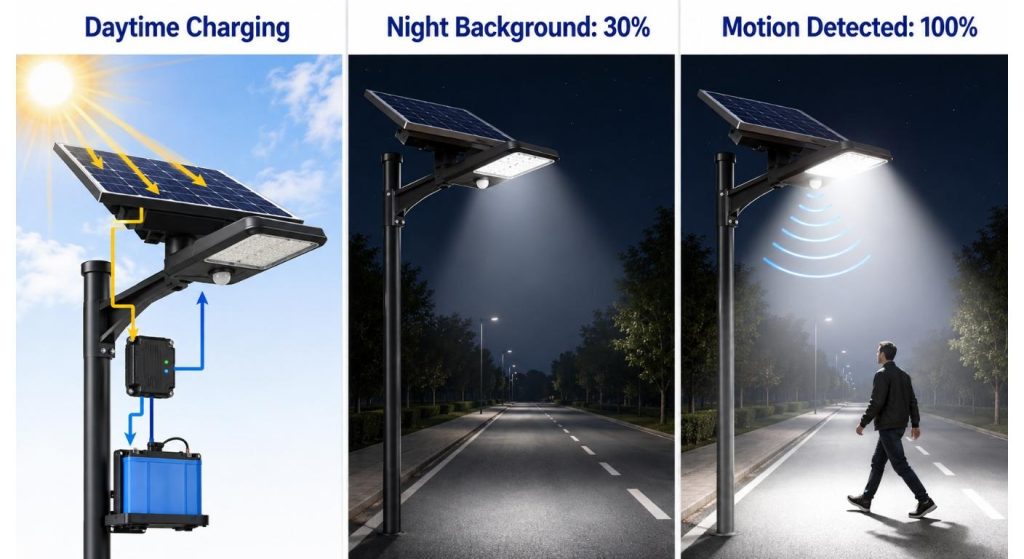
At night, a Motion Sensor controls the Energy Budget.
All solar street lights have a certain amount of stored energy. The solar panel produces electricity during the day time which is stored in the battery and used by the LED after dark falls.
A regular dusk-to-dawn light can have a constant output throughout the night. A motion controlled system is able to be set at a lower background level and only ramp up when pedestrians or vehicles enter the detection area.
A standard run profile may be:
l100% production in busy evening hours.
lLower background noise at low traffic levels
lAfter movement, temporarily brightened (added light)
lReduce production pre sunrise if battery reserve is low.
This approach will maximize the length of time the system is running, particularly on long nights or times of low sunlight. But, the energy savings are not only related to the presence of a sensor but to the actual traffic, sensor settings and the lighting schedule selected.
Dawn Lighting’s presentation on LED solar street lights demonstrates that the solar panels, battery, LED, controller, and various support for outdoor projects combine to create a complete lighting system.
| Evaluation Point | PIR Sensor | Microwave Sensor |
| Detection principle | Changes in infrared energy | Changes in reflected radio signals |
| Typical target | Pedestrians and nearby movement | Pedestrians, vehicles, wider activity |
| Power consumption | Generally low | Usually higher than PIR |
| Main advantage | Simple and selective | Broad and sensitive detection |
| Main concern | Temperature and movement direction | False triggering beyond target area |
| Suitable application | Paths and residential streets | Parking lots and wider roads |
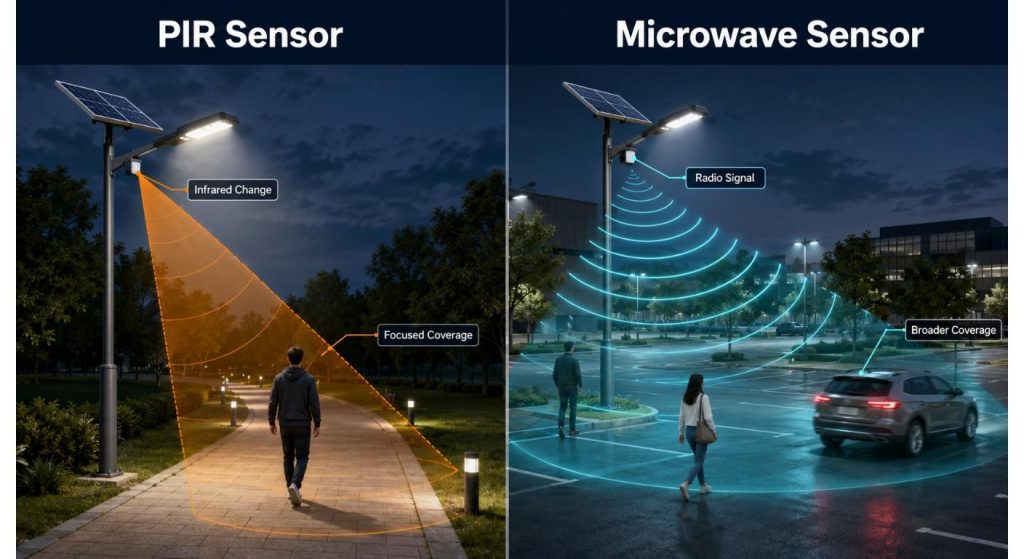
Outside, PIR and Microwave Sensors React in Different Ways
PIR Sensors determine a change in infrared energy typically from the movement of a warm person or animal across the area being monitored. They do not require a lot of energy and are inexpensive, but their performance may vary depending on the mounting height, temperature, and direction of movement, as well as obstruction.
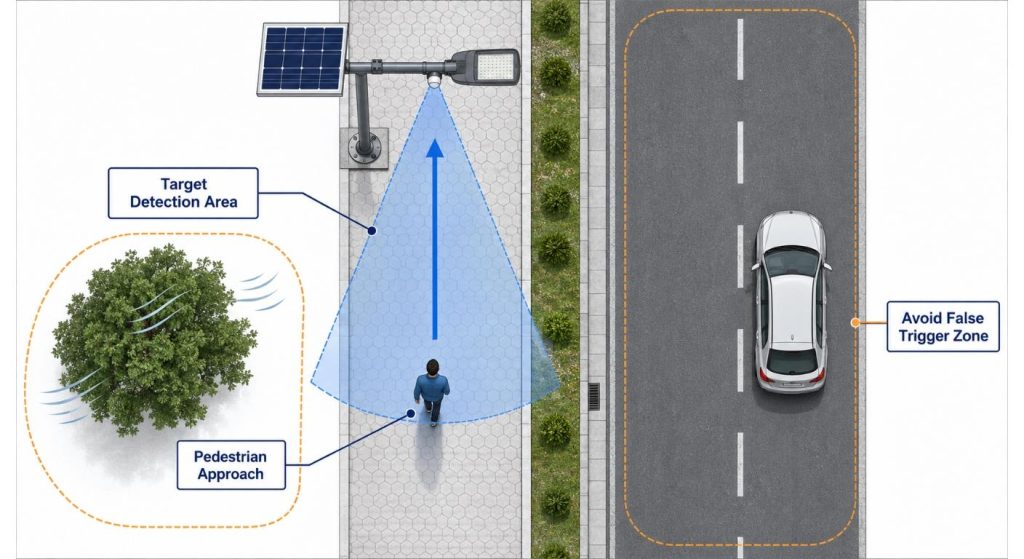
Microwave or Radar sensors transmit energy and sense the variation in the energy reflected. They will be able to detect movement in a larger region and can be used to respond to movement that PIRs cannot detect. However, it can get over-sensitive and activate unwanted due to traffic outside the target region, motion of vegetation or activity behind light membrane.
Both choices are not necessarily the better of the two. PIR is suitable for pedestrian walks and small community streets; microwave sensing can be used for parking facilities, larger streets and wider applications. The right or wrong choice is not related to the product label, but to the site.
According to Dawn Lighting, their solar street light motion sensor explanation highlights the importance of a balance between detection reliability, selectivity and energy efficiency.
Lighting Profile is more important than ‘sensor included’.
Two products which have the same type of sensors can act in very different ways at night.
One can go from 20% to 100% brightness level for 30 seconds. Yet another one can increase in a linear fashion from 30% to 70% and stay at that level for two minutes and then go back to its resting value. Some controllers can have multiple timed stages and basic controllers can have just one fixed response.
Buyers should define:
lWhen no motion is detected, brightness in background.
lActivated brightness
lActivation duration
lThe distance and angle at which the target can be detected.
lDimming/recovery behaviour
lEarly evening and late night times.
lWhen the battery is at a low state, there will be a response.
A full dark standby mode can save more energy, but can have a negative impact on visual comfort and may cause concern for pedestrians. In public spaces, a low ambient lighting level may be more feasible than a to-and-fro or dim/bright mode.
Solar and Battery must still be able to cope with the worst night.
Motion control should be used to increase the efficiency of the system, rather than to make up for the fact that the PV array or the battery is too small.
The system should be based on local peaktime sun hours, seasonal weather conditions, duration of the nights, LED power consumption, lighting schedule, expected traffic, battery DOD and desired backup nights. If a road is not used much during the planning phase, it can start to see increased use after development in the area (or nearby), and more activations and increased energy use.
For this reason, suppliers need to specify the number of nightly activations they have assumed when giving runtime calculations. Only ideal sun and minimum traffic can give false notions of battery autonomy.
Dawn Lighting offers more information about integrated housings, brightness, batteries, motion control and outdoor durability in its all-in-one solar street light guide.
The light will only detect things if the sensor is in place.
A sensor can’t defend an area that it can’t see.
Detection is affected by pole height, fixture tilt, road direction, trees, walls, parked cars, and sensor direction. A sensor that is pointed straight across the likely path of movement is likely to react differently to one that is pointed in the same direction as the movement.
It is recommended that installation teams carry out a night-time test once it has been installed. The test should verify that the light turns on where it is supposed to, its response time, if lights on neighboring streets cause false activation and if the lights are on long enough for a vehicle or person to pass safely.
If the luminaire angle or the position of the pole is changed during the process of installation, the performance of the sensor must be tested again.
Control Priorities vary with the different locations.
Residential streets require background light levels that are comfortable, but without abrupt aggressive changes of light levels near bedroom windows. A reliable pedestrian detection at walking speed is needed for pedestrian paths. This may require parking areas to be activated for longer periods of time and wider areas of coverage, and rural roads to preserve scarce battery power during periods of low sunlight.
If solar-panel orientation is more flexible than an all-in-one design that may be required for the project, a semi-integrated solar street light might be a better choice. If the luminaire is installed in a direction opposite to the direction of the sun, it may be useful to separate the panel from the luminaire to optimise the direction of the solar exposure.
This lighting mode should then be chosen with regard to the location and the activity pattern, and not be copied to the whole project.
Weatherproofing and maintenance is still a must.
Motion control does NOT eliminate the need for robust outdoor construction.
The buyer should check the following for the installed luminaire: ingress-protection rating of the complete installed luminaire, corrosion resistance, UV stability, battery serviceability, surge protection, controller protection, and operating-temperature range. The window of the sensor should also be clean and clear.
Maintenance checks should include: the cleanliness of the panels; the condition of the battery; the alignment of the sensor; the cable connections; the surrounding vegetation; and if the system has been activated at night. If false triggering occurs frequently, it is likely that the sensitivity is incorrect or that the environment has changed or the sensor position has not been chosen.
Confirmations to be made by the Project Buyers prior to the ordering.
Road or area dimensions, pole height, pole spacing, local solar data, operating hours, minimum background brightness, expected traffic, activation time, back up night requirement and installation environment are useful considerations to include in a quotation request.
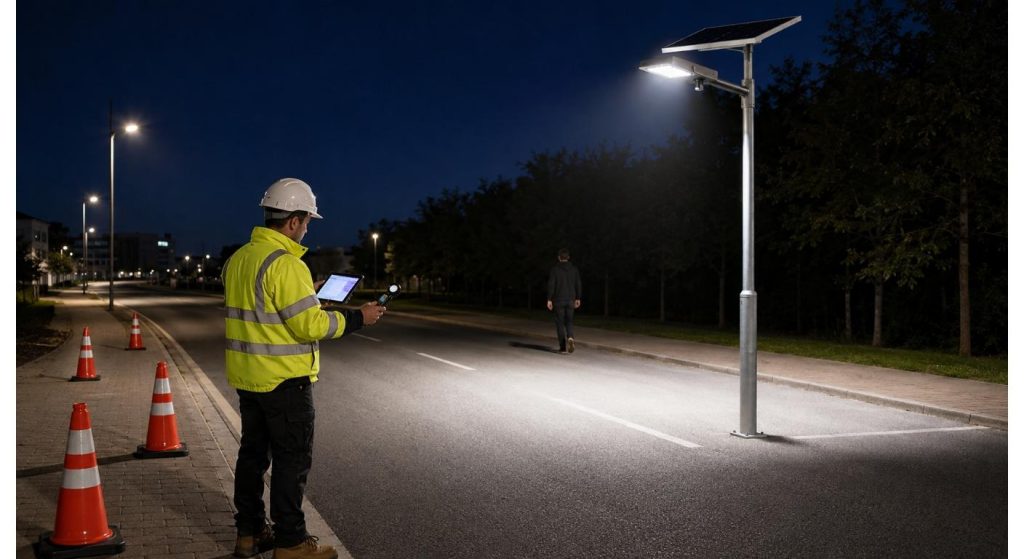
The lighting profile, battery calculation, sensor type, detection diagram, a photometric file, an installation drawing and warranty should also be requested from the buyer. A sample-unit field test is useful prior to a big municipal or commercial order.
| Test Item | What to Record | Acceptance Question |
| Detection boundary | Actual activation distance | Does it cover the intended approach? |
| Response time | Seconds before brightness increases | Is the response early enough? |
| Active duration | Time at increased output | Can users pass safely? |
| False activation | Number and likely cause | Are nearby roads or trees triggering it? |
| Background level | Measured or observed brightness | Is orientation still comfortable? |
| End-of-night battery | Remaining charge before sunrise | Can the system finish the night reliably? |
Final Project Check
A Motion Sensor Solar Street Light is successful if the users hardly notice the control process. The area stays easily visible, the brightness goes up at the right time, false activation is kept to a minimum and battery lasts through the night.
So the best system isn’t necessarily the one that has the longest detection range. It is the one which has been designed for the actual activity of the site including sensor, controller, lighting schedule, solar panel, and battery.
FAQ
Q1. What is a Solar Street Light with motion sensor?
It is a solar street light that illuminates by an LED light and adjusts its brightness level according to the movement. The sensor and controller aid in directing energy from the batteries to times when additional light is required.
Q2. If the light is not set to any movement should it go out completely?
Not always. Public areas generally prefer a low background level, and perhaps full-off standby for a very limited or low traffic site.
Q3. Which of the two sensors, PIR or microwave sensing is preferable?
PIR is energy saving and is suited for many pedestrian applications. The area of microwave sensing can be wider but its sensitivity needs to be controlled so it doesn’t get activated when it should not.
Q4. Would motion sensing make up for a small battery?
No. The size of the panel and battery must still be determined based on local sunlight conditions, night time, operating mode, the number of times the batteries are being used and the autonomy desired.
Q5. What places are motion sensor solar street lights more likely to be installed?
They work well in residential roads, parks, paths, campus areas, parking lots, rural roads, and remote facilities with varying levels of night time activity.

- 10 Meters Lamp Post
- 10 Meters Pole
- 1000w Led Projector
- 100W LED Tunnel Light
- 12 Meters Lamp Post
- 12 Meters Pole
- 1200w Led Projector
- 15 Light Pole
- 1500w Led Projector
- 150W LED Tunnel Light
- 1800w Led Projector
- 2 In 1 Solar Flood Light
- 200w Led Tunnel Light
- 50w Led Tunnel Light
- 6 Meters Lamp Post
- 6 Meters Pole
- 8 Meters Lamp Post
- 8 Meters Pole
- 800w Led Projector
- 80w Led Tunnel Light
- Colourful Decorative Light
- Conical post
- Courtyard Lamp
- courtyard light
- courtyard lighting fixture
- Decorative Landscape Light
- Decorative road Light
- Flood Light For Courtyard
- Flood Light for Garden
- Flood Light For Outdoor
- Foot Led High Bay Lights
- high bay led lights 100w
- industrial lampshade
- industrial LED shed lights
- industrial magnifying glass with light
- Integrated Solar Flood Light
- led courtyard lamp
- led courtyard light
- led high bay light 100w
- LED Projector For Stadium
- Led UFO High Bay 150W 5000k
- Lighting Plants Mining Price
- Maintenance Free LED Street Light
- Pic Controlling Tunnel Light
- PLC controlling tunnel light
- Post Top Garden Light
- RGB Landscape Light
- Rgbw Decorative Light
- Smart Tunnel Light
- solar courtyard lamp
- solar courtyard light
- Solar LED Road Light
- Solar Street Light For 10 Meter Pole
- Solar Street Light For 12 Meter Pole
- Solar Street Light For 6 Meter Pole
- Solar Street Light For 8 Meter Pole
- Split Type Solar Flood Light
- Sporting Projector
- Stadium Led Projector
- Street Lighting Post
